Roamin’ Out of Memory

I don’t know how I missed Roam the first time around. Every so often Ryan Laukat releases something like this, a twenty-minute title that stands in contrast to his sprawling adventures like Sleeping Gods, its sequel Distant Skies, or even time-conscious fare like Creature Caravan. Minor artifacts, in other words, but artifacts that shoulder more weight than their diminutive frames would otherwise indicate. Like ants. Or dung beetles.
Roam is no exception to the dung beetle rule. I’m pretty sure I played it way back when, only to slip from my memory like so much sand. It isn’t that the game isn’t pleasant, or even quietly clever. It simply lacks the pizzazz that might have otherwise marked it as a staple filler.
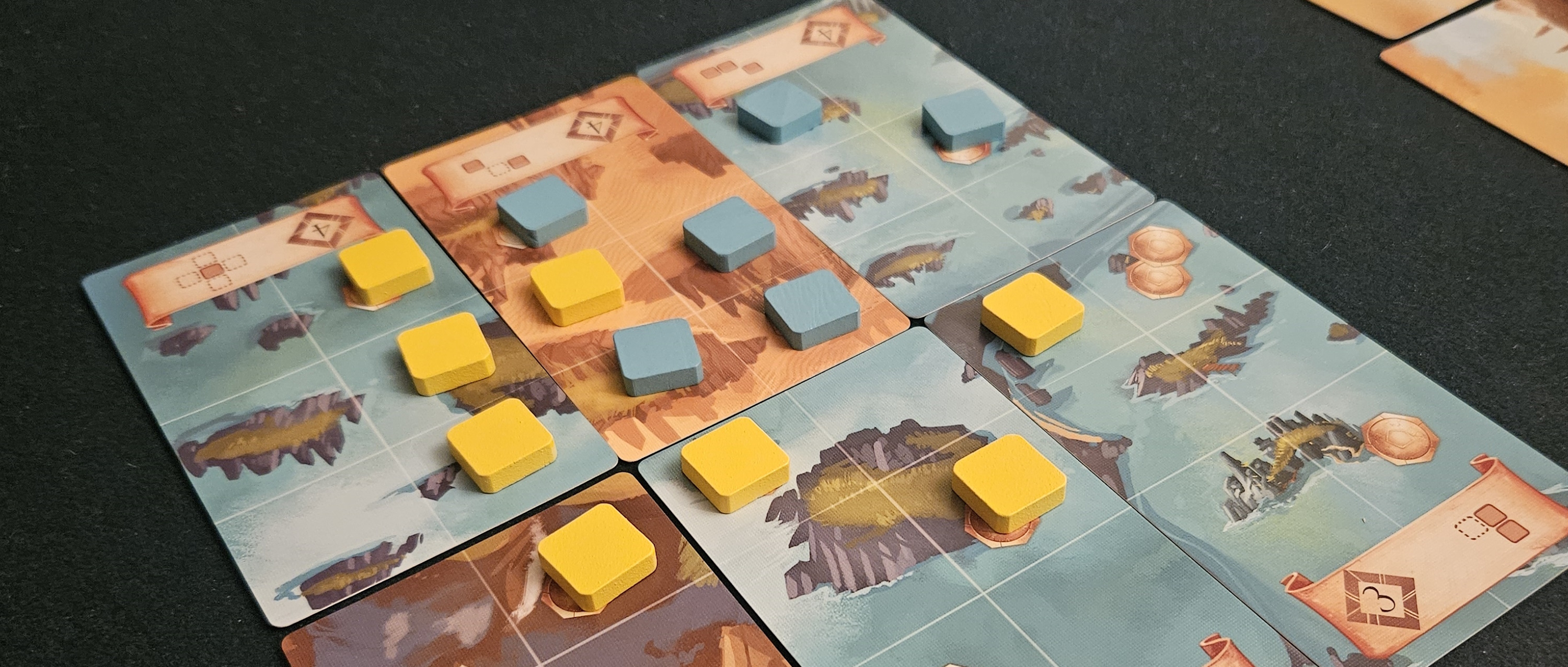
Tokens on maps. Unprecedented!
For all its color, Arzium seems like an unsettling place to live. When one isn’t beset by fire zombies and sea serpents, there’s the sleepwalking plague to worry about. All at once, a bunch of townsfolk have wandered off in a stupor. It’s your task to find these slumberers and shake them awake from whatever dream-task they’ve appointed for themselves, like weaving boats from grass or practicing their high-kicks.
It’s a funny conceit. Which makes it all the more shame that Laukat doesn’t do anything with it. At core, Roam is really an abstract auction game. You use cards to place tokens on a spread of other cards. When any given card is full, it’s awarded to whomever owns the most tokens on it. This card then flips over to become another adventurer, joining their rescuer’s retinue and adding a new pattern to their repertoire, which in turn allows them to place further tokens and save additional wanderers.
Right away, there are bad ways to play Roam. It doesn’t quite work with only two players, resulting in contests that are either too evenly matched or, once somebody has secured two or three additional companions, so far apart that it becomes an exercise in waiting around for the foregone conclusion to slouch into the station. There’s also no reason to eschew the extras, the little items you can purchase with the coins — earned from placing tokens on particular spaces or losing auctions — or even using the double-placement rule that adds a bit of oomph to the auctions themselves. Without these, Roam is not only too straightforward, it’s bland.

Your crew dictates the patterns you can place on the map.
With these additions, Roam shapes into an interesting auction game indeed. There are particulars to how shapes are placed; you need to fit the entire pattern onto the map, but can overlay segments even where rival pieces block your own, and dotted-outline squares can be filled in for some coins. It never reaches the level of Vlaada Chvátil’s Tash-Kalar, but it’s operating in a distinct enough space that it doesn’t need to.
The real draw are those items. They can be purchased with your hard-earned coins — a nice bit of tension, since you need those coins both to fill in dotted squares and to tiebreak deadlocked maps. Once purchased, they offer ongoing powers, like rotating one of your patterns, replacing an opposing token with your own, or reusing one of your adventurers. Importantly, items also add a sense of economy to the game, transforming coins into a side hustle that peels apart the range of possible scores by a fair bit.
Does it ever feel innovative, fresh, or essential? Nope. Not in the slightest. But it’s a fair bit better than its exterior would lead one to believe. Or even its interior, had one only played the basic rules with two players. It’s a minor Laukat, but Roam feels solid all the same, especially once the board starts to fill up with competing tokens. And there are some subtle tricks of tempo going on that elevate the experience, little rubber bands that keep trailing players in the game without actually demanding any rules overhead.

Roam really needs three or four players to come together.
Which is to say that there’s more to Roam than meets the eye. Not, you know, a lot more. But some. A little bit. Just enough to give it some pinch.
Is that enough? Probably not in today’s saturated market. Probably not for a game that released six years ago, in an environment that erases minor successes from our memory with each hot new box. Still, Roam is better than I expected, a small-scale auction game that looks pretty, shows admirable restraint, and maybe could have been a bigger deal had it been less small-scale and shown less admirable restraint. So it goes.
A complimentary copy of Roam was provided by the publisher.
(If what I’m doing at Space-Biff! is valuable to you in some way, please consider dropping by my Patreon campaign or Ko-fi. Right now, supporters can read my second-quarter update!)
Posted on July 8, 2025, in Board Game and tagged Board Games, Red Raven Games, Roam, Ryan Laukat. Bookmark the permalink. Leave a comment.

 SPACE-BIFF!
Leave a comment
Comments 0