Let Me Not Then Die Ingloriously

You know that moment in every ancient battle scene, whether in film or video games, where the lines have collapsed and now the burly infantry boys are fighting one on one, everybody mixed together and slashing wildly? Bonus points when two rival heroes spot each other in the fray and start murdering their way toward one another, hellbent on a personal duel where nobody will happen to spear them through the backside.
Sorry to disappoint, but those scenes are pure invention. There simply weren’t enough suicidal soldiers in the ancient world for such an engagement. Still, it looks hella cool, and it’s significantly easier to stage than an actual line of infantry trying to scare their opposite number into freaking out and running away.
One of my favorite things about Reiner Knizia’s Iliad, which I previewed last year, is the way it evokes those haphazard murder-thons, Greek boys in blue and red squaring off in a checkers-grid melee. Sure, the game is smart and all that, providing a thinky two-player match of wits that emphasizes clever investments over brute strength. But I’m really here for the chaos.
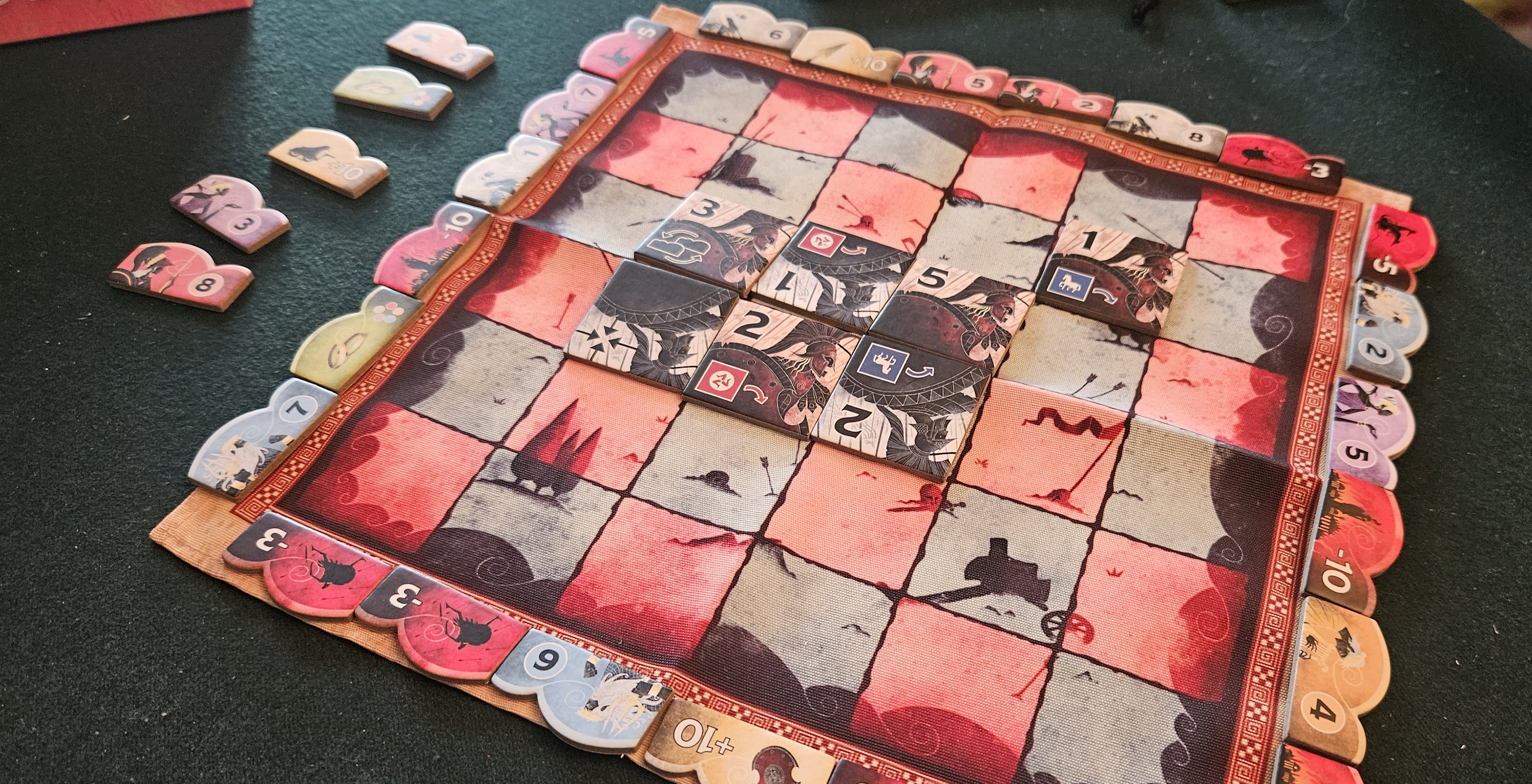
Battle is met.
Iliad, which one presumes takes place during the Trojan War, is all about control. Careful, measured control, which just so happens to be a far cry from hoplites breaking ranks and indiscriminately slamming into one another.
The core idea has that Knizian elegance to it. Played on a six-by-six grid, with half the squares belonging to the blue team and the rest to their red opponents, your goal is to fill the board so that your boys outmatch the enemy’s boys. Whenever a row or column is finished, both sides count up their troop numbers to determine who has emerged on top. This means each troop will count twice, adding their value to both their row’s and column’s contests.
This isn’t as straightforward as “high number wins.” When the game begins, each of those rows and columns is populated with two victory tokens. That’s right, two. Most correspond to the five gods watching the ruckus from the nearby mountaintop. Zeus, Apollo, Athena, Poseidon, and Aphrodite, although feel free to call them white, carrot, bubblegum, sea foam, and purple — this is, after all, a Knizia. Other tokens are worth positive points, some negative, and then there are two wedding bands that, when paired, count as a god whose favor you didn’t manage to secure. Sway all five gods and you win. Barring that — or if both players manage it — then higher score wins.
But that brings us to the way those rows and columns resolve. While it’s true that the stronger phalanx wins, both sides earn a victory token. It’s just that the winner of the current tally gets to pick first. This results in a few easy decisions, such as when it’s a choice between Athena for +8 points versus a plague for -5. But what about when the column offers a rumpy -10 versus -10? Or, more interestingly, when you’re given the choice between a god you already possess but for more points, and one whose favor still lies out of reach, but offering only one or two measly pips?
That’s Knizia, baby.

I miss the wooden tokens of the prototype, although I believe those are available as upgrades.
There’s a theory of tabletop game design that argues that every game is ultimately an auction, comprised of bids to determine who will secure which resources, points, or social capital. It’s a rather, ah, jejune theory, requiring a full mental gymnastics routine to hammer all the definitions into their proper shape.
When it comes to Iliad, though, it’s easy to see how one could come to that conclusion. Choosing where to place your soldiers, of which you only have access to two at a time, in order to secure their corresponding lanes, does indeed have the shape of an extended wager. Placing a rank-one hoplite is a signal to your opponent that you aren’t likely to invest much more in that row or column. Hogging up space with one of your fives does the inverse, indicating a spot you’ll fight hard to claim. The entire game is about making smart investments.
Of course, there are special powers, six types in all, for darkening waters that might otherwise be a little too wine-light. Your lowest-ranked hoplite might not offer much in terms of strength, but he can reposition an enemy tile, smacking even the heftiest troop into a more suitable square. The rank-four hoplite can flip itself and a rival tile face-down, transforming their value to zero. This is potent but situational, requiring adjacency to a beefy rank-five hoplite or one of those “dolos” troops that’s the sum of its two adjacent foes.
The most interesting of the group is the rank-three soldier. This guy lets you swap one of your victory tiles. There are five set aside when the game begins, randomly determined but all valuable. This encourages you to resolve one or two lanes early, just so you’ll have something in hand to trade out. This constitutes a second race underlying the game’s pitched contest, both sides hustling to secure a lane and then play the right troop to trade away some lame negative tile for a god whose favor is otherwise too tricky to secure fairly.
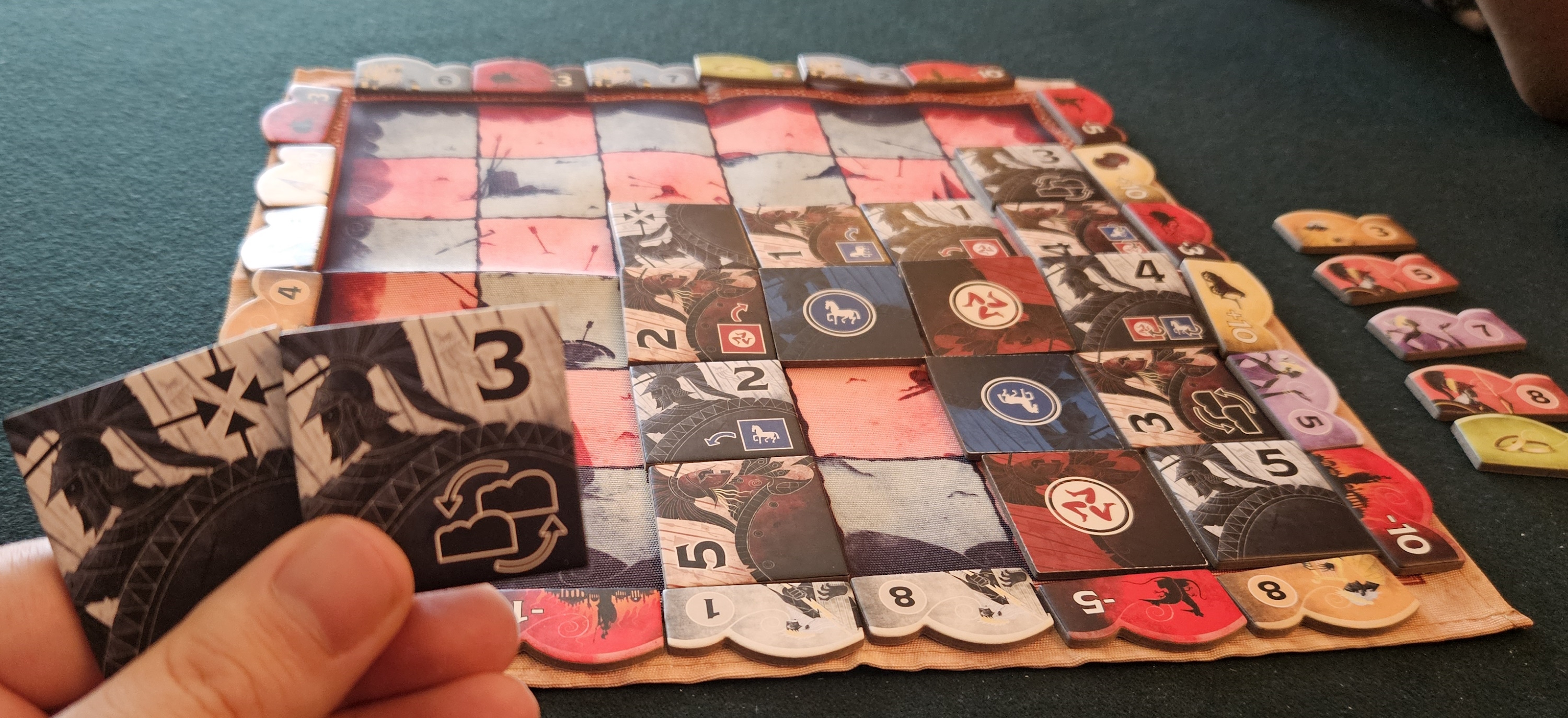
Where to place these burly boys…
Again, it’s so smart.
Maybe too smart? I know, I know, that’s a very silly thing to say. How can something be too smart? Still, I’ll put it out there. Iliad bears some resemblance to the careful maneuvers and antes of chess, not only in the sense that it’s an abstraction of premodern warfare, but also in how it puts your intelligence on the line. Making a poor move comes across as a reflection on your intellect, like you need to brush up on your Thucydides. It tends to produce stern contests, both players glowering at their pair of tiles and privately cursing the fates for handing them a dolos at exactly the wrong instant.
Of course, that’s also what makes it special. This is a self-contained Knizia, tight to the point of snapping like Achilles’ overtaxed tendon, with such clever gameplay that it hurts. Another success from the Good Doctor.
A complimentary copy of Iliad was provided by the publisher.
(If what I’m doing at Space-Biff! is valuable to you in some way, please consider dropping by my Patreon campaign or Ko-fi. Right now, supporters can read the first part in my series on fun, games, art, and play!)
Posted on June 17, 2025, in Board Game and tagged Bitewing Games, Board Games, Iliad, Reiner Knizia. Bookmark the permalink. 8 Comments.

 SPACE-BIFF!
Do you know Samurai? I have played Samurai, but not Iliad. But after reading you and Charlie, it sounds like you all are describing a two player Samurai. More or less. My question is, does it feel like that (sometimes games look similar on paper, but are completely different in play, see Glory to Rome and Mottainai)?
I have played Samurai, and I can see the parallel, although I think it falls more into the latter camp you’re describing. Maybe because different player counts can produce very different games!
I’ve never had the chance to play Samurai. I’m thinking I might pick up Pollen (the re-implementation of Samurai: the Card Game). Then again, when I went to the trouble of making my own copy of Dune, it wasn’t long before I saw the Gale Force Nine edition at Barnes & Noble; maybe I’ll try superstition and see whether it ‘works’ again. Bitewing Games seems to have a full slate already for the next year or so, but who knows?
“for darkening waters that might otherwise be a little too wine-light”
Masterful
Haha, thanks
Pingback: She’s a Grisly Monster, I Assure You | SPACE-BIFF!
Pingback: I’m Not Azure About This One | SPACE-BIFF!
Pingback: Real Moytura, Guys | SPACE-BIFF!