Sockeye Salmon Slayers
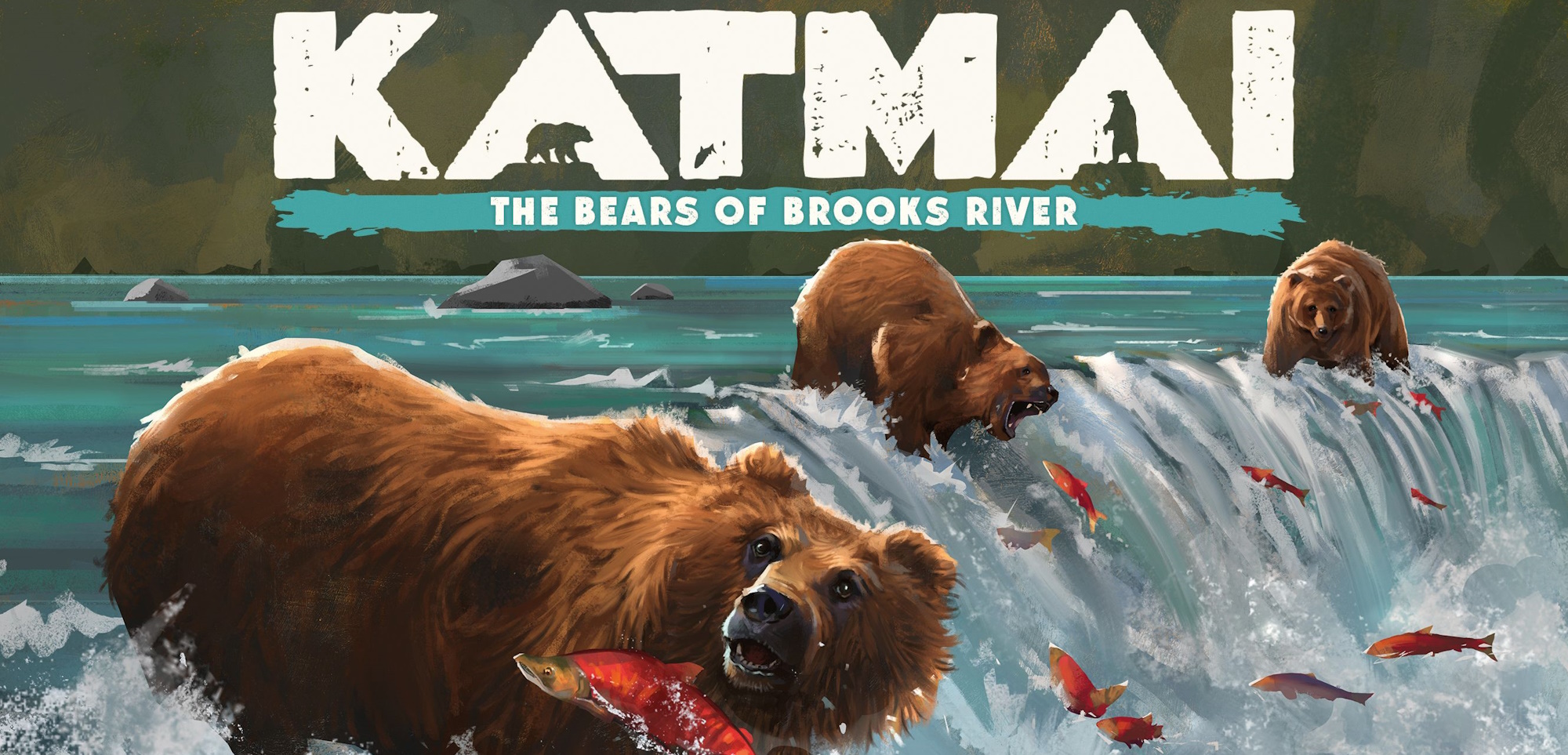
With their bright red scales and barbed mouths, sockeye salmon have always looked to me like an invasive species from some alien moon. That Alaskan brown bears love to eat the things by the hundreds only endears me to them further. Go bears. Get those fish heads.
Peter Ridgeway’s Katmai: The Bears of Brooks River puts these heroes front and center. Two sleuths of twelve bears have staked out a stretch of river and are determined to catch the most fish, jostling for position in the churning waters. Here’s the good part: I learned a little bit about brown bears. Here’s everything else: Katmai doesn’t stack up against its peers.
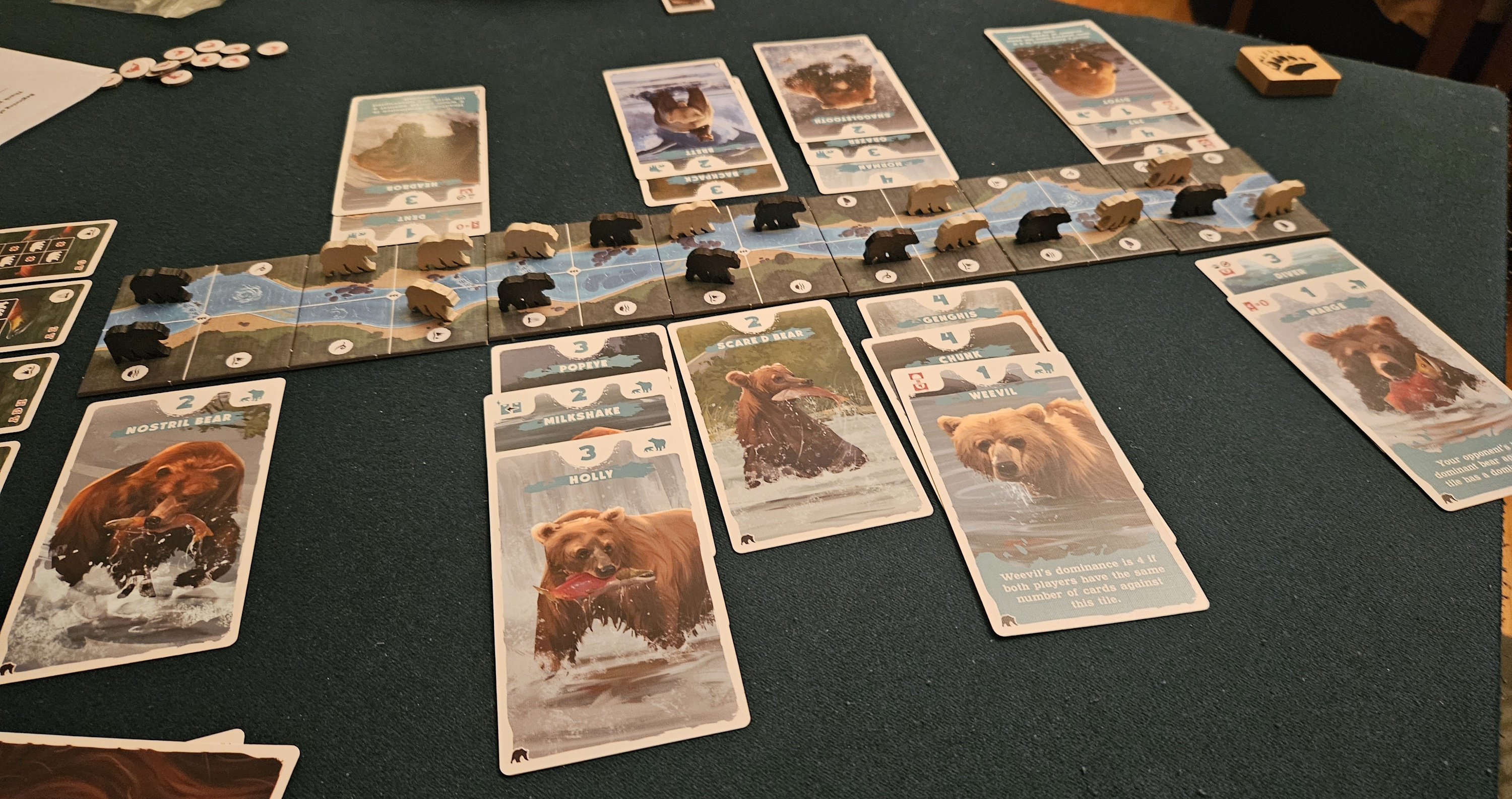
Take that, salmon!
Those peers, it turns out, are lane-battlers, titles like Omen: A Reign of War, Compile, and Air, Land, & Sea. Here the lanes are seven sections of riverbank, each offering four positions for bears to stake out for salmon.
For the most part, Katmai approaches the genre straight. Rounds see rival sleuths deploying their bears along those seven sections. When ten of twelve bears from each sleuth have been positioned, the relative strengths of both sides are tallied.
Here’s where it departs from the norm. When you secure a section of the river, you place a bear token on one of its four spaces. That token will remain there for the rest of the game, marking its territory. As more bears are added, it’s possible to complete patterns for salmon. These vary from one session to the next, with more demanding patterns offering greater rewards but also making it possible for your rival sleuth to horn in on your territory and block a perfect salmon harvest.
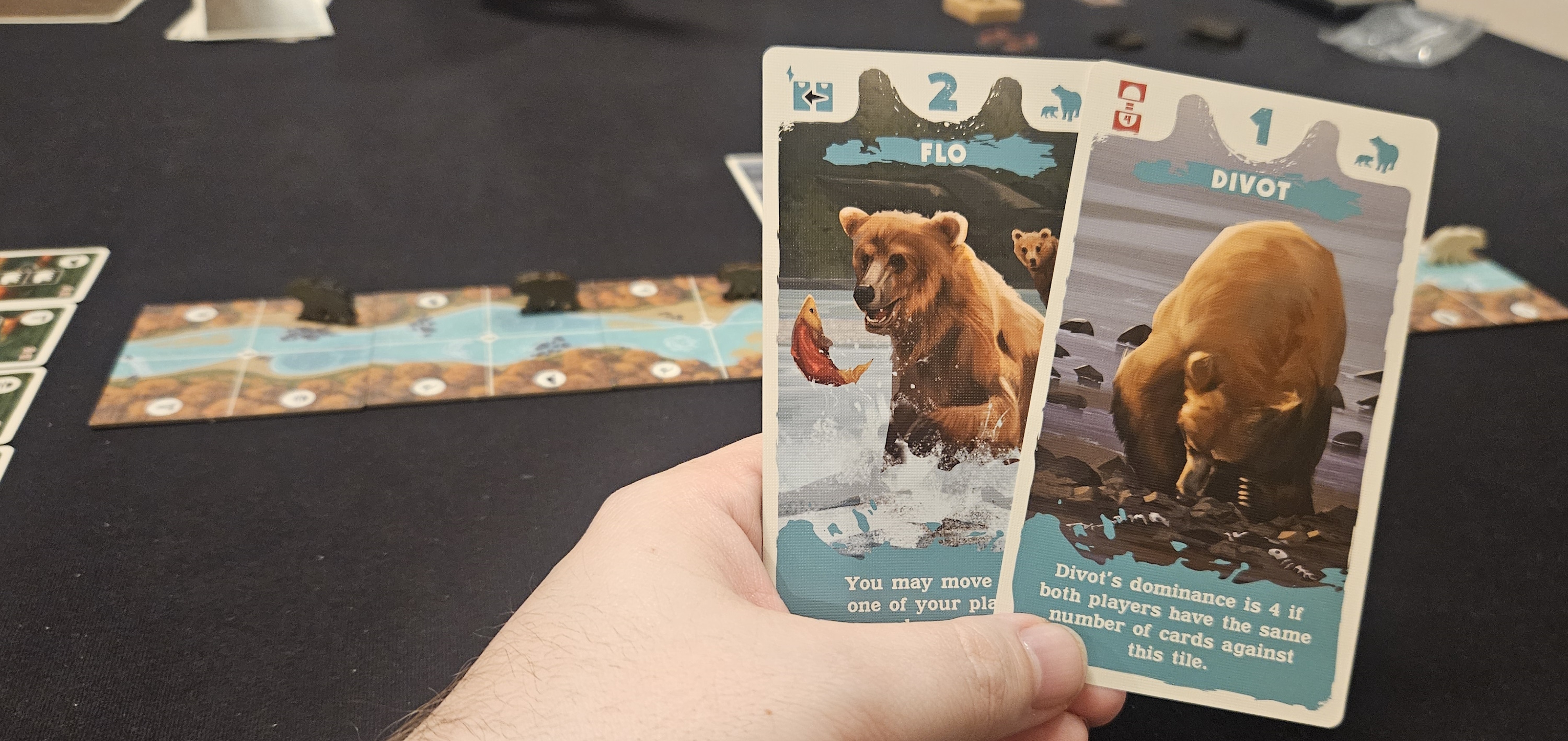
Flo and Divot wreck some salmon.
Unsurprisingly, the best thing about Katmai is the bears themselves. These are actual bears, creatures that bear-watchers observe via livecams during spawning season, and no small part of the game’s warmth comes from Tom Lopez’s illustrations and Ridgeway’s card abilities. Before long you’ll get to know the big boys, hulks like 747, Norman, and Chunk, who can’t help but make a splash when they appear on the river for their sheer bulk.
Even the smaller bears get their moments to shine. There’s Headbob, whose prowess at nabbing salmon translates into increased dominance at waterfall positions, or Divot, whose value increases in groups because of her tendency to hang around other bears to beg for their leftovers. We learn that “dominance” is a negotiated concept. Some bears, like Otis, aren’t dominant because they’re big, but because of their fishing skills, while others are sows whose litters elevate their reputation with the group. In game terms, their cubs function as tiebreakers.
Katmai uses these real-life identities to great effect, both on the table and in the rulebook. Every time I’ve played Katmai, we’ve called out our bears’ names, declaring “Nostril Bear!” and “Backpack!” and “Weevil!” with each flip. More than any other lane-battler I can recall, this engenders an immediate connection between players and cards. Knowing that these majestic animals are real, living beings, often with their own fishing strategies, friendships, rivalries, and tastes goes a long way toward marking Katmai as a worthwhile plaything.

Cards are deployed face-down.
Unfortunately, the game doesn’t go much further than that. Even though I haven’t seen any lane-battler that’s wholly similar to Katmai, it still comes across as rote and even somewhat dry.
Contests are low-sum affairs that rely more on what you pull from your deck than feats of cleverness or bluffing. Both sides utilize near-identical twelve-card decks, but require players to set aside two cards at random each round. If you happen to toss out your big boys or more efficacious fishers, you’ll likely yield territory to your opponent. There simply aren’t enough abilities to permit emergent strategies. Both sides have a bear that zeroes out a rival’s dominance, another that’s as dominant as the card sitting on top of it, and one that’s ultra-tough if both sides have the same number of cards. Playing two rounds of a single session is enough to showcase what Katmai has to offer.
Meanwhile, it’s interesting to place bear tokens along the river, but the scoring cards are outright bland. The basic scoring options are triggered too easily, often rewarding any proximity between bears. There are advanced cards as well, and these offer a significant improvement, awarding salmon to players who cluster their bears in certain ways, such as a group of four bears who aren’t stuck in shallows or three bears surrounding a single rival bear. These offer a more interesting way to play, but it doesn’t do much to supercharge Katmai’s sedate metabolism.
Even the tiebreaker is frustrating. The theory is solid enough. Either you play first in each exchange, signaling to your opponent where your next bear will appear, or you yield the first-play marker. But holding this marker allows you the right of first refusal on deploying the cub tiebreaker. In practice, the tiebreaker is nearly always superior to play priority. It’s one more example of how little friction Katmai generates with its decisions.

The objectives are, um, well, they’re objectives.
Then again, there are the bears. I suspect the artwork and identity will be enough for many of those who seek out Katmai. For me, however — and for my eleven-year-old — that’s only half of the essential equation. As much as I love how Katmai shows us the actual bears of its titular park, I wish it had produced a more enthralling play to accompany them.
(If what I’m doing at Space-Biff! is valuable to you in some way, please consider dropping by my Patreon campaign or Ko-fi. Right now, supporters can read my quarterly report on all things board games!)
A complimentary copy of Katmai: The Bears of Brooks River was provided by the publisher.
Posted on April 28, 2025, in Board Game and tagged Board Games, Katmai: The Bears of Brooks River, Osprey Games. Bookmark the permalink. 2 Comments.

 SPACE-BIFF!
hey dan,
when talking about Lane battlers, always Manitou comes to my mind (https://boardgamegeek.com/boardgame/263/manitou) have you ever played that?
it has a kind of mini deck construction element where you choose which cards from your pool you want to start the round with. But then you can capture the opponents cards.
I found it quite intriguing when I got it out probably about 25 years after my last play
I haven’t ever heard of this one! Thanks for the notice.