Flying Too Close to the Ruff

Trick-taking alert! This week’s instance of the genre is Trickarus, which scores an extra point for its pun of a title. Designed by Bajir Cannon, this one takes cues from Greek myth. You are an adorable pajama-wearing child with a set of homemade wings, flapping through the sky while performing sick dives and kicks. Surely you will not soar too close to the sun and be dashed on the rocks below.
No, your goal is to inflict the dashing on somebody else.
I love my pajama childs.
Fine, no children will be harmed in the course of playing Trickarus. Apart from maybe getting struck by lightning. Even then, this lightning is of the cartoon variety, all X-ray bones, a bit of singe around the edges, and then back to your frolicking with no lasting harm done.
Your goal, however, really is to soar as high as possible without doing the whole “melting wings” thing. Like many of the best trick-takers, Trickarus is about winning tricks but not too many. Every time you win, you move a little higher along the score track. Side note: the score track, like everything else in Trickarus, is ridiculously cute. Your tracker is no mere token but a representation of your aeronaut in their flight pajamas. Since this game takes place in the atmosphere, no two icarids can occupy the same space. Instead, when you move into a rival icarus’s spot, you blast right past them. Maybe even past multiple icarusoi at the same time.
This presents an opportunity to catch up from a low-altitude position, but also offers the game’s foremost challenge. Whichever child soars into the sun triggers the end of the game. They plummet into the space right below the lowest flyer, and then, depending on how many tricks are remaining in the current hand, have a bit of time to flap their way back into the topmost position. When the game ends at the end of that round, whichever icaroopsie is in the highest spot is declared the victor.
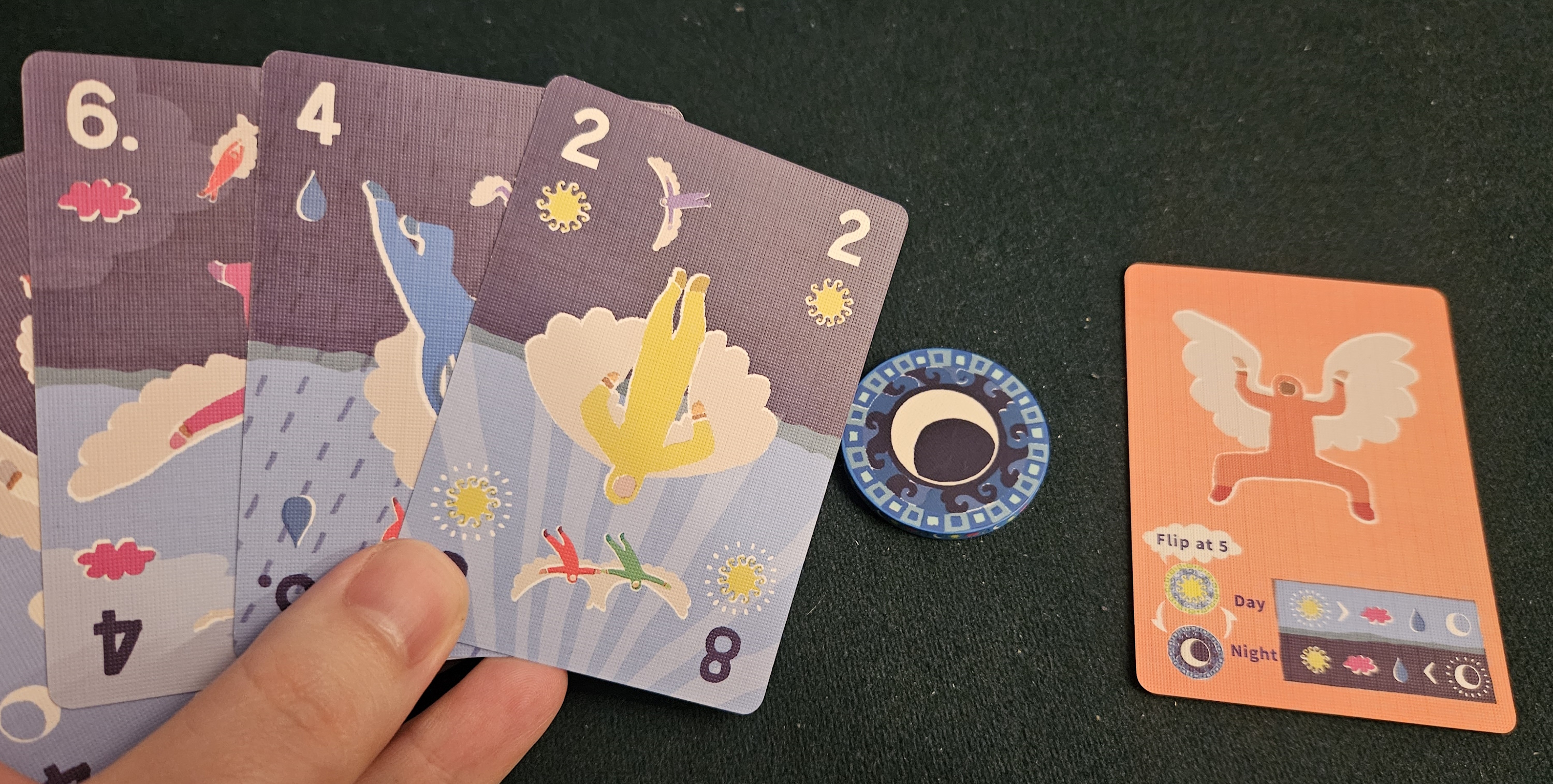
Simple enough. Except there’s a wrinkle. Because you’re fleeing from King Minos’s fortress — I’m presuming here, it isn’t like Cannon sticks all that close to the myth — your journey lasts through multiple days and nights. Whenever a rank-five card is played, everybody’s cards are rotated to their opposite side. This switches the trump suit from suns to moons (or vice versa), and can turn a winning card into a loser. Or, more importantly, a losing card into a winner. More than once, I’ve watched somebody position themselves just shy of Helios’s glow, only to be nudged into the fire by an ill-timed time-change. Sizzle, flop, that’s the legend.

Well that’s adorable.
Trickarus feels good in that uniquely trick-takey way, presenting important plays on the regular without overwhelming newcomers. Still, it sometimes soars amiss.
The biggest problem is the game’s length. The altitude track is too shallow. Our longest sessions have ended after just two hands, and it isn’t uncommon for the whole game to end after only one. While Trickarus doesn’t overstay its welcome, that’s barely any time at all. As soon as it’s laced into its wingsuit, it’s shrugging it off again. This puts a rather large burden on your opening hand, not to mention fails to generate any of the little dramas that reveal themselves in longer games.
Speaking of little dramas, Trickarus plays its tale a little too straight. There’s a single special card, the lightning bolt, which inverts the usual course of a trick by jolting its winner downward rather than pushing them up. Depending on timing, this can be a big problem, depriving an icarnerd of their position, or a godsend, zapping someone out of danger. But its inclusion introduces a texture I would have preferred to see explored in more depth. There’s an unrelenting symmetry to Trickarus, day changing to night and back again twice per hand. It would have been neat to see a few additional quirks included in the deck, both to upset the usual pace of play and to spread around any potential surprises between players. As it stands, holding the lightning card is a significant boon. Paired with the game’s truncated duration, the luck of the draw is more oppressive than usual.
![It's all part of my cunning plan to [checks notes] appear the fool.](https://spacebiff.com/wp-content/uploads/2025/04/4.-upside-down.jpg "It's all part of my cunning plan to [checks notes] appear the fool.")
Astute readers may notice that my cards are currently upside-down.
All told, Trickarus is an adorable little trick-taker, an admirable first effort from Bajir Cannon. I would have liked to see a few additional creases in its feathers, but that speaks to the pleasantness of what it already offers.
(If what I’m doing at Space-Biff! is valuable to you in some way, please consider dropping by my Patreon campaign or Ko-fi. Right now, supporters can read my quarterly report on all things board games!)
A complimentary copy of Trickarus was provided by the designer.
Posted on April 17, 2025, in Board Game and tagged Board Games, Learn Bridge Online, Trickarus. Bookmark the permalink. Leave a comment.

 SPACE-BIFF!
Leave a comment
Comments 0