A Mindful Rain

It’s been said many times before, but A Gentle Rain is not Kevin Wilson’s typical fare. Highly abstract, both in setting and objective, and showcasing a willingness to sidestep victory conditions altogether — a willingness that Wilson doesn’t wholly indulge in, although he gets close — this has all the makings of a pet project. For all that, it’s beautifully crafted and clearly wants to communicate something, even if that something is fuzzier around the edges than most board games manage.
I didn’t get it. The first time I played it, that is.
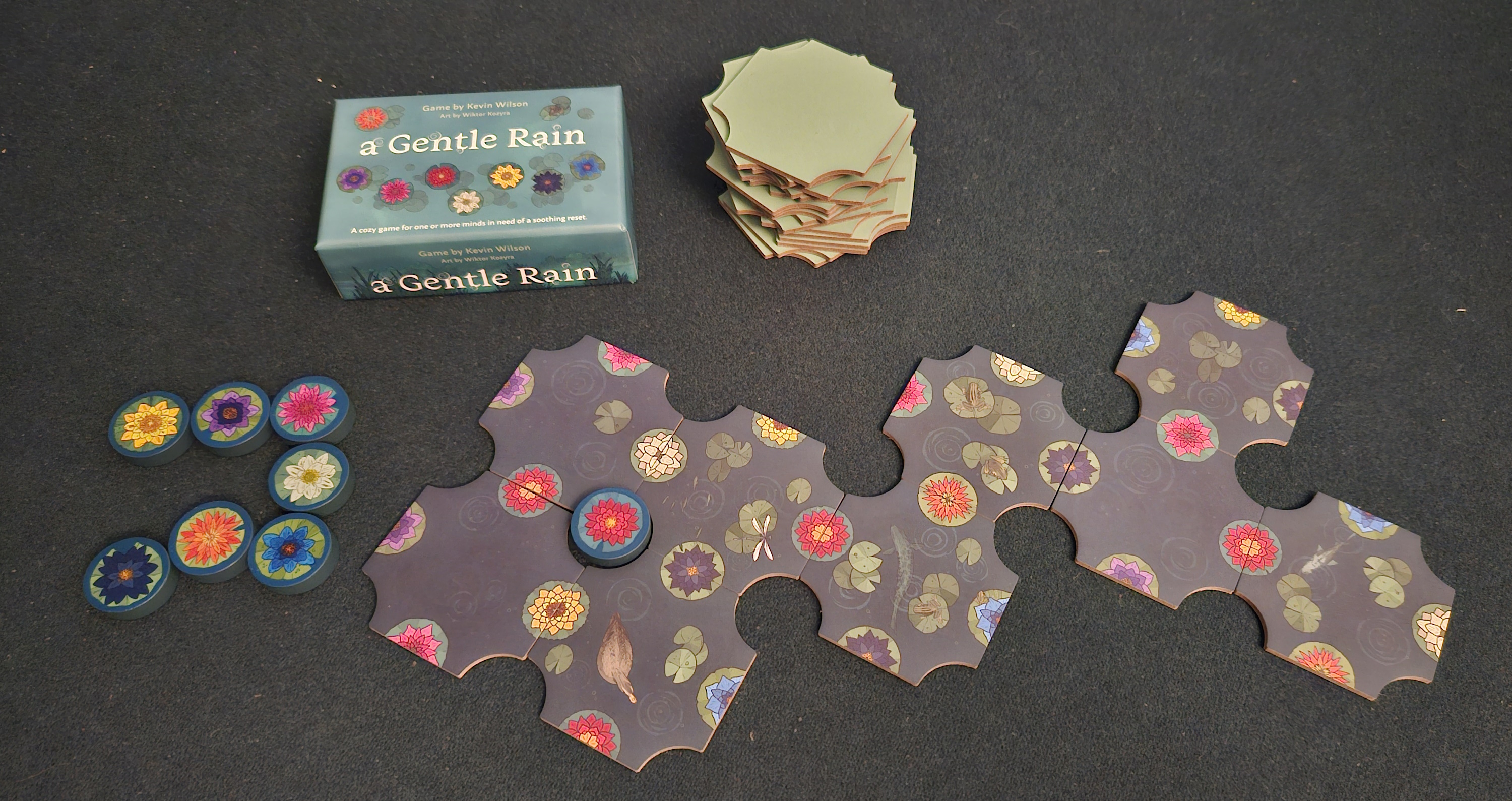
The game in its original incarnation.
The gameplay can be summed up in two sentences. Shall I prove it? Here, I’ll try it in one. A Gentle Rain is about placing tiles from a stack so that their edges align, permitting flowers to decorate their intersection.
Rougher than I’d prefer, but close enough.
It’s simple. So simple that even descriptors like “elegant” don’t quite suit it. There are some glimmers of strategy. Tiles never show two blossoms of the same color, so putting matching corners near one another is a misstep. Beyond that, A Gentle Rain isn’t a cerebral game, nor is it demanding in the traditional sense. When I played it that first time, trading placements with a friend, we remarked that it must function best as a solitaire game despite the count (1+) advertised on the side of the box.
Of course, we could both tell that strategy wasn’t the objective. The goal here, as stated outright by the box and the rules, is tranquility, a mindfulness of process that a small handful of board games have sought but countless achieve without even thinking about it. So many board games produce that effect, celebrating the small motion of pieces, the exchange of one component for another, the sheer pleasure of seeing disparate parts put into alignments both chaotic and rigid, that A Gentle Rain struck me as unnecessary, perhaps even gratuitous. I can revel at the visual feast of Michael Kiesling’s Azul, the intersection of geography and scoring in Josh Wood’s Santa Monica, the ease that settles over me as I align tiles in Torben Ratzlaff’s Beacon Patrol, and still feel the gentle pull of optimization. When I can have it both ways, what is the value of a game that only offers relaxation?
A week or two later, I was surprised when a second copy of A Gentle Rain appeared on my doorstep. I tossed it onto the pile, figuring I would review the original small box, then send this other one, the larger Bloom Edition, with its plastic flowers that appealed to me so much less than the wooden tokens, along to somebody else.
But then my five-year-old caught sight of it.
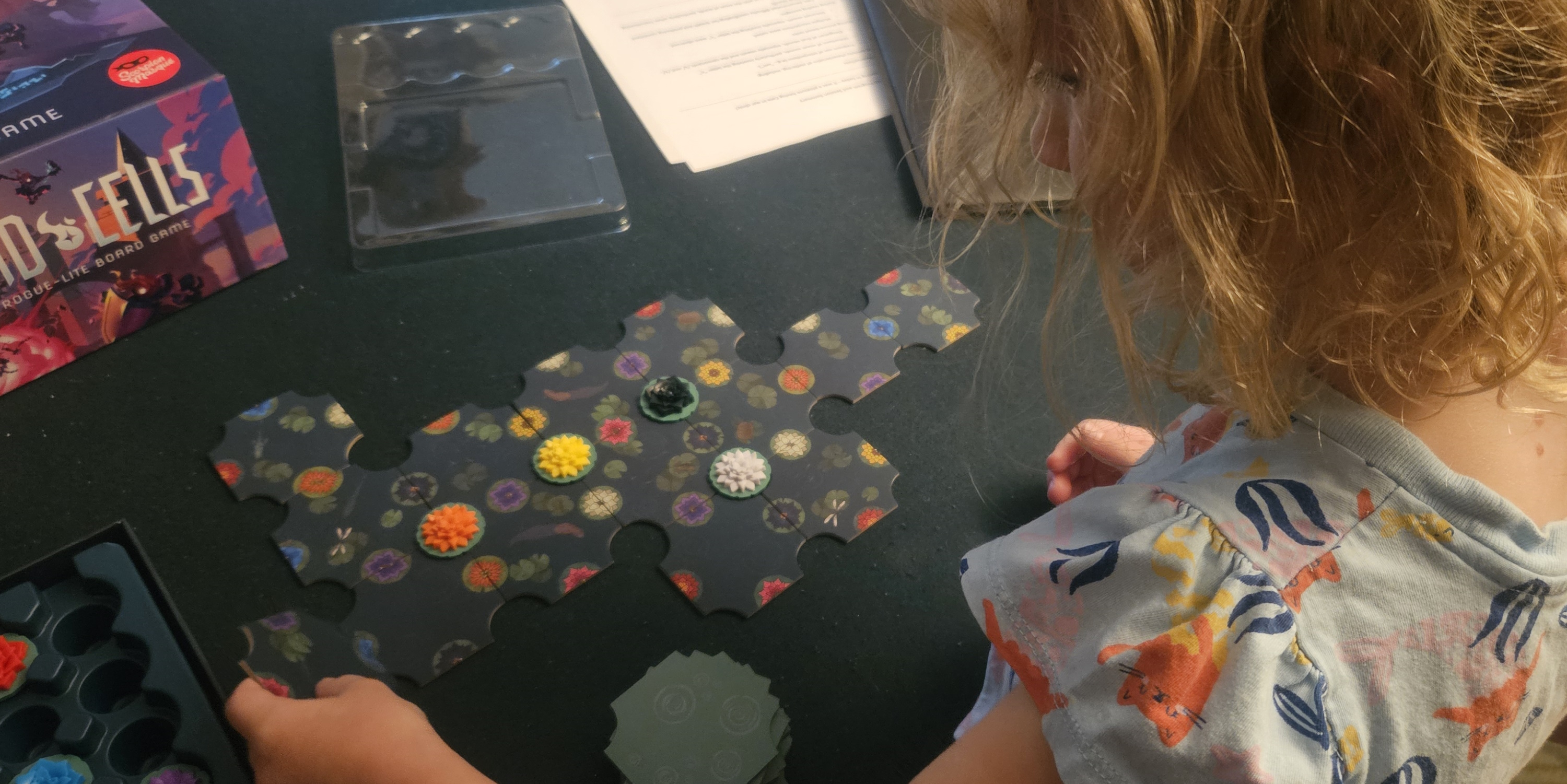
Playing the Bloom Edition with a cranky baby.
I have two children. My eleven-year-old is bright and artful, emotionally mature, loves school and social interactions. Her little sister, at five, is more like me, with qualities that are harder to express. Not because they don’t exist, but because they’re so approximate to my own. We were not brought up to think or say positive things about ourselves, we Thurots. It’s easier to frame every trait as a mishap. So while I try to tell her the many ways that she is good, how she is smart and thoughtful and curious and attuned to the many ideas swirling around her, it’s easy for both of us to phrase it more negatively. That she’s prone to gloom. Anxious about change. Too quiet and too watchful for her own good.
The morning after that second copy of A Gentle Rain materialized, she was having a meltdown. She loves school once she’s there, but donning a jacket and crossing the field sometimes strikes her as an insurmountable challenge. That’s where A Gentle Rain found us, in the middle of a negotiation to put on her coat. “What is the game about flowers, Daddy?” she asked. One more question in her ongoing filibuster.
I stopped. Looked at the game. Looked at her. And figured, why not? We were going to be late anyway.
After ripping through the shrink wrap, I explained the rules to her much how I taught them to you, as briefly and simply as possible. And then we played. She felt the texture of each piece with her fingertips. She lined up the blossoms, rotating the tiles this way and that until she found a combination that pleased her. She spent long moments pausing over which flower to place, debating the merits of each one.
In designing A Gentle Rain, Wilson included victory points. Placing all eight flowers is a win. Doing so with leftover tiles is an even better win. It’s a minor misstep, and one best ignored. To experience this game most fully, it’s better to approach it wholly as a process. The objectives may arise naturally on their own, the consequence of making the requisite matches, perhaps even the pleasure of doing so with a few tiles still in the stack. But there’s no value in the tally itself. If anything, it’s a detriment to the game’s actual objective, its attempt to spark mindfulness. To evoke calm.
That’s what I learned while playing it with my five-year-old. It took us fifteen minutes. We were late that morning. But when we walked out the door, her earlier frustration had thawed away. She laughed and skipped. When we approached the classroom door, she ran around my back, pretending to hide, giggling uncontrollably as I cast left and then right and then left again in my efforts to find her. And then she went into class and said goodbye and that Daddy was the best daddy in the world.
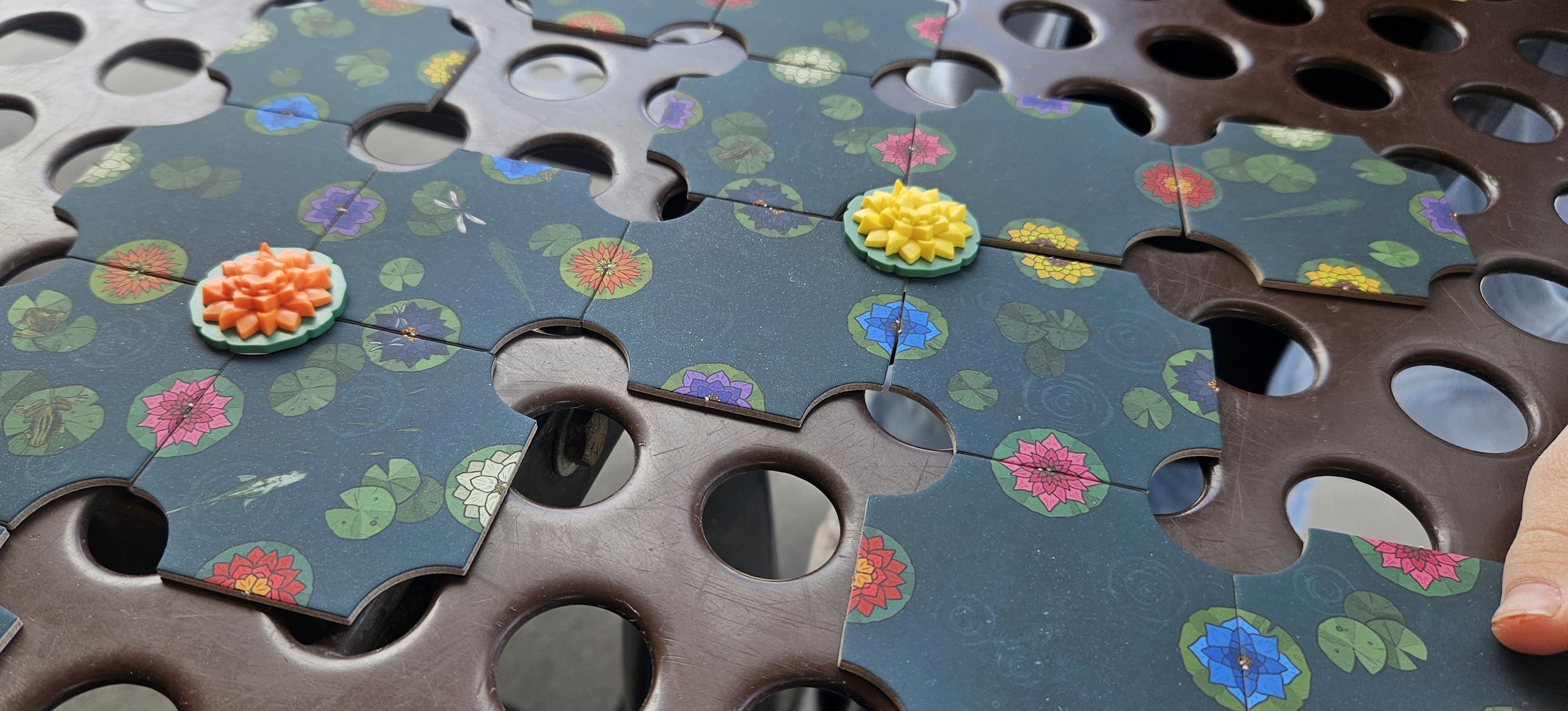
A Gentle Rain at the park.
We’ve played A Gentle Rain a few times since. She makes up new rules sometimes, or sees if she can stack the plastic flowers, or marvels at how the holes between matching tiles will admit a flower while those in the park picnic table will not, even though they appear the same diameter.
In the process of playing, that singular process, which I’ve witnessed in many board games but perhaps not so purely, so tightly managed, so trimmed of other considerations, she centers herself. She overcomes her apprehensions about the other kids on the swings. She stops fretting when her big sister runs out of sight. She plays a quick session with me, and then she runs across the pavement and onto the wood chips and rubber of the park, and climbs onto the ropes and handholds, and swings forward, feet dangling, mouth grinning, and becomes more fully herself.
(If what I’m doing at Space-Biff! is valuable to you in some way, please consider dropping by my Patreon campaign or Ko-fi. Right now, supporters can read my quarterly report on all things board games!)
Two complimentary copies of A Gentle Rain, across two different editions, were provided by the publisher.
Posted on April 7, 2025, in Board Game and tagged A Gentle Rain, Alone Time, Board Games, Incredible Dream Studios. Bookmark the permalink. 23 Comments.

 SPACE-BIFF!
Beautiful.
Thanks, Brad!
As a father of a 10yo and 4yo, that sounds about right.
Thank you Dan
Thanks for reading, Alex!
It’s interesting how kids brought up in a similar environment can have such unique and different personalities. My oldest is the extremely cautious, worries about everything “old soul’ while my youngest is the happy go lucky butterfly that just goes along with whatever life sends her way. Excellent job on the review as always!
I remember the first time I realized my kids were so different. It was so exciting. Having one kid, you can’t know how much is you versus how much is them. It isn’t until that second kid that you realize just how much they are themselves, which is both liberating and brings home the responsibility of caring for these little people.
A lovely review!
Thanks, Jeff!
I wonder what would have happened if more of us had an apprehensive release like this when growing up.
I’m trying to put my finger on why I find your writing so…moving? I’ve been reading your reviews for a few years now, and I think I came originally just for the gaming insights and the pretty prose.
But I stayed for moments like these. You write with a vulnerability and honesty that is rare in our daily lives. This moment that you wrote about here just connected to my soul – a father choosing to be late to school, playing a game with his daughter, and making a connection that wasn’t there a moment ago.
I wish I could write like you! Bravo sir.
I encourage anyone who reads this to consider becoming a Patreon for Dan – paying the cost of a cup of coffee once a month for moments like this is sort of a no-brainer.
Thank you so much for the kind words, Jason!
Wow. I had a similar experience to you on my plays of this game. But I don’t have a 10 yo in the house to round it out. Might give it some more time and mindfulness. Thanks for the lovely story.
Thanks for reading!
Could it be that you have once again written a parenting column disguised as board game critique? You are good at that, too.
Ha, not my intention in the slightest. These days I’m spending a lot of time fretting over how to be a better parent, a topic that bleeds into everything else.
As I recall, Kevin Wilson designed this during the early pandemic, and released it for free, to help people find some psychic relief during that frightening and uncertain time. It speaks to WIlson’s substantial abilities as a designer that he was able to conjure a meditative peace in players of his game using just cardboard, plastic, and very simple rules.
And speaking of abilities–perhaps the following is more a personal than a professional definition–but, to me, the difference between a reviewer and a critic is this:
A reviewer will tell you what a piece of media is, and if it is good or bad, and ultimately if their audience should consume it; a critic will place their experience of that media in the context of a time and place that an audience can react to, and thus transmit some morsel of the thoughts and feelings encountered by the critic to the audience.
Both have their place, but being a critic is much harder, and much rarer.
In a world bursting with games reviewers, thank you for continuing to be the preeminent games critic. This one caught me teary-eyed.
Thank you so much for the kind words!
Thank you so much for the recommendation, Dan. My toddler loves A Gentle Rain. He wants to know if your daughter can recommend any other games. Also, why isn’t she blogging?
Cheers,
Julian & William
My 5yo is happy to provide further recommendations! She loves Bites by Brigitte and Wolfgang Ditt, Spots by John Perry, Barbecubes by Brett Gilbert and Rob Sparks, and Wilmot’s Warehouse by David King. She also insists that she will learn “a big game” on her upcoming sixth birthday.
You’ve nicely illustrated how this simple pleasures game works, not by competition or strategy but by participation. That’s really lovely.
Thanks, Lee!
Pingback: Summer Ludens | SPACE-BIFF!
Pingback: Best Week 2025! All My Children! | SPACE-BIFF!