Resistance in France

“Timely” isn’t my favorite descriptor. It’s such a trite word, like we’re trying to persuade somebody to take our hobby seriously. I tend to feel that board games are timely because somebody bothered to create them right now, in this time and place, and the sooner we assume that contemporary objects have contemporary meanings, the better and more durable they become.
Unfortunately for all of us, concentration camps are back in fashion and due process has been downgraded to an inconvenience. These are the years that make art like In the Shadows not only timely but necessary, if only as a reminder that people have, elsewhere and in other times, resisted movements every bit as stupid and cruel as those rolling off their overfed haunches today. Dan Bullock and Joe Schmidt have an eye for such examinations, and In the Shadows is no exception. As models go, the history they display here is both a reminder and a corrective. If only we didn’t need them so badly.
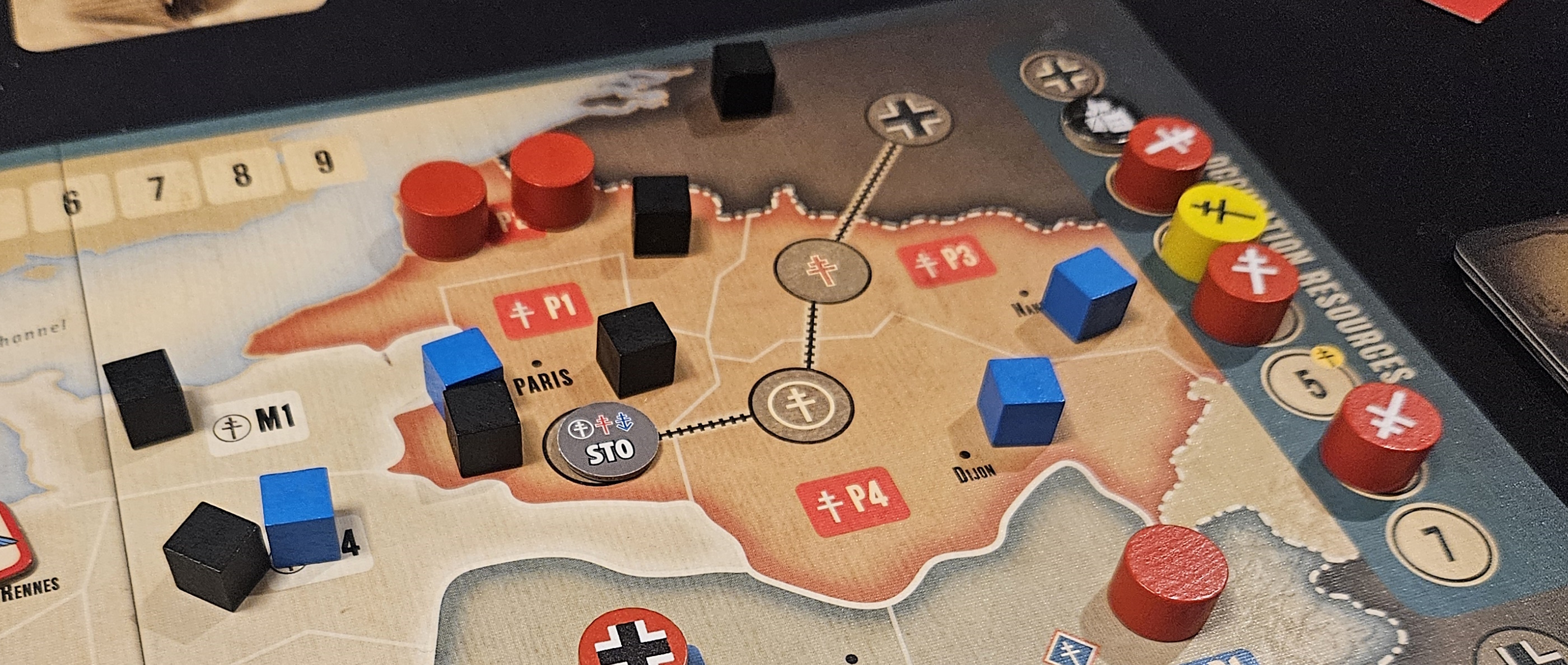
Exporting France’s labor, art, and natural resources.
I’d heard of In the Shadows a year or two before actually playing it, usually referenced as “the French Resistance game.” It’s a topic that’s been treated before, of course, as recently as last year’s War Story: Occupied France by Dave Neale and David Thompson, but In the Shadows goes a different route from that game, or any other in my recollection.
The first clue is found in the subtitle. “Resistance in France, 1943-1944” is more than a description. It’s a thesis statement. Traditional understandings of the resistance to German-occupied and -administered France usually fall into one of two camps. Either France was liberated by the Allies on D-Day, a narrative intended, in part, to subordinate France’s position in the dawning post-war order, or it liberated itself via a unified military resistance, Charles de Gaulle’s argument, conversely designed to preserve French dignity and global aspirations.
As is always the case, the history is messier than either narrative would have us believe. There was no singular “French Resistance,” but many French resistances that adhered to a wide range of stripes and political bands, all opposing the occupation in their own regions and according to their own methods. Accordingly, nor indeed did everybody’s resistance look the same. There’s the prevalent romantic image, the freedom fighter leaning oh-so-sultrily against sandbags or a motorcycle, pilfered German submachinegun in hand. But there were also couriers and radio operators and forgers and guides and safehouse keepers and thousands more who turned a blind eye to resistance activities rather than tattling to the local kommandant.
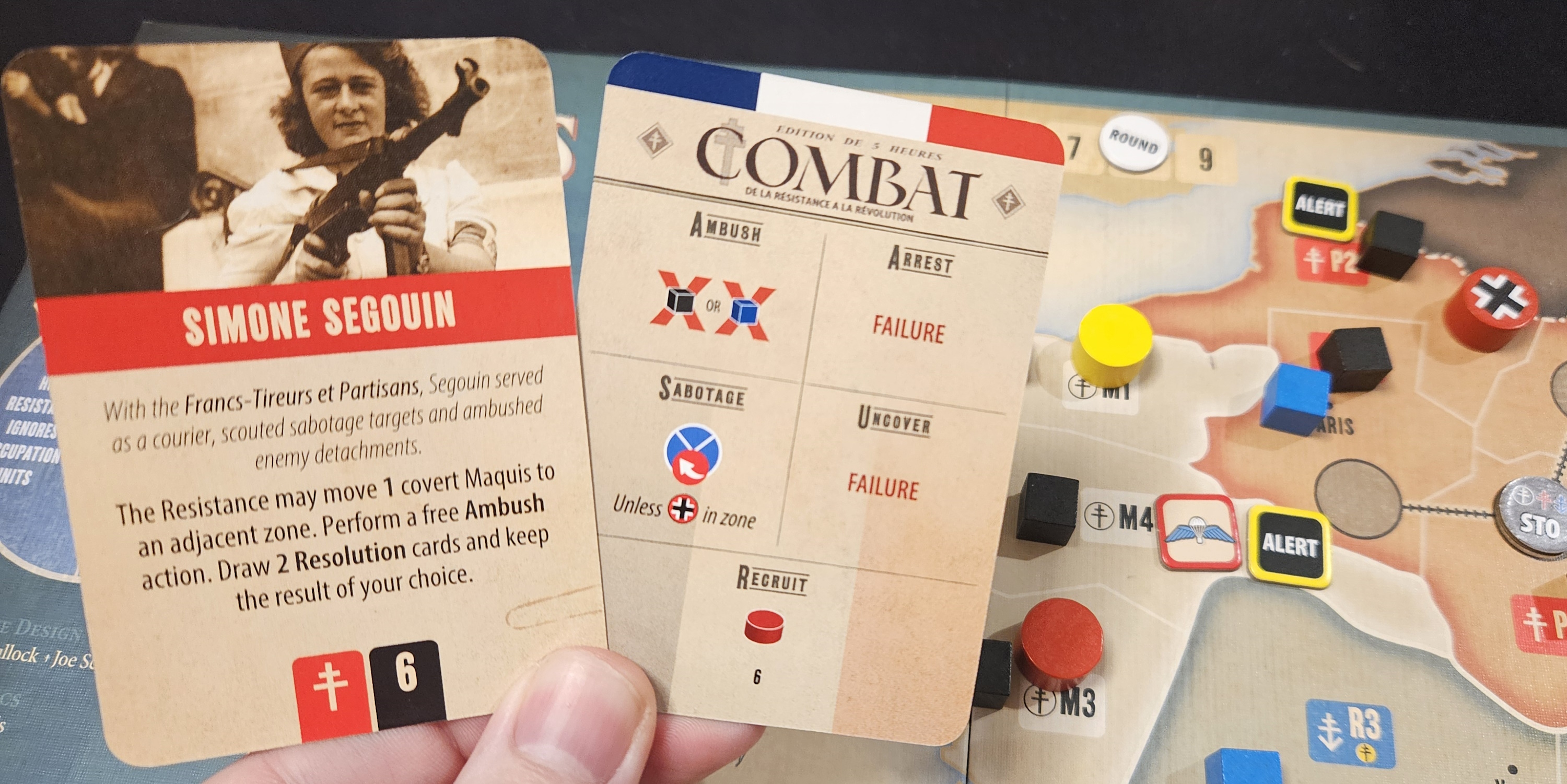
Simone!
With In the Shadows, Bullock and Schmidt undertake to portray that resistance, one that looked less like a unified front than many sticks scattered in the wind, each puncturing German tires or whisking refugees out from under German search parties or dodging German work orders.
At times, that portrayal is hard to make out, even borderline gamey. Rather than presenting France as a single country, this one has been divided into three administrative districts, each with a further four zones that function as the spaces for pieces to inhabit and move between. Like innumerable historical games before it, this is a card-driven affair. Cards offer both action points and events, the latter of which must be carefully timed so as to capitalize on some positive occurrence or dodge the worst consequences of something that favors your enemy. It isn’t anything we haven’t seen before.
Where it differs from most other CDGs, however, is that the cards are tied to those administrative districts in the form of suits. Actions in a card’s district cost the usual amount, letting resistance cells sabotage infrastructure, ambush occupiers, or recruit compatriots. But in other zones, everything requires an additional action point. You’re still free to launch a surprise attack halfway across the country, but it will cost you.
This is only the first of many touches that Bullock and Schmidt leverage to present an atypical French Resistance — apologies, resistance in France — but it’s a surprisingly effective one. Even when operating at peak efficiency, their cells safely concealed from La Milice Française and armed Maquis striking directly at the Germans, the Resistance’s options feel fragmented and piecemeal. Unlike the insurgents of the COIN Series — which donates a few strands of DNA to In the Shadows in the form of underground cells that must be exposed before they can be arrested — there’s really no tipping point when all those guerrillas gather in the capital city to overwhelm the dominant regime. Instead, this is a battle of slow erosion, fought as one granule at a time batters itself against the mountain.
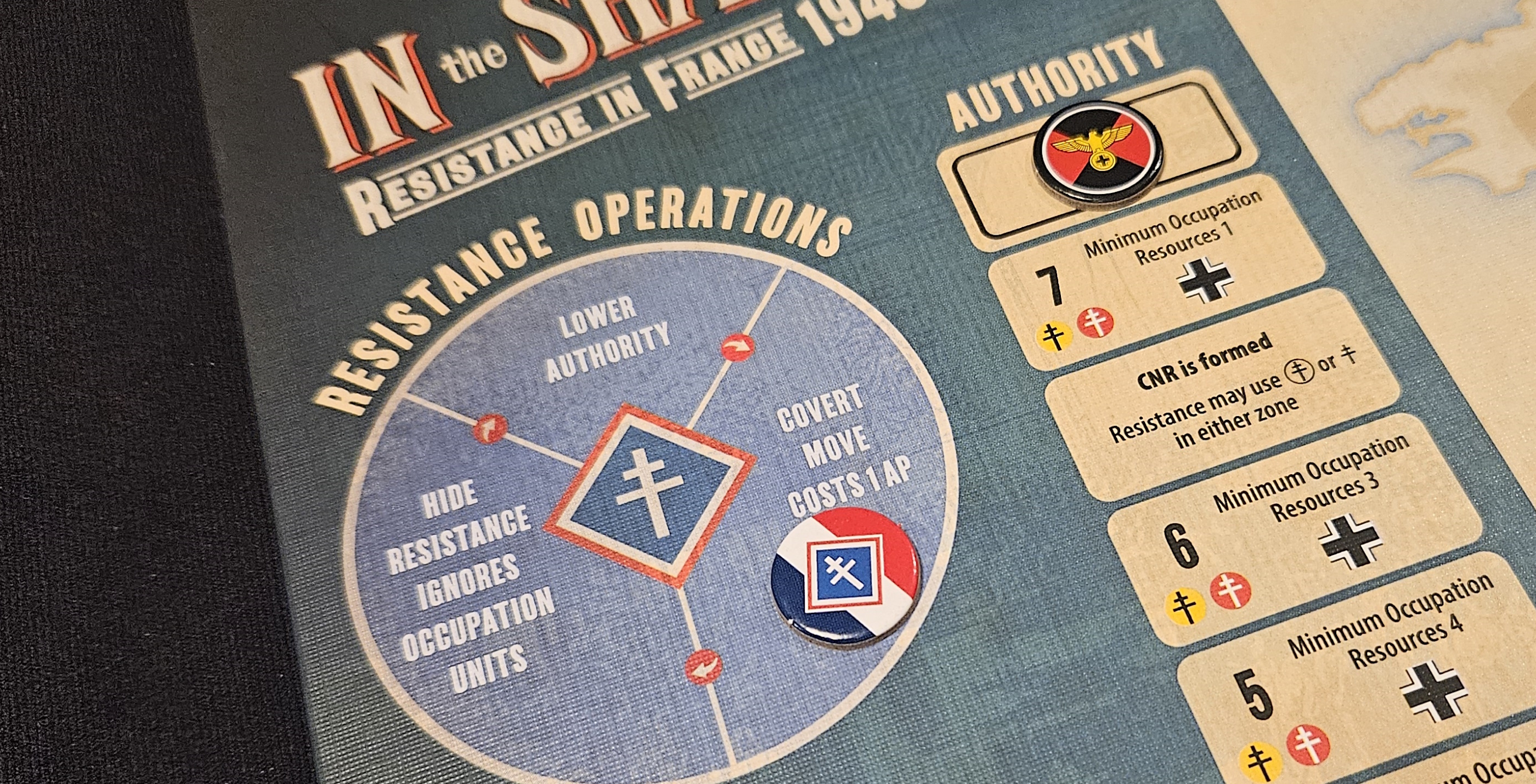
Eroding the authority of the Occupation is painstaking but necessary.
Which is saying a lot, considering this game’s compact nature. A full session lasts only nine rounds, totaling perhaps forty minutes, a cue taken from similarly brief titles like Fort Sumter or Red Flag Over Paris.
In the Shadows happens to be a stronger game than either of those, and in that short span there’s a lot to tackle. The Resistance’s approach is gradual, using sabotage actions to circle a three-space rondel that grinds away at German authority. The Occupation, meanwhile, divides their time between disappearing agitators — hardly a straightforward process, as those agitators must first be ferreted out — and loading trains with workers and plunder to drag back to Germany.
This latter detail is one of the game’s sharpest commentaries. Fascism has always been a rapacious ideology, one that cannot stand on its own legs for two minutes without swiping somebody else’s fence post to serve as a crutch. Here the pillaging of France is presented as an overly snug collar, one that might tighten into a noose at any moment, and a significant proportion of the game’s event cards deal with this gradual leeching. Little by little, the Occupation is required to shift loads of French resources from Paris to Germany. Over time, this helps to secure the German player’s victory conditions, but also injects additional cells into the Resistance player’s recruitment pool.
Like I said, it’s sharp, although I suspect our ur-fascists won’t have the head to understand the statement. But look, they will say, they were getting all those French masterworks and workers! What they miss is that those despoiled resources weren’t enriching the average German citizen. Fascism had taken its toll already, churning so much manpower eastward that there was no way to prop up German manufacturing without drafting foreign labor and materiel. Thus the vicious cycle: to keep its war machine fed, Germany resorted to slave labor, which in turn galvanized its opposition. Even at its most ironclad, fascism was a cannibal that couldn’t help but take mouthfuls out of its own face.
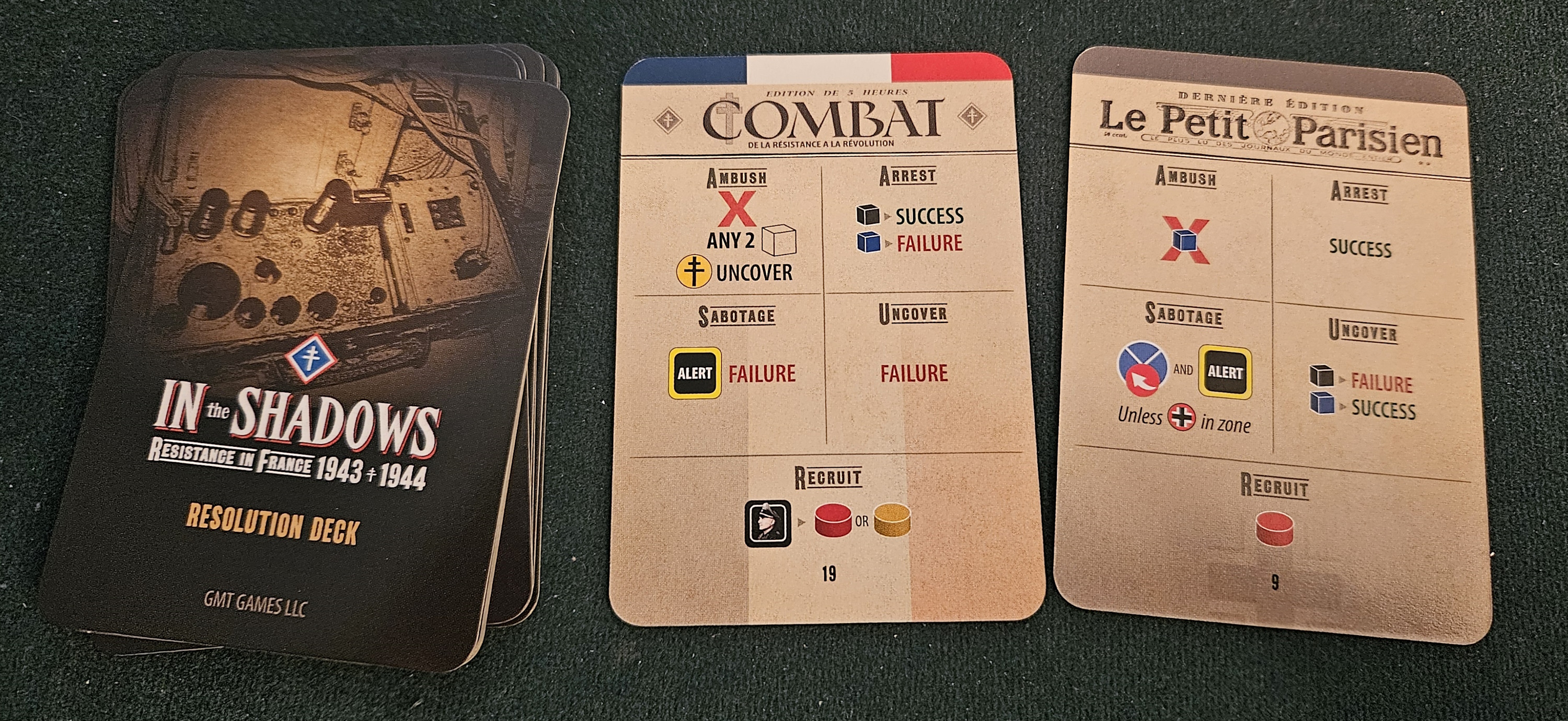
The combat resolution deck is infuriating.
It’s impressive to see a board game, especially one this diminutive, touch on so many motifs. In a single sitting, In the Shadows manages to celebrate the heroism of Occupied France’s many resistances, clutter the romantic notion of a singular French Resistance, and thumb its nose at fascism in the process. There are even some uncommon notes in there, such as the way French units might be infiltrated by informers, making their arrest all the more likely.
Despite its strengths, there are a few discordant notes. Perhaps the most errant of them all is the resolution deck, a fantastic idea that pops in the barrel like a squib round. The notion is that each of the game’s many actions, ambushing and sabotage for the Resistance, uncovering and arrest for the Occupation, hinge not on a roll but on a flip from the deck. This enables not only the usual binary between success and failure, but also a spectrum of possibilities in the middle. Recruiting new insurgents, for example, might succeed if the Germans have revealed the Butcher of Lyon, while a particular Occupation investigation will succeed more often thanks to the presence of Milice units or infiltrated Resistance cells. This produces a wide range of outcomes and tailor-made probabilities.
It’s also a huge bummer. Drawing three failures in a row feels uniquely hateful in a way that a roll of the dice does not, and that goes double when you’re playing as the Resistance, whose attempts to repeat actions are hamstrung by the need to reveal their underground cells. There are ways to massage the odds via a second draw, but these are limited. Most of the time, I dreaded every pull from that little deck.
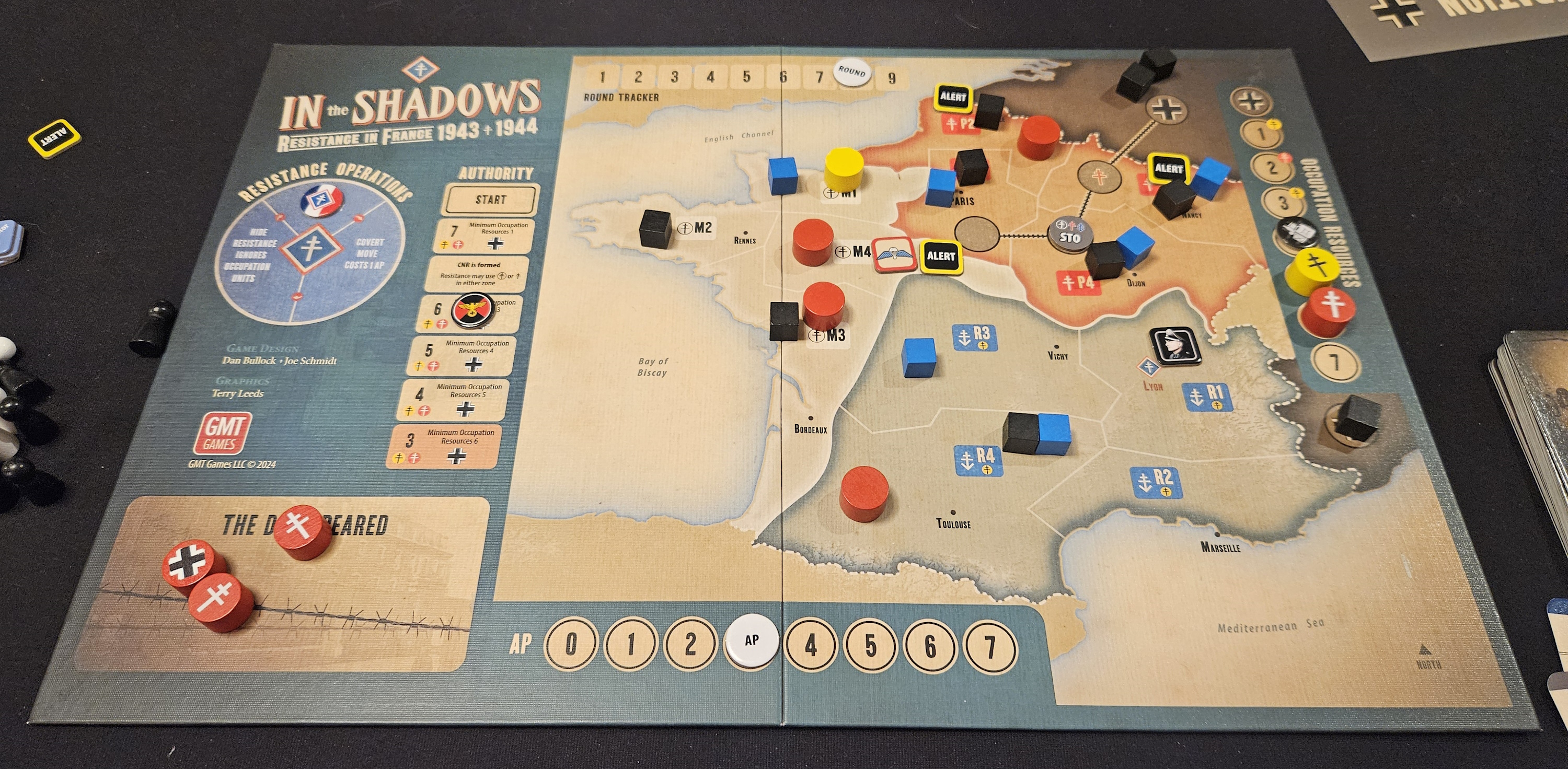
A sobering, but timely (ugh!) experience.
On the whole, though, In the Shadows is a mighty little thing, a forty-minute wargame that makes its point, offers a tight contest, and then clears itself from the tabletop. It’s a reminder, too, that resistance took many forms — art as well as everything else, passive and active participation alike, until the occupation had been spread thin and made brittle. Make of that what you will. I wish it weren’t so timely.
(If what I’m doing at Space-Biff! is valuable to you in some way, please consider dropping by my Patreon campaign or Ko-fi. Right now, supporters can read my quarterly report on all things board games!)
A complimentary copy of In the Shadows was provided by the publisher.
Posted on April 3, 2025, in Board Game and tagged Alone Time, Board Games, GMT Games, In the Shadows. Bookmark the permalink. 15 Comments.

 SPACE-BIFF!
Got our first play in of this yesterday and it’s really cool! Will have to review it when I get some more plays in, but not sure I can do it the justice you did.
Psh, I’ll be first in line to read your take.
Dan! You deleted the Nazi’s comment right before I responded to it! Maybe that’s a good thing anyway. Thanks for this thoughtful review!
Heya Paul V! Sorry, but I don’t see the comment you’re referring to. My spam filter is pretty wonky, so things sometimes go missing. Could you clarify?
Wowzers. Dan, I so often have to look up your deep references to historical events and now I ask about one of them to better understand your review. I asked a genuine, honest, maybe naive, question and now I’m being called a nazi? I’m not sure what just happened.
In any case, keep up the good reviews.
Huh? I’m not sure what anybody is referring to with this “Nazi” stuff.
I’m squinting very hard but I’m struggle to see the parallels between the present and the French resistance who were fighting the Nazis, a political death cult that murdered 14 million non-combatant soviet peoples and 6 million Jews in gas chambers. Is this happening somewhere that I’m not aware of? If not, the comparison strikes me as in very poor taste.
If we really are living under an emerging fascism shouldn’t you being taking up arms and going underground? They’ll be rounding you up in the night soon won’t they?
I never saw where Dan compared the French resistance to a board game review, must have missed it. You though are downplaying a movement that tried to lynch their vice president. Many historians have pointed out the ways that America is sliding headlong towards authoritarianism, which makes your whole line of argument not only ignorant but appalling.
Dan, can we just ban this moron already?
There’s plenty to be said about people being sent to Salvadoran prisons, including citizens, stripped of their right to due process, or how the current dominant political regime in the United States repeatedly platforms individuals who signal their fascist intentions — including by sieg heiling — or how the single most famous poem to come out of the Holocaust is about speaking out against authoritarianism before its worst excesses become reality…
But instead of saying any of that, I’ll remind you of something I very clearly wrote in the review, that one of the points explicitly made by In the Shadows is that there are many ways to resist authoritarianism than by taking up arms.
Now shoo.
It is mind boggling that someone posing as a historian needs to be reminded that a Salvadorian prison is not a Nazi concentration camp. The Nazis did not come to power because of a salute and their ideology was not reducible to one either. No amount of sieg heiling can bring the Nazis back. The idea that you are resisting the rise of fascism by writing a board game review is the most obscene and embarrassing form of fantasy cosplay I’ve ever heard of.
Grow up
The US has been holding and torturing people illegally in Guantanamo Bay for decades, the Bush administration killed, by conservative estimates, 1.5 million innocent people in an illegal war in Iraq, the Obama administration committed innumerable extra judicial killings that it openly celebrated, while overseeing the extra judicial practices of the war on terror, deporting millions of migrants from the US and turning Libya into an open air slave market. It also imprisoned and tortured journalists, like Julian Assange, who actually spoke out and weren’t just playing board games. Was that fascism?
I’d call much of that imperialism rather than fascism, although there’s plenty of overlap, and I’ve protested against some of those actions. But what’s the point of discussing definitions with you? You’d just holler about something else.
Time for you to go.
Get rid of the troll. This is the same pro-Russian dipshit from a year or two ago. Just lots of insulting attempts to draw false equivalency between everything. He’ll keep telling you that board games and board game reviews can’t be worthwhile while shouting at a board game reviewer on the internet. Right – because HE’S fighting the good fight down here in the trenches.
I want to defend the assertion that this design was a commentary on how some individuals are pressed to resist fascism and its parallels to the present. We resist in different ways, and yes, sharing art can be one of those ways, just as some distributed clandestine press, forged travel papers, acted as radio operators and other actions that didn’t involve taking arms. The folks in the vanguard of the resistance in France were often those with the most to lose. They were the ones most likely to be abducted, to disappear into a foreign labor camp, to be the target of reprisals. They were already marginalized. Few would risk themselves in defense of them.