In the Margins

At a mechanical level, In the Ashes, the gamebook by Pablo Aguilera, is a major accomplishment. Full of novel solutions to problems that have dogged the format since somebody first decided to put a game inside a book, I was repeatedly struck by Aguilera’s creativity. Nearly every encounter did something new, exciting, or innovative. Sometimes all three at once.
But before you order the thing, let’s rein in our expectations. In the Ashes is also a hot mess. At least in the format I played it, anyway.
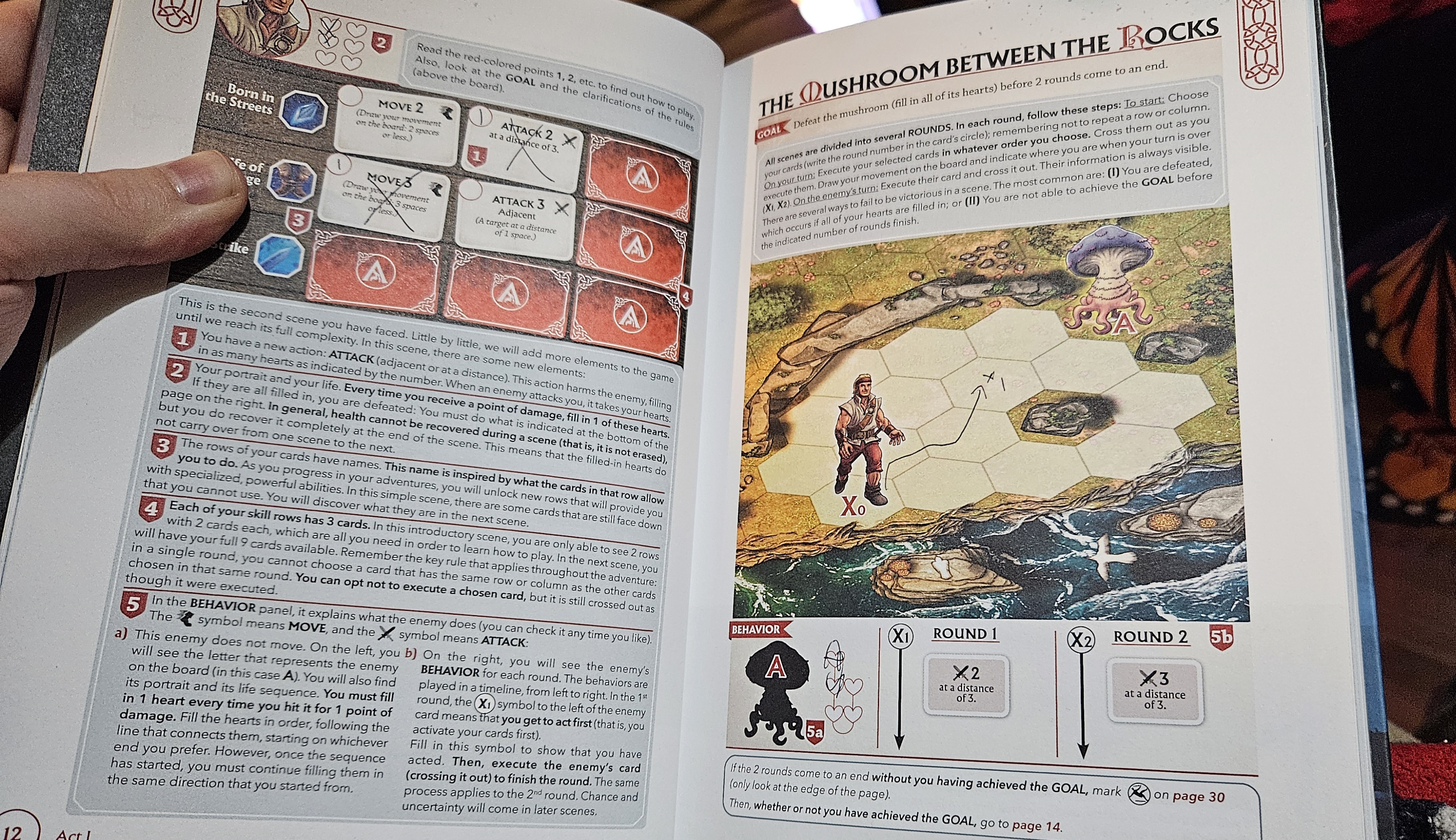
Finally learning to read.
In the Ashes tells the tale of Vestar, a fisherman who finds himself thrust into an epic adventure when an explosion rocks the interior of the island he calls home. An expedition is mounted to investigate, shady characters lurk at the periphery, and a jumble of monsters stand ready to snack on anybody who happens past their lair.
Right away, it’s almost impossible to talk about In the Ashes without some spoilers. Not so much narrative spoilers as those of the mechanical variety. I’ll keep the details to a minimum, but both the book’s strengths and weaknesses are tied to Aguilera’s design and writing choices, leaving us very little to talk about otherwise.
For instance — and if you’re truly fetching for a pristine firsthand experience with an inconsistent gamebook, you had better stop here — Vestar isn’t the only point-of-view character the game offers. Around the one-third mark, Vestar steps aside and we’re introduced to another character, one we’ve only become briefly acquainted with through the backstory. Roughly another third of the book after that, our deuteragonist is similarly shuffled offstage so we can play a third main character. These stories eventually tie together, but you’d better pay attention if you want their eventual reunion to make a lick of sense. At eight to fifteen hours long, that’s plenty of time to get hazy on all those contrasting character motivations.
It’s a bold decision, and like everything else in In the Ashes, it produces mixed results. On the one hand, it leans heavily into the notion that becoming is always more interesting than being. By spending only seventy-ish pages with each character rather than the whole two hundred, you’re given enough time to choose a pair of class specializations, gather some items, and then chuck them over a proverbial fantasy cliff until they’re ready to reemerge unscathed a few chapters later. Nobody sticks around long enough to grow dull.
On the other hand… well, let’s circle back to that.
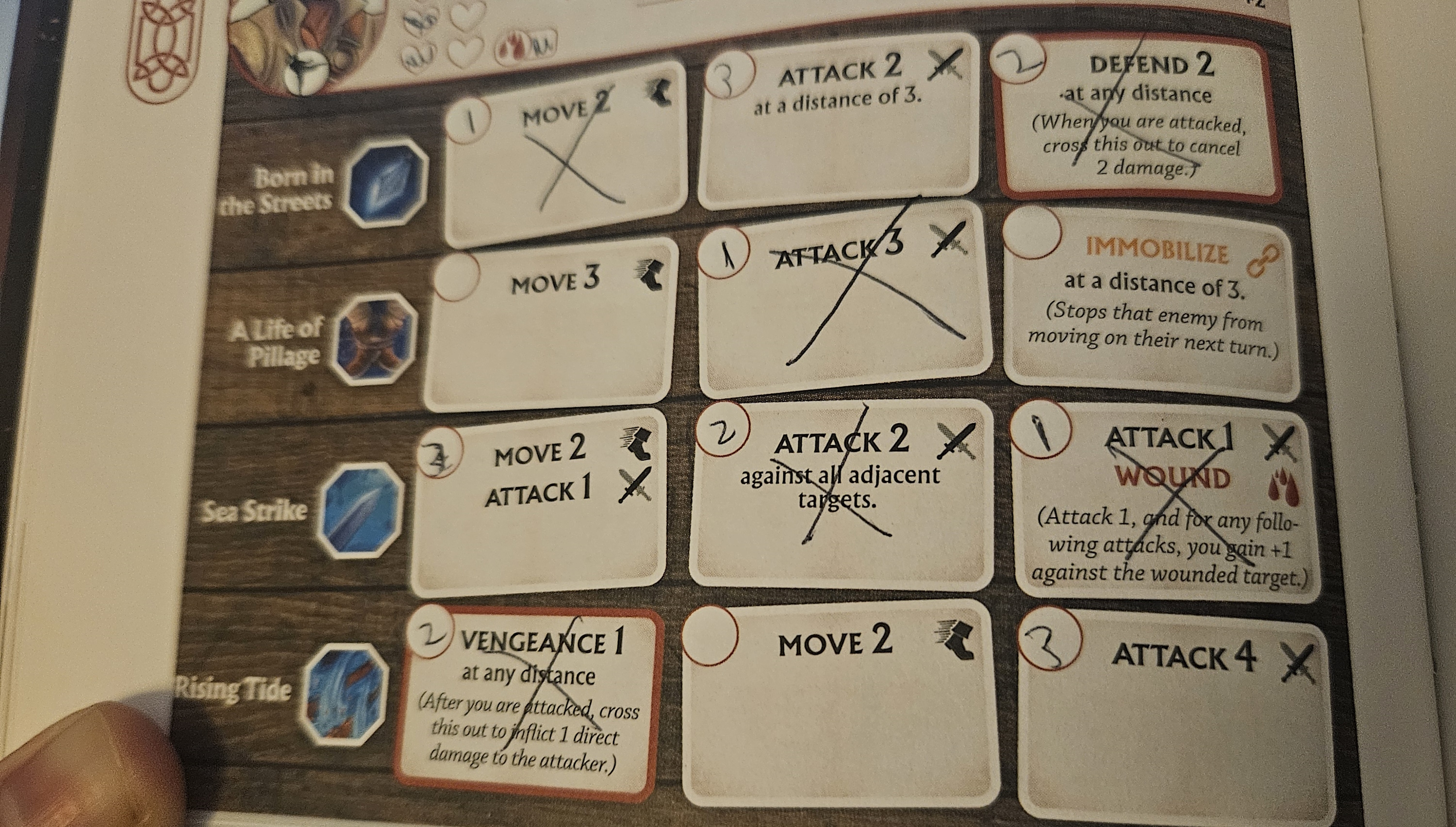
The card system is pretty solid.
The strong point of the entire gamebook is the battle system, a workhorse that Aguilera deserves real credit for, and which he puts through its paces. After the requisite paragraphs of exposition, you’ll turn to a double-page battle encounter. These display a huge range of information: special rules, a hex grid where the battle actually takes place, and trackers for everybody’s life points and abilities. Thankfully, Aguilera introduces us to the rules one snippet at a time and deploys copious reminders, not to mention a compilation of the relevant rules in the back of the book. It isn’t complex, exactly, but it’s more fine-tuned than I expected.
The centerpiece of these battles is a card system that’s printed directly onto the top left of each encounter. At first, your character has three rows of cards, although new unlocks gradually permit a fourth and fifth row. These represent the moves, attacks, and special abilities your character can unleash on their foes. Movement has you scrawl little arrows onto the hex grid, attacks scratch out your opponent’s hearts, and there are little status effects like wounds and immobilization for tweaking enemy behavior.
Each card can only be used once per encounter. That’s to be expected, but there’s an additional limitation to consider. On any given combat round, you can only use cards that don’t share a row or column. This feels somewhat gamey in that it exists entirely “outside” of the battle taking place on the page, but it’s soon apparent that it’s also a necessary evil, forcing you to make tough decisions that might otherwise be trivial. This extends to some of the narrative decisions as well. Picking a specialization lets you add a row of cards, and depending on your preferred playstyle you might opt for an attack in the movement column, a particular special ability, or to lay traps rather than confronting foes directly.
To be clear, these decisions aren’t always as expressive as they might sound. Combat veers between little puzzles with foreordained solutions and more open-ended encounters that tend to be rather easy. You can see everything in advance, all three enemy moves displayed in a row, so there’s nothing preventing you from visualizing the whole battle like some sort of fantasy precog.

One of three random number generators.
Smartly, Aguilera places some restrictions on this forecasting via lots and lots of randomization. And while these don’t entirely ablate the efficacy of planning ahead, at least they make the accuracy of your plans somewhat negotiable.
In total there are three outcome generators in the game, each with its own quirks. The basic option, and the one common to the game’s monsters and your opening protagonist, is simple enough. By flipping through the book and stopping at a random page, you’re presented with a die result that modifies attacks to deal more or less damage. Easy peasy. So easy peasy, actually, that my fingers quickly “remembered” the clusters that produced better results. Bad fingers. Bad.
Elsewhere, another character randomizes her rolls by having you squeeze your eyes shut and jab your pencil onto the page, potentially missing a shot altogether if your graphite should stray afield of the number grid. This generator is more clever than the first, especially once enemies start futzing with it by marking out entire portions of the grid.
The third and most robust generator is a rune system. Whenever your spellcaster casts a spell, you choose one of three attached symbols and flip to the runic appendix at the back of the book, which delivers a snippet of narrative and tells you how to resolve the attack. This is the least random of the group, relying on your knowledge of the various runes that govern this world’s magic. Trying to deploy the rune of dust in the middle of a swamp is folly, for example, while a rune of swamps will prove extra effective.
That is, if the runes conform to any logic whatsoever. While this system is the most robust of the three, it’s also the most aggravating. More than once, I figured a particular rune was an obvious choice, only for my spell to fizzle ineffectually against a foe’s hide. It’s a problem not so much with the game’s mechanical side than with its broader issue: the writing.

Let’s say I find you pretty on the inside.
I don’t want to bag on the writing too much. In the Ashes is a translation, making it impossible to know whether the game’s inconsistencies stem from its transition from one language to another rather than arising from its original state. Maybe these sentences string together better in the original Spanish? Maybe the story comes across as picaresque rather than unstructured? Maybe there aren’t so many non-sequiturs?
Maybe. In English, though, the composition is lacking, both narratively and structurally. Since this is a book, ostensibly containing a curated sequence of events, In the Ashes has the opportunity to present a coherent throughline. Instead, combat encounters aren’t all that far off from flipping a monster card in a Terrinoth knockoff and wondering why you’re fighting a giant mushroom mere moments after defeating some cultists. It’s a missed opportunity, leaning into board gaming’s pet definition of “theme” as a thin veneer overlaid atop a mechanical object, and not every other medium’s understanding that themes are unifying concepts or ideas. What is the theme of In the Ashes? More often than not, the answer is “generic fantasy adventure.”
Lest you think I’m just being a snob about this game’s congested writing, it trickles into every other aspect of the design. We are, after all, not only playing a game; we’re reading a book. On their own, combat encounters are interesting enough. But they often present choices to the player, flashpoints between breaking a monster’s special ability or assaulting its pool of hearts directly. At times, In the Ashes insists that these narrative strands will lead somewhere, commanding the player to flip to a certain page and mark a symbol in the margin. Devoid of context, however, these decisions are airy and vague. More than once, I stumbled upon one of those marked icons and rotated the book upside-down to read the relevant outcome, only to discover that the consequence had little to do with the action I’d taken earlier. In some cases, I could barely even recall the inciting event, so thin were the connective tissues between cause and effect.
It isn’t long before this thinness begins to wear on the gameplay. The hex battles are solid enough that they could easily mark time in a better narrative. But they’re also flimsy enough that, in this story, with its absence of tendon between its bones, with its utter dedication to replicating the worst offenses of tabletop adventure games, they’re reduced to loading bars in between flavor text. Somewhere in the middle of the second act, I began contemplating skipping over the fights. I wasn’t in a hurry to reach the next story beat. Oh no. I just wanted to see what mechanical novelty Aguilera would add for the next character. In the Ashes had ceased to function as either a story game or a battle game. Instead, it had become a showcase for some cool solutions that I would love to see in a more coherent gamebook.
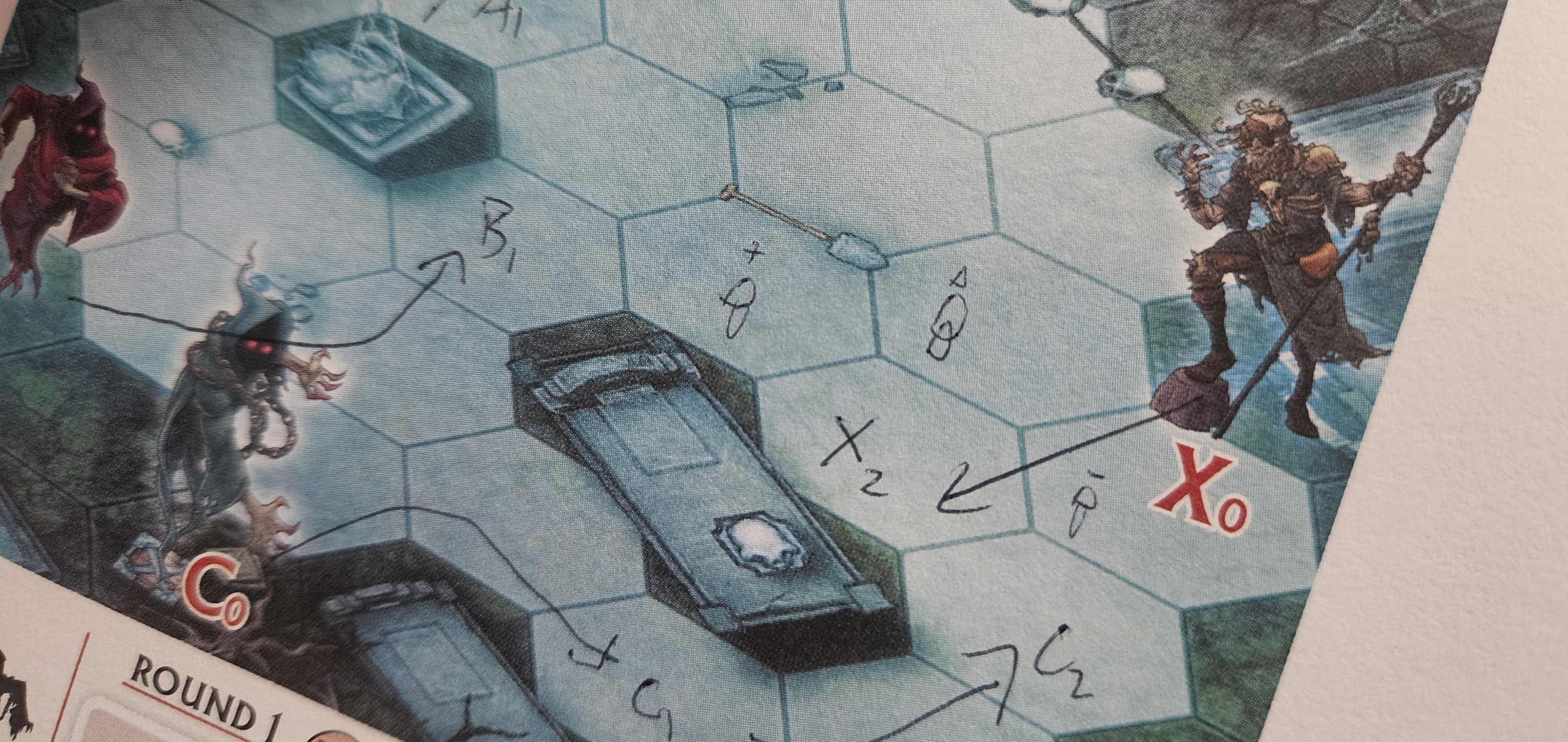
Movin’ around. Makin’ friends. Slayin’ them.
I do mean that. At a mechanical level, In the Ashes does tremendous things with its format. I have my hangups about how thoroughly a single playthrough defaces the book, making it impossible to play again or pass along to a friend, and that complaint goes double for a hardback book rather than some cheapo paperback. Still, this game is positively drowning in good ideas.
But it never enlists those good ideas in service of anything other than a meandering narrative and disjointed structure. The result is a title that’s most interesting as marginalia, as the gamebook that inspired the gamebook that will truly be worth the paper it’s printed on. I sincerely hope such a game is created someday.
(If what I’m doing at Space-Biff! is valuable to you in some way, please consider dropping by my Patreon campaign or Ko-fi. Right now, supporters can read my quarterly report on all things board games!)
A complimentary copy of In the Ashes was provided by the publisher.
Posted on April 2, 2025, in Board Game and tagged Alone Time, Board Games, Devir, In the Ashes. Bookmark the permalink. 4 Comments.

 SPACE-BIFF!
Hi Dan, thanks for the review. I’m Pablo Aguilera, the author.
I’m glad you liked the mechanics of the different characters and scenes in the book. Although it is hard for my ego to read some things, I take them as constructive criticism 🙂
I have taken note of your comments to try to improve my prose and its consistency. I’m a novel writer and as you say the narrative in “In the Ashes” I approached it as a simple link between action scenes.
The next book is well underway, and includes more depth in the story and characters, more choices and investigation scenes (like Mansions of Madness) in addition to the typical combat scenes. Of course, new mechanics, personality tracks, new items and abilities.
Kind regards,
Pablo.
Sounds good, Pablo! I’ll await your next book with great anticipation.
Great review as always, Dan, and despite the criticism, I have bought the game book, Pablo, both because I like narrative-heavy games (I play them with someone, never solo, but they are just as fun), and because I want to support you. Looking forward to your next game with improvements, while I am playing this one! 🙂
Very cool! I hope it lands just right for you and whomever you play it with.