Gleaning Aidalon

I suspect there’s some wordplay behind Hubworld: Aidalon, the forthcoming card game by Michael Boggs and Cory DeVore. In ancient Greek literature, an eidolon is an image-spirit, a sort of displaced hologram that allows a character to be present without actually, you know, being present. In his drama Helen, for example, the Athenian tragedian Euripides contends that Helen of Troy had been whisked away to Egypt prior to the great war. There she languished, replaced by a phantom who launched a thousand ships in her name.
As references go, it’s a subtle but fitting nod. Hubworld: Aidalon is itself an eidolon, an image-spirit of Android: Netrunner that may perhaps launch a thousand icebreaker runs in that game’s absence. Certainly it’s already launched a couple dozen such runs on my table. Coming soon to Gamefound, Earthborne Games is offering two decks for the cost of shipping while supplies last. And I’m pleased to report that this early peek is as promising as they come, not only burning the afterimage of Netrunner into our retinas, but in some ways offering a fuller and more exciting take on the concept.
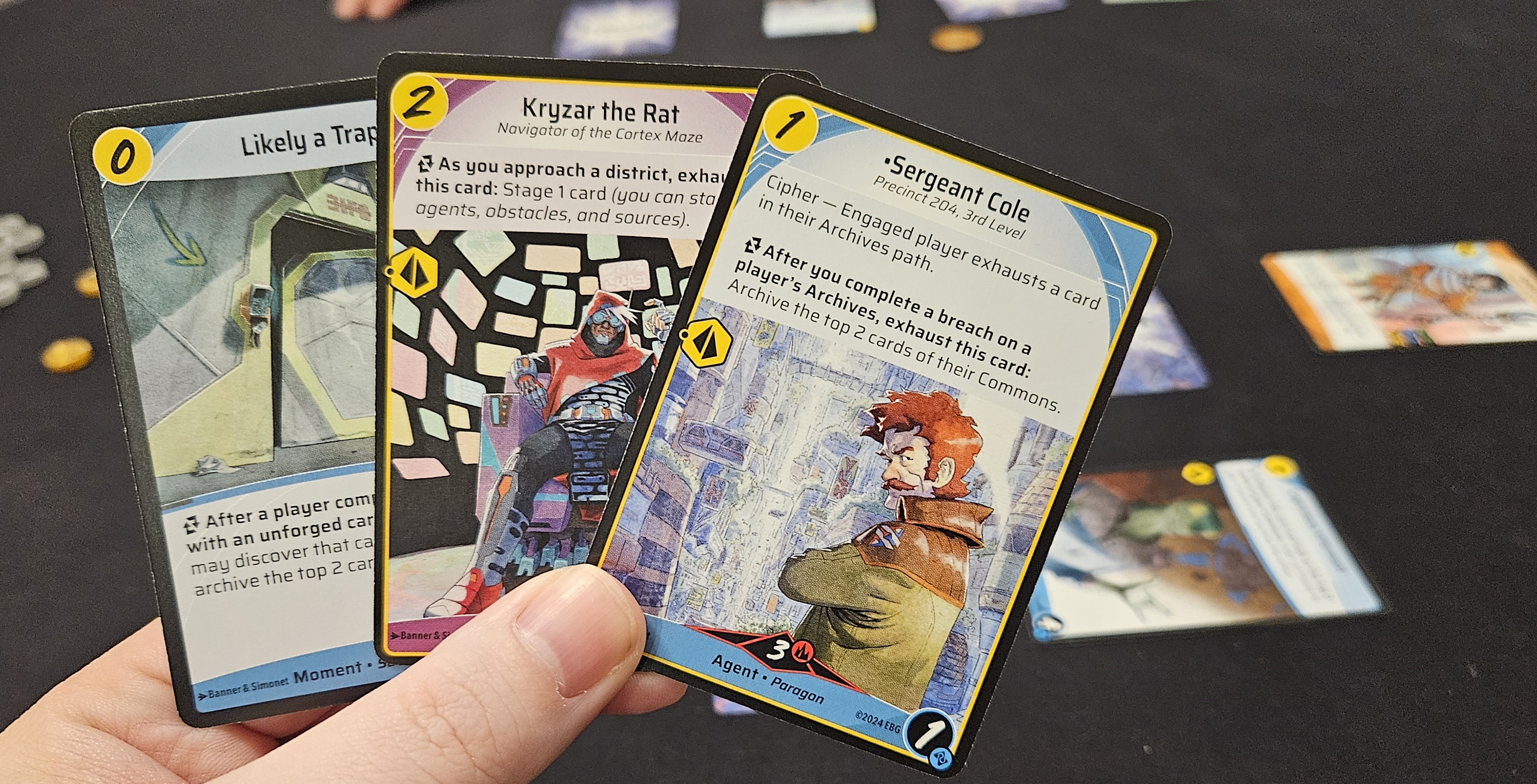
The illustrations are placeholders, but honestly I dig the look.
Welcome to Aidalon. Once the premier hubworld of a great interstellar community, its shipyards and districts were the envy of the galaxy. But that was then. Now, with the arrival of the Collective and their portal networks, Aidalon has fallen into obsolescence. In chaos, though, there is opportunity. Seekers with a hand in the black market and the will to coerce influential agents to their banner might chart a course upward. Past the scrappers. Past the old noble houses that once ruled this world. Maybe even past the Collective itself.
Okay, so that’s the fluff — although let’s be real, the neon-soaked backdrop of Netrunner was always part of its appeal. Like that game, Hubworld is gritty and grounded, albeit with an extra dose of space opera and significantly less neon.
Also like Netrunner, Hubworld revolves around establishing and probing defenses. In Netrunner, these were servers loaded with valuable information. One player, the Corp, filled these servers with unethical agendas and deadly traps, hoping to delay long enough to progress those agendas to completion. Meanwhile, the other player, the Runner, did everything in their power to break past the Corp’s defenses and expose their nefarious objectives to the world. It was a deadly game of cat-and-mouse, one where it wasn’t always clear whether you would catch your rival’s tail or their teeth.
In many ways, Hubworld is similar. In place of servers, players have districts. Three in all, as opposed to Netrunner’s potential sprawl, one for your draw pile, another for your hand of cards, and a final district for your discard pile. Each of these districts is protected by a lane that can contain up to three cards, concealed face-down until either probed by an enemy incursion or flipped face-up in exchange for some amount of shards, the game’s currency.
Right away, the biggest transformation from Netrunner is that every player is both Corp and Runner, both hunter and hunted, both protector of their own districts and thief trying to crack the vaults safeguarded by their rivals. It’s a major alteration, stepping away from the stark asymmetry of Netrunner. Those two complimentary decks, for example, are perfect mirrors of one another, only distinguished by your choice of seeker and the order in which you draw your cards.
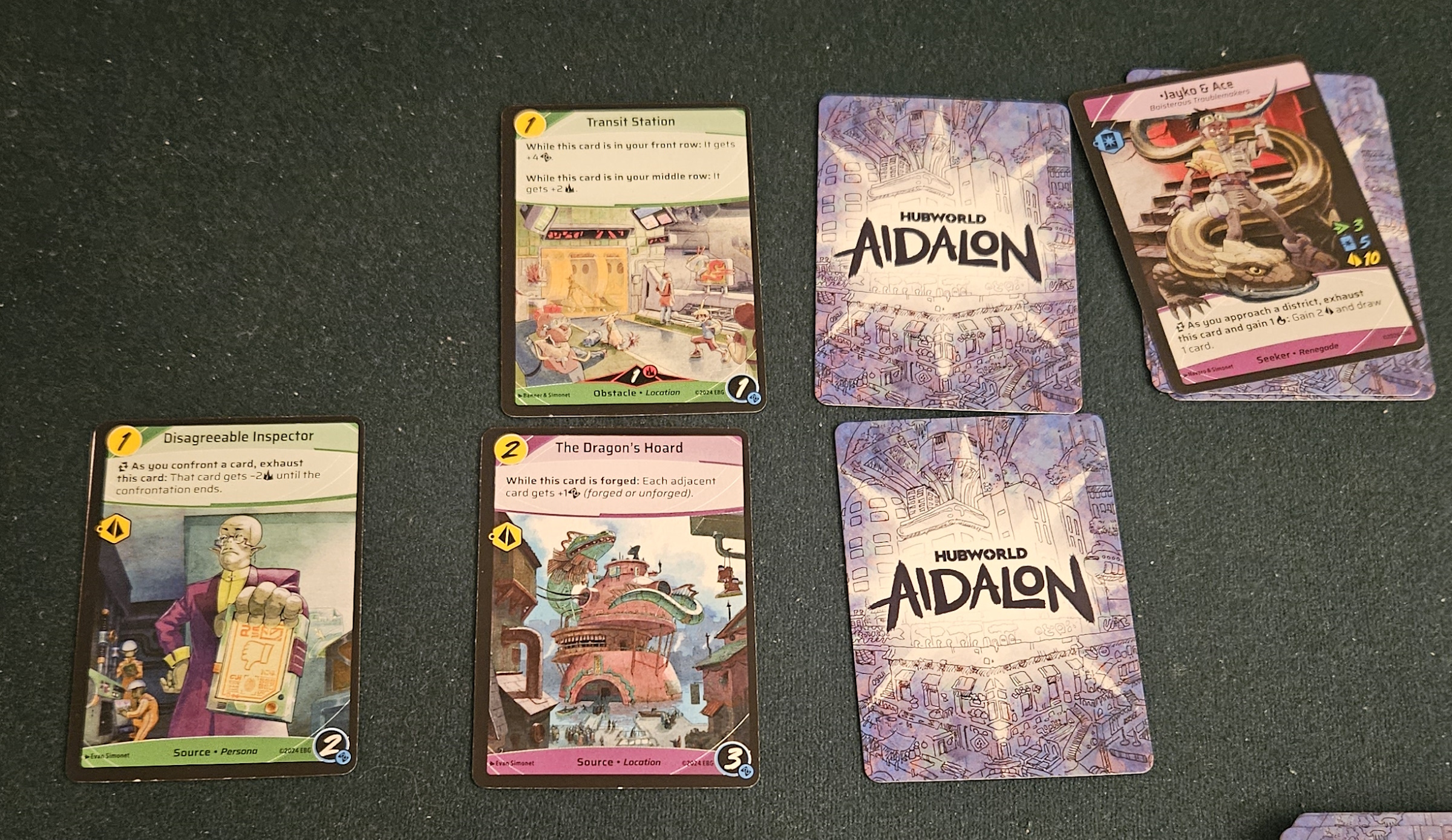
Break my ice, if you can.
But rather than feeling like a limitation, this opens up an entirely new way of thinking about the roles previously staffed by the Corp and Runner. Netrunner generated its tension through asymmetry, the Corp’s agendas slowly ticking their way to completion and the Runner racing to suss out their location and peel away their defenses. Here the risk arises from the fact that you are touchable in the exact same way as your opponent. The cards on the table are both your defenses and means of attack. Depending on what you’ve hidden in front of you, that might mean you’re free to flip everything face-up, exhausting cards for extra resources or employing assets to break past rival defenses. At other times, it’s better to keep everything concealed, waiting like pressure plates to ensnare your foe. Or maybe, just maybe, hiding your most essential cards in plain sight.
Let’s back up and talk about the cards. There are five types in Hubworld, each essential to your deck. One is your “seeker,” your avatar within the game, who sits on the sidelines and provides an ongoing ability. Easy enough. Then there are “moments,” single-effect cards that you pay for, use, and throw away. There are a few sub-types. Some cost actions, others react to specific triggers, but the gist is always the same. These are your deck’s workhorses, offering immediate benefits and then clearing out of your hand.
“Sources” and “obstacles” are more permanent. These are played into your grid, those nine spaces in front of you, and either offer some ongoing ability (sources) or protect their lane (obstacles). In both cases, there’s a big difference between “staging” one of these cards, meaning you play it face-down, and “forging” it, when you pay its cost and flip it face-up. Once played, these stick around in your grid until somebody comes along and wrecks them. This costs shards, like everything else in Hubworld, and offers some long-term considerations about future heists on your opponent’s districts.
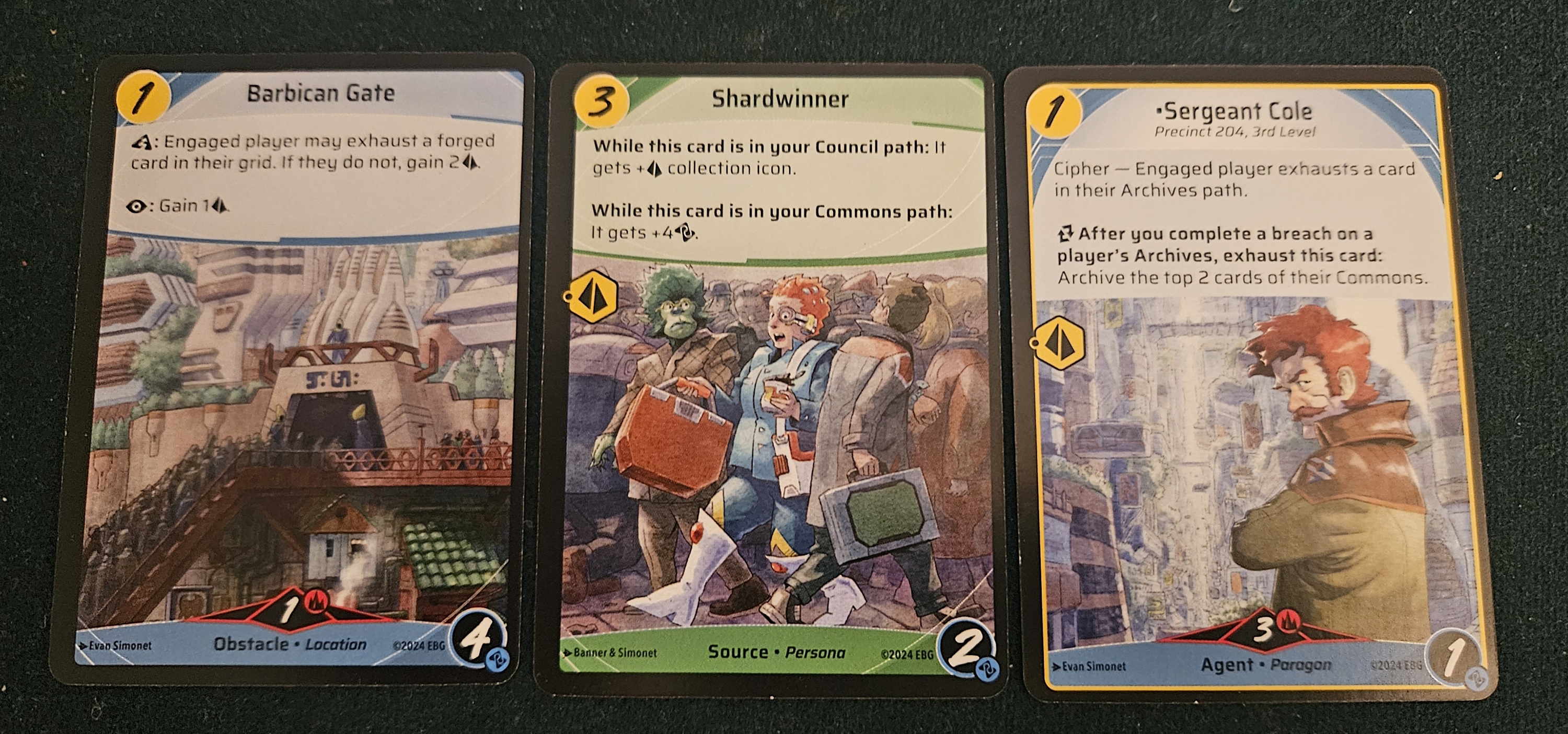
Some of the cards you might encounter while delving.
Here’s an example. Let’s say you’re trying to bust into your opponent’s commons, the game’s fancy word for a draw deck. Along the way, you might stumble across a card they’ve played, the Barbican Gate. The cost to bypass the Barbican Gate isn’t high, only a single shard, but unless you exhaust a card in your own grid it will also award two shards to its owner. Not too bad, all things considered, but fueling your rival’s economy doesn’t sound like a great idea. However, if you pay four more shards, you can destroy the Barbican Gate forever. Now you’re presented with a long-term cost assessment. Do you really want to keep paying that toll, messing with your cards and potentially funding your opponent, or would you rather crash through the Barbican Gate this once and be done with it?
Sources offer a similar quandary. Continuing our example, after the Barbican Gate you see a face-down card. You decide to risk a peek — and this really does pose a risk, since some cards only trigger when uncovered — and find a Shardwinner. This is a basic economic card. Each round, its owner can exhaust it for an extra shard. Better yet, if it’s sitting in the lane protecting their council (jargon for your hand), it will earn an extra shard. Okay, so you don’t want it to survive, since it will keep giving them shards, and it only costs two shards to destroy. Sounds like an obvious choice! Except, oops, you’re currently delving into their commons, and the Shardwinner costs four additional shards to break in that lane. Paying six shards seems rather steep indeed. Maybe it would be better to leave this one alone.
Next up is the card you’ve been angling toward this entire time: Sergeant Cole. Hard-boiled detective. Deadbeat dad. Agent.
Ah yes, agents. This is the last and most important of the game’s card types. Agents are Hubworld’s answer to Netrunner’s agendas, and in some ways they’re the game’s most dynamic and intriguing idea.
Like sources and obstacles, agents can be placed in your grid. But they can also be hidden away, remaining in your deck, hand, or discard pile. Whatever their position, it’s important to keep track of these folks. That’s because these are the game’s primary target. If you capture three of your opponent’s agents, you win. Conversely, if they capture three of yours… you get the idea.
Capturing an agent isn’t easy. Like obstacles, they have a barrier that keeps them safe. Like both obstacles and sources, they cost shards to break. Unlike those cards, however, many agents also have a cipher ability. This is an additional requirement that must be met before they can be captured. Sergeant Cole, for instance, can only be captured if you first exhaust a card in your discard lane. That might sound like a small thing, but that tends to be everyone’s least-populated lane, and it’s pretty common to exhaust cards for resources, leaving you without the necessary access. Happen across Sergeant Cole with all the cash in the world but no cards to exhaust and, well, you won’t be bagging the detective today.
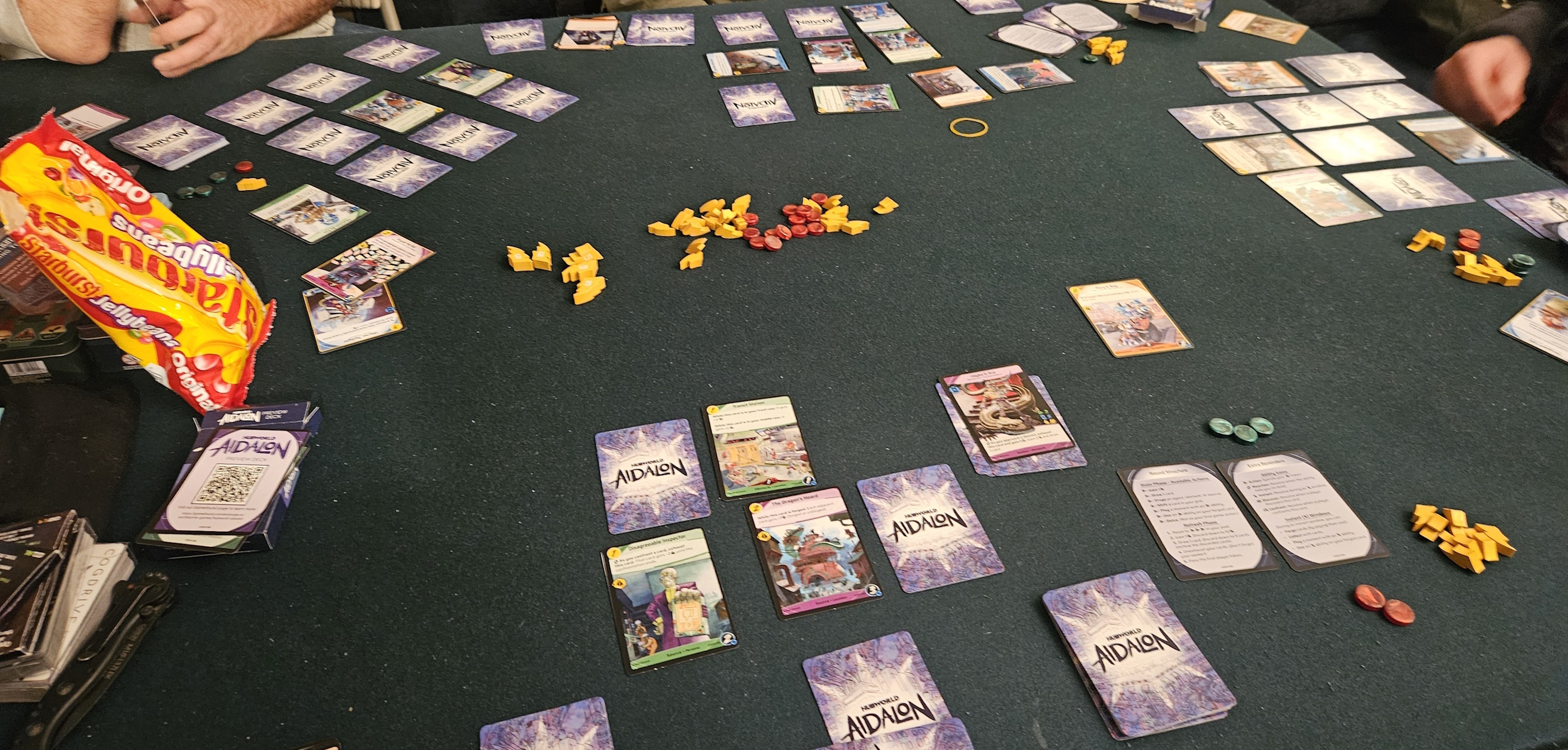
The four-player game is messy but intriguing.
What makes Hubworld: Aidalon so cool is that these concepts and card types and lanes combine into a gordian knot of potential traps, economic hot spots, and high-priority targets. It simultaneously evokes many of Netrunner’s highs while pulling a few new rabbits from its hat.
Take those agents, all of whom are shockingly powerful. Our old friend Sergeant Cole offers a reaction. Whenever you breach your opponent’s discard pile, you’re allowed to peel two cards off of their deck and dump them into their discard pile. In effect, you’re skipping the need to hunt through their deck for rival agents. Keep in mind that most players will tend to defend their discard less enthusiastically than their other two lanes, if for no other reason than because it doesn’t start filled with cards like their draw pile and hand.
But deploying Sergeant Cole, or any agent for that matter, is risky. Because while he’s expensive to capture, revealing his position means your rival has already won the information war. It would be safer to keep him locked away. Except that, too, presents its own issues, potentially gunking up your hand or letting your opponent head toward the obvious destination, your deck. So there are other options. Hiding your agents in your grid, their digits beefed up by a nearby Dragon’s Hoard. Or tucked into some corner, ready to be whisked away by the well-timed reveal of a Waterway Ferry. Crud, you might even hide them on the front row, masquerading as Canal Networks or Eye Enforcers, cards your opponent is liable to skip over rather than anger.
And Hubworld accomplishes these head games with only thirty-six cards per deck. For a proof of concept, that’s real promise. Of course, it remains to be seen what this game’s card pool will look like, whether it will be too limited or too flabby, or whether it might devolve into a solved state the instant the min-maxers get their mitts on it.
For now, though, I’m already salivating at the possibilities. There’s so much potential room in this sandbox. I want to see new traps, more icebreaker analogues like the Disagreeable Inspector, jerk agents with persnickety ciphers. I wouldn’t mind seeing the four-player game given some potential cards, maybe in the form of sources that reward breaking cards rather than leaving them all for your opponents to encounter. The four-player game, by the way, is pretty remarkable. Despite some flaws, the fact that it functions at all is an accomplishment.
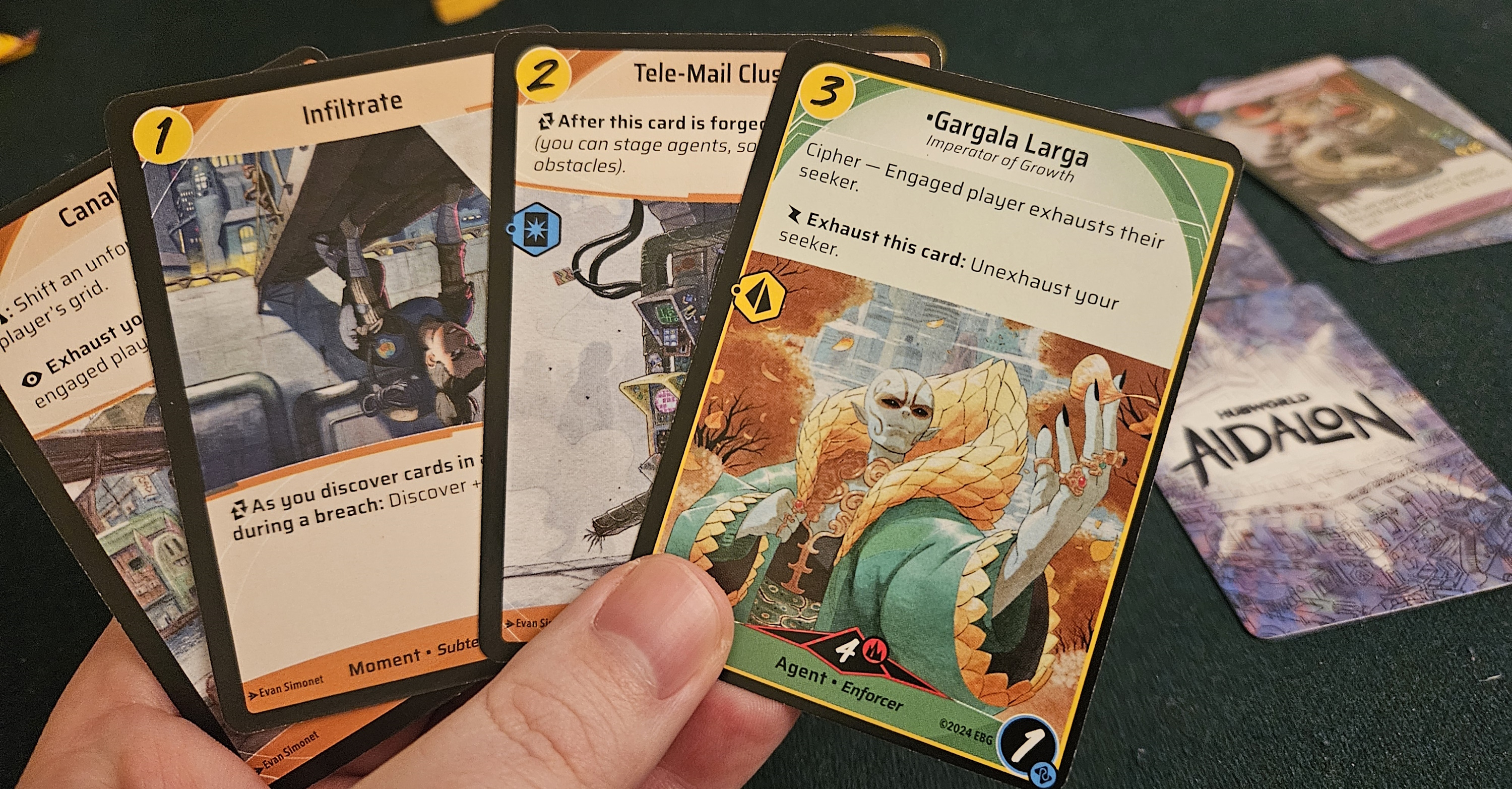
Check out that rizz.
More than anything, I’ve come away from my first few plays of Hubworld: Aidalon persuaded that its homage to Netrunner is merely a launchpad. It may have started its journey as an eidolon, but somewhere along the way it must have taken on its very own shape and form. Even as a pair of mirrored decks, its identity is undeniable. In this early format, it’s already considerable. I’ll be following its progress with great interest.
(If what I’m doing at Space-Biff! is valuable to you in some way, please consider dropping by my Patreon campaign or Ko-fi. Right now, supporters can read big stonking essays on the movies and video games I experienced in 2024.)
I received two copies of Hubworld: Aidalon for free from Earthborne Games, but so can you. (While supplies last, of course.)
Posted on March 24, 2025, in Board Game and tagged Board Games, Earthborne Games, Hubworld: Aidalon. Bookmark the permalink. 10 Comments.

 SPACE-BIFF!
Holy cats! I had no idea this existed. I loved Earthborne Rangers from last year and was a huge fan of Netrunner in its heydey. I’ve already ordered my decks. Thanks for the preview, Dan!
Thanks for reading, and happy running/delving!
Thanks for the heads up. Where are they advertising this? great idea. Cost of entry is a low as you can get. Loved the idea of Netrunner, but this sounds better.
I don’t know about advertising, since they emailed me directly, but you can find the link to their webstore in the second paragraph of the article. Or here, since that seems easier: https://www.teamcovenant.com/games/hubworld-aidalon
Thank you for this! That’s so cool that they’re essentially sending demo copies out into the world at less-than-cost because they’re so confident in the quality of the game. I’ve already ordered mine and I’ll put them in a little box next to my Null Signal System Gateway decks.
Nice! I hope you enjoy it if you give it a whirl.
Awesome that you reviewed this right around the same time that my decks arrived! Unfortunately, I ordered first, then watched the Covenant How to Play video…and I wasn’t necessarily excited by what I saw. It reminded me of several things I don’t like from a few different CCG’s, namely: from MTG, it reminded me of “milling”, where your opponents can discard cards from the top of your deck, which often feels bad, and having an opponent “diving” into your deck in this game at least feels similar. It also reminds me of Yu-Gi-Oh, with the facedown cards and “traps” and such. Bleh. I’ll still try it since I now have the decks, and I’m hoping that changes my mind, but going in it already feels like the game might not be for me. But again, thank you, Dan.
Interesting! Did you not play Netrunner? It replicates both the face-down cards and “milling” from that game pretty closely, so I guess I didn’t even consider any other parallels.
Could be interesting. Might order a deck set.
Android Netrunner has a “game” outside of play. At least I and my friends became quite engaged in finding and testing synergies. Hence play was probably only 1/3 of the experience.
Anyway thanks for some good info!
There currently isn’t anything to do outside an actual session, for obvious reasons. Like I said, it’s promising, but we’ll have to see what develops.