Cul-de-Sac Caper
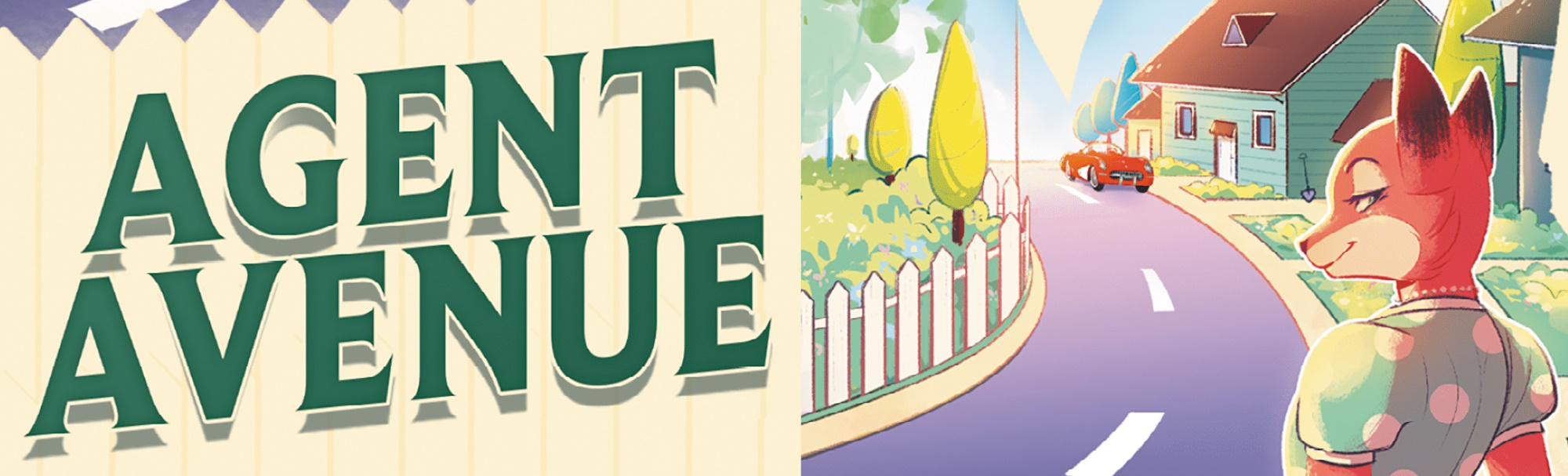
It’s incredible how the smallest change — like, say, player count — can transform a game from a perfectly fine experience into a cerebral tango. That’s a dance with brains, m’dear.
Agent Avenue, designed by Christian and Laura Kudahl, is one such title. Two secret agents have gone undercover in the same suburban neighborhood. Now they’re recruiting their neighbors in a race to out their rival before they get similarly de-closeted.

Gotta learn to get along with your neighbors.
Before we go any further down this rabbit hole, a word of warning. Agent Avenue, especially at first glance, is so slight that surely it must have hollow bones. A full session might last two minutes or twenty, depending on how fumblingly you handle your cards. Each turn proceeds according to rather simple logic. From my hand, I select two cards. One of these I place face-up in front of me. The other I place face-down. The only major rule is that these cannot be copies of the same card.
You’ve likely guessed what happens next. That’s right, you pick which card you’ll take for yourself and which you’ll leave for me. It’s classic I-cut-you-choose, aka the pie rule, aka a game so old that our shrewder cave-dwelling ancestors were probably using it to “fairly” apportion mammoth bits.
As you might expect, much of Agent Avenue depends on the cards themselves, and apart from one or two reservations everything here is top-notch. The gist is that you move along a circular track according to the card you just picked up. Your goal, generally speaking, is to catch up to your rival before they catch you. But cards don’t provide single effects. Depending on which copy of the card you just collected, how far you move may vary, and even whether you move forward or backward. Nabbing your first Double Agent moves you backward one space. Your second Double Agent sprints you forward six spaces. From that point onward, however, every extra Double Agent moves you backward again.
It’s a smart concept, and Kudahl and Kudahl pack plenty of drama into something as simple as a two-card selection. If I reveal a Saboteur, a card that only moves us backward, you’ve got to ask yourself what my hidden card could be. Is it a Daredevil, who moves you forward the first two times you collect it, but then loses you the game outright if you complete the trifecta? Could it be the Mole, one of only two cards with a single copy in the deck, which burps you backward three spaces?
Or maybe I’m just bluffing and there’s something really potent under there. Like a sturdy Enforcer, always creeping you forward a few steps. Or a Sentinel, truly powerful once you’ve collected a full set. Or a Codebreaker, putting me one step closer to winning instantly.

Leading each other on a merry chase.
The funny thing about Agent Avenue is that you could play it right now. No, really, I’ve already told you about pretty much every card. Apart from those two singles, there are six copies of each neighbor. A few times per game, you can ditch something from your hand to draw a replacement. There. You know the rules.
At this point, you might be wondering where the protein of this particular dish is to be found. And sure, played with only its basic deck, Agent Avenue isn’t bad. It’s good, even. But there are two additions that really bring it into its own.
The first is the black market deck. This is a selection of power-ups that can be earned whenever your pawn lands on the rounded corners of this cul-de-sac. Some offer immediate powers, like instantly recruiting a Sentinel from your hand, the somewhat riskier option of recruiting the top card of the deck, or mind-controlling a neighbor out of your rival’s tableau and into your hand. (With fresh-baked pie! Because this is a pie-rule game! Are we full of theme yet?) Others confer ongoing benefits, like flipping those awful Saboteurs into opportunities to move forward instead of backward or a sinister twin that doubles the impact of every Double Agent. Some even add new ways to win the game.
Black market cards add a crucial layer to each selection. Now you’re not only trying to rush along the track. You’re trying to rush while landing on particular spaces. While also endeavoring to prevent your rival from landing on them. While also also maybe moving backward on purpose. Not often, mind you. But sometimes.
Of course, these considerations shouldn’t be taken lightly. More than once, I’ve seen somebody lose because they focused too much on their footing and not enough on the destination. That somebody was never me. I promise.

That fox is trying to seduce me.
That’s the first addition, and it goes a long way toward making Agent Avenue feel complete. The second is that it truly shines as a partner game.
In its usual two-player incarnation, Agent Avenue is clever enough. As I’ve noted, I certainly wouldn’t consider it a bad game. But with four minds seated around the table, it’s sublime. Now you have a partner. A partner with whom you must subliminally communicate your intentions. On your turn, one of you places a card face-up. The other adds a card face-down. The other team then gets to discuss, deliberate, and ultimately select which card they want, all the while communicating nothing about what they’re holding in their hands.
Let me tell you, working against a rival is one thing, but working against a rival while trying to hammer out a cohesive strategy with a partner? That’s real secret-agent shit. Now instead of playing cat-and-mouse, you’re playing cat-and-mouse-and-cat-and-mouse, and hopefully you’re the cats. Except sometimes it pays to make that show of reluctance. When your partner hesitates over a selection, when they grimace at the card you’ve just revealed, that becomes part of the game’s texture as well. Have they just inadvertently signaled something? Or is that their way of needling your rivals into nabbing the wrong card?
Either way, now you’re but one half of a team. Like an average denizen of the suburbs, come to think of it, stranded on that island of gravel and lawn and doing your best to get more out of the neighborhood potluck than you put in. Like Mr. & Mrs. Smith. The superb Francesca Sloane and Donald Glover series, not the bad Brangelina movie. And as a team, you sink or swim depending on how well you can mesh your intentions with execution, how tightly you can wend together a workable approach under pressure. Like I said, it’s sublime.

With black market cards and four players, Agent Avenue is something special.
If I gave ratings, Agent Avenue is one of those games that would deserve two separate digits. But let’s not get hung up on particulars. While I like this one perfectly fine in any incarnation, as a partner game there isn’t anything quite like it.
(If what I’m doing at Space-Biff! is valuable to you in some way, please consider dropping by my Patreon campaign or Ko-fi. Right now, supporters can read big stonking essays on the movies and video games I experienced in 2024.)
A complimentary copy of Agent Avenue was provided by the publisher.
Posted on March 20, 2025, in Board Game and tagged Agent Avenue, Board Games, Nerdlab Games. Bookmark the permalink. 1 Comment.

 SPACE-BIFF!
Pingback: No More Mr. Mice Guy | SPACE-BIFF!