Kinfire. That One.

Here’s a funny thing: playing Kinfire Delve, the three small boxes spun off of Kevin Wilson’s much grander Kinfire Chronicles: Night’s Fall, I figured they must be runty versions of the larger thing. Those side quests feature the same cast of heroes as Chronicles, albeit parceled out two per box, with a card system that sees them either using cards for their principal effects or to boost their fellow heroes. Surely, I assumed, the massive slab that was Kinfire Chronicles would be deeper, smarter, more compelling?
If anything, it’s the other way around. I’ve been playing Kinfire Chronicles: Night’s Fall for some months now, picking through its storybook, slaying its monsters, and scouring the lighthouse-protected city of Din’Lux for its coziest inn. And I have to say — I prefer the little ones. By a lot.
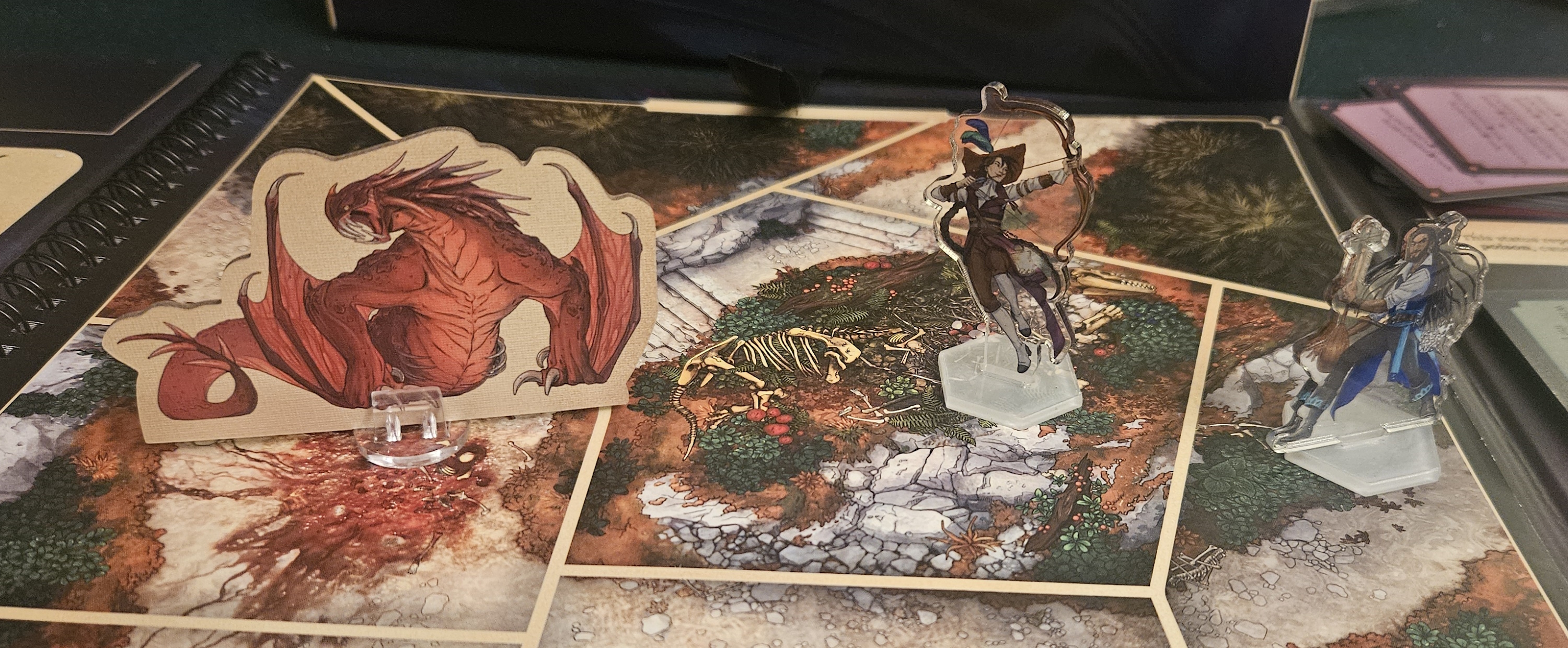
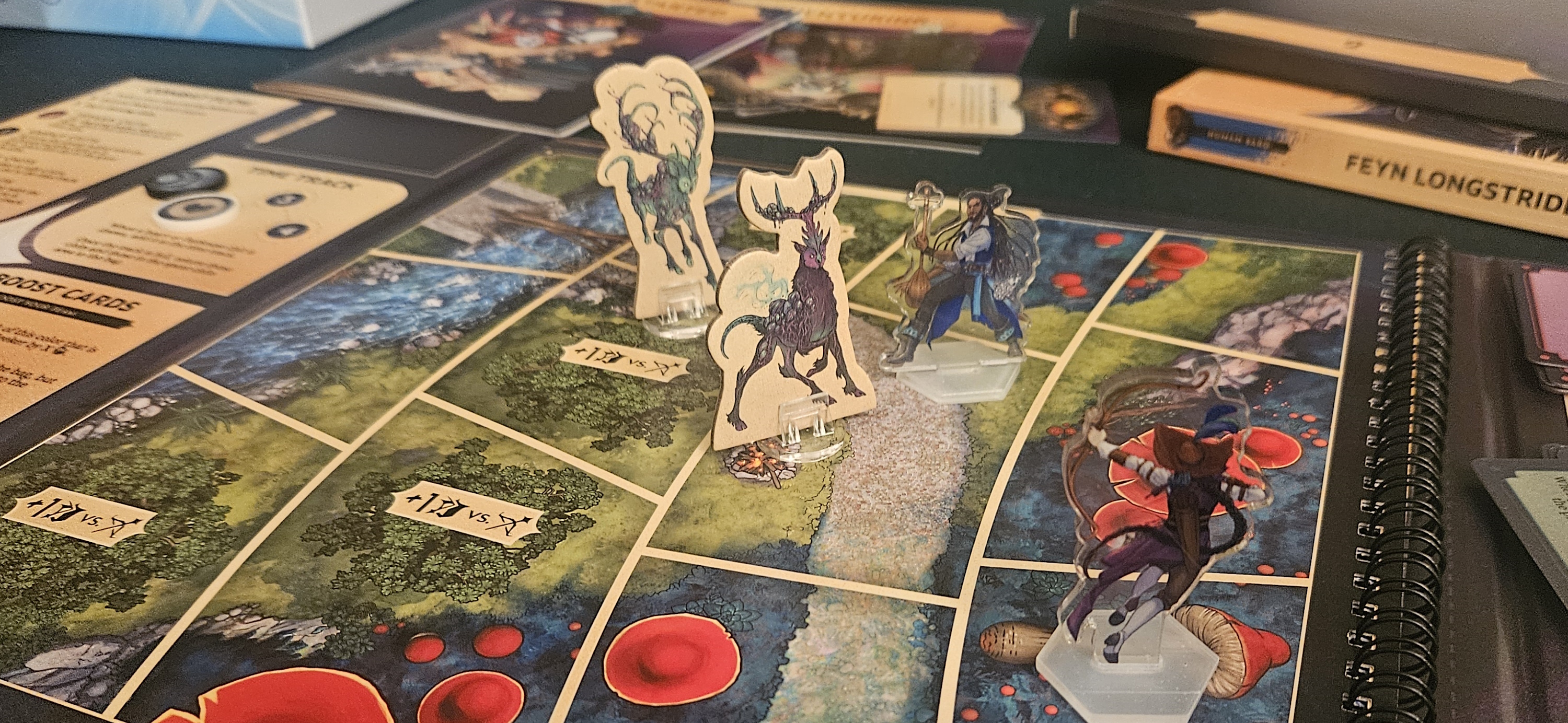
Kinfire Chronicles goes hard with its monsters.
I read somewhere that it says something palliative about a society when its people grow obsessed with the apocalypse. I don’t know about all that, but there’s a grim beauty to the end of this particular world. At some point, the “starless nights” fell across the land, plunging these fantasy nations into a blackness that left them twisted up inside and out. The only remaining refuge is Din’Lux, kept alight by a magical lighthouse and the kinfire that burns within. Our heroes carry lanterns sparked with that same fire, braving the tortured landscape as they… well, that would spoil things.
As fantasy apocalypses go, it’s bleak and hopeful in equal measure, and lets Wilson’s team run amok. This is a boss battler. Rather than delving dungeons one hallway at a time, quests open with some light choose-your-own-paragraph decision-making, the consequences of which might inflict some early injuries or fill your deck with a few fatigue cards, before cutting to a throwdown with some cankered beast. Some of these opponents lean into the twilight madness of the world, familiar from a thousand RPGs but a little nastier, a little uglier.
You know. Some of them. When Kinfire Chronicles takes cues from the likes of Annihilation and Stalker — the alienness of our very own world, fungal and floral and bursting with variety — that’s its element. Slaying a creature that’s gone a bit wrong is exciting. Then, buzzing from that encounter, you might crack open the next box to discover a trio of bandits, all mundane and ordinary, like turning some unfortunate corner from Morrowind to Skyrim.
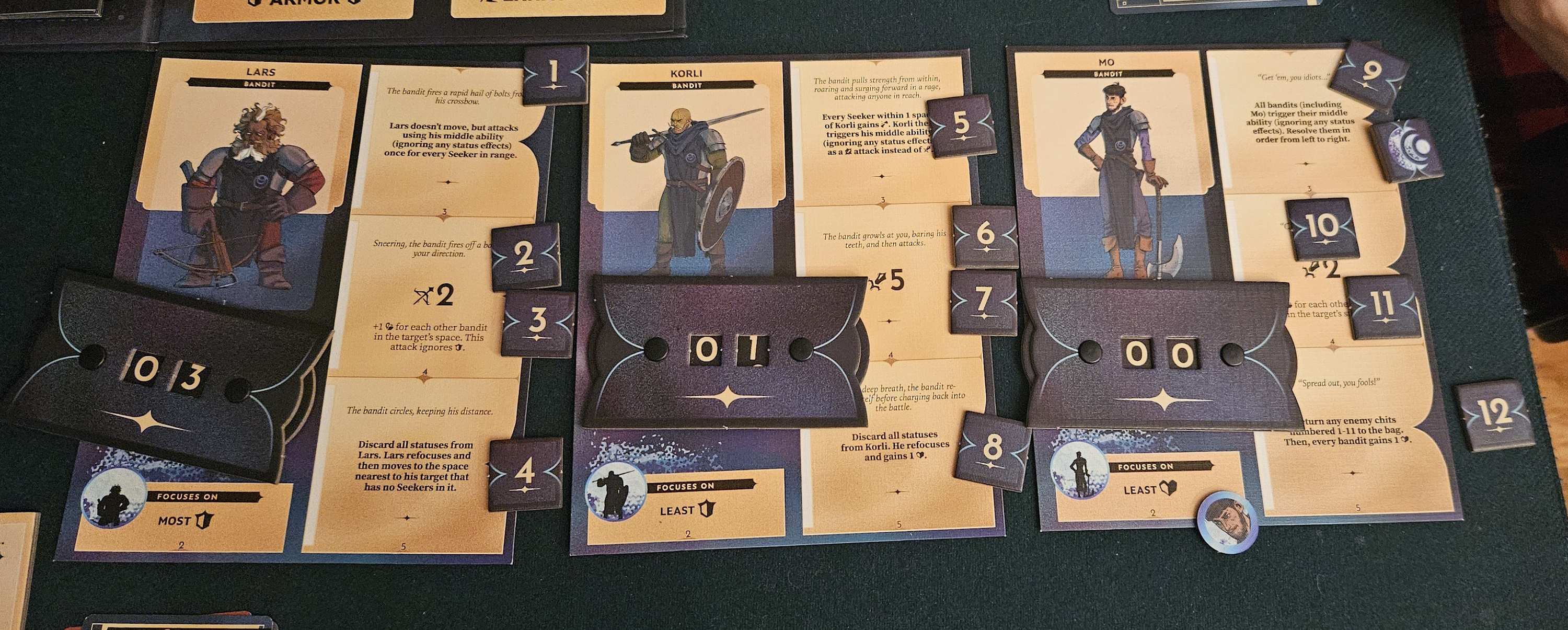
Enemy activation is smooth.
It’s a strange departure, too, from the world presented in Kinfire Delve, where one could hardly flip a card without being confronted by something strange and unsettling. Some of the difference comes down to format; each of those games took us on a tour of a location, full of rooms and traps and baddies, while the glimpses in Chronicles are limited mostly to descriptions and those bosses. Fair enough. But while the vacillating tone is the first indication that our footing might be slippery, it’s hardly the last.
Combat, for the most part, is serviceable. Each fight uses a bag full of chits, half of them representing the members of your team and the other half standing in for your foes. You draw a chit and, depending on its symbol, either take a turn or resolve a rival action.
In terms of encounter design, this affords quite a bit of flexibility. Your team can spend a certain resource to re-attempt a poor draw, whether to avoid a deathblow or finish off an opponent, and there’s a nice variety to everybody’s range of actions. While no monster’s vocabulary extends much past “stab hero” and “stab hero but also make them limp,” Wilson mines the concept for quite a few variations. For the most part, this breathes life into each encounter. One boss does not feel too similar to the next. Sure, the parity between hero and enemy chits delivers a certain flatness. There’s never a moment, for instance, where a crowd of enemies threatens to overwhelm your heroes through sheer numerical advantage, since both a lonesome drake and a crowd of assassins has the same number of initiative chits, but, well, let’s not nitpick this thing to death.
The damp squib in the game’s arquebus is the card system. Similar to the action in Kinfire Delve, your heroes veer between taking their own actions and boosting those of their compatriots. Unlike the cards in Delve, however, these are not dual-use. Instead, every card either shows an action or a boost, with hands cycling if you find yourself holding nothing but the latter. At best, you’re given a range of actions and must select the best option given the situation. Will your attack hit every enemy in a space? Move a friend out of danger? Draw too much aggro when you can’t afford it?
More often, though, these actions are so straightforward that they become obvious. For example, there’s almost never a reason to not play a damage boost. The deck’s suit-matching limitations are stringent enough that waiting for a future attack is testy, enemies are generally chunky in the hit-point department, and there’s no better way to stop a monster from biting you than biting it even harder before it gets the chance. More often than not, the combat in Kinfire Chronicles feels less like I’m making hard-considered decisions, and more like I’m running through a flowchart.
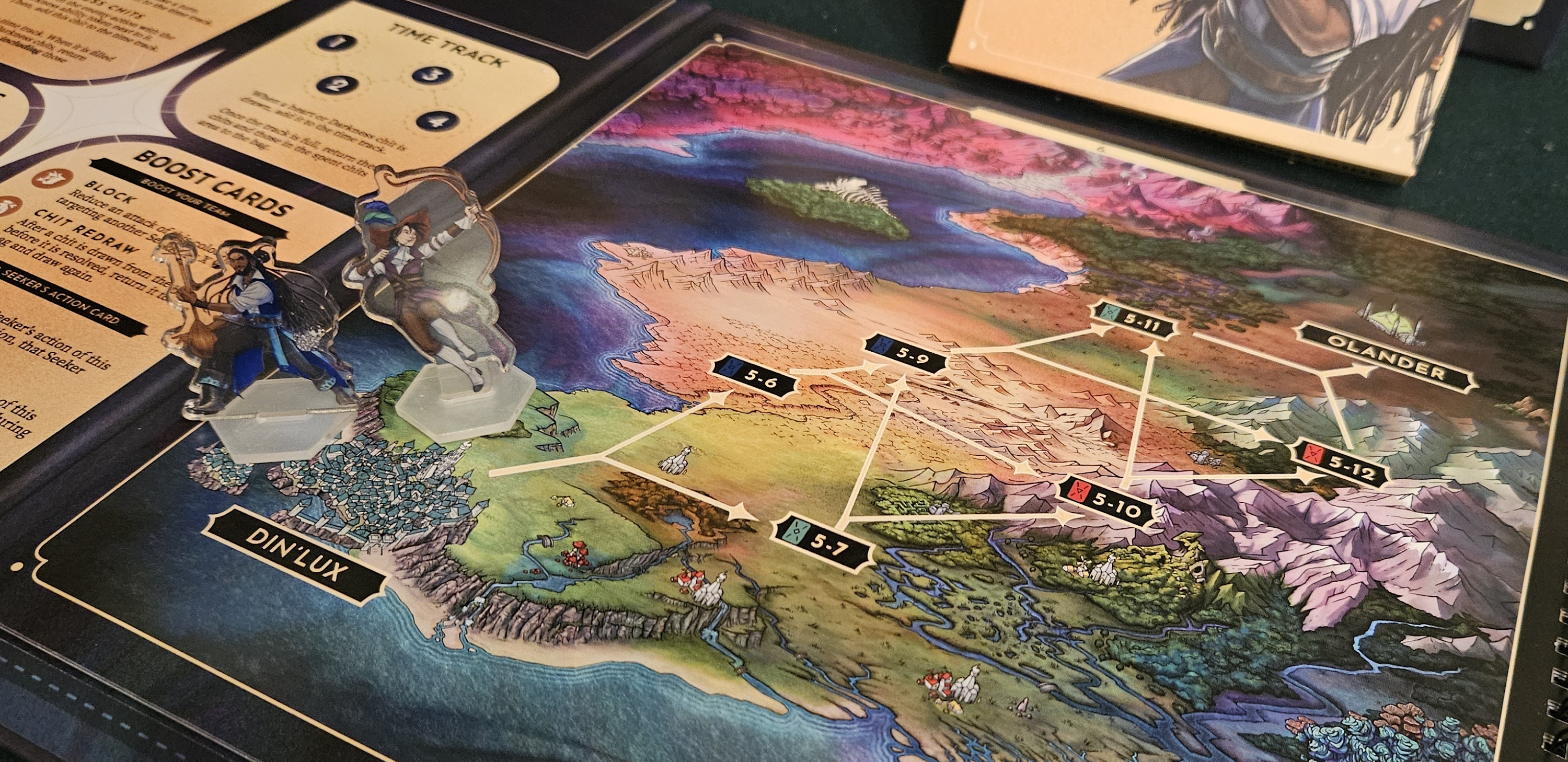
On occasion, you’re given opportunities to forge your own path.
Look, I know this review is coming up negative, so let me list some nice things about Kinfire Chronicles.
The packaging. No, seriously, the packaging is tremendous. Upon opening the box, you’re presented with neatly ordered rows of cartons. There’s a big one for the health trackers, storybook, and atlas, another for the card collection, smaller ones for each hero, and a tidy collection of scenario boxes. It erases the chore of setup almost completely, and is so infinitely superior to the barfed-up mess that is Gloomhaven’s prep work that it’s hard to imagine going back to assembling my own dungeon maps.
The story. Okay, I’m not going to oversell it. Wilson won’t be winning any awards for best original screenplay. But the presentation is top-notch. Scenarios open with some basic exposition and let you make a few choices as your heroes pursue some villain. At its best, you’re given the opportunity to travel along an overland map or maybe creep down some corridors. It’s all very Young Adult, but my eleven-year-old liked it well enough that she penned her own choose-your-own-adventure book in imitation, so that’s a critical success.
The heroes. Each of the six included heroes is distinct from the others, both in appearance and handling. They receive little story beats at regular intervals, and can have small but significant input on various decisions and tests within the scenarios.
The deck construction. I think this is where Wilson intended the cards to have their greatest effect. Instead of leveraging dual-use cards like in Kinfire Delve, here you’re asked to construct a dedicated suite of abilities and items. The game includes booster packs that offer “random” rewards, gradually adding better or more varied options to the card pool, while items or training can be purchased at city vendors to round out any gaps. Rather than being offered on their own, every card comes as a pair, one action and one boost. This is where you make actual decisions about your hand, in preparation for combat instead of within combat itself, and while I would have preferred the balance to be tilted toward the actual fighty bits, it’s nice that the deck construction is given so much attention.
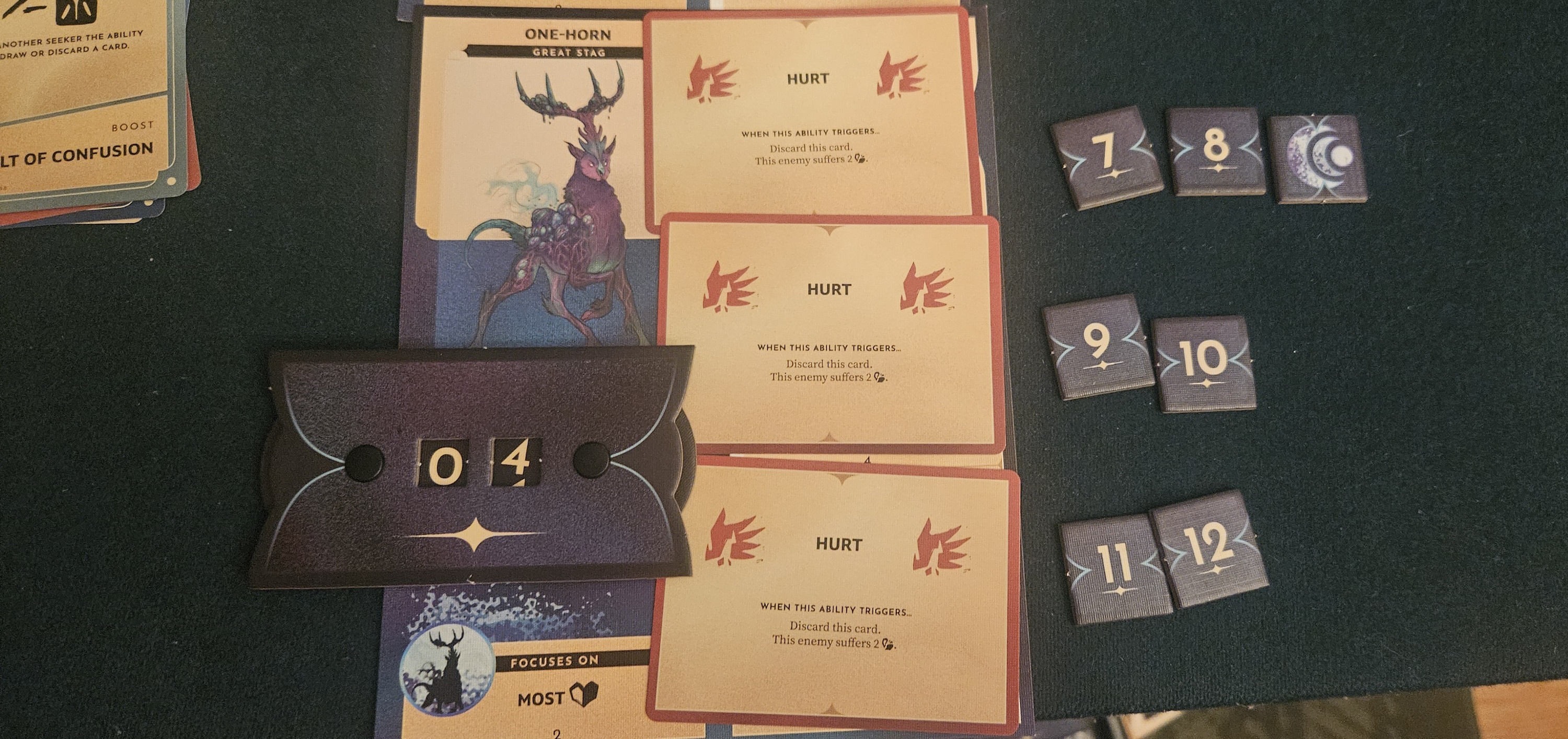
Ouchies!
Taken holistically, these points in Kinfire Chronicles’ favor are hardly inconsiderable. This is a lavish and lovingly crafted world, full of color and nooks that demand to be explored. At certain points it’s even generous, holding back some of its finest scenarios for side quests your band might never encounter.
Despite all that, it misses too many beats. Take, for example, the city. Din’Lux is the last sane refuge for a dozen species. It’s a sprawling place, multi-tiered, with locales and shops that are each given their own detailed description via in-game guidebooks. In between missions, you’re allotted a few “city actions” and set loose to explore, to shop, to poke around the alleyways and tourist hotspots. Who’s visiting these places when the whole world has turned batty? Who cares! The city is your oyster.
Except many of these destinations simply don’t matter. You’ll uncover new upgrades, sure. Every so often you’ll stumble across a side quest or someone worth talking to. More often, you’ll receive a little description. Some local color. A snippet. But these are short and unimportant. Even my eleven-year-old eventually reached the point where she would ask, “Is there anything real at location thirty-four?” We didn’t want another description. We wanted to see ourselves imprinted on the world.
There are moments when such an imprinting occurs. By the end of the story, Din’Lux comes to matter in a wholly tangible way. The conclusion is good enough that I’m glad we held out rather than giving up halfway through. By then, though, it’s too late. Din’Lux deserved to be a character that did more than wait in the wings for its cameo.
Because here’s the bottom line: there were moments, fights, scenarios in Kinfire Chronicles: Night’s Fall that delighted us, that made us gasp in surprise, that offered some perilous or humorous situation that will stick in our memory. But those moments were few and far between. More often, we found the game too easy, our excitement too readily tempered, our attention too easily sidetracked. My kiddo called it “tedious” at one point, right before asking if she’d gotten the meaning of “tedious” right. This marks Kinfire Chronicles as the first board game to make her, well, bored. Not always. Not often. But some of the time. Enough that she asked if we could fast-forward to the end of one fight that was clearly swinging in our favor.
Playing a sick lute solo.
Kinfire Chronicles: Night’s Fall, in the end, is many things. A boss battler. A deck construction game. A fantasy universe teetering on the brink of ruin. As if there’s any other kind.
Perhaps, above all, it’s an ambitious project that doesn’t quite realize those ambitions. There is so much here here. But none of its corners feels entirely sharpened. The next time I visit Din’Lux, I think I’ll mark it down for a vacation rather than an extended stay.
(If what I’m doing at Space-Biff! is valuable to you in some way, please consider dropping by my Patreon campaign or Ko-fi. Right now, supporters can read big stonking essays on the movies and video games I experienced in 2024.)
A complimentary copy of Kinfire Chronicles: Night’s Fall was provided by the publisher.
Posted on March 11, 2025, in Board Game and tagged Board Games, Incredible Dream Studios, Kinfire Chronicles: Night's Fall. Bookmark the permalink. 5 Comments.

 SPACE-BIFF!
Lovely as always Dan, thank you.
I happened to re-read your Policies page today, and was meditating on the consequences of accepting review copies of games from publishers.
This review is a good example of why it works for you: you are a comsummate professional, and I trust that you will give your true experience to us rather than spit-polish it up a bit out of fear that the publisher wont send you their next game. I imagine this could lead to awkward interactions at conventions etc, but you know that and that is a price that you AND THEY are willing to pay for what you do so well. Thank you!
I’m sure that if a publisher sent me a lavishly-produced and expensive game, I would feel compelled at least not to savage them if indeed I had not had a good time with their game (not that you savaged them here, just saying). But you have established yourself in this industry. If a publisher doesn’t send you a game, I, your audience, will wonder why, and what they were afraid of.
Strong work.
Thanks for the kind words, Jason!
Pingback: Wet Behind the Gills | SPACE-BIFF!
Pingback: Skyblivionrockmarsh | SPACE-BIFF!
Pingback: Kinfire Homeowners Association | SPACE-BIFF!