Climbing Three Ladders

Is ladder-climbing and deck-shedding the next phase of our hobby’s obsession with trick-taking? It may well be. I’ve covered plenty of trick-takers from New Mill Industries over the past year or so. Now the small-box publisher has released a trio of shedder-climbers. Let’s take a look at each in turn, shall we?

I RELISH the opportunity to KETCHUP on my reading.
Greasy Spoon
I think Sean Ross’s Greasy Spoon might have been one of the first ladder-climbers I ever tried, introduced to me by Shreesh Bhat (the designer of Aurum) a couple years back via one of those browser-based platforms. Like all of the titles in this batch of releases, it’s a two-player climber only, and tasks players with emptying their hand — and in this case, their private deck as well — by putting together special orders at a diner.
As an introduction to the concept, there aren’t many better than Greasy Spoon. Ladder-climbers tend to focus on “melds,” combinations of cards such as singles, matches, or runs. And, look, it took me long enough to get a handle on the specialized terminology of trick-takers, so even Ross’s minor swap in terminology from “meld” to “combos” and “plates” was enough to nudge my understanding over the ledge.
The gist is simple. The lead player reveals a menu item. That could be a single drink (one card), a side (two cards), or an entree (three cards). If you’re ambitious, maybe a combo (an entree plus either a drink or a side). The following player then attempts to improve upon that menu item. Back and forth it goes, players throwing away cards, until one or the other decks out and wins.
Crucially, though, you’re forced to stay within the same category when following. Unlike many other ladder-climbers, where you might improve the meld — say, from a pair to a run of three — here you can only bump up the complexity so much. A drink becomes a higher-value drink. A side of fries becomes a side of fancy rings. A hot dog becomes a cheeseburger. This puts a lid on the game’s increasing bids, which goes a long way toward keeping the proceedings comprehensible for newcomers.

This… is not very handy.
In other words, Greasy Spoon was exactly the right game for Shreesh to break me into the genre.
Beyond that, I’m not so sure. The whole thing tends to rubber-band. Not because of any artificial constraint, but owing more to the format altogether. This is a common quirk of card-shedders, where playing early combos can make it rather difficult to dump anything once your hand has been whittled down. I call it a “quirk” and not a “problem” or an “abomination” because genre veterans don’t see this as any more of a problem than card-counting in a trick-taker.
To his game’s credit, Ross provides a few avenues to avoid getting stuck. With such a slight range of cards — only three suits, ranks that only go up to six — it’s fairly easy to build combos. Also, you can “backburner” cards that aren’t working for you, shuffling them back into your deck for later use. As a result, the game feels great to handle, and keeps the cards moving at a rapid pace.
On the whole, it’s a good option for first-timers, but I’ve found myself moving on from it in short order. It doesn’t help that the New Mill production doesn’t provide references for the menu. When teaching, I had to prop open the rulebook for my partner. This isn’t a long-term problem; as noted previously, it’s a rather straightforward affair, and it doesn’t take long to internalize the various melds. Still, it would have been nice for this intro-worthy climber to include a couple of menu cards to help onboard new players. A decent start to the trio. [EDIT: I had an early print of Greasy Spoon; the finished print will have the menu on the back of the rulebook as well. Nice!]

Hickory dickory!
Dickory
Another Sean Ross title, this time with Hanibal Sonderegger, Dickory takes a single idea to its furthest extreme. Unlike Greasy Spoon, here players are confined to a single, and rather compact, deck of 48 cards. There is only one suit, with ranks from one to twelve, four copies apiece. Your objective is to shed your hand, and only your hand. How hard could it be to get rid of eleven measly cards?
Reasonably hard, it turns out.
The big wrinkle is that the cards “loop” according to the whims of a queue. When the game begins, six cards are dealt in a line. The rightmost card dictates the highest rank, complete with a little mouse token that can be placed on the box to keep both players straight. For example, if the rightmost card shows a four, then four is the high card, with decreasing ranks of three, two, one, twelve, eleven, and so on. So much for lucking into a draw of high numbers.
Even trickier, this queue can be manipulated. As the following player, you can draw cards from the queue into your hand. This is both a problem and a boon, bulking out your hand but potentially producing stronger melds. Meanwhile, the high rank alters with each claimed card. You can only draw from right to left, which means the high rank is always changing. By playing tactically, the right claims can transform a stinker hand into a batch of unbeatable high cards. Until your opponent starts fiddling with the queue themselves, naturally.

Changing the rankings…
Gosh, this one is brain-burny. As much as I love the mouse, I’m not actually sure putting the token on the box aids the game’s legibility. At any given time, you’re hunting for melds, assessing the queue for cards that will allow for even better melds, trying to claim cards that will improve your hand without padding its size too much, and keeping a fourth eye on your opponent as well. There’s a reason Ross and Sonderegger provide three varying degrees of complexity in the rulebook. This one needs that gentle on-ramp.
That said, I adore how bite-sized it is. It’s a ten-minute climber-shedder, perfect for best-of-three matches, and it lives up to its name. No, not the nursery rhyme — rather, that the title is a play on dickery. For all its compactness, moves can cause real consternation. With experience, it’s possible to throw your opponent’s efforts into disarray with even minor adjustments to the queue.
At the same time, changing the value of the high card allows for a surprisingly high degree of player agency, easing the luck of the draw. It isn’t erased altogether, but the edges are fuzzed somewhat. The result is a brilliant little game, emphasis on “little,” that’s simultaneously tricky to read but sharp in execution.
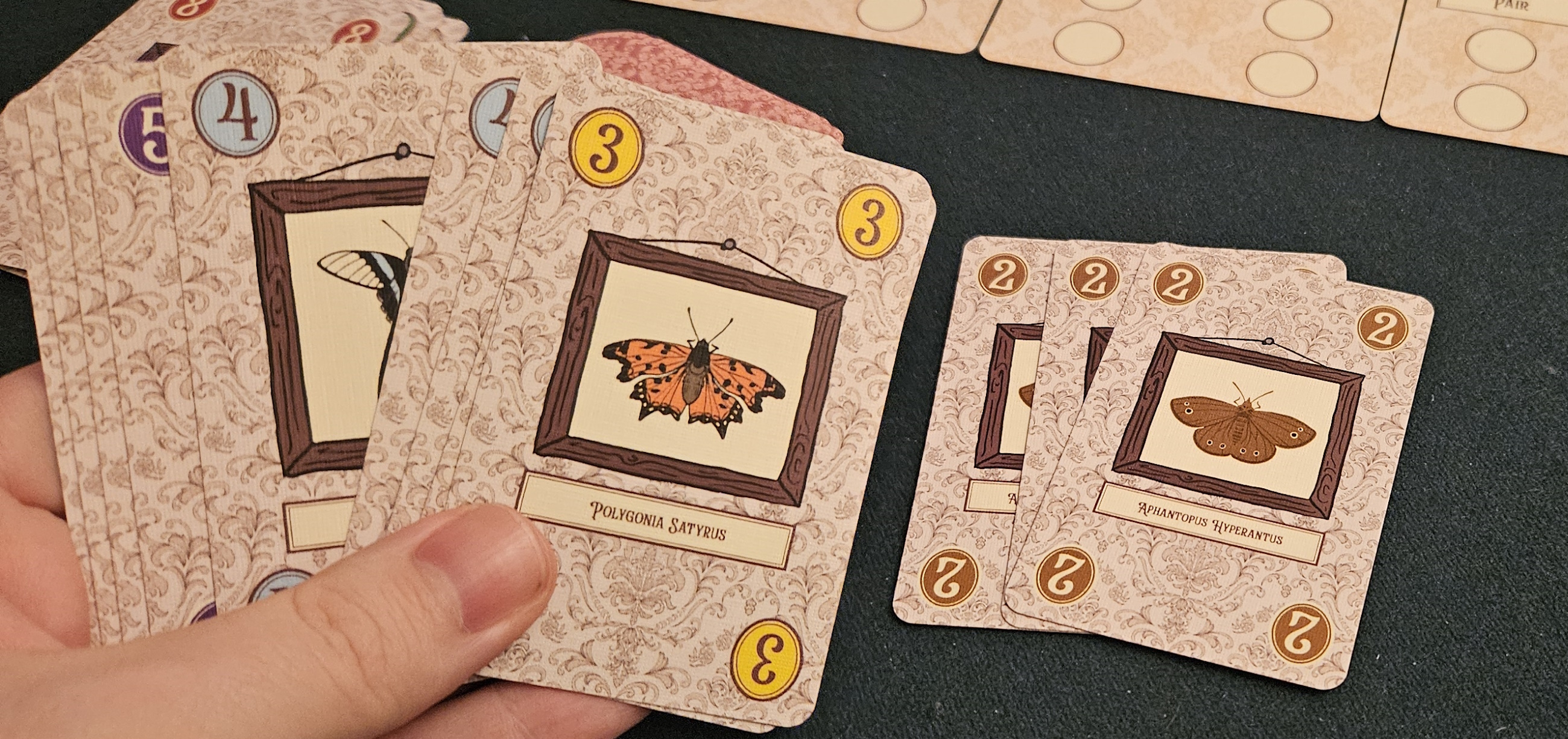
GAH
Lepidoptery
Deep breath. Confession: I am terrified of butterflies. Okay, mostly moths. But we took the kids to the nearby butterfly sanctuary and, friends, they are close enough that I was sweating.
But here’s the thing. Even though the images of all those dusty-winged sky-bugs sends prickles down my legs, this climber-shedder, designed by Srinivas Vasudevan and David Karesh (not that one) is easily my favorite of the trio.
It probably has something to do with my appreciation for hybrid games. Lepidoptery is a ladder-climber, but it’s also a riff on Connect Four. Yes, you’re doing the usual thing, putting together melds that will hopefully cause your opponent to fumble their response. Like the previous entries in this trio, it’s entirely possible to win by flaying your deck down to the bone.
At the same time, the quality of your meld also determines where you get to place a token on a “board” — really a combination of twelve cards — in hopes of making a line of four. Up, down, left, right, diagonal, it’s all legal, and can conclude the session in your favor long before your deck runs dry.

Focus on the tokens, focus on the tokens…
Along the way, Vasudevan and Karesh add a few small tweaks to prevent Lepidoptery from becoming too rote. As I noted, your meld determines which column you place a token in. That token is subject to “gravity,” dropping to the bottom-most open space. At the same time, a marker runs along the bottom of the board, preventing you from making the exact same meld twice in a row. If you produce a low pair and your opponent replies with a slightly higher pair, you’re barred from responding with an even higher pair, thank you very much.
Meanwhile, your hand only replenishes when you fail to respond to a meld. This also resets your marker, letting you follow up with anything on your next turn. Passing, then, provides an advantage of its own, one that must be selected carefully lest you yield too much board control to your opponent.
Aside from the shudder-worthy images on the cards, Lepidoptery is a masterclass in tempo. Unlike some connect-four varietals, here it’s possible for someone, thanks to a run of strong melds, to get multiple placements in a row. This naturally produces an uncommon texture to the contest on the board, encouraging players to deploy melds according to the outside logic rather than only what’s in their hand.
To be clear, this is more of an abstract game with climber-shedder elements than the other way around, and purists may well begrudge the emphasis on placing tokens rather than assessing the hand in its usual vacuum. For me, though, this is exactly the sort of thing I’m on the lookout for, a clever blend of game systems that adds to more than the sum of its parts. I barely even mind those horrid bugs.
(If what I’m doing at Space-Biff! is valuable to you in some way, please consider dropping by my Patreon campaign or Ko-fi. Right now, supporters can read big stonking essays on the movies and video games I experienced in 2024.)
A complimentary copy of Greasy Spoon, Dickory, and Lepidoptery was provided by the publisher.
Posted on February 27, 2025, in Board Game and tagged Dickory, Greasy Spoon, Lepidoptery, New Mill Industries. Bookmark the permalink. 7 Comments.

 SPACE-BIFF!
My first name only has one n, thanks to the nuns in the tiny town that I was born who insisted on spelling my name incorrectly for me, but correctly for them, regionally.
Also, fun fact for you, my original design for game inspired by the Julian cipher.
Hanibal, thank you for the correction! I entered your name correctly on the second attempt, but my darn front page must not have accepted the update in a timely manner. My apologies!
No apology needed, autocorrect is simply doing its job. It is I who have the off-putting and hyper-regional spelling.
Hey, I would love to have a cool name like “Hanibal!”
Congrats on the release. Dickory sure is a nasty little thing.
Okay, I cracked up at the David Koresh joke.
Just bought Lepidoptery to support Daniel, based on this review. Thanks, Dan!
Nice! I hope you love it!