Eternal Sunshine of the Trick-Taking Mind

Once, in high school, I embarrassed myself in front of a crush. Emerging from the school play’s pit orchestra, I was accosted by a friend with a cup of hot cocoa. He grabbed me by the front of my shirt, snagging my then-new chest hairs in the process. In agony, I smacked him on the back of the head, only for his cocoa to splash onto the dress of the school police officer. “What the hell is wrong with you?” the officer shouted. I turned to find a crack to wither into. But there she stood, the girl I just wanted to play footsie with, gaping in horror at my behavior.
We all have bad memories. Sometimes, though, those memories are dangerous to touch, like prodding a canker sore. Brendon Fong’s We Need to Talk is a dual trick-taker and card-shedder about overcoming the painful memories of a failed relationship in order to move on to something new. And it’s about as close to therapy as the format gets.
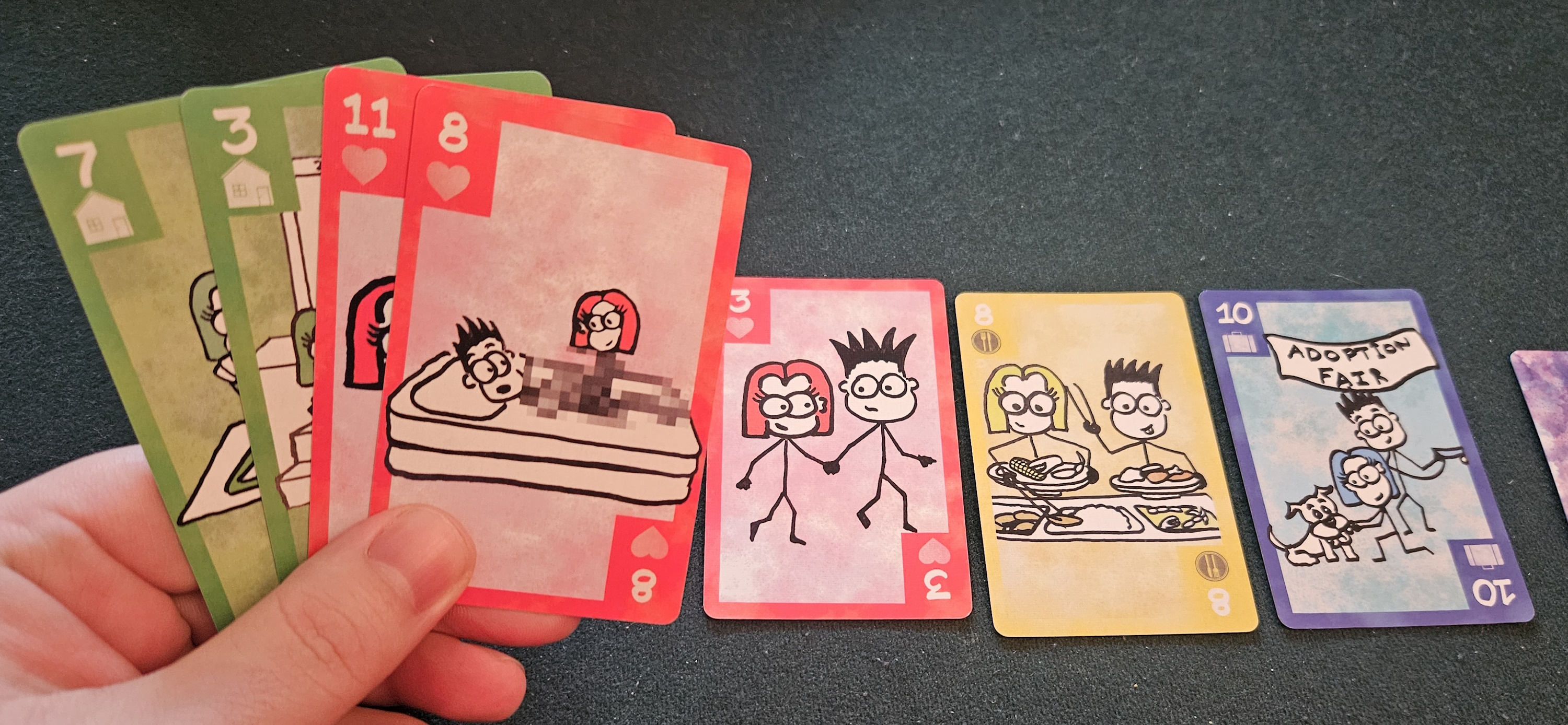
Fluid memories and core memories.
In a peanut shell, the concept goes something like this. Each round is broken into two phases. In the first, players conduct a fairly boilerplate trick-taker to claim cards. Then, in the second phase, they use those cards as the payload for a card-shedder, dumping sets and runs as quickly as possible.
But the thing about We Need to Talk is that it doesn’t quite fit into that appointed shell.
Let’s start with the trick-taking. Like most exemplars of the genre, tricks are must-follow. There’s a randomized trump suit each round. More importantly, everybody is also asked to consider the composition of their memories. Everybody begins with three “core memories,” passed to them by their neighbor. Once everybody is acquainted with the game, these present a minor minefield, cards you know you’ll need to shed later in the game, so you might as well gather others that match their suit or rank.
Gathering those cards is straightforward enough conceptually, although the usual subtleties apply. Claiming a trick means you nab every card in it — which runs the very real risk of seeing somebody amassing too many cards. Too many laden memories, to use the game’s parlance, not unlike an intake patient informing their therapist that they hope to tackle their PTSD, ADHD, and chronic pain all in the first week. Oh, and could we also talk about our childhood trauma?
Okay, so it’s risky to take too many cards. You want a big enough hand to afford you some options, but not so many that you can’t work through them all. Fortunately, there are ways to claim cards in a more measured manner. Some ranks let you steal any card from the trick before its winner takes the whole pile. Another lets you draw from a marketplace of memories in the center of the table. And then there’s the player who successfully keeps their hand trim. You’d think going into therapy with only your three core memories would make for an easy hand to shed, but no. That player is forced to claim the trump card and some hidden memory underneath it.
In other words, nobody comes to this process with as much clarity as they would like. We all have our problems. Even if we would rather pretend we’re whole.
Maybe especially then.

There are a few ways to acquire memories.
The card-shedding phase appears normal on the surface. Your goal is to be the first person to rid yourself of all those uncomfortable memories. This is done by playing melds — in the common tongue, by playing sets or runs, the higher the better. Or, barring that, to have as few as possible when somebody else goes out. Every card stuck in your hand is worth a point. A point against you, not in your favor.
The wrinkle, though, is that one of the game’s five suits is considered “awkward.” These are the memories that throw you for a loop. While going through a hand, you might play a solid meld. Say, a run of five cards. That’s great! Except whenever you include a purple card in a meld, the requirement for the next meld is inverted. Rather than forcing your opponent to play something better, such as a higher-ranked run of five, now they’re allowed to play anything weaker.
This endows the shedding phase with a stilted rhythm — and I mean that in the most complimentary sense possible. It doesn’t always feel natural, bouncing between headspaces. One moment you’re trying to cobble together strong melds, the next a single rank-1 card might be the emotional equivalent of five-card flush. More than once, we nearly missed a swap.
But the awkwardness is the point. Knowing when to vary the meld’s quality soon becomes a skill in its own right. Despite initially feeling counterintuitive, it’s possible to master the game’s mutability, to learn to ride that changing wave all the way to a clear hand.
Or a clear head. The game’s metaphor isn’t perfect. Read too harshly, one might decide it’s about competing at therapy. That strikes me as unfair. We Need to Talk taps into something universal in the way it handles troublesome memories as baggage that needs to be worked through before we can find peace. The vacillating meld quality even reminds me somewhat of the trigger card from the much more serious title Heading Forward by Jon du Bois, an intrusion into the game’s regular state of play that must be confronted and, hopefully, worked through. Here, as in that game, there’s no such thing as linear progress. Sometimes we step backwards. Sometimes we fall. Or relapse. Or give in to despair and humiliation. The trick lies in finding a path forward regardless.
Heh. “The trick.”

Dumping those bad memories!
The result is a strange little plaything, to be sure, but also one that lifts well beyond its weight class. Fong’s approach is clever in all the right ways, full of changes to the trick-taking and shedding templates that are subtle without being too vague and a tone that’s empathetic without coming across as preachy. The illustrations, too, suit the game’s mood. There are awkward moments, true, but they exist alongside trips to the farmer’s market, a conversation over coffee, walking arm-in-arm down the street. It’s a reminder that not every burden is some profound trauma. They can be little hurts, unnoticed slights, even the burden of good times that are no more.
What complicated things we are, we bundles of nerves and nervous energies. In presenting its decaying relationships as a trick-taker and card-shedder, We Need to Talk does the uncommon, letting us probe the canker sore but with a bit of distance and some good humor. Tally one more for trick-taking. In its favor, not against it.
(If what I’m doing at Space-Biff! is valuable to you in some way, please consider dropping by my Patreon campaign or Ko-fi. Right now, supporters can read a 3,000-word overview of the forty-ish movies I saw in theaters in 2024.)
A complimentary copy of We Need to Talk was provided by the designer.
Posted on January 29, 2025, in Board Game and tagged Board Games, Skeptical Otter Games, We Need to Talk. Bookmark the permalink. 4 Comments.

 SPACE-BIFF!
Love this review – I saw that this game was first released at Game Market West. Is there another way to get a copy of this game?
I believe currently the only way to obtain a copy is by directly contacting Brendon Fong. Fortunately, his email is already in the thread!
Thank you for such a great review!!!
You can inquire about purchasing copies directly at SkepticalOtterGames@gmail.com
Pingback: Best Week 2025! The D.T.R.! | SPACE-BIFF!