Chu-se Wisely

The time has come for Tom Lehmann to design a trick-taker. Okay, that’s not wholly accurate. Chu Han, set during the Chu-Han Contention, is strictly a ladder-climber and card-shedder, but the genres overlap to such a degree that most laymen couldn’t tell the difference. More importantly, as befits the creator of Race for the Galaxy, Res Arcana, and Dice Realms, Chu Han has a few cool ideas up its sleeve.

Picking the best play.
At first blush, it’s surprising how closely Lehmann sticks to the sheet music. Chu Han is a tight duel for two players, each of whom controls one of the ancient Chinese states. Both sides draw a chunky hand of cards. The objective is to get rid of them as quickly as possible, ideally while your opponent is still holding quite a few. Legal hands are downright simple: singles or matching ranks. There are no runs or sequences to consider, and, given the staggered nature of the card rankings, higher-valued sets are increasingly hard to assemble. Bit by bit, both sides creep toward the 31-point threshold necessary to claim dominance.
The first big wrinkle is that you can improve the composition of your hand in the middle of a trick. Let’s say your opponent has played a powerful set. Four threes, perhaps. In order to respond, you will need to play four cards of a higher rank. Glancing at your hand, you’re holding three fives. One off from being able to spin the trick in your favor. Now you have a choice. You can either pass — which will allow your rival to begin the next trick and potentially block you out again — or you can accept a writ.
Writs are a devil’s bargain. This will let you draw two extra cards. You can use them immediately, and even if they don’t help you build a better match right this instant, they’ll still be available in future rounds. The downside is that you’re putting the hand at risk. When one player goes out, they not only score a point for every card their opponent is holding, but also for every writ that foe took this round.
Depending on timing, then, taking a writ might represent a three-point swing. Ten percent of the score your opponent is trying to accumulate.
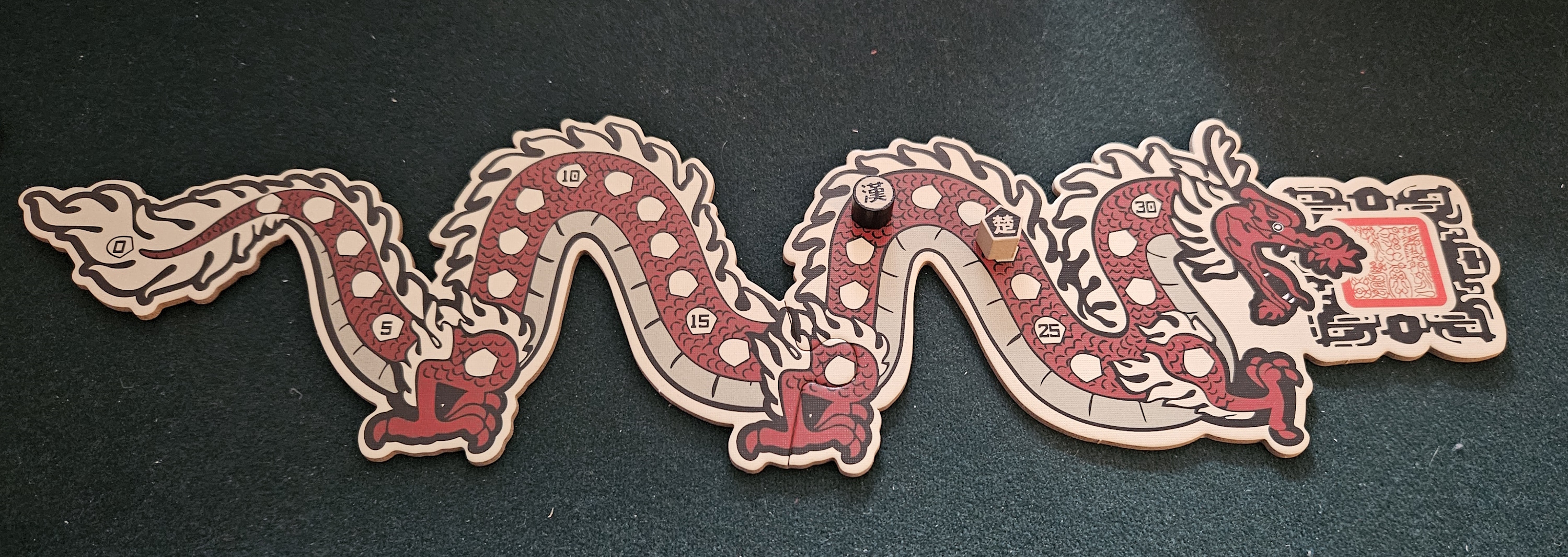
The scoring board is out of control.
Smartly, the option to accept a writ arrives whenever you need to play. This regularly gooses the tempo and stakes of Chu Han. It feels a little bit like the metagaming in Jon Perry’s supernal Air, Land, & Sea, rewarding players who know when to fold and when to accept some extra risk to potentially swing a trick’s momentum in their favor.
There are other small alterations. Each hand, for instance, might have its rules upended by an event. Some of these represent “calm” periods with no rules changes, but others can alter the nature of the hand entirely. One lets the loser of each trick claim a card from all those played that round. Another limits when writs can be claimed. Some are transformational, such as the event that turns rank-one cards into an opportunity to score big points.
Even more transformational are the card abilities. Not every card is burdened with special rules, but many come paired with their own miniature superpower. Rank two cards, for instance, can be massed together for a sudden influx of points. Threes and sixes, meanwhile, all have their own powers. There’s Xiang Yu, who can perform a gambit to pass immediately, but doubles the points awarded for this hand. Peng Yue lets you respond to a set with an equal set rather than having to cobble together something better. The figurehead emperor is a lowly rank zero card, but can also function as a wild, offering that crucial veneer of legitimacy to an otherwise useless hand.
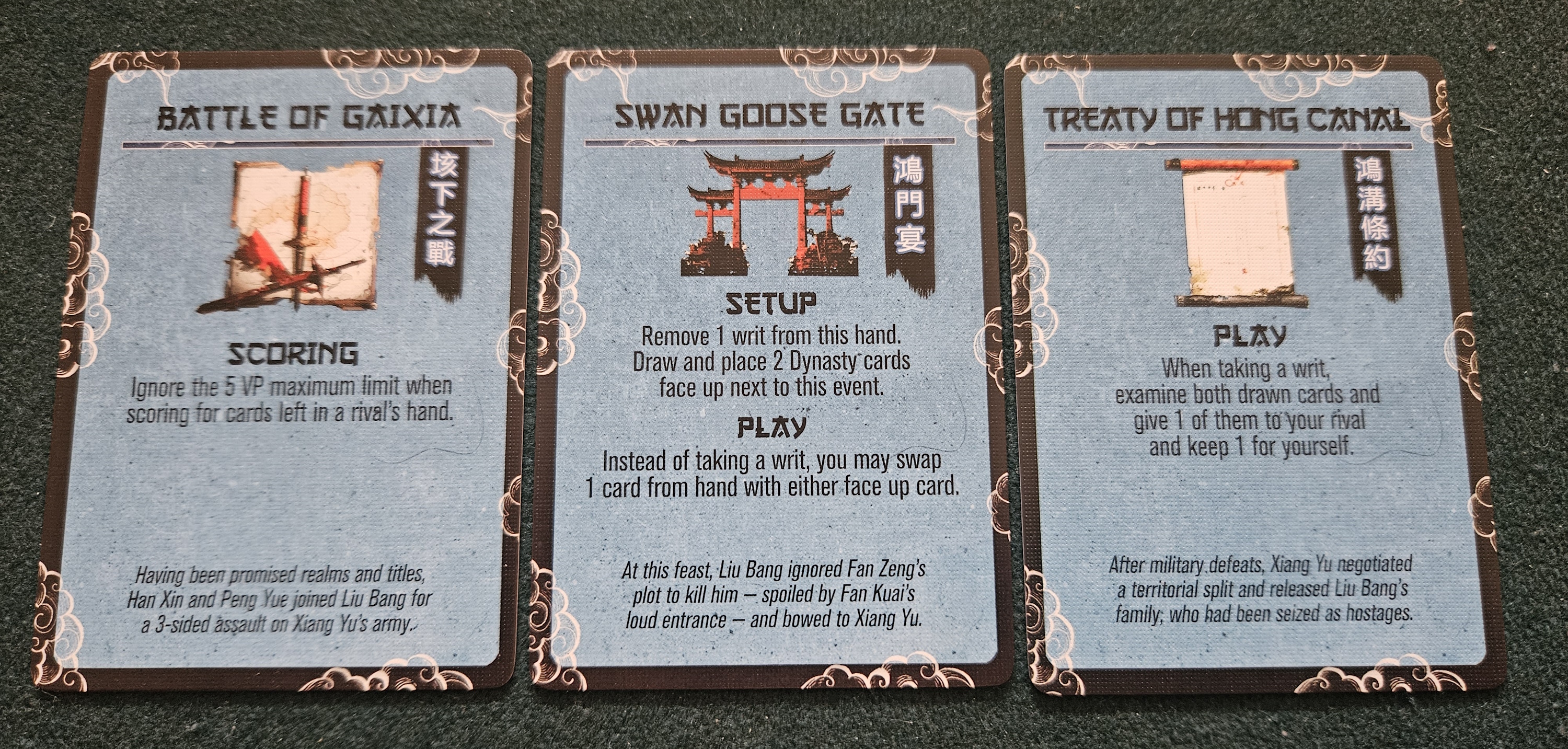
Events give each hand its own flavor.
Veteran tricksters will know well that much of the genre is about counting cards — if not every card, then those of major importance, such as trumps. Lehmann’s special cards are numerous enough to keep everybody uncertain about a potential ambush, but also sparse enough that they don’t occupy too much mental real estate. Liu Bang, the leader of the Han, may be a lowly six, but he transforms into a ten against the nine. Powers like that tend to stick in the memory.
Once you understand how they all work, that is. The rulebook is terse where it comes to card powers, leaving certain rules assumed or unstated. For such a small game — small enough that it comes with an optional tuckbox to carry the game around in rather than its default container — questions abound on BGG. It’s entirely possible to learn, but the process isn’t nearly as smooth as it could have been. Similarly, some powers, such as Zhongli Mo’s capability to play a run of cards rather than a match, seem shockingly overpowered until you learn the proper ways to counteract them. For such a slight game, there’s a lot to chew on here. The problem is that most of those mouthfuls are meaty, but there’s also some gristle to work through.
As soon as that point arrives, though, Chu Han marks itself as an intriguing take on the genre. Even as more designers take a stab at cards with game-altering powers, few handle their cardstock with such seeming effortlessness as Tom Lehmann. He understands how to leverage a simple concept into a sword dance, complete with feints and unexpected thrusts.

Everyone is rather beefy.
In the end, Chu Han is a worthwhile, if minor, additional to Lehmann’s catalog of experimental titles. Its gameplay is fierce and measured. Somewhat surprisingly, its most apt addition to the genre is not its battery of card powers, but those humble writs. Seeking a better hand rather than merely passing adds a measure of gambling to each play. In many card-shedders, the player who first whittles their hand down to one card is often stuck for an extended period. Not so here. Little by little, one can risk it all on a more durable selection of cards. That those risks are so considerable yet so intoxicating is one more testament to the flexibility of our oldest genre, not to mention Lehmann’s ability to craft something formidable from familiar parts.
(If what I’m doing at Space-Biff! is valuable to you in some way, please consider dropping by my Patreon campaign or Ko-fi. Right now, supporters can read a 3,000-word overview of the forty-ish movies I saw in theaters in 2024.)
A complimentary copy of Chu Han was provided by the publisher.
Posted on January 27, 2025, in Board Game and tagged Board Games, Chu Han, Matagot. Bookmark the permalink. 2 Comments.

 SPACE-BIFF!
Great review as always Dan!
On the subject of trick-taking games, do you plan to review Fuego? You don’t usually review Keymaster games, but I’m very excited about this one and I’m wondering if you saw the game or want to play it.
I wouldn’t be opposed to reviewing it, but unfortunately it isn’t on my radar. I haven’t heard a peep from Keymaster in ages.