Wrinkles in Space-Time

I don’t know if time is a flat circle, but it does have a way of bringing us back around to where we started. Ascending Empires, Ian Cooper’s mashup of space exploration, empire building, and dexterity-based gameplay, was one of my first modern tabletop flings. I even reviewed it, way back. I got a rule wrong, and the embarrassment was bad enough that I considered not writing anymore.
Now, fourteen years after the original game’s release, Cooper has produced the Zenith Edition. The original game can be found in the box, but let’s be real: fourteen years is like three full generations in board game time. Let’s see how the new edition fares in the cold depths of space. Or worse, an over-saturated tabletop market.

Space! It’s big and empty. Apart from those gigantic planets all over the place.
As in the original game, Ascending Empires: Zenith Edition speaks the language of space empires as a shorthand, using our expectations of the genre to skip the pre-flight checklist and jump straight to warp. This allows it to stick close to the template, rolling through each of the Xs in that hoary old 4X designation. Exploration? Yep. Planets are hidden when the game begins, concealing whether they offer research potential or function as a floating space slingshot. Expansion and exploitation? Those, too, with little armies and outposts and research stations soon painting the stars your preferred color. Extermination? It almost goes without saying.
The gimmick is what set the original apart, and it’s once again what makes the Zenith Edition worth a second glance. Rather than moving your vessels in the usual fashion, counting spaces across a grid or contesting zones of control, the starfield here is an unbroken plane. Ships, by the way, are propelled by flicking. As in, yes, you rear back your finger and smack them into the yonder.
A gimmick it may be, but it’s a gimmick with purpose. Not only in the sense that it requires skill — although that’s true — but rather in that it says something different about the way human exploration has always functioned. In fiction, starfaring is generally presented, rather inaccurately, as analogous to sailing, dominated by navies and captains and often fought via exchanges of torpedoes. It’s easy to see why. Like a submariner, astronauts are bubbles of atmosphere preserved only thanks to fragile machines. Just as a broadside could tear through a frigate, we hold an intuition that spaceships would be similarly sheared by a pellet or missile. One’s best hope is to evade detection at all.
But Ascending Empires leans into the analogy, and in the process might just say something a little bit more reliable. Leaping between stars, it argues, is going to be as testy and dangerous as leaping between undiscovered continents. When a vessel is commissioned and launched, it may well drift off course or overshoot its target — or, as often happens in the game, rebound from the planet and miss its gravity well altogether.
The original Ascending Empires was played on multiple boards with jigsaw nibs holding them together. These boards had a tendency to warp, leaving the terrain marred with irregularities, impassable dips or sharp changes in elevation that an enterprising player could try to skip their ships against. The rulebook included a concession to these imperfections. Because space-time is irregular, it said, your ships might interact oddly with these folds. It almost read as an apology, an acknowledgement that the components weren’t perfect but, hey, it’s 2011 and nobody is making the good stuff yet.
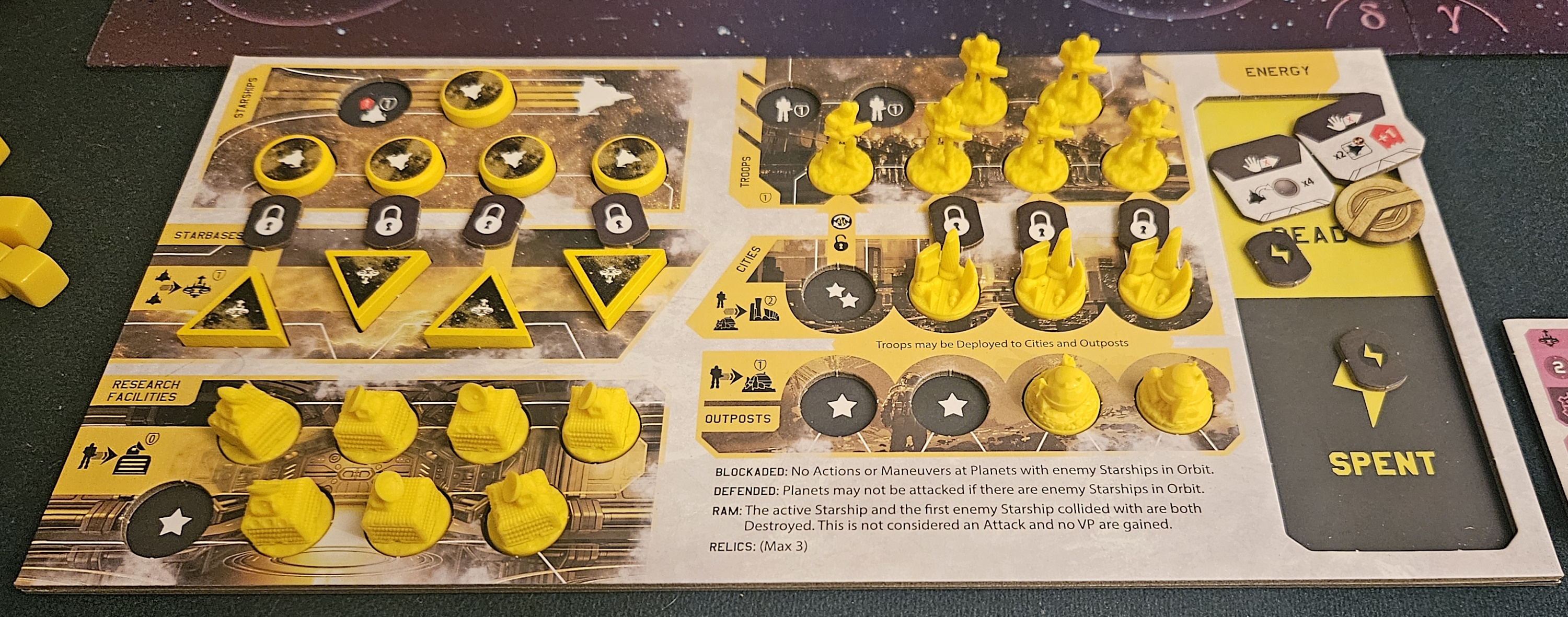
Template for an empire.
Now in 2025, the Zenith Edition’s playmats are neoprene. There are holes cut in the fabric that secure the planets. Their rubbery texture holds them tight, preventing them from skipping out of their cell thanks to a slap shot. The game is smoother. There are no wrinkles in space-time.
In a way, I miss those folds. I miss when a shot would jar against the cardboard and send a ship rolling off the edge of the table, or some ship’s aerobrake would go wrong and send a planet’s occupants tumbling onto the board. Don’t get me wrong, this experience is smoother. There is no half-apology in the rules. There’s also less bullshit. Ships can still be lost in space or accidentally ram into one another. But those moments when your disc would barely clip the jigsaw ream between boards and spin off into the unknown — gone. Again, for the better. But their absence makes space travel that much safer, ablating some of the original game’s incidental commentary on the testy nature of exploration and discovery.
The companion to the Zenith Edition’s improved board is the expanded role of building. Ascending Empires always asked players to settle far-flung worlds, but here those options have been duly expanded. There’s a cycle of life out there. Ships land on planets to become troops. Troops become outposts and cities. Outposts and cities produce troops. Research stations unlock technologies, which alter the rules in various ways. There are bigger warships to unlock, heftier discs that also bring their own perks to the table. A new energy system adds some flexibility to your actions, letting you spend tokens to take extra moves or deploy additional ships. It’s smart, less linear than the original game’s approach to both actions and technology, without really adding much in terms of complexity.
Other little additions are peppered throughout. There are now starbases, the least intuitive inclusion in the whole package. Starbases unlock additional ship discs for you to use, but they don’t actually produce ships. They sit in orbit, but don’t fight in space. Instead, they’re an additional way to protect your planets, both conceptually in that they add a pip to your planet’s defense, and physically on the board. With some clever placement, you can deploy them like gigantic umbrellas, keeping enemy ships at bay. The only problem is that their straight edges don’t tend to rebound rival vessels quite as rigorously as your planet’s rounded shape. Still, they’re a nifty inclusion that adds some texture to your civilization’s expansion into the stars.
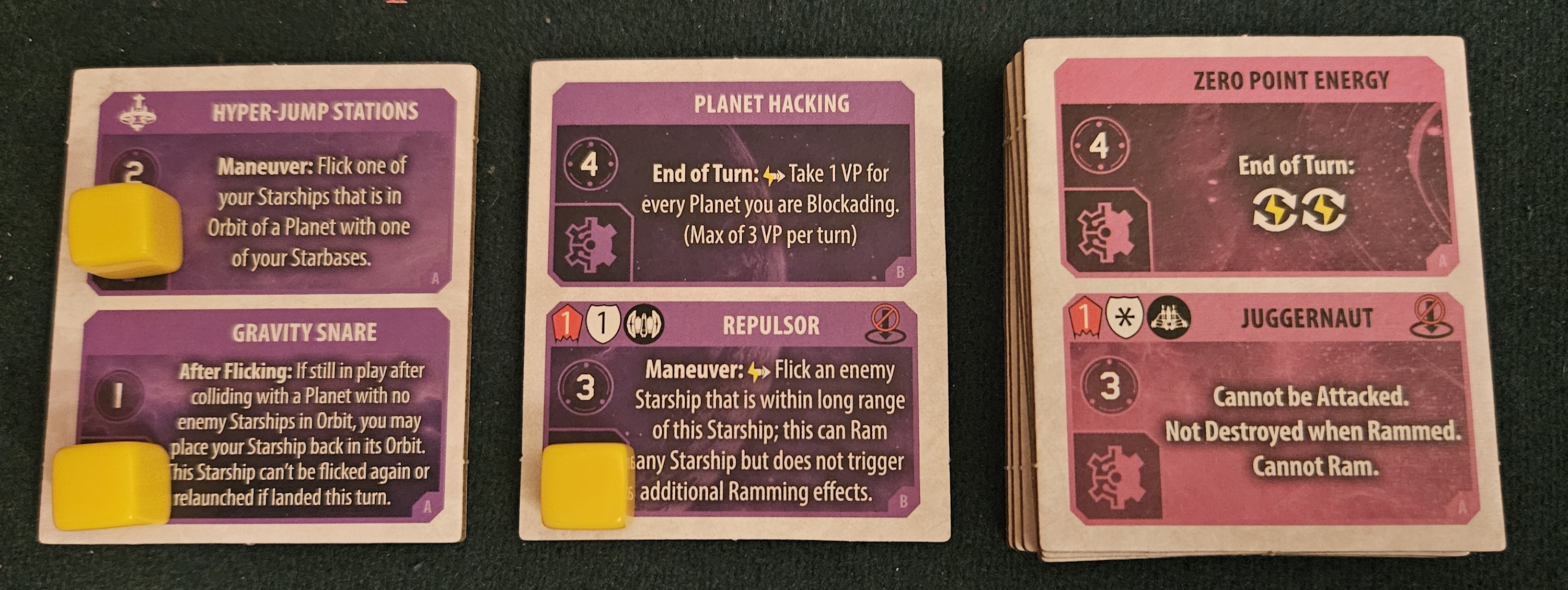
The research system is more flexible than before.
It’s hard to gauge which has changed more over the past fourteen years, my own expectations or those of the hobby at large. In this plus-sized format, Ascending Empires presents its own risks. There’s a lot of box here.
The bad news is that certain details feel somewhat dated. Combat, for example, is rarely exciting. Your goal is to put your ships within striking range of enemy ships or occupied planets, requiring shuffleboard-style flicks that coast to a stop within a short distance of their target rather than rebounding at inventive angles. In practice, these squabbles tend to cluster around gravity wells. That makes sense. Out in the void, there’s precious little to fight over.
In that same practice, however, these bouts tend to be all-or-nothing affairs. It takes two ships to beat one, and many ships to besiege a planet, so an incoming fleet doesn’t present a tactical challenge so much as an exercise in assessing acceptable casualties. Often, it simply isn’t worth the cost to come to a planet’s aid. Given the game’s stringent arithmetic, there’s no such thing as deploying a flagship to defeat a numerically superior fleet. Either you have the ships nearby or you don’t. Either you can spare x-number of flicks or you can’t. In the years since the original game’s release, other titles have done the combat-via-flicking thing with more variation, for instance by letting players launch smaller ammunition discs from the top of their main pieces. By contrast, Ascending Empires feels set in its ways.
There are other niggles as well. The game’s duration is a little too long, its objectives a little too boilerplate. To be sure, awarding points for settling an outpost in every quadrant is a perfectly suitable way to explain how players ought to behave. Get out there! Settle widely! Get into scraps! But when every goal sticks to that same format, the game starts to feel samey.
On the upside, even samey gameplay gets a pass when it’s this good — or at least it nervously edges around the complaint without making eye contact. Ascending Empires isn’t special because it’s a wholly new thing. It’s special because it feels right to handle. I’m not only talking about the flicking, which is plenty good, even great when you land a perfect shot. Rather, the simple appeal of a 4X game that fits into two hours and tickles those pleasure centers when you establish a city in a hard-to-reach spot, beat back an enemy expedition, or surround a floating space behemoth.
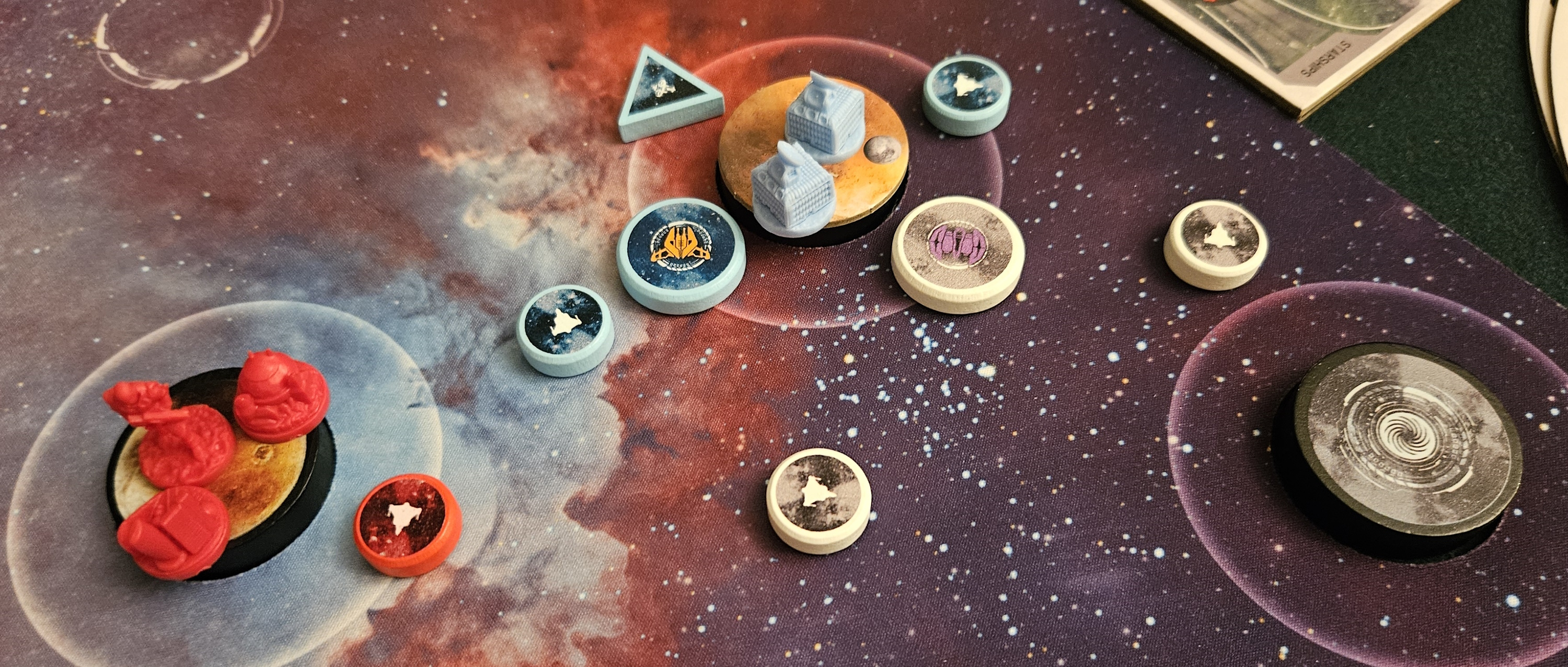
Space battles are often the least interesting part of the game.
It’s not quite tactility so much as a durable connection between the actions you take on the map and what they mean above the table. Founding a research station, for example, unlocks new techs that correspond to the planet it was built on. Now, when you venture out into the dark or swoop down on an enemy world, it’s because that land is valuable to you in a concrete way. Rather than being one more patch of undifferentiated terrain, it’s precious because you need one more research station on a purple planet.
The same goes for the game’s other activities. Launching a fleet is like blasting a shotgun across a field, the pellets of which will need to be gathered together again for an invasion. Warships are formidable not only because they offer new abilities, but also because they’re heftier and easier to target. Everything feels tangible in a way that most board games simply don’t manage. Everything matters.
And that’s why I’m happy to have spent a few more hours with a game that, in its own way, deepened my interest in board games. Fourteen years later, Ascending Empires is better than ever. Even with some refurbishment, there are cracks showing beneath the plaster. But it still stands apart from the crowd, not because of its central gimmick, but because of how intimately it binds its wings to its body. The result is a game that still soars.
(If what I’m doing at Space-Biff! is valuable to you in some way, please consider dropping by my Patreon campaign or Ko-fi. Right now, supporters can read a 3,000-word overview of the forty-ish movies I saw in theaters in 2024.)
Posted on January 16, 2025, in Board Game and tagged Ascending Empires, Board Games, Play to Z Games. Bookmark the permalink. 6 Comments.

 SPACE-BIFF!
Heartily agree – and I also wrote a review back in 2011 of the original game!
https://opinionatedgamers.com/2011/08/30/review-ascending-empires/
And now your excellent review is going to make writing my own review of the new game that much harder. 🙂
Interesting! How have you been finding the new edition?
I see lots of the same things you do – I like the change in how movement works & the addition of the energy mechanic.
Weird twist: we’ve been building less research facilities – the relics allow some of that kind of behavior in a one-off way and may be siphoning off some of the desire to fight for a particular planet type.
I did find that adding ancient libraries & guardian starships had a double positive effect – lessened the number of relics in the game (making discovery a bit more valuable) and offered a couple of new ways to harvest points. The one game we played with the Megaconstructions we only built one – and the team that did it lost, so we’ll see where that goes from here.
I haven’t tried the megastructures yet, but the other stuff has all been interesting. One thing I don’t love is the need to sort the relics during setup; I wouldn’t have minded a more “wild west” approach. Will we see a guardian starship? Libraries? Robot defenders? Let it get crazy in here!
I think I’d still rather play FlickFleet!
I was thinking about FlickFleet while talking about the combat! Put some little ammo discs on the top of these ships!