Vandalizing the Barbenheimer
Let’s get this out of the way right now: Christophe Lebrun’s Barbarian Kingdoms isn’t going to teach you anything about the migrations, settlements, and wars that transformed European power across the fourth through ninth centuries. It’s one thing to fudge the timeline so that Attila and Theodoric are contemporaries, but Ælle? The centuries, they pass like falling leaves.
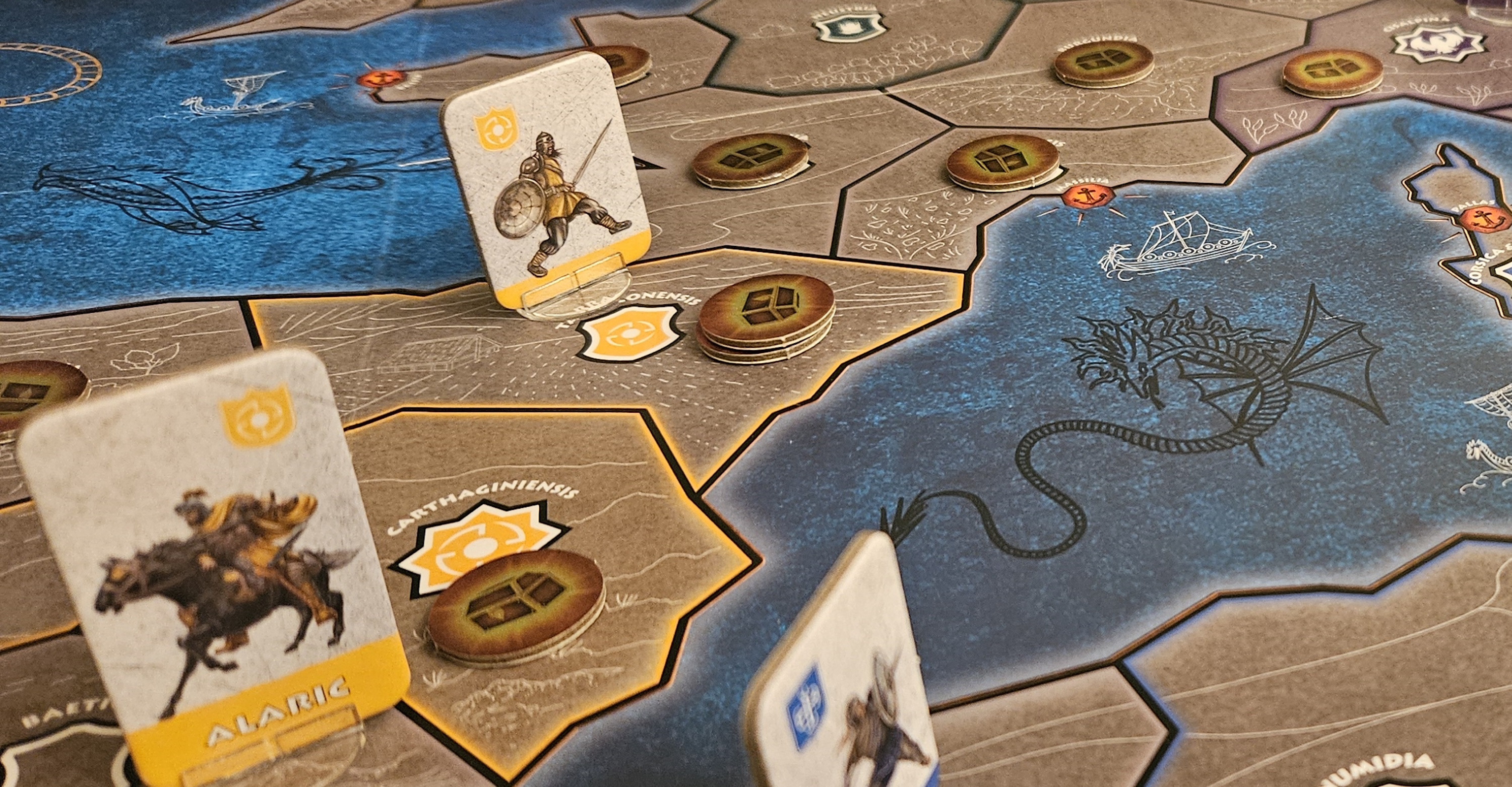
Barbs barbing.
As a board game, Barbarian Kingdom fares somewhat better thanks to its novel approach to treasure. From a thousand miles up, the concept is simple enough. You are a barbarian king — again, look, these titles aren’t really all that accurate, but I’ve been informed that sometimes I get too hung up on the historiography behind these things — who has recently occupied a portion of western Europe.
The road to victory is paved with gold. More specifically the tremissis, those little coins introduced by Theodosius. When the game begins, you have a hoard of gold coins, divided into denominations of one, two, and three. Your starting provinces, too, host a few coins. Beyond your borders, the unclaimed territories of the Roman Empire are also rich with gold, their value initially concealed from view. As you expand your kingdom, you will enter into new provinces to ransack their supply of treasure and swell your personal hoard.
But gold has multiple uses in Barbarian Kingdoms. Expanding your borders requires you to lay claim on occupied territories, investing coins back onto the map to place one of your control markers there. Similarly, raising armies injects tremisses back into a province’s economy. The more you govern, the wealthier your territory becomes. This, in turn, invites the gaze of neighboring kings to turn greedily toward your lands.
That gaze invariably turns to conquest. Here, too, money talks. Battles are simple but deadly, with the loser watching all their participating armies perish — and possibly their king as well. Given the flexible loyalty of barbarian armies, however, you can purchase additional strength simply by investing coins. This will boost your strength at a tidy exchange rate of one coin for one strength. That isn’t half-bad. For reference, an ordinary army is valued at three strength, while a king usually hovers at around six. Since armies can only reinforce a battle depending on the lay of the land, this usually caps one side’s strength at around nine.
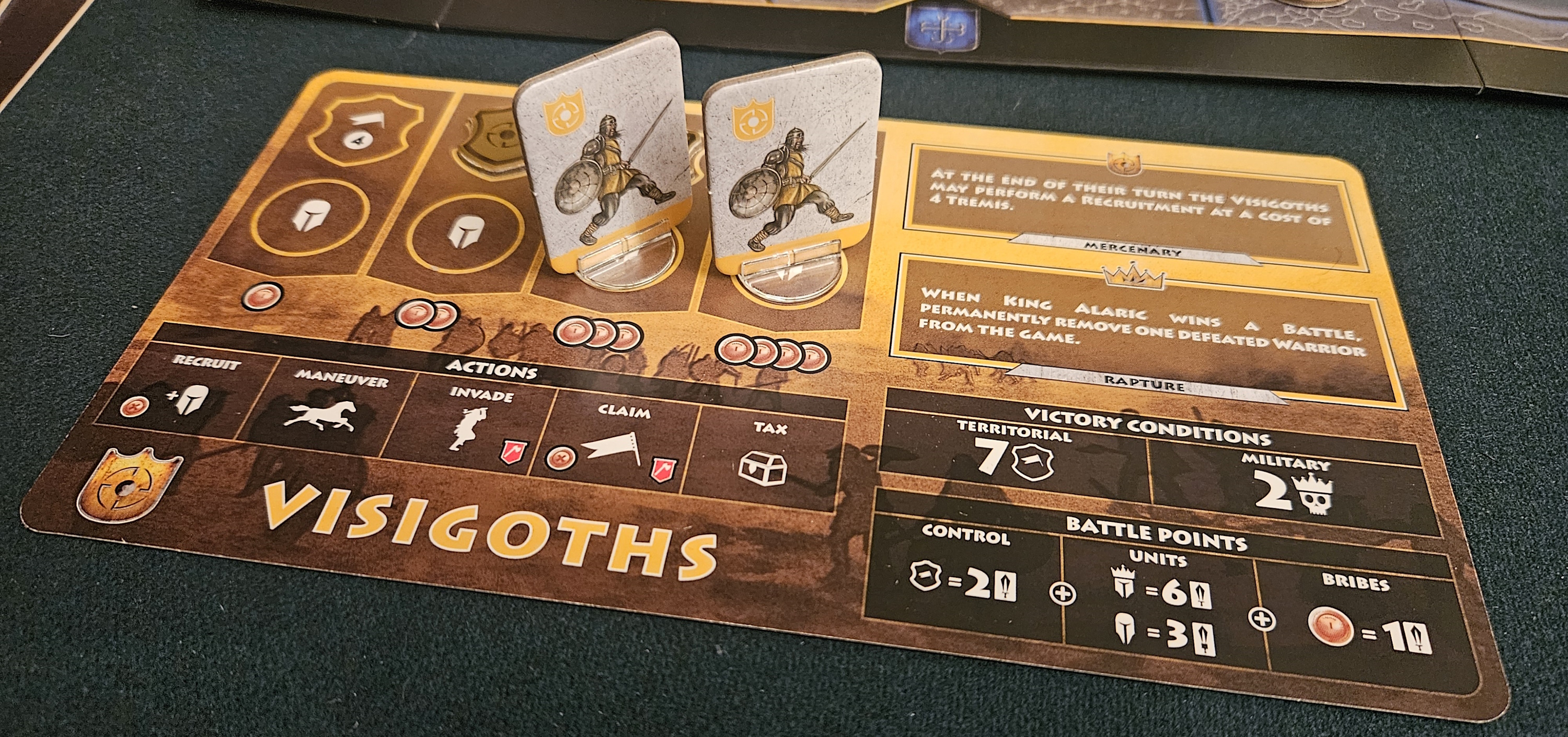
Claims and armies.
In other words, gold can and will swing a contest into somebody’s favor. The problem is that any gold you spend on mercenary turncoats will find its way to your rival king. When the battle is finished, both sides receive the gold their opponent spent. Naturally, this can transform even smaller scraps into major watersheds. More than once, I’ve watched as one side dramatically overspent, killing off an opposing army, maybe even a king, but handing over 12 or 20 gold at a pop and only receiving a few coins in return. This is liable to hobble your economy over the coming rounds, requiring the player to waste multiple actions taxing their populace or raiding weak neighbors rather than bulking up their armies and making considered inroads toward ultimate victory.
As closed economies go, this is a clever and thought-provoking system. Everything is circular. Money comes from the land, returns to the land, and is exchanged between rivals. I would even call it a nice historical touch, uncommonly close to the way coins functioned going into the medieval period, as signifiers of loyalty and relative merit, rather than as a currency of actual exchange.
There are little touches that reinforce the idea. For instance, you can’t make change. If you’re holding onto a bunch of three-value coins but you only need to spend two gold, well, you’re going to spend a three-value coin. It’s a small thing, but it forces players to think about the wealth of their provinces, the type of coins they’re holding, rather than a straightforward fungible integer. Pillaging a province might reward a single coin or a high-value diamond that isn’t actually all that valuable outside of bribing some scruffy warriors.
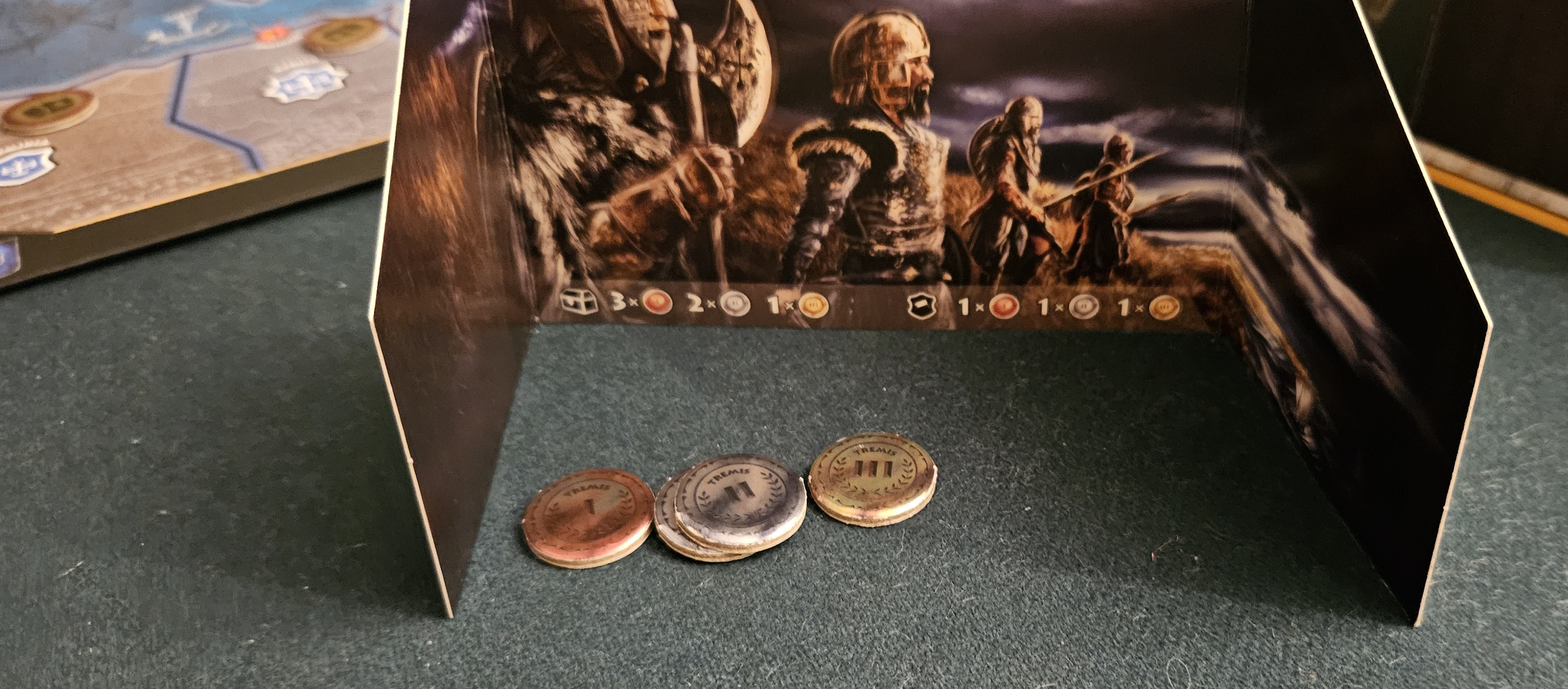
Loot! Everybody needs loot.
If I’m being frank — that’s a barbarian pun, by the way — I almost wish the game had focused more on the economics of the period than where it actually lands. Barbarian Kingdoms, I’m sad to say, is disappointingly boilerplate. The actual barbarian migrations, settlements, conflicts, and eventual confederation into kingdoms and empires, is a fascinating and complicated period, full of feuding Roman elites and tangled webs of patronage, conflicting invitations to settle and disputes with former allies, landed warlords and snubbed nobles, and so much more. It’s a period that begs to be given its time at the table.
Here, though, all the juicy details have been tossed out the window for an above-average currency system and a straightforward conflict between players. Don’t get me wrong, at its best the game offers some marrow, with up to six rival kings seething for position. But that seethe is strangely unbound, both from the period and the wider considerations of its economy. Your goal, for example, isn’t to build a kingdom. It’s to either claim seven territories or kill two opposing kings. That’s it. There’s a victory point system, but it seems to exist for little more than our edification. Surely it doesn’t matter to the actual moment-to-moment gameplay. It’s like counting points in chess — sure, it can be done, but there’s a reason almost nobody does.
In some cases, Barbarian Kingdoms ends before it even has a chance to begin. Most sessions last less than an hour. Actually, I don’t believe I’ve seen it last any longer than fifty minutes. I know “short playtime” makes for a great bullet point on the box, but some games need room to breathe, to allow for discussion and negotiation, to allow an arc to develop. This is one such game. Even as it stands, minus anything else I might have wished it could have been, Barbarian Kingdoms often comes across as truncated. The drama, such as it is, usually comes down to a small handful of battles, a few invasions that tactfully avoid interference from interested neighbors, and some last-minute panicked table-talk. For a game about barbarians, it settles for a whimper rather than a yawp.
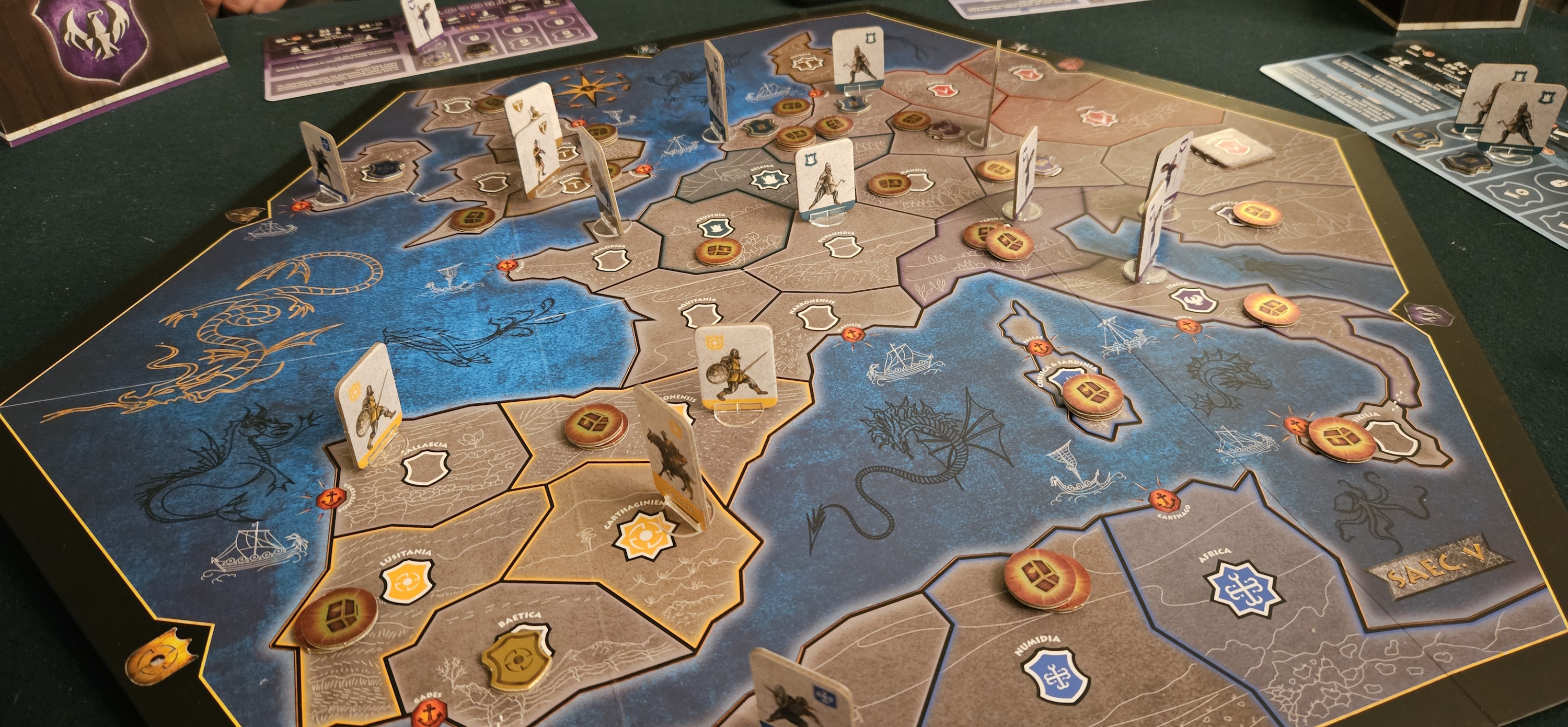
Oh hey I’ve been there. Not all of there. Just some of there.
I’m divided. When Barbarian Kingdoms works, it almost functions like an ultra-light version of Diplomacy, with little feints and debilitating thrusts. But it hovers between two realms, asking for devious interactions without quite providing the tools that would enable them. I appreciate many of its details; the unusual coin economy, the transactional battles, even the host of powers offered by each kingdom. But like some of the smaller barbarian migrations, this one fizzles out almost as soon as it has started. When it comes to board games, this period is still awaiting its Attila.
(If what I’m doing at Space-Biff! is valuable to you in some way, please consider dropping by my Patreon campaign or Ko-fi. Right now, supporters can read a 3,000-word overview of the forty-ish movies I saw in theaters in 2024.)
A complimentary copy of Barbarian Kingdoms was provided by the publisher.
Posted on January 6, 2025, in Board Game and tagged Barbarian Kingdoms, Board Games, Jester. Bookmark the permalink. 6 Comments.

 SPACE-BIFF!
I want someone to be hung up on the historiography of these things, no harm in it being you 😉
Thanks!
I would add, if someone has to be hung up on the historiography of these things, I am glad it’s Dan.
Thank you, Dan, for the thoughtful review!
Just to clarify, the game’s action is set between the late 5th and early 6th centuries. The Ælle featured in the game is Ælle of Sussex (likely distinct from Ælla of Northumbria, whom I believe you’re referencing).
While historical accuracy is obviously not perfect, we aimed to capture the essence of the era. If you noticed any glaring inconsistencies, please feel free to email us—we’d be happy to consider adjustments for a future reprint!
That last hover-over text was fun, because I had coincidentally pointed my cursor directly over that snake, and then the text said “See where that snake is?” Whoa, I do! I do, Dan!
Good job, Secret Eye Ace!