Mad Libs from the Stars
Posted by Dan Thurot
One of my favorite subgenres of speculative fiction is the first contact story. Whether it’s the (hideously misguided) Prime Directive of Star Trek, the mimicked conversations in Blindsight, or the failed Christian witness of The Sparrow, the notion of alien minds coming into sharp collision has always fired my imagination.
It’s safe to say, then, that A Message from the Stars sounds like exactly the sort of board game I would love. Designed by Clarence Simpson, this one is all about an alien ship, human scientists, and the half-understood snippets passed between them.
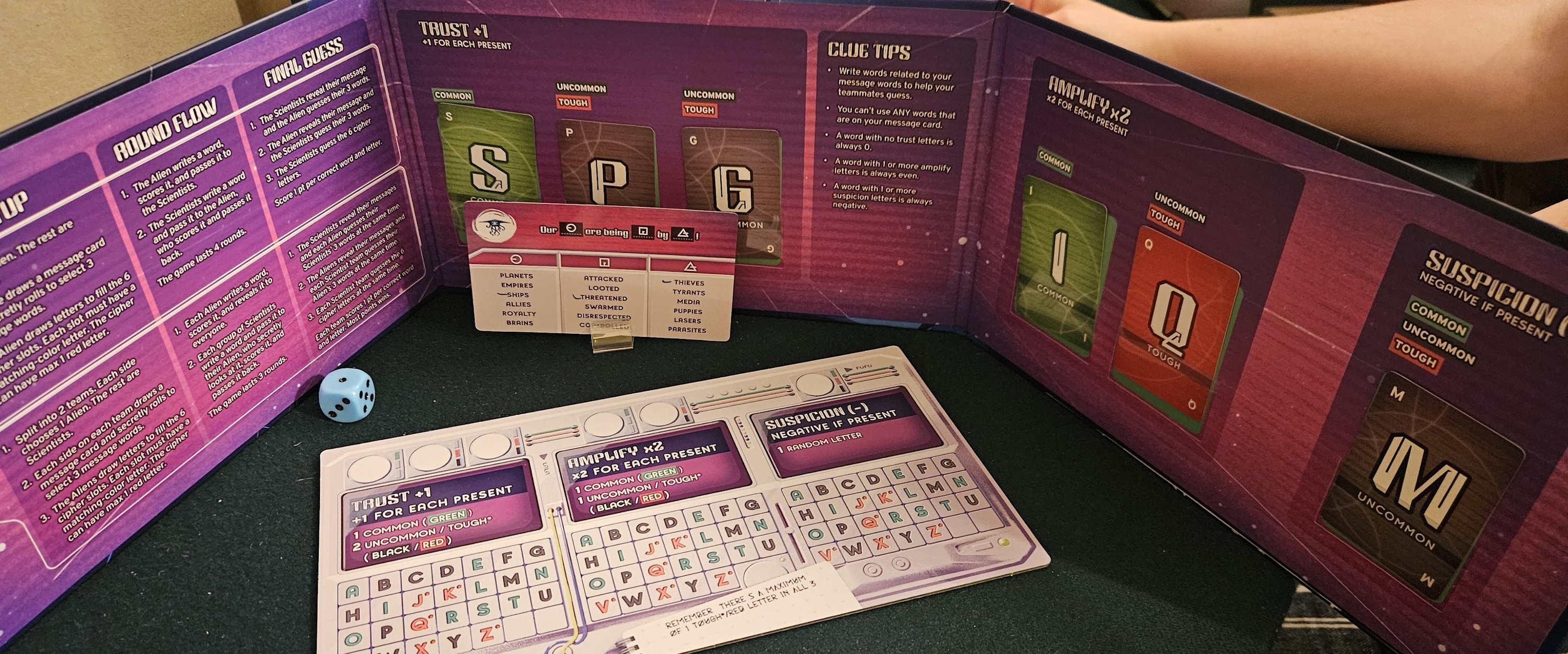
An alien mothership, where the Latin alphabet is sorted according to rarity.
At the risk of straying into the weeds before sharing even the scantest details about A Message from the Stars, there are competing schools of thought about what it would take to communicate with an alien lifeform. There’s the linguistic approach, which holds that alien translation would be much like contact between human cultures: slow, boring, and full of pointing at nearby objects to establish a shared vocabulary. (See, for example, the inaugural chats between Grace and Rocky in Project Hail Mary, most of which Andy Weir mercifully fast-forwards.) On the other end of the spectrum lies the mathematical model, which posits that since all of existence is math anyway, speaking in equations and constants is the only sane option. There’s also a more fatalistic perspective, one that argues that we can’t speak to alien minds that exist on our own planet, so why should we expect to converse with those that evolved under divergent circumstances?
A Message from the Stars falls somewhere in the middle of the linguistic/mathematical spectrum. Rather than limiting language to either schema, its communiques are both encoded equations and packets of semantic meaning.
Let’s take them in turn.
First, the equation. One player is always required to play as the alien intelligence. Their role is to send words to the scientists. They can only send one word at a time, and they’re always accompanied by a digit. This digit is the source of the game’s underlying equation, a selection of six letters of varying values. Three of these letters indicate “trust” — already a linguistic leap of faith, but let’s go with it. These add +1 to the word’s value. Others amplify the value, multiplying it by two. Finally, a “suspicion” letter flips the value of the whole thing into the negative.
It’s numerology, in effect, albeit not so mystical that anybody is going to be assigning divine significance when the alien blurts “SOUSAPHONE: -6.” Instead, these digits soon prompt a lengthy arithmetic reverse-engineering. For anyone who’s played any sort of puzzle game, its motions are familiar. There will be hypotheses, tests, refutations. These are put through their paces by the scientists’ own communiques to the alien mind. These will also be tallied according to the alien’s private logic and returned, paving the way for eventual understanding.

Decoding the message.
On its own, this process is raw and calculating, potentially even mind-numbing. It isn’t uncommon for the table’s problem-solvers to put their heads together and do the heavy lifting, leaving their associates out in the cold. To some degree, of course, this is a player issue, like quarterbacking or alpha-playerism. But it’s also an issue that A Message from the Stars directly fosters. A more mathematically minded player can explain their reasoning to their fellow players, but these detours are also delays. More than once, I’ve seen a player, left behind, insist that those with a handle on the equation just get on with it so the group can move onto something else.
There is a second layer to the puzzle, one that’s more immediate to our meaning-craving minds. It isn’t enough to guess at the alien’s intended numerology. Both sides, alien and scientists alike, are also trying to spur the other to understand a hidden message. This message, generated at the outset of the session, is presented as a Mad Lib. “Our _____ are being _____ by _____!” reads one, with words such as “brains,” “disrespected,” and “lasers” offered as possibilities.
These fill-in-the-blanks puzzles are the connective tissue of the game. It isn’t enough to send a word back and forth; players must also send words that hint at the final meaning of their message. These double meanings become the main topic of conversation. Perhaps the scientists need to determine whether E or U is a trust letter. So they need to send a word to the alien that isolates one of those letters, but also don’t want to use a word that might mislead the alien about the subtle distinctions between “attacked” and “controlled.”
These conversations do tickle the gray matter, it must be said. They’re also somewhat dry. A Message from the Stars is awash in downtime. Much of it is spent well, like solving a sudoku, fiddling with alphabetical possibilities. At other times, especially when one hasn’t been swept up in the game’s currents or when playing as the alien, these minutes have a tendency to drag on.
Certain modes improve the situation. The game can be played with competing teams, two aliens and two rival cohorts of scientists, each hoping to have their transmissions decoded before the other, and this goes a long way toward reintroducing some tension to conversations that can otherwise become too academic and drawn-out. This works for much the same reason that Denis Villeneuve added international brinkmanship to Arrival, his adaptation of Ted Chiang’s “Story of Your Life.” We run fastest under the gun.
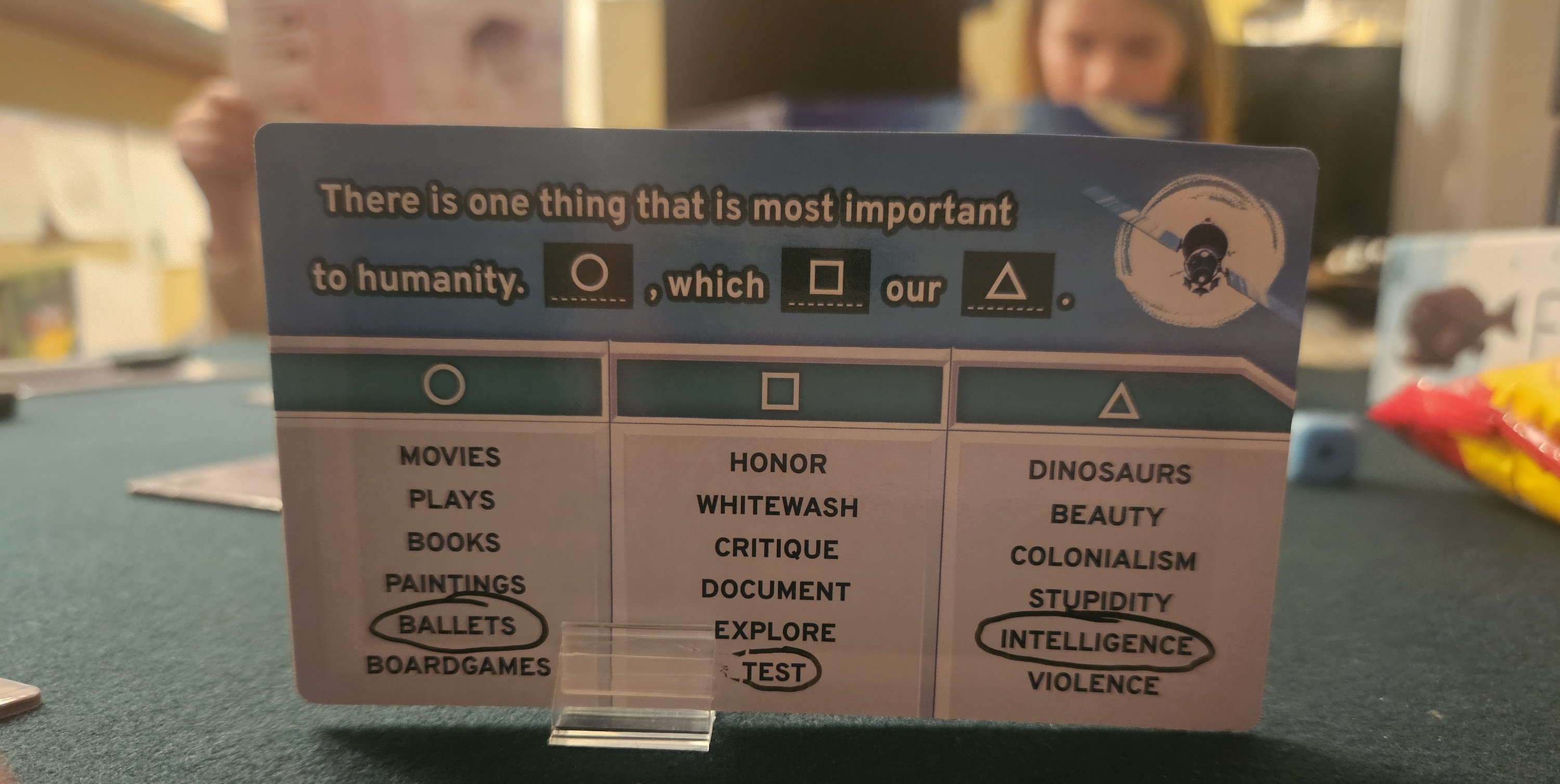
Oh. That’s… very important information.
While the game benefits from some actual competition, I’ll confess that A Message from the Stars, despite tickling that portion of my brain that loves a good puzzle, is still more remote than I would prefer. I think of it as inhabiting the same conceptual genre as Damir Khusnatdinov’s First Contact, another board game about alien conversations, but one that uses Vlaada Chvátil’s Codenames as the semantic core in its discourse between minds. Language can be tremendous fun when it’s fumbling and imprecise; in A Message from the Stars, the precision of its formula makes for good problem-solving, but not especially good commentary on language. Between that and its downtime, this is one game I don’t mind playing but don’t intend to seek out.
I’ll translate into a tongue that more of us might understand: ADEQUATE: 6.
(If what I’m doing at Space-Biff! is valuable to you in some way, please consider dropping by my Patreon campaign or Ko-fi.)
A complimentary copy was provided.
Posted on December 18, 2024, in Board Game and tagged A Message from the Stars, Allplay, Board Games. Bookmark the permalink. 12 Comments.

 SPACE-BIFF!
But if played as 2 player game with 2 persons with said mathematical mindset, it is very fun and surprisingly tense first encounters. That being said we would never play this with more than the two of us. Thanks again for fantastic text.
Nice review! Just a quick correction on the title of the book (which I recommend reading for all those that haven’t!), it should be Project Hail Mary for the English version of the book 🙂
Gah! Thanks for the correction! (For what it’s worth, “Operation Hail Mary” hits my ear better.)
Agreed!
Hah, what a great way to introduce the numerical rating to your column!
Its annual appearance!
Always happy to see a mention of Arrival, one of my all-time favourite movies.
I saw this game and it spoke to me: language! (I hold a BA in Linguistics). Sci-fi! (big sci-fi geek here). First contact! (huge Star Trek fan).
But from what I saw, it looked really dry, so I decided to skip it. You have validated my decision, thanks!
Yeah, good call if you want something a bit more peppy. It’s a good game! But also quite dry.
Ironic that your pictures hold no hidden messages this time…
Noticed that too 🙂
Ha, yeah, big fail there. I had some alt-texts in mind, but forgot before publishing the piece. Oh well.
Pingback: A Desire for More Cows | SPACE-BIFF!