Finally, a Game for Turophiles

It’s hard to imagine talking about Fromage without a few cheesy puns or some choice selections from my personal cheese journey. Fortunately for you, I’m professional enough to know when nobody needs what I’m peddling.
Fromage is a hot item right now. That might seem silly, but there’s something appreciable about cheese being the topic of the moment rather than zombies or pirates. Designed by Matthew O’Malley and Ben Rosset, it carries undertones of one of their previous games, The Search for Planet X, thanks to its rounded board and considered timing. Despite its creamy appearance, it offers some truly formidable decisions to chew over.
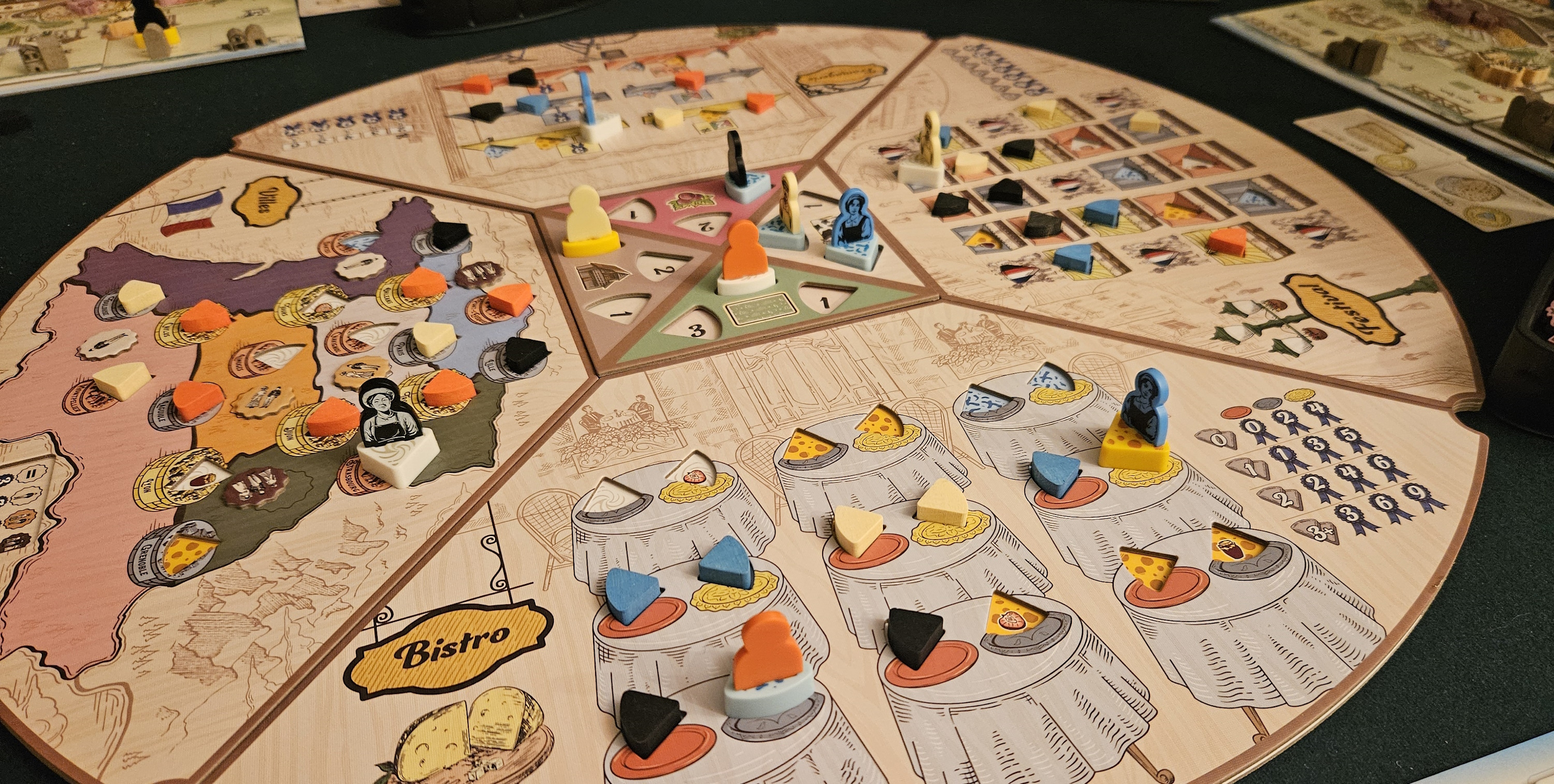
The entire board is a cheese wheel! How’s that for “theme,” suckers.
The first thing about Fromage that demands attention is the game board itself. Its four wedges are arranged in a circle, one that rotates to present players with new quadrants as in-game months pass. Whether this represents a cheese wheel or a turntable charcuterie will be the topic of debate for years to come.
Regardless of its thematic import, the construction of this lazy susan is appealing enough on its own, both pleasantly tactile and afforded true significance when it comes to gameplay. This is no mere gimmick, you see. Fromage is a worker placement game, but one that’s played simultaneously. On any given round, you only have access to the wedge facing you. More importantly, the placement of your cheesemakers is all-important. Each action requires you to position your workers such that they face away from you. It’s only when they rotate to face you again that you get to pick them up and put them to work doing something else.
But their specific angle depends on the strength of the assigned action. Hence a minor activity, such as gathering a few berries or only aging cheese a single month, will see them rotating to face you again on the next turn. Prepping more vibrant cheeses or amassing larger quantities of goods means they might not be available for nearly a full rotation.
This is the axis that Fromage turns on, both literally and as the fragrant note beneath every major decision. You can only place at most two cheesemakers on a turn, one to gather resources and another to make cheese. This forces the player to consider the potency of not only the current turn, but those coming down the line. It’s entirely possible to stumble into overly abundant turns, with too many workers to assign all at once, or dead turns with not enough staff on-hand to accomplish anything worthwhile. Or even to accomplish anything at all! In sharp contrast to the rubber-banding offered by many nu-euros, O’Malley and Rosset are smart enough to allow players to reap the consequences of their own actions. Sitting on your hands because all your cheesemakers were busy elsewhere this turn is the proper reward for hubris. Cheese hubris.
Along the way, you also need to assess the ongoing availability of each worker. Rather than functioning like the ludic equivalent of Kraft Singles, each worker specializes in a particular type of cheese. There are three categories in all, hard, soft, and bleu, and it’s worthwhile to pay attention to upcoming quadrants to ensure the right cheesemaker is available to work the proper wedge when it spins around. Timing is everything.
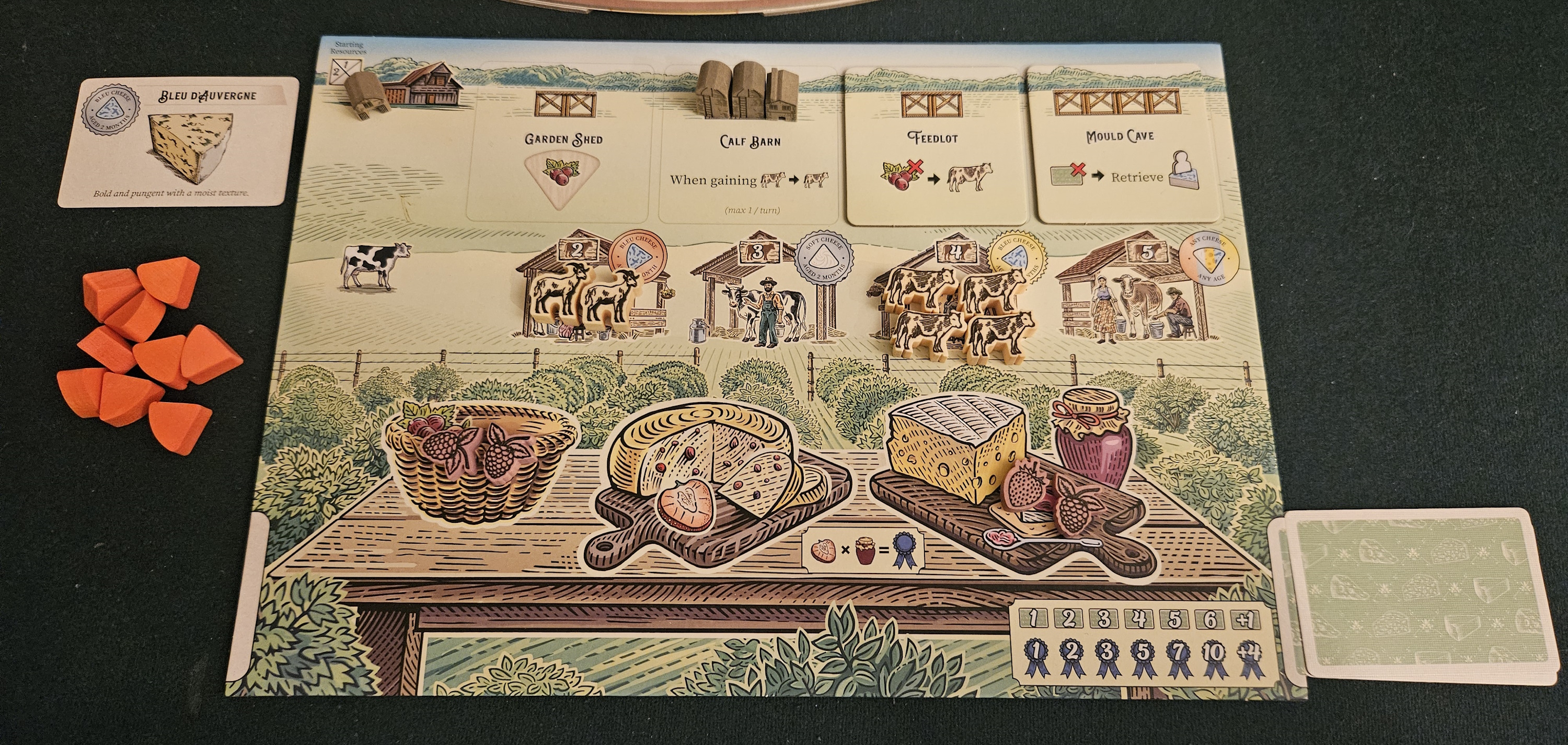
I hope this is how cheeseries really look.
Okay, not everything, although much of Fromage comes down to careful timing. Every wedge of the wheel offers its own contest for points, sufficiently differentiated from the others that the stakes are immediately clear.
The Bistro, for example, is all about making cheese pairings, placing your own cheeses opposite one another to improve the value of your individual platters. This is probably the easiest of the quadrants to read, although this legibility also lends itself to rival sabotage, with fiendish cheese-nemeses (nemecheese?) potentially plating their bries opposite your roqueforts and ruining the whole assemblage. The Fromagerie, on the other hand, offers minor perks for displaying your wares on various shelves, with end-game scoring bonuses for wide product placement. These slots are severely limited, but also worthwhile for the resources they award.
More cutthroat are the other quadrants. The Festival sees you trying to dominate foot traffic. Contiguous booths award major spills of extra points, but also ample room for your rivals to horn in on your showcases. The Villes, meanwhile, require you to export your cheeses to conquer France. No, really, this quadrant plays like an ultra-lite area majority wargame. It’s basically Paolo Mori’s Caesar! but with cheese. Unlike the other segments, controlling a region is an all-or-nothing affair that might return a big fat zero despite your careful investments. Stray into the wider world at your own peril.
While these quadrants dominate much of Fromage’s mental real estate, you also need to tend to your very own cheese factory. This is where resources are spent to improve your chances of becoming France’s premier cheese king. (Cheeselemagne?) Outbuildings add new actions, improve your resource gains, or add new avenues of scoring. Livestock can be milked in bulk to add bonus cheeses to the board, the only way to place more than a single cheese per turn. And fruit can be mashed into cheeses or jams. Ideally both, since those values are multiplied for a scoring bonus when the game ends.
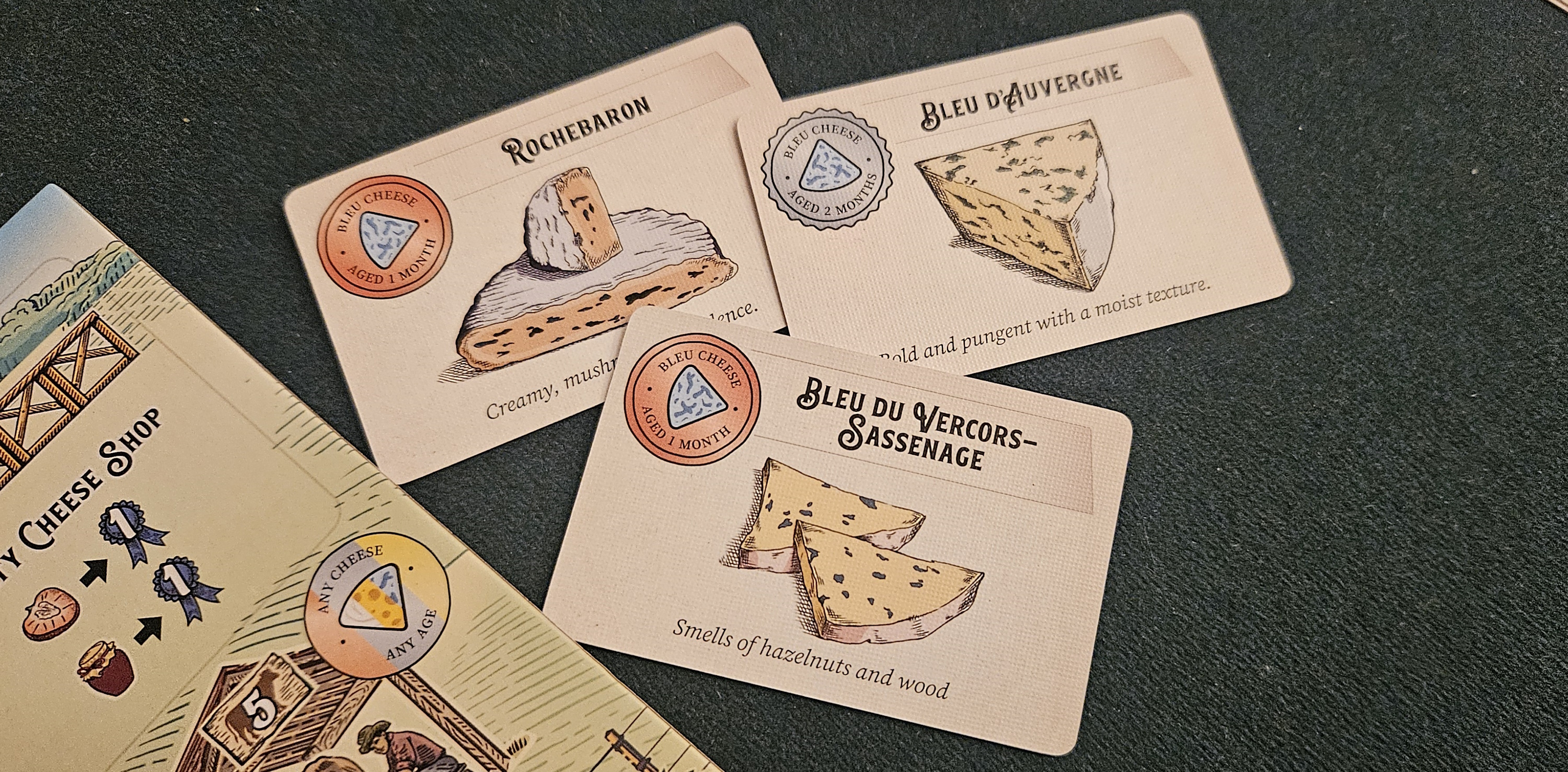
“Bold and pungent with a moist texture” is my dating profile.
I know this sounds like a lot, but one of Fromage’s most impressive feats is that it never becomes too much to handle. Rather than curdling players by asking them to think about everything all at once, O’Malley and Rosset skim their wide array of resources, actions, and scoring criteria down to a single quadrant at a time. Any given turn is limited to one resource, one contest, and the extras you’ve accumulated at your own creamery. With experience, players can learn to cover more ground, specializing in various arenas while making tactical inroads into other portions of the board. There’s room to grow, but newcomers will find that Fromage excels at narrowing its scope to a manageable mouthful at a time.
Where the game suffers is in its endgame, and I don’t envy these designers the problem of choosing how to bring Fromage to a satisfying conclusion. When somebody places their final cheese, that’s it. Everybody removes their workers and tallies their score. This tends to give the last few turns a weird sensation of brinkmanship, everyone watching one another’s cheeses and waiting to place their final workers until they know how the player with the fewest remaining wedges intends to act. It’s an unfortunate intrusion into the game’s usual pacing and simultaneity, concluding with a whimper rather than a bang.
To be clear, this isn’t a deal-breaker. On the whole, Fromage is a delight. Apart from some wonkiness in its last turn or two, this is what I like to see from a modern Eurogame. There are heaps of ways to earn points, but they’re distinct and challenging rather than feeling like rough equivalents, with some sectors offering greater risks but commensurate rewards, while others play it safe. The action placement is simple in form but devious in consequence, with nearly no restrictions or persnickety prerequisites, but potentially locking players out of strong turns in the future. This is the polar opposite of, say, a Vital Lacerda title, where an action might be so overburdened with particulars and provisos that it requires multiple sessions to become intuitive. Here the actions are dead simple. It’s their later considerations that offer a wealth of trouble.
Also, to reiterate, it has a lazy susan! How nifty is that? Better yet, Fromage transforms its rotating menu of actions into an indispensable component in a larger whole. Everything comes back to those questions of timing and availability. What initially struck me as a silly gimmick proves to be the game’s smartest innovation, asking players to consider every cheesemaker’s placement and cooldown, while also keeping the game’s mental bandwidth at manageable levels. Smart.
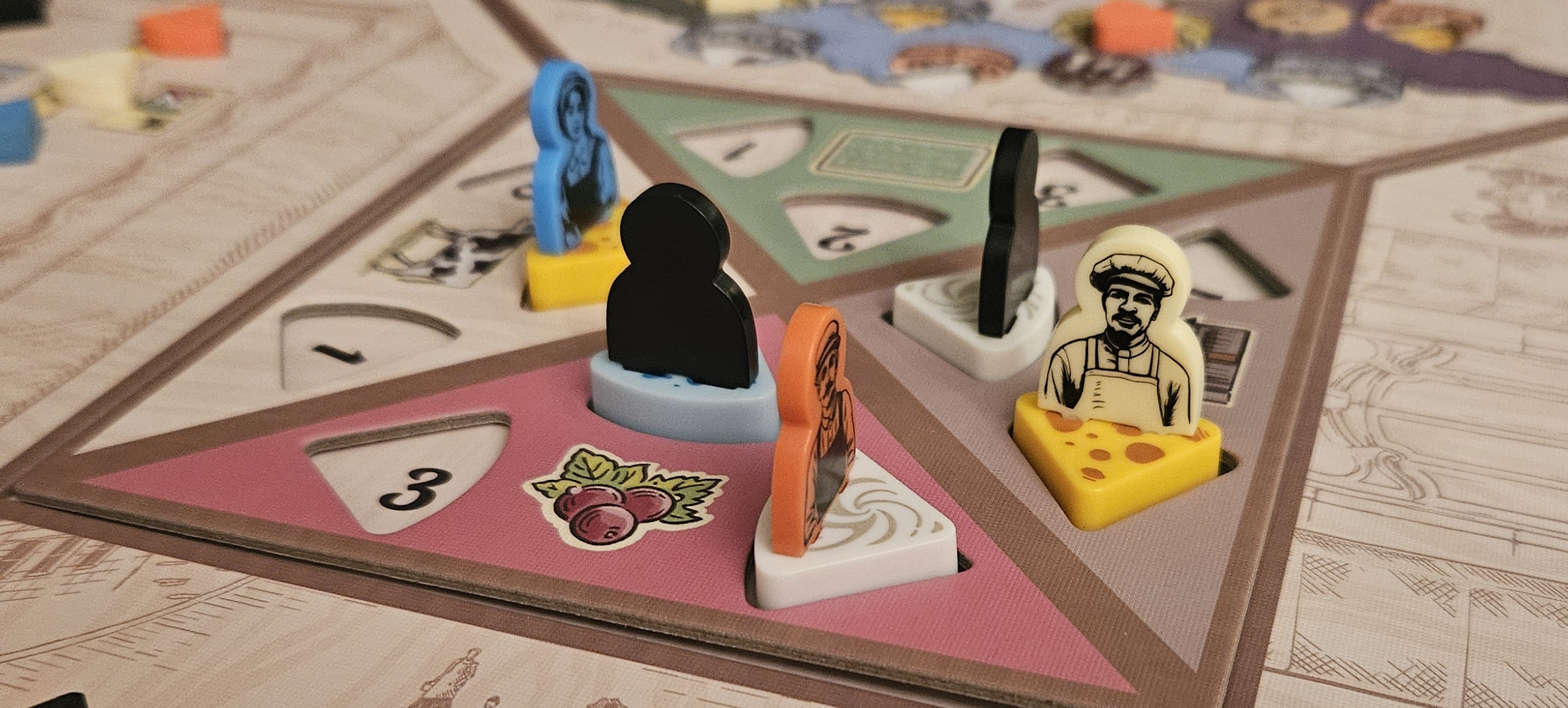
Gathering resources.
All told, Fromage is one of the year’s surprise delights, and a last-minute delight at that. I wasn’t sure what to expect going in. A game about cheese, ha ha. Instead, O’Mally and Rosset have produced a fine plaything, one that offers a gimmick with significance, loads of options packaged into bite-sized morsels, and a joy of place that made my tummy rumble. Pairs well with good friends and a tolerance for sudden conclusions.
(If what I’m doing at Space-Biff! is valuable to you in some way, please consider dropping by my Patreon campaign or Ko-fi.)
A complimentary copy was provided.
Posted on December 16, 2024, in Board Game and tagged Board Games, Fromage, Road To Infamy Games. Bookmark the permalink. 12 Comments.

 SPACE-BIFF!
As much as I enjoy me some cheeeeese, Gromit, what I’ve really been checking for is the end of year awards! Soon?
Soon! Best Week always takes place on the last week of the year.
As a gamer, I’ve been curdled too many times. Also, it’s a little-known fact, but Lenin was an adept cheesemaker.
Your reviews are incisive and informative, and I appreciate that they are not just rules explanations. I think you are achieving your goal of considering games as objects similar to art and literature. But the cherry on top is when you include things like
“Bold and pungent with a moist texture” is my dating profile.
That made my morning.
Thanks for the kind words, Aaron!
Well done on resisting the “Paolo Mori’s Cheeser!” pun.
Oh dang it. Should have thought of that one.
How’s your Fromunda cheese?
pungent and moist
Reminds me of Kami-Sama, which used a similar rotating board with quadrants, but was an area majority game instead of a worker placement.
That one did not catch on nearly as much.
It’s always strange what catches on and what doesn’t, isn’t it? Lots of luck involved, as in any industry.
Pingback: Best Week 2024! Combined! | SPACE-BIFF!