Journeys in the Dark
All I play anymore is trick-taking games. Now and then, fortunately, one of them catches my fancy.
This month’s example is David Spalinski’s Torchlit. A self-published production, and so far only sold at this past weekend’s Indie Games Night Market alongside titles such as High Tide and Out of Sorts — which I wasn’t able to attend, but by all accounts was a resounding success — this is as close to a hybrid trick-taker as one gets without actually tipping over the line.

These dark halls are full of ghosties.
As a trick-taker, Spalinski sticks to the basics. This is a must-follow trick-taker with a whopping seven suits. Each suit depicts a different monster, one of which, the dragon, functions as trump.
Right away, though, there are some significant departures from the norm. The first is the way Torchlit handles victory. In usual fashion, the winning card is determined by highest trump followed by highest led card. Except that only determines the winning rank. Everybody who played that rank “wins” — which, in this context, means they move their adventurer deeper into the dungeon they’re plundering. There is no tiebreaker. Torchlit doesn’t need one. If everybody plays the same rank, everybody moves forward. Which is a rarity, but I have seen it happen.
The dungeon, portrayed as a series of eight numbered cards, covers quite a bit of ground. It tracks how many tricks you’ve won, but that’s the least of it. After each trick, whomever played the lowest card temporarily becomes the “dungeon warden.” The warden gets to seed some of that trick’s cards into the dungeon’s chambers. Ones go into the first room, threes go into the third, and so forth. The rubric for which cards get added is simple enough — one card per suit, although there is a significant exception — but the gist is that the warden is assigning points that will be awarded at the end of the hand. If you happen to stop in a room with a dragon and assorted monstrosities, well, that’s more loot for you.
Meanwhile, there’s also the titular torch. At the outset of the hand, one of your cards becomes your torch and is reserved face-down. If you happen to reach that card’s printed chamber, you earn extra points. If, on the other hand, you fail to reach your intended destination (or blow past it in your haste to kill more monsters!), then it’s added to that chamber for anyone else lucky enough to reach it.
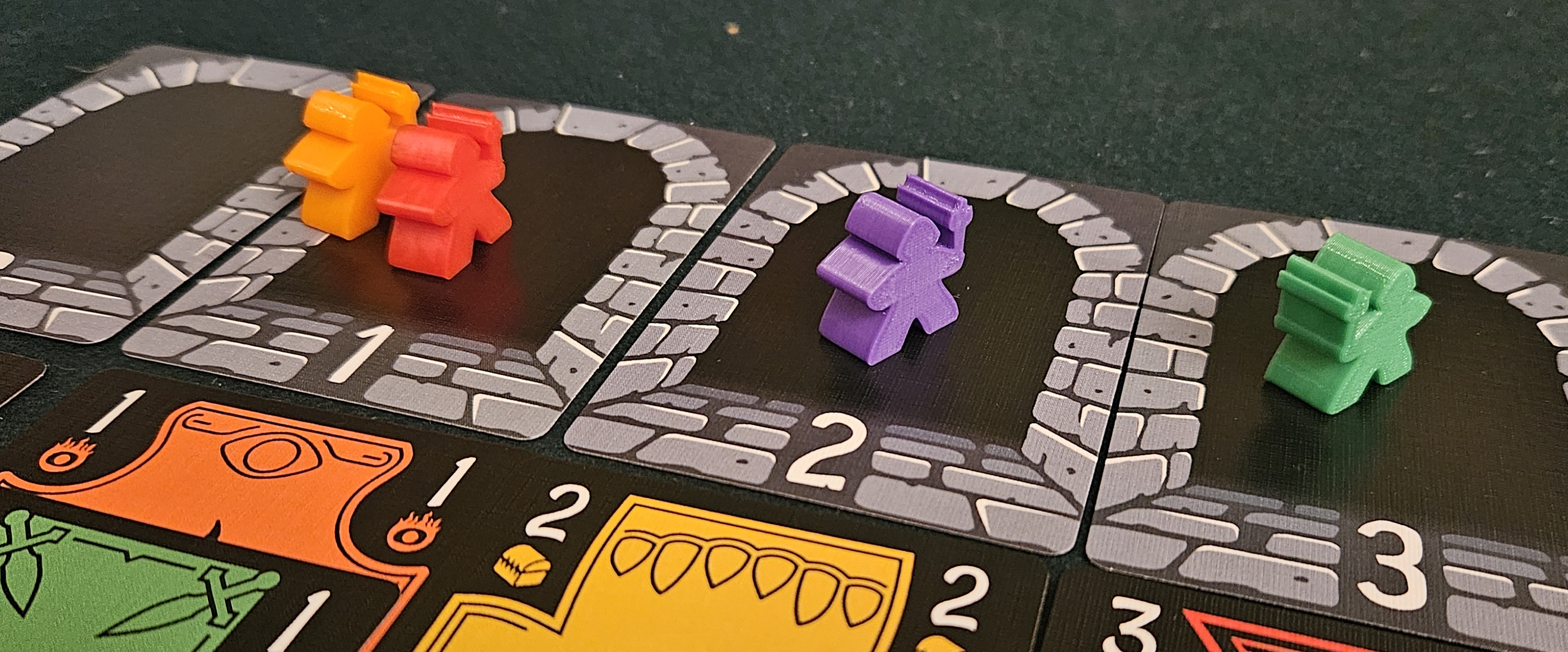
Check out our hapless happy adventurers!
What makes Torchlit so gripping is the way these elements add to more than the sum of their parts. The torch, for instance, is a simple contract bid. But the way it functions, granting points for a successful bid but potentially nudging somebody else’s score should you flub, adds a spatial element that’s never far from mind. It also helps that you’re given a last-second chance to alter your bid, swapping out your torch for the final card in your hand.
Meanwhile, the layout of the dungeon is unusually dynamic. Playing the low card to make yourself the dungeon warden is a formidable option, potentially letting you stack your target destination with points. Then again, your control is only partial; other adventurers can bully their cards into the mix, increasing their loot no matter how overbearing your command.
Oh, and there’s plenty of elbow room for sabotage. Remember, everyone who has the winning rank moves forward. With a carefully-timed dragon card, it’s possible to trick rival adventurers into blundering out of their current high-value chamber in lieu of some pittance down the next hall. This is when Torchlit really comes to life, everybody in your merry band going out of their way to trip up their besties. Then again, maybe they want to dive deeper? It isn’t quite Schadenfreude, but it’s tinkering in the same workshop.
Like any good adventure, the last few tricks are the most exciting of all. Usually by that point everybody has settled into a groove, either closing in on their target or trying to squeeze into a room with high-value loot. Like the best trick-takers, the path between full control and a vaguely controlled tumble is narrow, but also faintly visible in the wavering light. That’s where Torchlit thrives, those moments of cold hard agency almost startling when they appear. If you can’t manage a good score on your own, well, there’s also the possibility of forcing the winning player to go halvsies with you. That’s what happens when multiple adventures finish in the same room. It’s always a bummer. Unless, that is, you’re hoping to take somebody down a peg.
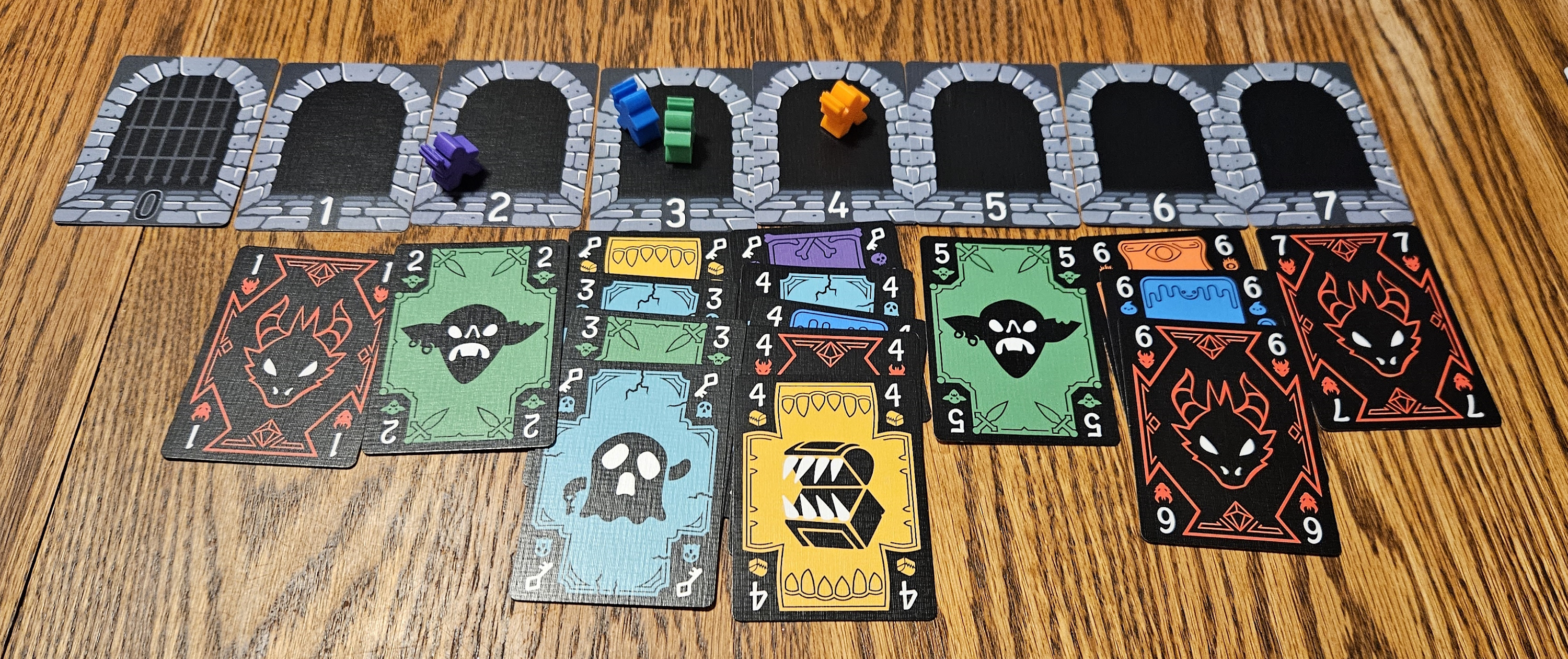
Key cards deepen the decision space.
Like I said up front, Torchlit is very nearly a hybrid trick-taker. It often feels like one, albeit without the burdensome rules of titles like Brian Boru or Arcs. Once again, right when I think I’m growing tired of this eldest genre, somebody comes along and shows me something new.
(If what I’m doing at Space-Biff! is valuable to you in some way, please consider dropping by my Patreon campaign or Ko-fi.)
A complimentary copy was provided.
Posted on December 10, 2024, in Board Game and tagged Board Games, Torchlit. Bookmark the permalink. 10 Comments.

 SPACE-BIFF!
This sounds delightful!
It really is. Fair warning, it’s just uncommon enough that it may require some slight recalibration. But it flows after a round or two.
Thank you for your exceptional coverage of some of the IGNM games! I’ve enjoyed reading these.
Thanks, Chris!
This can now be preordered!
https://www.newmillindustries.com/store/little-dog-games
I tried this game and the rule book needs some work.
Question for you, can you ‘win’ and ‘lose/warden’ in the same trick.
According to your explanation, the highest rank card (by suit, red>lead suit>other suits, than by its value, 1-7) determines the value that moves characters along the dungeon and the lowest valued card is the lower/warden for the trick.
So specifically, if a played trick is 1 blue, 0 red/trump, 1/blue, the winner is 0 red, meaning all 0 value card get to move their characters. The loser is 0 red?
For further clarity, if a played trick is 1 blue, 0 red/trump, 0/blue (only change from the first example), the winner is 0 red, meaning all 0 value card get to move their characters. The loser is 0 blue? (in the rules the last player from the lead player is tie breaker order?)
Yes, you can advance and be the warden in the same turn. There is no such thing as “losing” a trick. The rulebook terminology is clear that the winning number advances while the low number becomes the warden. Those can be the same number.
Pingback: Best Week 2024! Better Together? | SPACE-BIFF!
Pingback: Photograph of a Battlefield | SPACE-BIFF!
Pingback: Tricker Taker Soldier Spy | SPACE-BIFF!