Where a Million Diamonds Shine

If Imperial Miners used one of those home DNA kits, it would swiftly find itself on the front page of Reddit as yet another story about one’s parentage being thrown into dispute. Despite being named to capitalize on the success of Imperial Settlers, itself a descendant of 51st State — but also a parent to the other 51st State — Tim Armstrong’s design doesn’t actually display all that many of its predecessors’ hereditary traits. Why do I look so much like your college sweetheart, MOM?
But maybe this is a good thing. Freshly doubtful of its pedigree, perhaps Imperial Miners can forge its identity anew, free of the family’s medical history of clutter, obsessive hoarding, and frustrating expansions that require players to sort through multiple decks of cards.
Well. At least Imperial Miners escapes the first two fates.
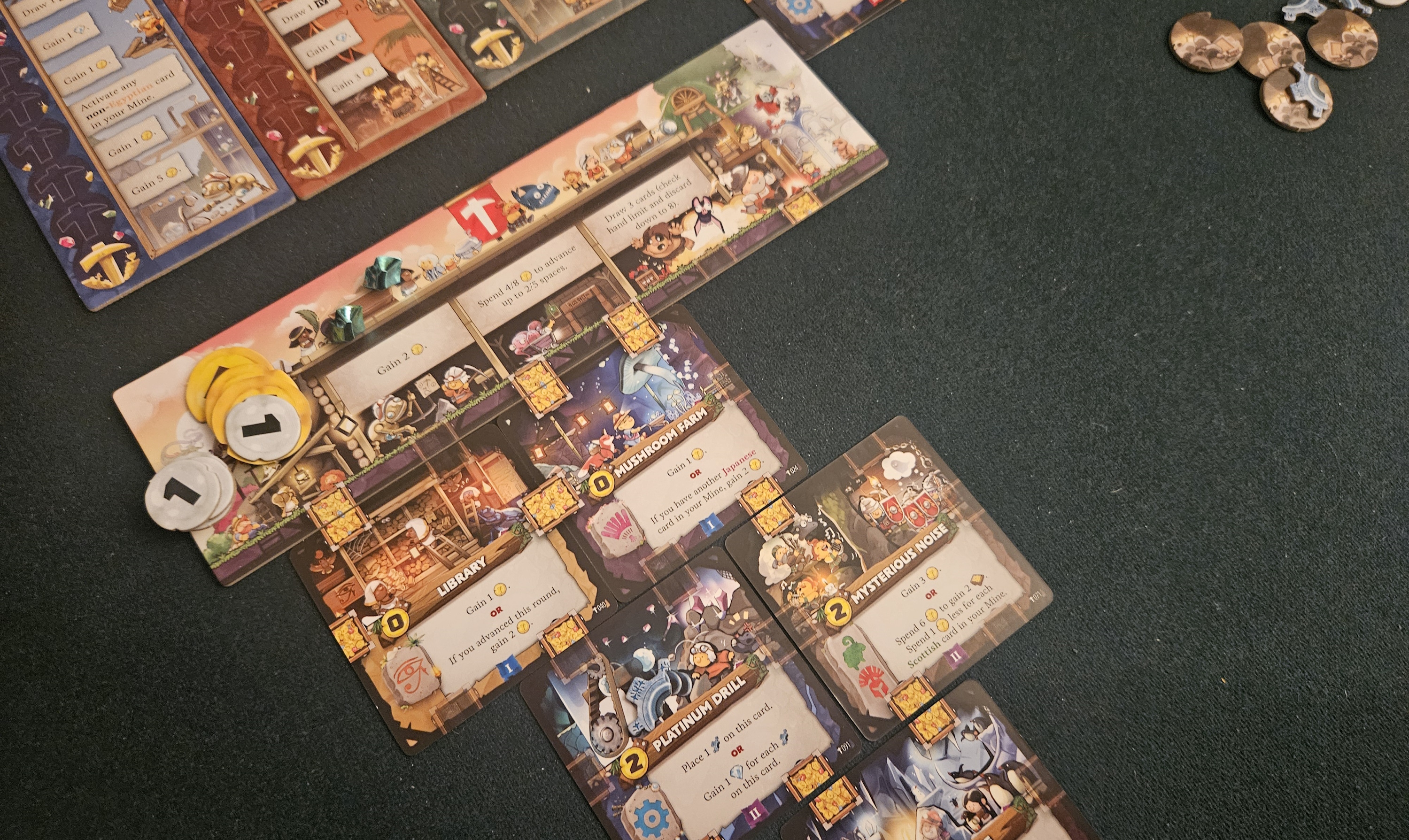
Digging into the earth.
As you may have gathered, the first thing to note about Imperial Miners is that it really has very little to do with Imperial Settlers or any of its cousins. Gone is the three-layer dip tableau, gone is the double-sided playspace, gone are the individual faction decks pit against a different universal deck.
The factions do return, albeit poured into a shared jumble from which everybody draws their assortment of various mining chambers. Indeed, much of the game revolves around trying to sort that jumble into something functional, like welcoming castoff children into a found family.
Fine. Enough with the family metaphor.
Your goal is to dig downward from the surface one card at a time. Turns are pleasantly unburdened, not to mention played out simultaneously with your fellow players. Someone reveals the top card from the event deck, and then everybody adds a single chamber to their mine. There are one or two placement rules to keep straight, but they largely come down to “cards should be offset from one another” and “don’t dig a chamber without another chamber directly above it.” Instead, the focus rests mostly on lining up the proper edges for scoring bonuses, represented as gold-laden minecarts, and hunting for the proper abilities.
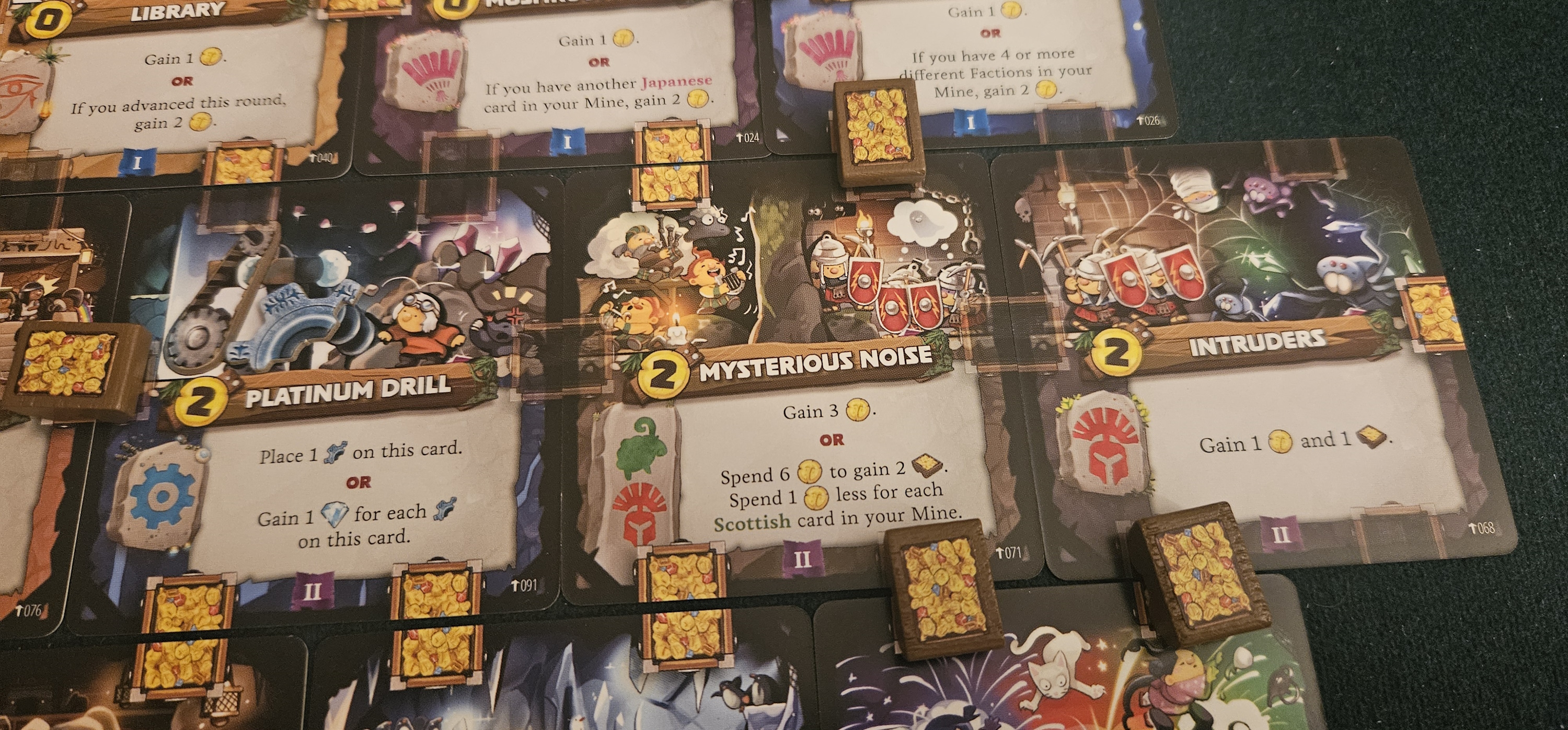
Atlanteans, Scots-Romans, Romans. True diversity on display.
The game’s big addition to the usual formula is that your placed card then triggers its ability, which begins a chain reaction of activations upward until you reach the surface. It’s a clever take on engine-building, especially since running those engines offers little decisions as you decide whether to bend right or left, making it more like operating a vehicle than nudging something into motion and watching it run on its own.
It helps that Imperial Miners is populated by a cast of weirdo kids, each of whom bring their own abilities to the table. As in previous Imperial outings, this is a strange bunch, a near-even mix of historical and fantasy nations. The Scottish, according to some stereotype I never got the memo on, are tremendously expensive, but also come paired with ways to reduce their costs, while the Egyptians move players up the game’s bonus tracks, the Japanese lean into their natural diversity (!?), and the Romans… actually, I forgot what the Romans do, which maybe outs them as the gang’s most whitebread kiddo. On the more fantastical side, the Atlanteans add little gears to their cards to boost productivity while the Barbarians collapse entire sections of their mine for temporary boosts that might need to be excavated again later.
Much of the game is spent digging — aha! — through the deck for anything that will riff on your other cards. There are a few counterbalances to consider, like the points generated by card adjacencies versus those earned whenever you send another chain of combos surface-ward. Other achievements ask you to jump through hoops, such as landing atop the best payouts on the advancement tracks or nabbing valuable fourth-level cards to attach to your mine’s deepest depths.
In spite of its many options, Imperial Miners is surprisingly light. Fans of Imperial Settlers, let alone the woollier 51st State, may find themselves taken aback by just how airy it is. Some of this lightness is, in fact, smoothness; I’ve noticed zero corner cases or ambiguities, always a nice thing to see from a publisher that has sometimes stuttered in translation. But the remainder is indeed a certain frictionless quality that leaves Imperial Miners feeling like we’re all going through more or less the same motions to produce more or less parallel scores. It’s faster than its predecessors by a long shot, but it’s also more siloed, with no room for interaction nor even much interest in letting any of its combos generate much heat.

The advancement tracks offer little bonuses.
If anything, its speed is also a minor detriment. Imperial Miners is so fast that it borders on understaying its welcome, like a friend who swings by to say hello only to remember on your doorstep that they’re needed elsewhere. A full session lasts ten rounds. That translates to exactly ten cards, which feels somewhere between two and five cards too short to run your mine’s full engine more than twice.
I know it’s odd to say that I wish that a game were longer, but there it is. The game’s first expansion only compounds the problem, with two new factions, the Weirdlings and Aztecs, who add a day/night cycle or assess bonuses according to what you’re holding in your hand. These need to be sorted into the deck; rather than piling everything together, each session should only be played with six factions. But when your game doesn’t even take an hour to complete, a lengthier setup starts to take its toll.
All told, I don’t want to come down too harshly on Imperial Miners. To some degree, my quibbles are derived from its broken pedigree, which speaks to a greater depth and complexity than it manages. But I do appreciate it as a lightweight option, not quite a filler but also short enough that it doesn’t consume a significant block of your average game night. I just also wish it had been more ambitious. It would have been nice to see players disrupt each other or combos be more pronounced. As it stands, the whole thing is so absent of hitches that it catches neither elbows nor much attention.
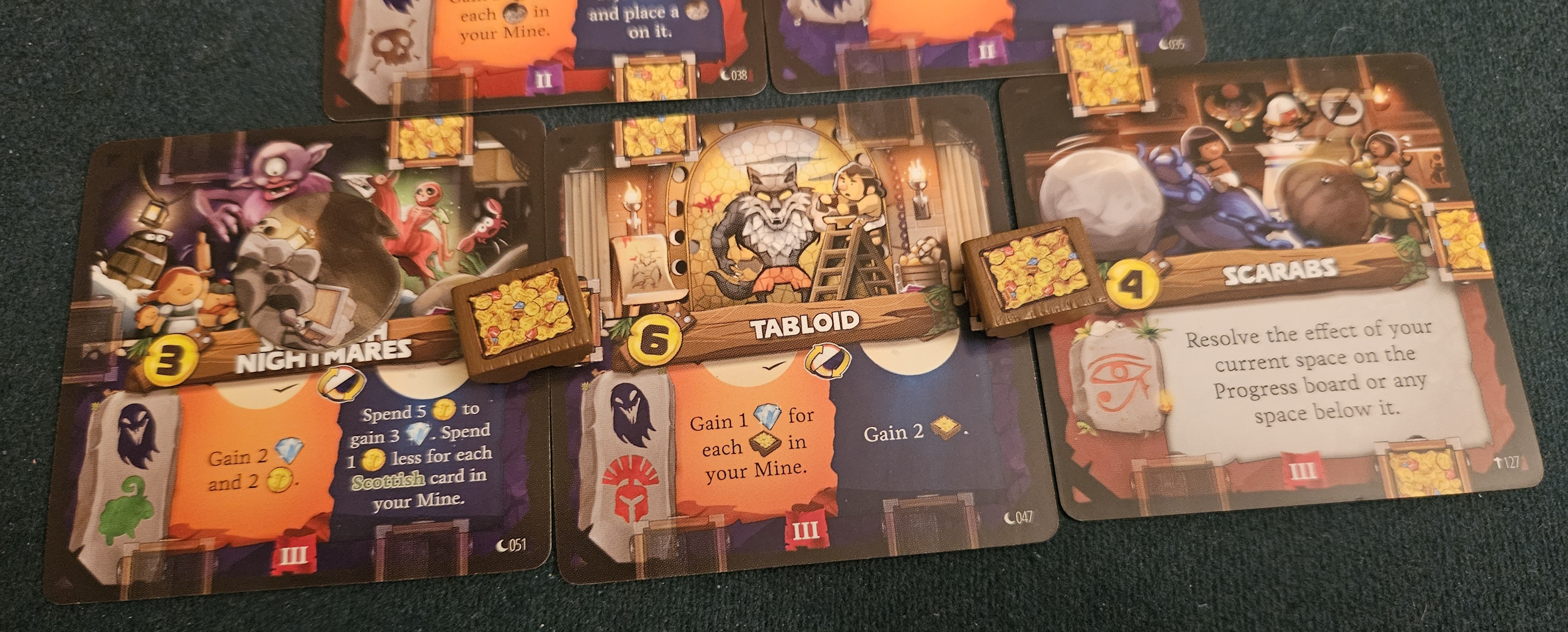
The Weirdlings and Aztecs add new concepts to the game.
Still, it’s a pleasant enough diversion, and its emphasis on cascading triggers is worthy of emulation. Imperial Miners carves out an identity distinct from the one passed down to it — and the life it chooses to lead is quiet, solitary, enviously innovative, and not as exciting as it could have been.
(If what I’m doing at Space-Biff! is valuable to you in some way, please consider dropping by my Patreon campaign or Ko-fi.)
A complimentary copy was provided.
Posted on November 5, 2024, in Board Game and tagged Board Games, Imperial Miners, Portal Games. Bookmark the permalink. Leave a comment.

 SPACE-BIFF!
Leave a comment
Comments 0