Intergalactic Knizia, Verse Three: Orbit
It is the future. The year 2,000. After enduring alien abductions in Silos and a testy diplomatic delegation in Ego, humanity has become just as insipid as ever. That’s the subject of Orbit, the third and final volume in Reiner Knizia’s intergalactic trilogy and the first title of the saga that doesn’t improve on one of the Good Doctor’s older games.
As reluctant as I am to say it, it shows.
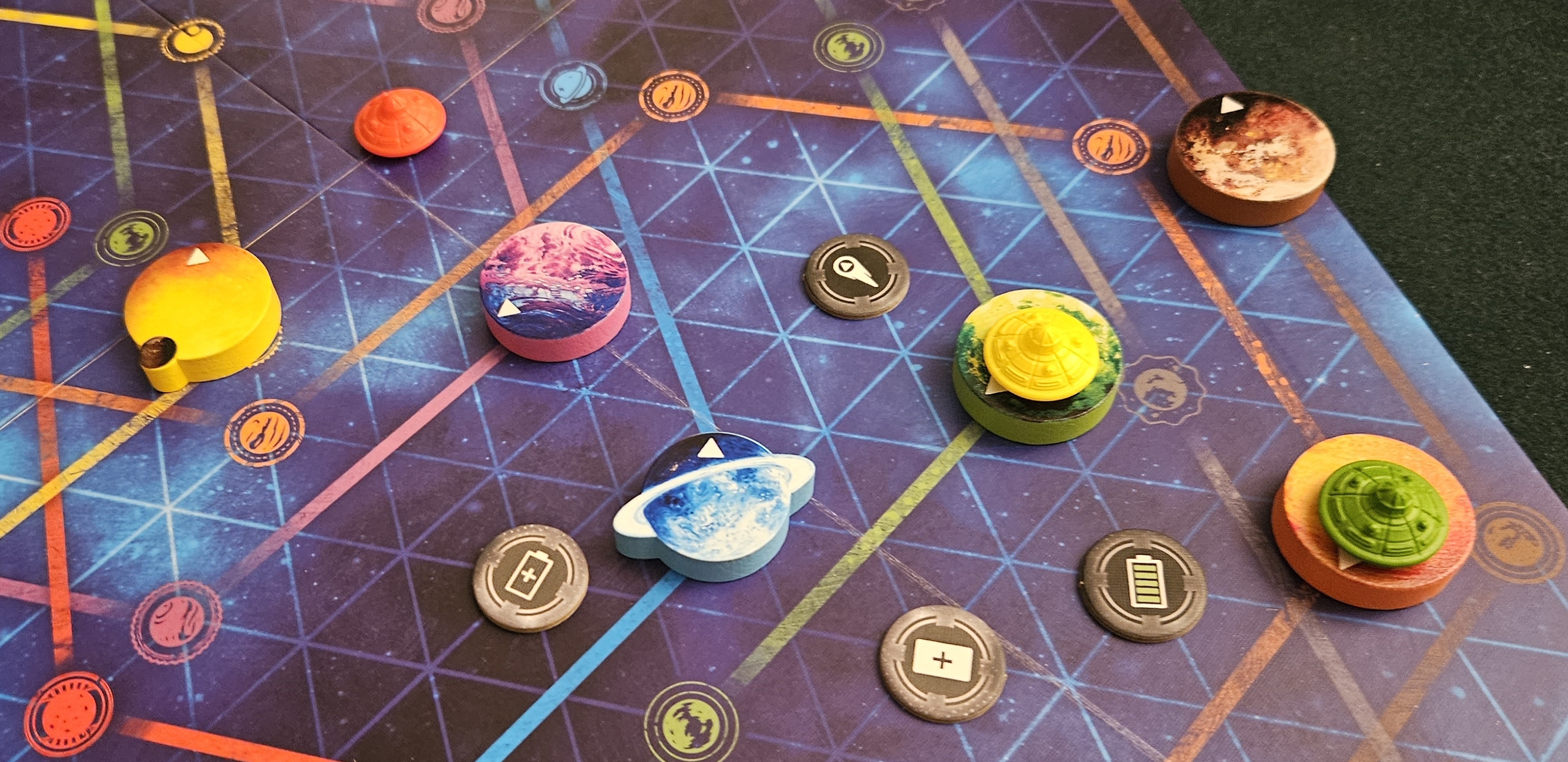
These planets won’t stay still for a dang minute!
Look, I’m as excited as anybody at the prospect of visiting alien worlds. Star Trek is my jam. My browser opens directly to the James Webb Space Telescope live feed. In Ada Palmer’s Terra Ignota, I was unreservedly on the side of the Utopians. So when I say that I will be the first body thawed out for the brain-probe to Alpha Centauri, you will agree.
Orbit is about interstellar tourism, but it somehow manages to make the prospect of dropping by Saturn for a weekend seem almost mundane. That’s fine. This is a route-optimization board game, after all. It only needs to succeed at the routes and the optimization.
It very nearly does.
Your goal is to be the first space tourist to visit seven alien worlds before returning to your home planet. The big wrinkle is that these planets are basically the three-body problem magnified to eight bodies, bouncing around like billiards balls on a frictionless table. Their routes are set. You can see them in advance. But every turn when somebody plays a card to move their little saucer across the galactic map, they’re also required to shift at least one planet. Sometimes these movements are simple. The ringed blue planet moves one space forward along its orbital path. The red planet jumps forward by two spaces. The green and brown planets both move. That sort of thing.
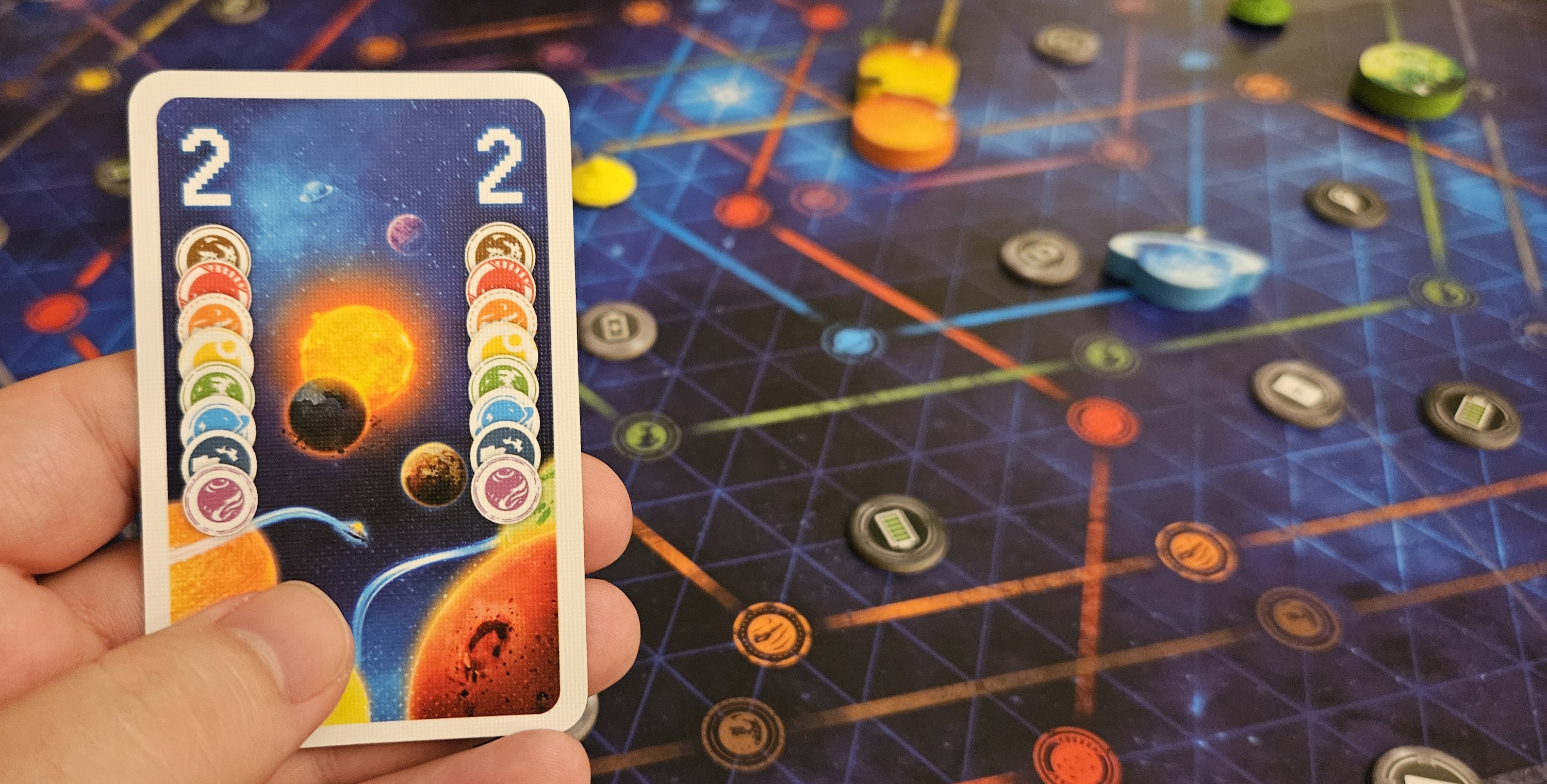
The cards aren’t the most exciting method for resolving turns.
Every so often, and especially once you mix in some of the expansions, things get zanier. These inject some much-needed life into Orbit, and they’re enough of an improvement that I really don’t recommend playing without them. Temporary nebulae can be placed on the board to slingshot planets farther along their paths, making it harder for players to intersect with their intended destination. The reverse side of the board allows planets to move along variable rather than linear paths, letting the current player alter their orbital mechanics entirely. Presumably these sudden reversals aren’t killing entire biospheres with their hundred-thousand-KPH inversions.
Not that it would matter if they did. This is the blandest sort of tourism. You’re chasing stamps in your passport, not that local flavor. The distinguishing feature of the purple planet is that it gives you a purple stamp, not that its distinct purple hue derives from a particular tundra lichen or its bromine atmosphere. The dark planet that creeps along the board’s outer perimeter might seem foreboding, but it’s more like the outer ring of a transit system, slow but perfectly useful if you aren’t in a hurry.
Ack! There I go again. Orbit doesn’t want to do those things and that’s fair enough. But what it does well isn’t especially interesting. Playing a card lets you move your ship — a weirdly burdened affair given the faintness of the lines on the board — and shift a planet, but also lets you gather energy cubes for additional movement or flip a planet to a new heading. Everything is functional enough. But the cards don’t inspire either cleverness or excitement. Regardless of what you draw, your movements will fall into the same general range. Occasional cards move extra planets, but don’t top off your batteries. For a Knizia game, it’s all so featureless.
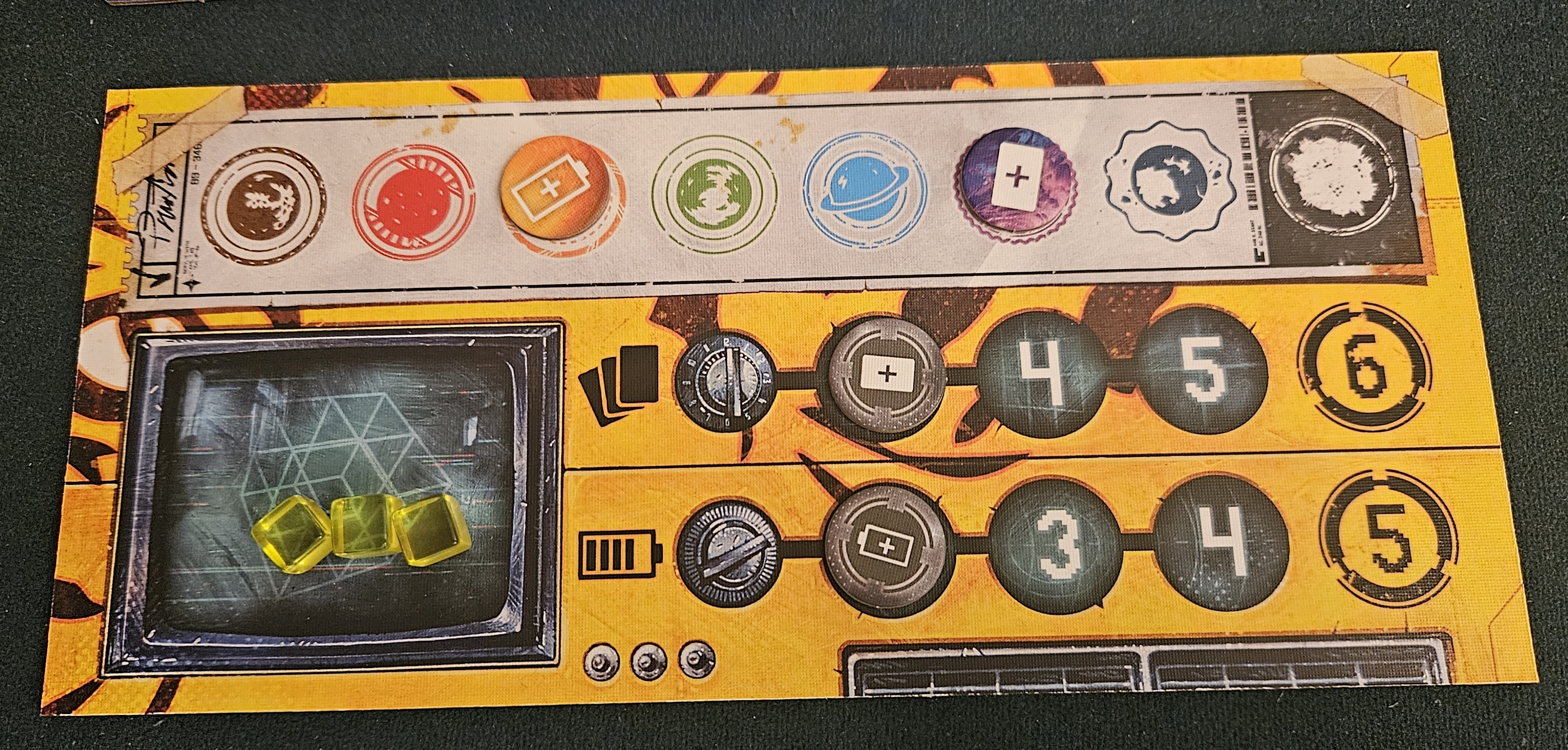
Upgrading your hand size and energy storage is worthwhile.
The game’s primary zest comes from its wellsprings of dickery. Because planets carry ships whenever they move, and can pick up ships when they intersect in marked spaces, clever players will often park themselves in the path of an oncoming planet. These intergalactic taxis bridge the void in a fraction of the time your little thrusters require, so much of the strategy comes down to hopping planets like a flea riding dogs across the park.
But! There’s nothing stopping a rival player from playing cards that spin a planet away from your position. Or, if they have one of the rare cards that moves a planet twice, blitzing it past your position. It’s like standing at a bus stop only for the bus to blast past like you’re the invisible man, putting you late for work and tweaking your social anxiety at the same time. Unsurprisingly, matches often come down to whichever player evades getting bypassed the most. When played with jerks, the whole thing becomes livelier, more animated.
That isn’t the same as being good. There are simply too many ways to get around the whims of those spinning celestial bodies. There are space stations for upgrading your hand or batteries, and even board-spanning wormholes that deposit you closer to your intended destination.
These wormholes represent the game’s conundrum in micro. Because Orbit isn’t a game that can be played poorly, neither is it a game that can be played well. In every single play, everyone has been within reach of their final planet. It’s like Around the World in Eighty Days, except everybody waltzes into that smoking parlor within a five-minute window. Also, no adventures were had along the way.

Oh, that’s nice.
I don’t want to short-sell it too badly. The problem Orbit places before you isn’t bad by any means. It’s certainly better than the last move-between-orbiting-planets game I played, with breezy rules and a pleasant aesthetic. It helps that you can smack a planet out of a friend’s reach. That’s never not funny.
But compared to Silos and Ego, Orbit is the runt of the litter. It lacks not only the pedigree of those titles, but also their gradual improvements and even sense of place. Gone is the player psychology, the adventure, the downright silliness. Instead, these tourists are the dull sort who view heritage sights through their cameras and refuse to taste the local cuisine. Maybe the aliens were right to prefer cows.
Orbit, along with Silos and Ego, is on Kickstarter right now.
(If what I’m doing at Space-Biff! is valuable to you in some way, please consider dropping by my Patreon campaign or Ko-fi.)
A prototype copy was provided.
Posted on October 17, 2024, in Board Game and tagged Bitewing Games, Board Games, Orbit, Reiner Knizia. Bookmark the permalink. 13 Comments.

 SPACE-BIFF!
I’m honestly really surprised by this! I’ve only played twice so far, and not with any of the advanced stuff, but I’ve really enjoyed its breeziness and dickery, and the games have not been overly close. It’s a lighter, more chaotic affair than the others for sure but that’s not a knock in my book. Can’t wait to try the team mode too.
Glad to hear it’s firing for you!
Lol, the “future year 2000” reminded me of this 🙂
That’s exactly what I was referring to. 😉
Reading your review gave me Fast Sloths vibes. Would this be a fair comparison? And if so, I’m duty bound to ask which you prefer.
Sorry, I haven’t played Fast Sloths!
Gee, it’s too bad that Bitewing couldn’t stick the landing for an impeccable sci-fi trilogy here; those have a way of sticking to the memory no matter what medium they appear in.
You mention it “doesn’t improve” on a Knizia original–is this actually a remake of something in his gameography? I ask both as a Knizia neophyte and because you made it a point to compare the earlier incarnations in both your previous reviews of these Bitewing titles. If this is a brand-new title, perhaps that’s the source of your disconnect here; not all “inspired by…” designs are, uh, inspired. If there IS an earlier game, is that one more worth playing, or are we at about the same level of meh?
No, this one is completely new. The other two are reworks.
This is the one brand new title of the bunch, hence that comment — I could see this working better for me down the line, for example with some additional breadth to the cards. And I will note, it sounds like some other folks have enjoyed it quite a bit more than I did! But, yeah, it didn’t quite grip me like Silos and Ego.
Looking at the campaign page to make a final decision regarding this trilogy, I noticed they did not feature your review for Orbit, while I knew you had written one. I was bound to check what was wrong about your blurb…
This ends my conundrum, as Orbit was the one I was the most interested in among the three (I already own Beowulf: The Legend and prefer this theme immensely compared to Egos which I just can’t grasp; besides, a game I on vs. a game that would cost me about 70€ with VAT and shipping is an easy choice to make).
I don’t quite like what Bitewing is doing, blinging out Knizia games like crazy. I used to think that it was good to be a Knizia fan because he was published by mass-market publishers and they were extremely accessible.
Babylonia, with its minimalistic components, still emphasized the design, at no expense of the aesthetic feel.
But here… we have meeples with little hats? The art is so busy and overdone I can’t read the boards. Sure it’s pretty and I am sure they went at great lengths to be functional (and the Babylonia board, in comparison, is neither pretty nor actually functional…), but in the end, this accumulation of art, components, silk-screenery, thematic fuss, just gives me an overall nausea for these games, while driving their price tag out of my reach.
I wish we will still see mass-market Knizia designs like Blue Lagoon and that it will not become a hobbyist fetish.
Hey Dan, looking back at this early review, I’m curious if you had the opportunity to try the 2vs2 mode, or the Nebular expansion that adds the upgradable engine and ways to speed up planet movement and block lanes. Seems like those who love this game really enjoy it, do so as a team vs team game with the collaboration and extra upgrades.
Sadly, I did not. I have a final copy now. Maybe I’ll give it another shot.
Pingback: Intergalactic Knizia, Verse Two: Ego | SPACE-BIFF!