Leave It in the Pattern Buffer

Montgomery Scott, chief engineer of the USS Enterprise, was known to quadruple his estimates for emergency repairs. This excess was eventually termed “buffer time,” and allowed Scott to maintain his reputation as a miracle worker. Later, after becoming stranded on the surface of a Dyson Sphere, he kept himself in suspended animation for seventy-five years via his ship’s pattern buffer.
The moral of this story is that Star Trek contains one too many uses of the word “buffer.”
Despite growing up on The Next Generation and loving “Lower Decks,” the episode about the Enterprise‘s lower-ranking officers who lived in fear of Commander Riker rather than regarding him as a lovable goofball who never learned how to sit in a chair like a normal person, I haven’t watched even one minute of the animated series by the same name. It isn’t anything personal. I just don’t watch much TV these days. After playing Star Trek: Lower Decks: Buffer Time: The Card Game, that doesn’t seem likely to change anytime soon.
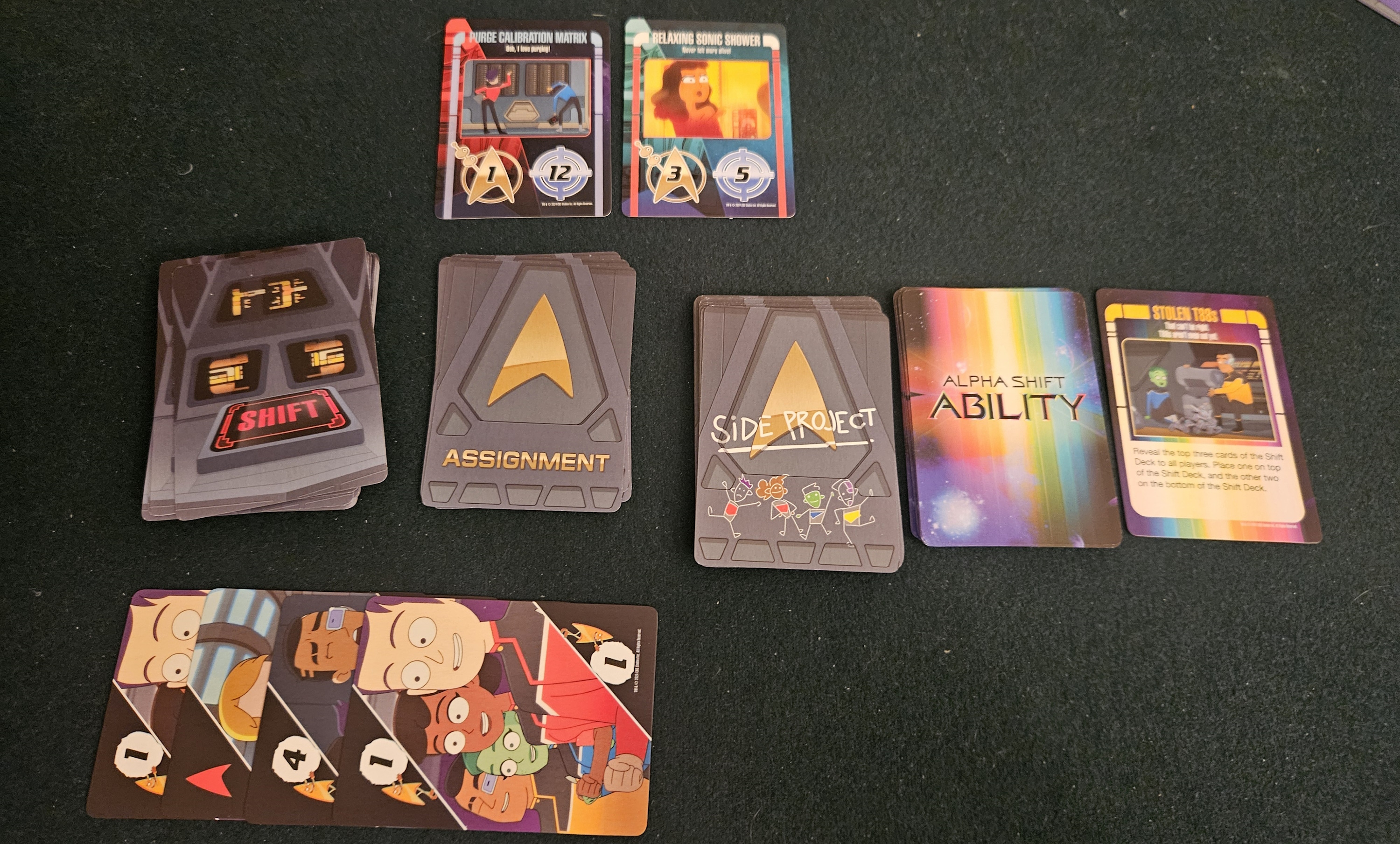
Buncha decks. Not holodecks.
Conceptually, Buffer Time tickles my inner slacker. The junior officers of Lower Decks are a harried bunch, handed one impossible task after the other by their ship’s command staff and left no free time for the elevated pursuits of the 24th century. Like, I dunno, attending clarinet recitals and making inappropriate recreations of Deanna Troi in the holodeck. Their goal, then, is to finish their assigned tasks with enough wiggle room to nab the occasional sonic shower.
If Buffer Time does any one thing well, it’s that it captures some of the absurdity of this utopian-but-deadly far future. Assignments include tasks like mucking out the holodeck’s bio-filter (by percentage, how much of that is Reginald Barclay?), unjamming replicators, or escorting heavy-drinking Klingon dignitaries. It’s refreshingly mundane, emphasizing the maintenance that would be necessary to prevent paradise from sinking under its own filth.
But that’s where the good stuff stops. Despite its humorous edge — much of which, this ignoramus suspects, was lifted directly from its source material — the game itself is drudgery.
The problem is not so much the game’s length, which is short indeed, or that it’s especially difficult, which it is not, or even that it’s so twee, which is a big part of its appeal. Rather, there simply isn’t much to do. Your crew is given a series of assignments. These require a certain amount of effort and afford, on occasion, a slight bit of leisure. Optionally, you can add side projects, which increase your leisure but also require more effort. Your goal, broadly speaking, is to accumulate enough leisure before the game ends.
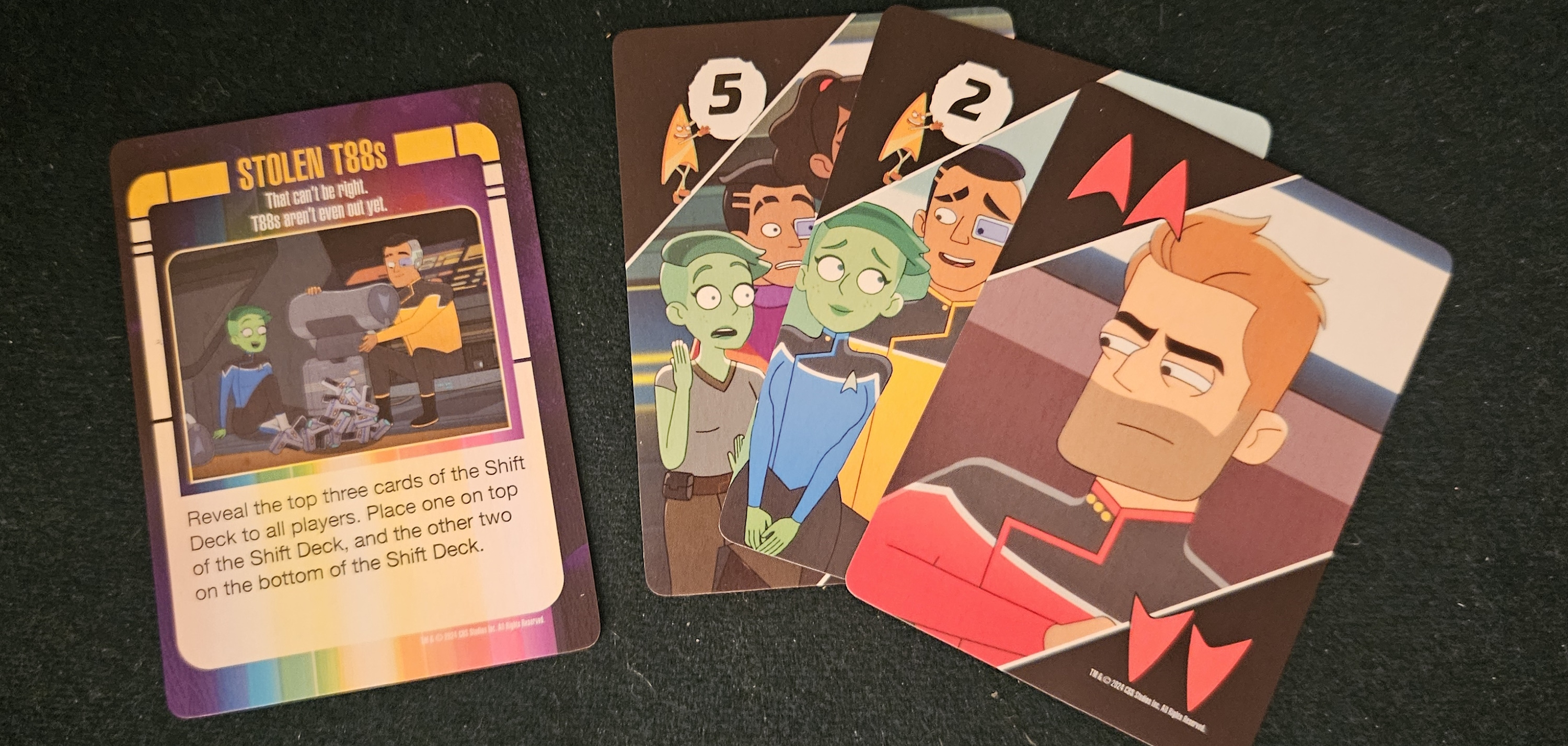
Effort furthers tasks, while officers are punks.
To fulfill these tasks, you draw from the main deck… and that’s more or less the entire thing. Most cards increase your effort, bringing you closer to completing your assignment and any side projects. A few cards, however, represent officers checking your work. Once too many officers appear, you’re given a reprimand and a new assignment, losing out on any leisurely side projects along the way.
Buffer Time, then, is a game about pushing your luck to the breaking point. You want to finish multiple side projects per assignment, but cramming too many hobbies into the cracks of your day job is a surefire path to failure. You have a few optional abilities, alpha shift cards, which upset the usual process of drawing from the main deck — a relief, since that’s like 80% of the game — but plenty of these abilities are as bland as the ordinary course of affairs. All that’s left is to draw a card. Then the next player draws. Then the next. The next. Next.
I suppose, if we wanted to strain for a deeper meaning, this mundanity could pass for a commentary on the drudgery that occupies these people’s lives. But Buffer Time has neither the imagination for such a commentary nor the chops to develop it into a worthwhile endeavor. In literature, certain authors can evoke emotions through the skill of their craft. I think, for instance, of how John Crowley’s Ægypt cycle alternately evokes confusion, tedium, and the thrill of discovery not only narratively, but compositionally, or how the final lines of Cormac MacCarthy’s Blood Meridian hammer certain refrains to coil the reader’s unease into a root of horror within the belly.
In a medium where “composition,” for lack of a better word, dictates how players interact with the artifact on the table, many designers develop a muscle for such things, utilizing the pace of their actions, their play mode, the way turns are passed, and so forth, to transform players into avatars of their intended emotional function. Think of the panic of Space Alert, the childlike excitement of Millennium Blades, the unbalanced scales of Doubt Is Our Product, the desperation of Comanchéria. These functions are hardly limited to serious or heavy games. Think, too, of the many small accountancies of nearly every Eurogame, and the way they cast every subject as a micromanager’s fantasy. Board games struggle with direct emotion, but excel when it comes to establishing tone.
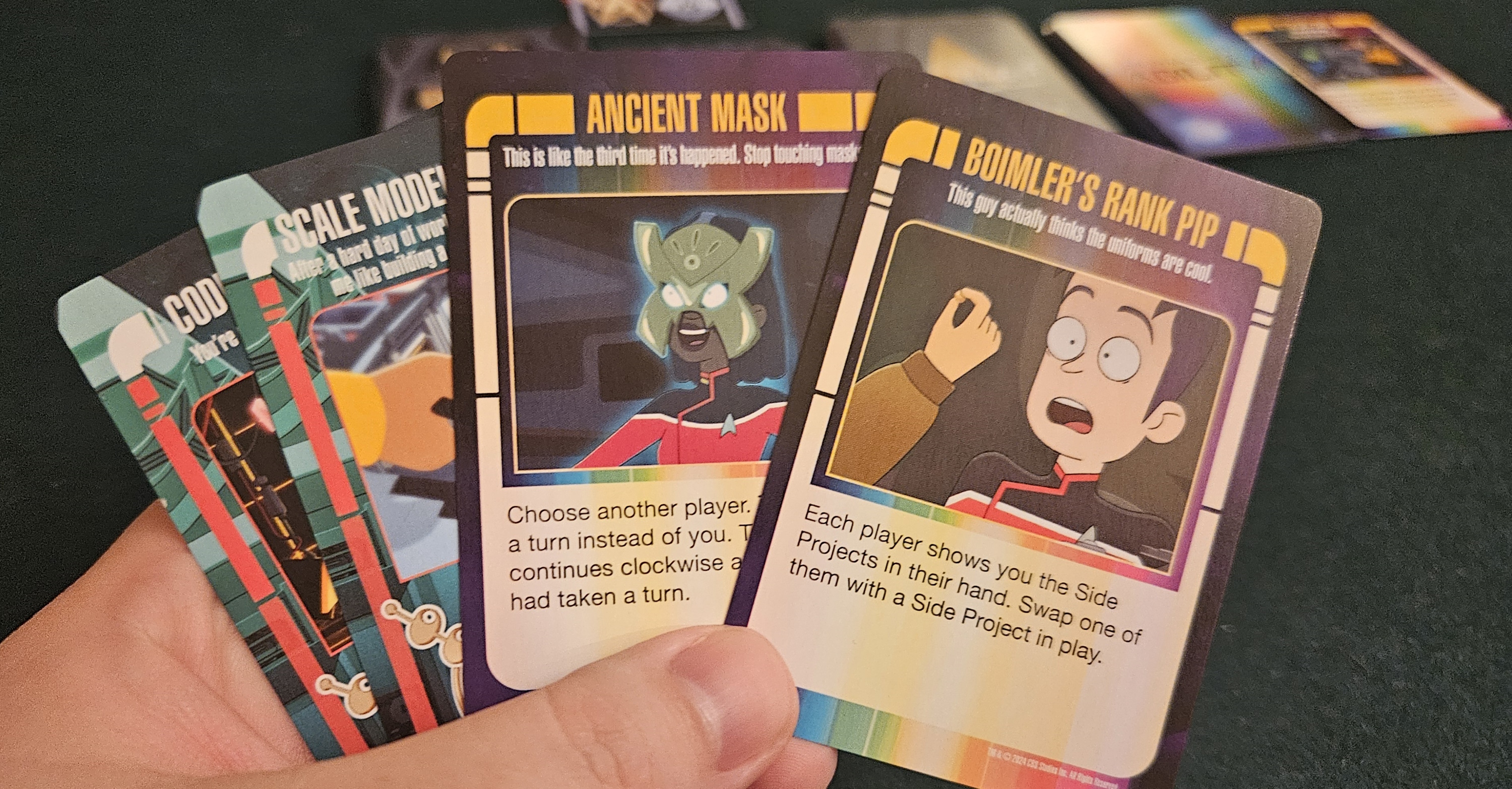
Sounds like a wacky time.
Buffer Time does not. Nor could we expect it to. Its credits, which list seven designers, a project manager, and a chief creative officer, have all the hallmarks of design via committee. This was created as a tie-in and nothing more. For all its overabundance of design, what’s missing is direction, purpose, or even game. I don’t know the first thing about Lower Decks, but it could be Enterprise for all it matters. Regardless of the specific series, Star Trek deserves better care than this undifferentiated goop. Even more critically, the game’s players deserve better.
(If what I’m doing at Space-Biff! is valuable to you in some way, please consider dropping by my Patreon campaign or Ko-fi.)
A complimentary copy was provided.
Posted on October 14, 2024, in Board Game and tagged Board Games, Buffer Time, Modiphius Entertainment. Bookmark the permalink. 2 Comments.

 SPACE-BIFF!
I don’t have a copy of the game, but I am a fan of the series and by your description I think tie-in hits (way too) right. There’s an specific episode about how the captain hears admit buffer time and starts straining the crew to the point of madness – all because of efficiency metrics or such.
Take that, crew! (and players!)