Our Sea-Washed, Sunset Gates

After spending countless hours trekking across Ryan Laukat’s more expansive landscapes via Sleeping Gods and its sequels, Primeval Peril and Distant Skies, Creature Caravan is a throwback to his earlier titles not only in terms of setting, but also time commitment. It doesn’t quite hit the twenty-minute duration of Eight-Minute Empires, clocking in at closer to an hour, but Creature Caravan shows Laukat in fine form, pressing his craft forward while once again proving why he achieved popularity in the first place.
Or, to use a more lively term, Creature Caravan is a banger.
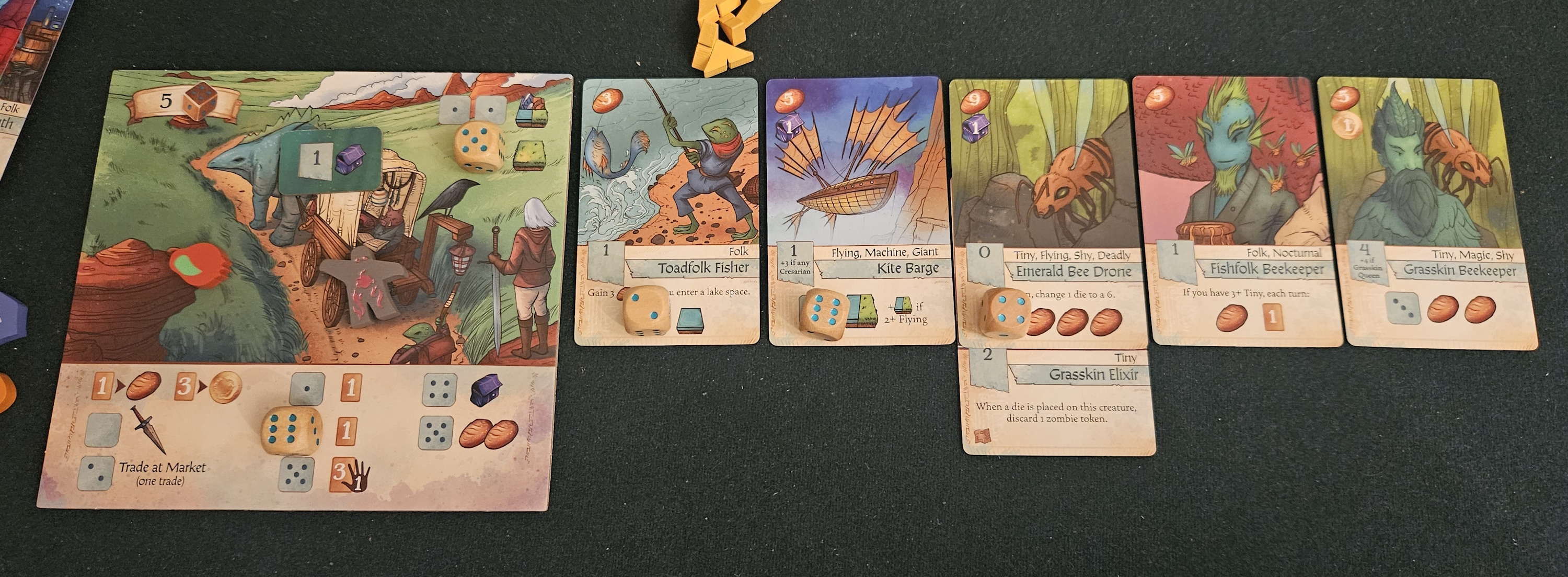
I love my weird family.
If you’re following the history of Laukat’s World of Arzium with rapt attention (disclaimer: I’m not), then perhaps the happenings of this fantasy realm will strike some familiar notes. Thanks to an outbreak of fire fairy-infested zombies in, um, I forget its name, let’s just call it LeftSidiumOfTheBoardium, refugee caravans have begun the slow trundle eastward to some distant sanctuary city. You are given command of one of these caravans, tending a roster of colorful wanderers and managing its limited resources as you choose camp sites, dodge zombie raids, and pick your way over mountains and through canyons.
Think The Oregon Trail with an immunity to dysentery and more bottled demons and you won’t be too far off. In some ways, this is The Oregon Trail I wanted all those years ago, a grand adventure that occasionally feels harsh but doesn’t kill my children the first time we float a river. Your caravan, represented on the map by a covered wagon, is offered tough choices at every turn. Cross a stretch of mountains, or stick to the prairies where zombies roam? Camp at a white tower for extra cards, or seek out journey-easing fruit?
The game’s central mechanism comes down to dice. Everybody starts with five of the things and plays simultaneously, rolling and assigning rattlebones until they run out of things to do. This simultaneity is the reason for the game’s speed, by the by, and those looking for deep interaction between caravans will be disappointed. There are points of intersection, but these are largely limited to the market, where swapping your earthly possessions for bread or slaying zombies will lock other players out of those same exchanges.
It would be easy to call this is a flaw of the game, but such an assessment strikes me as short-sighted. Not only because I often appreciate the fellowship of multiplayer solitaire, but also because it suits the game’s setting. There are victory points, of course, and the invisible forces we’re trading with are happy to gouge us with increasingly exorbitant prices. But on the whole this is a solitary enterprise, caravans rolling past one another in the night, too bone-weary and too aware of our mutual poverty to compete directly.
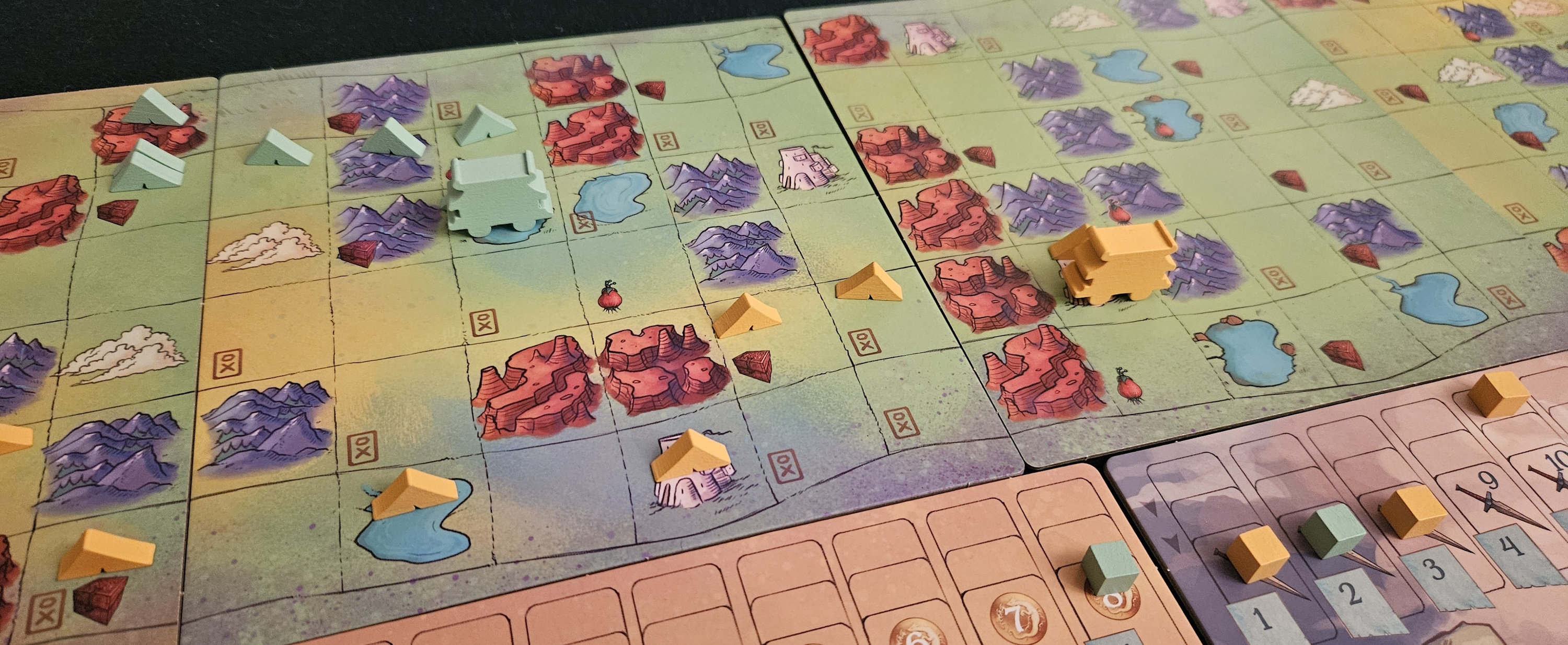
Creature Caravan isn’t a race game, but it sort of looks like one.
The game’s solitary nature also lands the focus where it belongs: the cards. This isn’t the first of Laukat’s titles to feature a cast of vibrant and intriguing characters, but it may well be his most robust troupe. Much of the gameplay depends on these characters. You’ll churn through quite a few, tossing some out of your hand for bread or coins to purchase others that suit your company better.
It goes without saying that these are a picturesque bunch. There are humans and frogfolk and sentient machines and at least one magical horse that gallops across entire stretches of grassland but also comes across as a treacherous ally more than a steadfast steed. These characters feel more alive than usual, although it isn’t easy to pin down why. Most offer new ways to assign dice, adding to your combat values against zombies, foraging for resources, or helping pull the wagon train. Others modify your abilities altogether, like a Serpent Trainer who somehow translates slain zombies into food or Grasskin Growers who, with an investment of bread, can bump two of your dice up to their maximum value.
To a one, every card also sports a variety of tags, keywords like “magical” or “delver,” which seem minor but both trigger point bonuses and deepen their sense of inhabiting this world. Every addition to your party is loaded. You’re always on the lookout for the right keywords, the most helpful abilities, little spills of additional points. Hence the need to churn through the deck. A full company can only host twelve cards, requiring careful consideration before you welcome every flying bat or ne’er-do-well who offers a steady supply of mystery meat to the caravan.
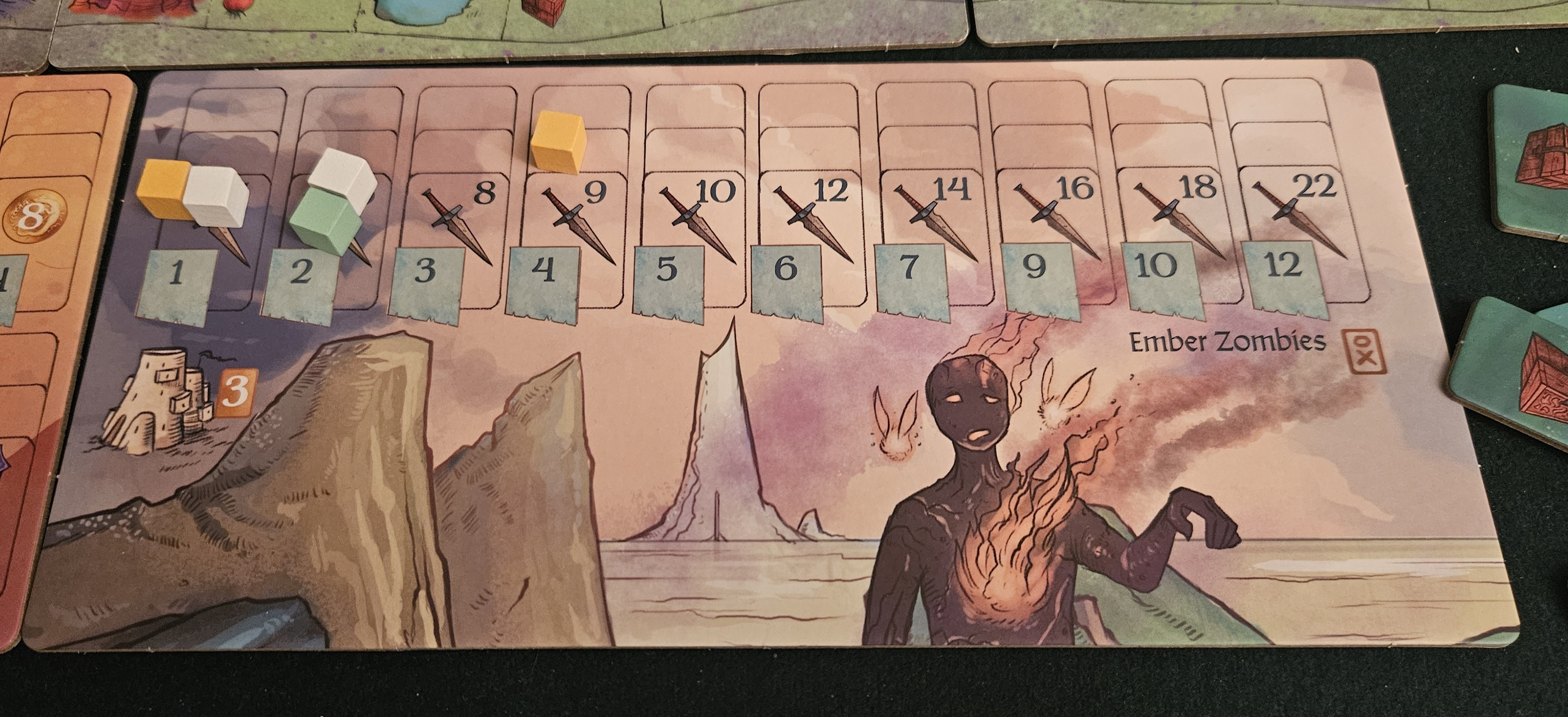
Fire fairy slander!
Along the way, Laukat manages one last surprise. Creature Caravan is not only beautifully crafted, not only a good board game about rolling dice and licking the spoon for every last victory point, but also a surprisingly empathetic take on caravans of refugees fleeing from danger.
From an outsider’s perspective, everybody in this ragged bunch probably looks much the same. One wonders at the reception they’ll receive when they arrive at the sanctuary, all dusty and sunburnt. Is Arzium dominated by a religion whose holy book includes thousands of injunctions to aid foreigners and migrants, but has decided that hate is more convenient? One hopes not. As insiders, we see the caravan for what it is, a melting pot of beings who wouldn’t have shared a cup of water if life hadn’t turned against them, people brought together by desperation and tenacity. Strangers turned family.
This is why I call those cards the proper focus of Creature Caravan. Watching one’s wagon cross the countryside is satisfying enough, but it pales in comparison to the breast-warming joy of assembling a company over the course of those dozen turns. With repeat plays, I’ve developed favorites, people I’m always happy to see pass through my hand even if they don’t find their way into this particular fellowship. There’s the Forgotten Princess with her locked chest full of gold coins. The Red Canyon Spider, terrifying to look at but capable of remediating a bad roll. The Theoretical Mystic, always scrying for additional cards — perhaps even sacrificing himself in the process. The Cursed Warrior, good in a fight but worth negative points upon reaching the city. My daughter’s improbable favorite, the Grave Robber, also knocks a few points off your score. “Undesirable,” they probably call him. But he’s a reliable source of gold, and gold can be traded for bread. In old journals and newspapers I read some of the things they called my ancestors when they were kicked out of this or that place. Then I read what people say about today’s huddled masses, and feel that flicker of despair. Creature Caravan isn’t a cure, but it serves well enough as a demulcent.
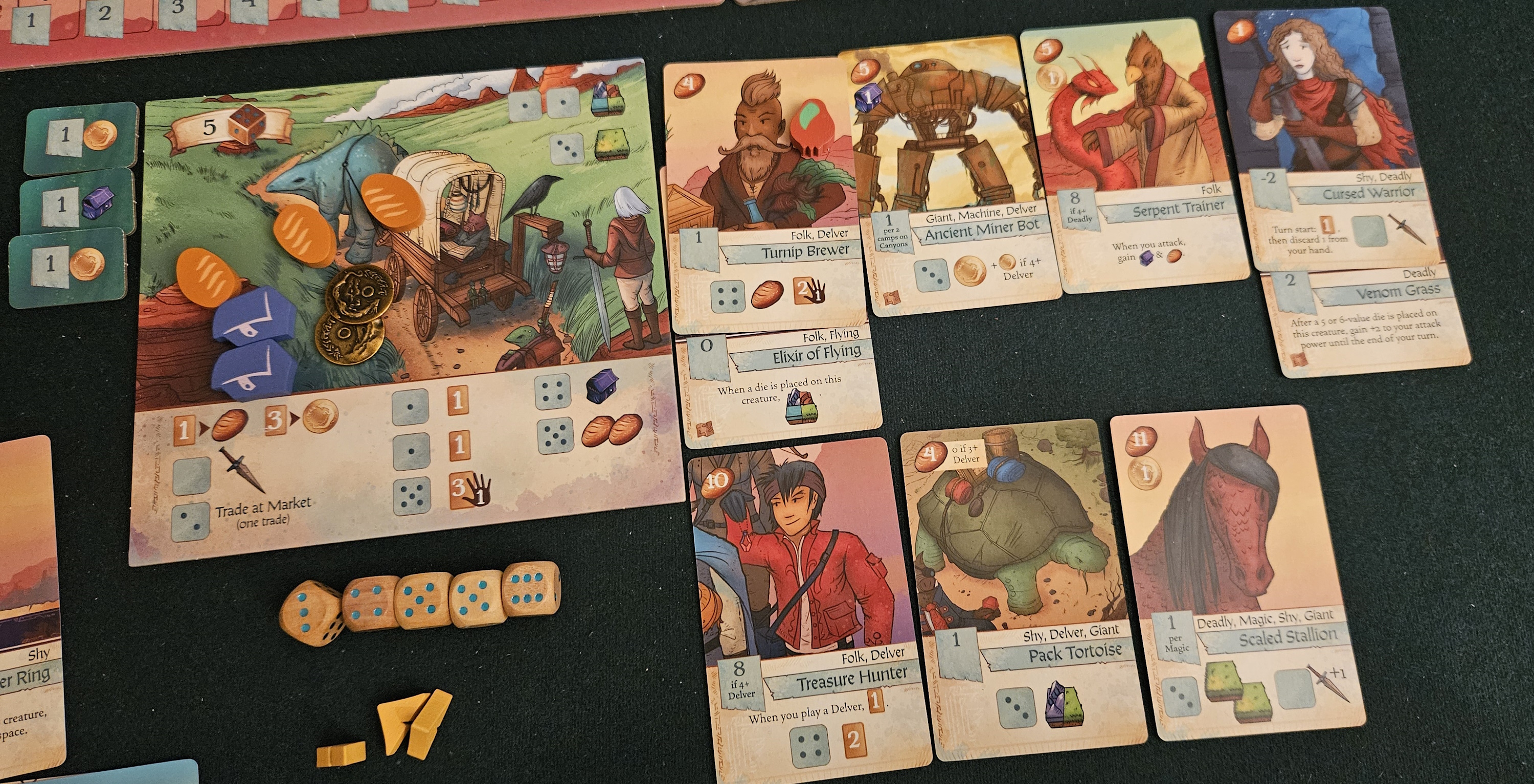
There’s real joy to be found in putting together the right motley crew.
I like this one. It feels good to play. There are multiple levels to that statement. Like some of Laukat’s best games, Creature Caravan has a certain effortlessness to it. In place of complex systems, it’s intuitive, breezy, welcoming. More even than that, it’s one more stop on a long journey, full of hardship that isn’t too hard and unknown weirdos who feel like friends. I hope, wherever they’re going, that someone cares for them as much as we did.
(If what I’m doing at Space-Biff! is valuable to you in some way, please consider dropping by my Patreon campaign or Ko-fi.)
A complimentary copy of the deluxe edition was provided.
Posted on October 3, 2024, in Board Game and tagged Board Games, Creature Caravan, Red Raven Games, Ryan Laukat. Bookmark the permalink. 3 Comments.

 SPACE-BIFF!
Board games as social commentary, now there’s an article idea for you 🙂
Hey! Wish I’d thought of that!
Pingback: Roamin’ Out of Memory | SPACE-BIFF!