Nightmare Jass

Lurching across the table like some horror-flick slasher, Kazuma Suzuki’s Somnia wears the skin of an older trick-taker. In this case, that victim is Mittlere Jass, a peculiar three-player Swiss trick-taker that’s all about trying to avoid the middle score. Like the other titles in this season’s New Mill Industries releases, especially last week’s Man-Eating House, this is a fiddly trickster that’s somehow all the more compelling for its jagged edges.
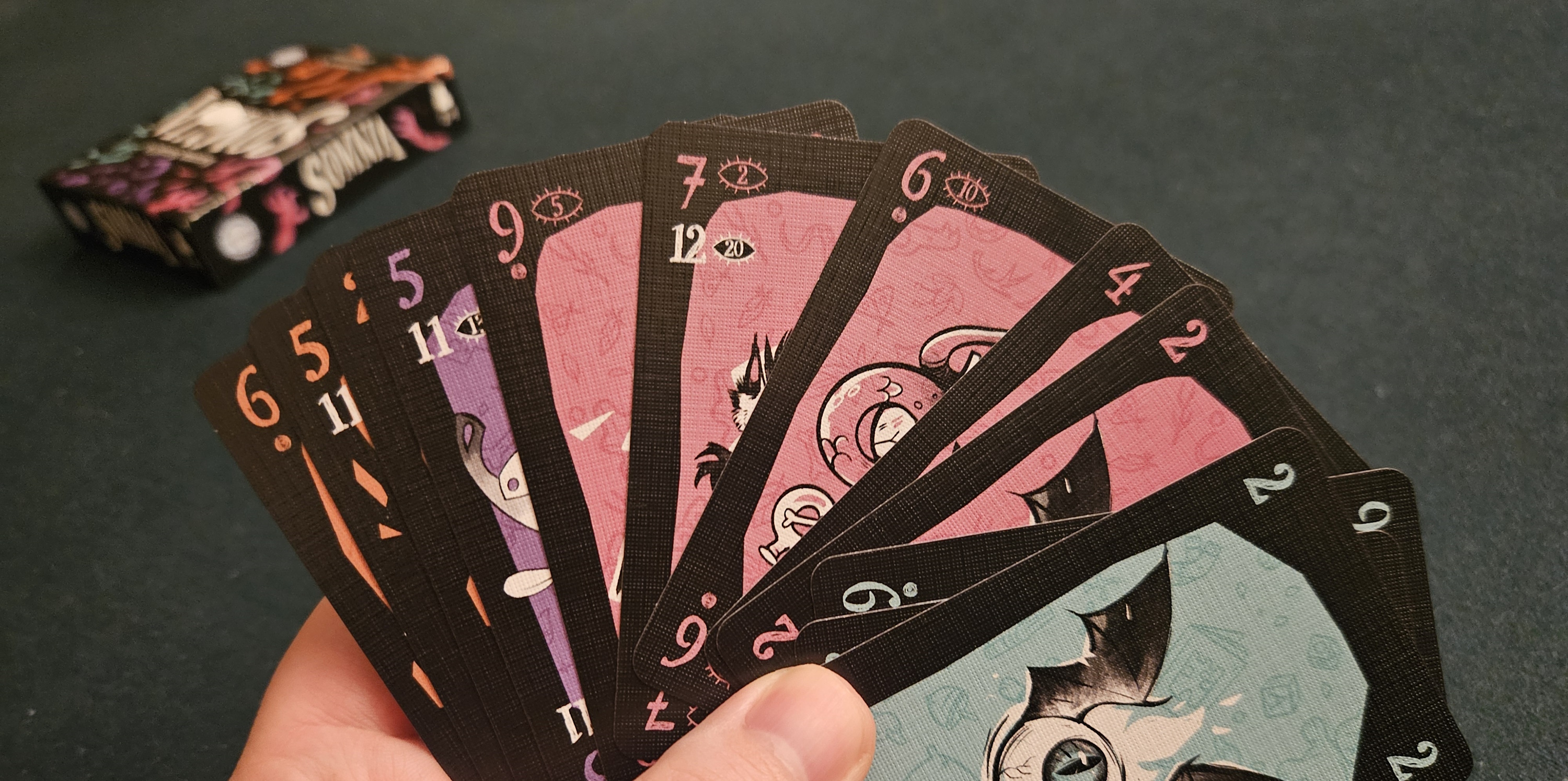
The picture! The picture! The trick-taking picture!
First, the basics. Trick-taking. Okay, not that basic. Trumps. Yes. Exactly that basic.
There is a trump suit in Somnia, but you don’t know what it is when the hand begins. More accurately, it has yet to be assigned. You know that moment about halfway into a hand when somebody can’t play into a suit, so they finally reveal something else? That’s when it happens. The card that gets revealed in place of the led suit becomes the trump. Rather cutely, Somnia provides a disc and the box lid itself as the means for marking which suit has morphed from anodyne to all-important.
And it matters a whole lot because the newly appointed trump cards may alter their values. Not too many of them. Just two. Mittlere Jass is what we call an ace–ten trick-taker, defenestrating the royalty to provide a tight deck of only thirty-six cards. In that grand tradition, Somnia’s deck is similarly slim, with point values assigned to various ranks. But two of those ranks transform when their suit becomes the trump. Their digits get a bump. Instead of 5 and 7, now they’re 11 and 12. Also, their point values change. Instead of being worth nada and two points, now they’re worth fifteen and twenty points.
These altered values are a big deal. Your goal in Somnia, textually, is that you’re trapped in some dream-realm and the only way to escape is by outrunning your fellow dreamers. On the table, that means you have a certain number of “life points” that gradually bleed out according to the game’s internal logic, so you’re working to avoid being each hand’s loser. In the three-player game, that usually means keeping your points at a specific target. You need to win at least one trick or you’ll lose a life point. But you also don’t want to score too high or you’ll lose a life point. But also you don’t want to come in second place. Or tie. If you do either of those things, you will, yep, lose a life point.

The box tracks the trump suit. Cute!
This rubric may seem convoluted, but, in the three-player game at least, it isn’t hard to internalize. This, perhaps, is one of Somnia’s other parallels with Man-Eating House. Not only are they both horror card games — Somnia less so — but also, they sink or swim depending on their player count.
In this case, I really wouldn’t recommend Somnia with four. The rubric blows outward at that count, adding too many provisos for its scoring to flow naturally. Last week I bellyached about Man-Eating House’s flowchart. This is that but even more bullet-pointy, and sans the handy reminder card. It works fine with two, but three is really where it shines, its shifting targets visible but never too difficult to parse.
Inside that Goldilocks zone, it’s how the game feels that really sets it apart. I mentioned that Somnia’s mid-game reveal is a big deal. That’s because it can potentially poison somebody’s score pile or transform a flimsy hand into a winner — albeit a winner that might push their score too high and draw the attention of whatever nightmare demons rule this realm. This is one of those nail-biters where winning a single trick might push you into that dreaded second place. Or push you too high. Or be exactly what you need to stay competitive. It’s not a game of hitting targets so much as it is about dodging targets, except everybody else is also dodging those targets. Somebody is going to get zapped. You just need to make sure it isn’t you. Easier said than done.
Still, I can’t help but feel that it’s a one-trick pony. Don’t get me wrong, I like Somnia. It feels good to play. Scrambling out of that middle position hits the right notes. But it doesn’t get me laughing like Schadenfreude. It doesn’t have the uncomfortable team dynamics of Man-Eating House. Reapers, Daniel Newman’s title in this latest batch of releases, has that nifty contract-bidding system going for it. Of these trick-takers, this is the one I’m least likely to find myself wandering back to.
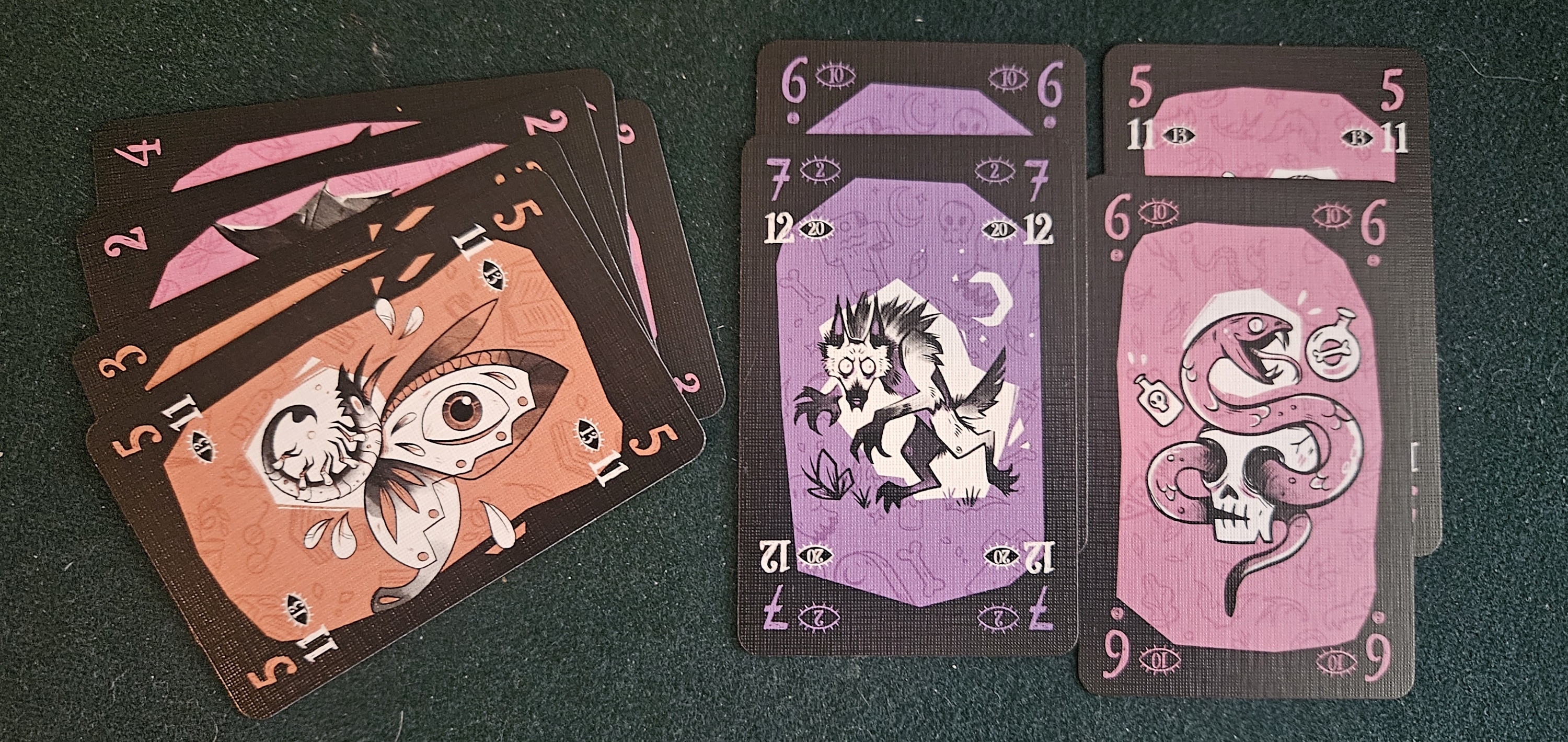
Pay attention to those scores…
In a way, Somnia is easiest to appreciate as a face-lifted piece of trick-taking history. The Jass family is strange and wonderful, and it’s lovely to see Suzuki’s bringing Mittlere Jass to a wider audience. For my part, though, I tend to appreciate some of the modern hobby’s more radical approaches.
Somnia goes up for preorder at New Mill Industries on October 1st.
(If what I’m doing at Space-Biff! is valuable to you in some way, please consider dropping by my Patreon campaign or Ko-fi.)
A complimentary copy was provided.
Posted on September 24, 2024, in Board Game and tagged Board Games, New Mill Industries, Somnia. Bookmark the permalink. 3 Comments.

 SPACE-BIFF!
This looks great. Getting traditional games to the table in a modern, easier-to-learn package is a soft spot for me. I’m in.
Nice! I hope you have a great time with it. New Mill’s dedication to importing these cool little Japanese trick-takers is admirable.
Pingback: Idle Tricks Are the Devil’s Game Table | SPACE-BIFF!