I Need an Adult
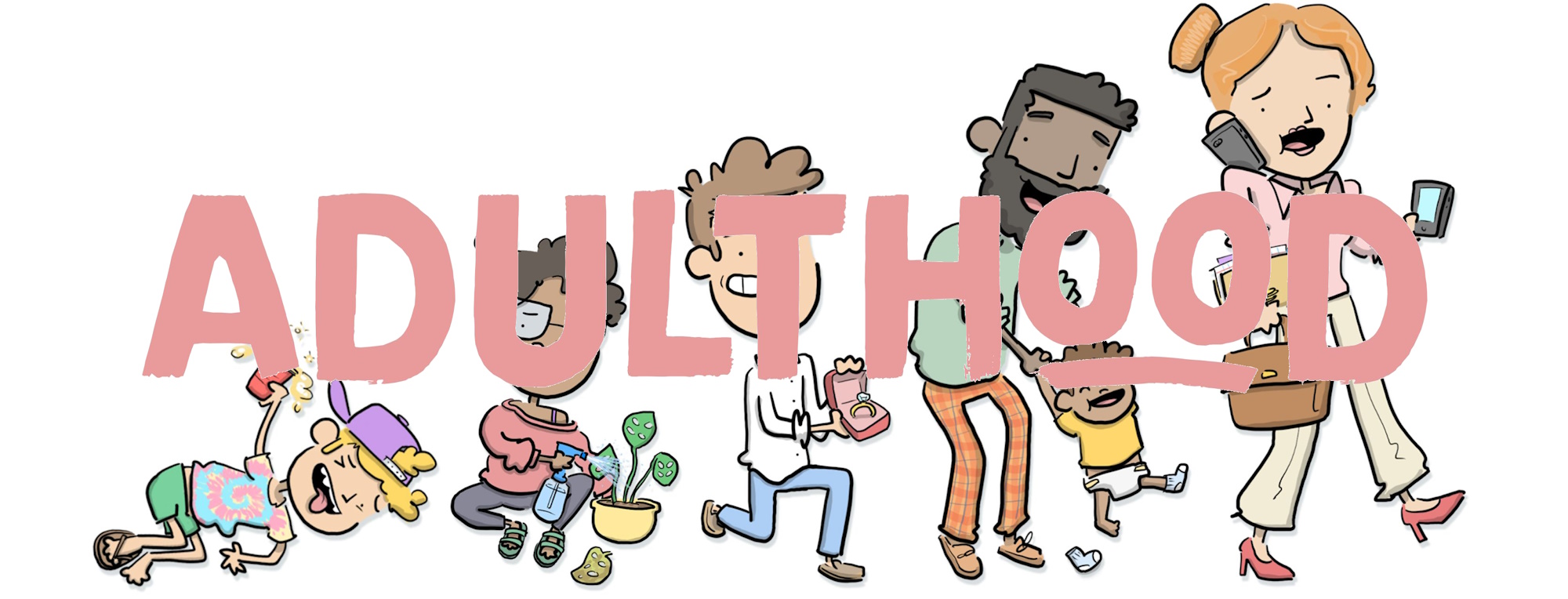
The first time I played The Game of Life — yes, the one from the 1960s with the spinner that went up to ten and the gender-coded pegs in the cars — I loved it. No kidding. I was pretty young, maybe twenty-six or twenty-seven (okay, I was twelve), and it was one of the first non-abstract board games I’d ever tried. I immediately asked for a copy for my thirteenth birthday.
And then I played it again. To this day, I’ve played The Game of Life exactly twice. To use a word I normally don’t like very much, that second play was just so boring. The spinner had lost its novelty, my little car beep-beeped through the exact same story beats, and one player sped to the end and had to sit around for half an hour while everybody else caught up.
Johnny O’Neal’s Adulthood reminds me a bit of The Game of Life. Don’t get me wrong, it’s the better game of the two by at least a dozen country miles. There’s no spinner, but what the game loses in toy factor it makes up for in almost every other regard. Still, though, playing Adulthood raises some of the same thoughts dredged out of twelve-year-old Dan. Namely: Is this really what adulthood is like?

Out here livin’ life.
Welcome to the rest of your life. In the ludic parlance of Adulthood, being an adult is all about parceling out your limited resources. The main one is time. Each round gives you eight time tokens to be spent across a handful of categories. Your career allows you to bleed away your hours for money. Community and leisure generate positive impact and happiness — victory points, in effect. Wellness produces energy, necessary for certain functions, but also handy as a stand-in for time when you need to burn the candle at both ends.
In addition to these universals, another, more defined resource exists in the form of cards. There are multiple decks of these to draw from. Some, such as the adult deck, are filled with endless variety, from wholesome experiences and volunteering opportunities to shady crap like buying NFTs to fill the twin holes in your head and heart. Others, such as the decks for partners and careers, are more limited, even bottoming out as a four-player game reaches its later steps.
It’s hard to know what O’Neil is trying to say with all of this. Are these decks shorter than the others because career and dating options dry up with age? Or did O’Neil simply not think it worth including more options? In either case, Adulthood contains plenty of editorializing through the cards’ satirical bent. Working as a plumber is time-consuming and doesn’t pay all that well, but if you stick with it you’ll get to spend even more time unclogging sinks. A home gym costs a bunch of cash and confers only a tiny benefit. Getting into board games is expensive. Insomnia will make you miserable, but at least you get an extra time token. Your high school reunion awards bonus happiness, but only if you’ve accrued enough wealth, fame, or family icons. Avocado toast is one of the most expensive cards in the entire game. Becoming an investor or being innately popular switches the game to easy mode. Your peers will hate watching you glide over life’s rougher patches.
There’s another deck, life events, which periodically doles out game-altering effects. These, like the rest of the cards in Adulthood, don’t walk a tightrope so much as they dive off the tightrope into a soapy tub filled either with candy or sharks. Some will face breakups, layoffs, and insurance bills, while others receive inheritances or elope with their partner to forego the price of the wedding. There are certain gestures toward balance — the aforementioned inheritance spells trouble with the family, while most negative life events allow you to take the meditation action for free. (More on that in a moment.) But let’s face it: Adulthood isn’t balanced, it isn’t meant to be balanced, if anything it should be even less balanced.

Choosing what will feature in my life next.
Its best details are those that arise in all its messiness, which is also where it happens to emulate life the closest. When the game opens, everybody draws three values. These are end-of-game victory bonuses. Maybe you want a bunch of cash, or you’re energized by friendship cards, or you’re into that tradlife — as in, married and promoted at work.
(Okay, that last one only works if you’re role-playing as a male. Adulthood isn’t prescriptive per se, it doesn’t assign you a set gender role or whatever, but it still leans toward certain lifetime achievements over others. To give one obvious example, polyamorous relationships exist, but only after you to draft a particular card from the market. Whether intentional or not, the things that are always permitted versus those that are only offered as exceptions establish the baseline the game expects players to trend toward. And lest you think I’m only including exceptions in one direction, it’s also worth noting that other human undertakings — religion, enrichment that isn’t “fun,” the joys of spending time on nothing at all — are also labeled as exceptions. It’s a limitation of the format more than anything, so I’m not offering this as a critique so much as an observation. But the fact stands: when points are largely produced through pleasure or impact, entire dimensions of the human experience go missing. The adults of Adulthood are either islands or archipelagoes, never the in-between. The landmasses are there, but absent the reefs and shoals and fathomless depths that seem empty but nevertheless connect them.)
ANYWAY. Values. So you have these hidden goals. When the game begins, you’re only aware of one of them. With meditation, you can pick up those face-down value cards to learn more about what your scoring objectives are. If your life hasn’t panned out as you’d hoped, you can even meditate to swap a value out for something new — although, again, anything you draw from that deck is initially hidden.
Adulthood goes one step further. For an additional bonus, you can seek out a partner who supports those goals. That bonus, however, is only achievable if one of your values bears an icon that matches your partner — to whom you are married, in case you wanted to mull further over which lifestyles this game favors.

Ah, the perennial question: should I date a teacher?
Despite the particulars, this is what Adulthood does best. It posits that adulthood is not drudgery. Oh, it will contain drudgery. Plenty of drudgery. But adulthood can also be a constant quest of reinvention, an unending process of asking yourself who you want to become, what sort of human being best inhabits your skin, whether you’re headed in the most fulfilling direction. The adulthood of Adulthood is richer when experienced curiously. You can blitz through the game assigning time tokens and spending money and dodging events. To come out ahead, though, one needs to ask what really matters to them.
To some degree, this makes Adulthood’s assumed answers to those questions even more jarring. But it also elevates Adulthood from a gently barbed take on age and aging into a celebration of life. Like The Game of Life, it trends in certain directions. But those trends have a gentler hand on the tiller than the one that steered the vessel in 1960.
It’s still sorta boring. Yeah, I said it. Especially after the first play or two, and especially with three or four players, Adulthood has a tendency to drag on. It only gets worse once you’ve seen all the cards the game has to offer. There’s no sense of connection between players, a missed chance to include community-building or dating or high-school rivalries or really any social element at all. Nor is the solitaire mode especially satisfying; in a truly baffling stroke, it strips out the values cards altogether, instead offering a bland timed points-chaser with none of the base game’s curiosity.
But in spite of all that, I have enjoyed Adulthood on a few levels. In much the same way my twelve-year-old self appreciated an examination of a life busily lived, I can’t help but be charmed by the many avenues Adulthood takes us along. It’s also a cultural artifact as much as anything. Infamously, The Game of Life was all about accruing assets, a tell for the values that produced it. Adulthood operates much the same way. At least I hope it does. Its emphasis on self-examination is welcome. Maybe half a century from now we’ll be able to see it more clearly. I hope for that, too.

Board gaming requires a hefty buy-in. Ouch.
Whether anybody will be playing this thing in half a century is a bigger question, not to mention a less knowable one. Here: I’ll set a calendar reminder. Let’s meet back here in fifty years. Deal? Deal. Bonus points if you come back with enough diamond or family icons.
(If what I’m doing at Space-Biff! is valuable to you in some way, please consider dropping by my Patreon campaign or Ko-fi.)
A complimentary copy was provided.
Posted on September 5, 2024, in Board Game and tagged Adulthood, Board Games, Brotherwise Games. Bookmark the permalink. 13 Comments.

 SPACE-BIFF!
Have you played The Pursuit of Happiness? The theme sounds the same as this, but not sure how the gameplay would compare.
Someone on Twitter asked the same thing! Unfortunately, no I have not. Maybe I should take a look.
12 year old Dan’s disappointment and awareness of the ludic limitations of the Game of Life, is the Space Biff origin story we’ve all been missing and waiting for.
I imagine Geoff was there on that fateful day making annoying car noises as the rest of table waited for him to finish his turn.
Haha, that’s right, I was always getting salty about ludic rhetoric.
Ha! Love it.
This sounds a lot like a sanitized version of Friedman Friese’s 2005 game Funny Friends. It even uses time tokens, has life event, profession, and goal cards, etc.
Have you ever played it?
Sadly, I have not.
I just wanted to comment that I, too, have a calendar in my Google Calendar called “Weird long term reminders” that exists specifically for this sort of “Let’s meet back here in 50 years”. The sort of thing that happens rarely but regularly in various forums & other online spaces.
This reminds me of The Game of Life the Card Game. Have you ever played it?
Sadly, I have not. Should I?
I was going to say, no. Definitely not. But then I realised, all of these games of life, even if they are not worth playing as games, are perhaps worth playing as documentaries. Reflections on the culture and the time that birthed them.
I would imagine so! Although that might be a project for somebody else, haha.
Pingback: Joy in the Burnout | SPACE-BIFF!