The Man DeLorean
Here’s what I’ve gleaned from watching one episode of The Mandalorian. It’s Star Wars, all right. Boba Fett is taking petty bounties to reforge his armor after it was melted by that sandworm on Arrakis. He learns how to ride a bipedal potato, shoots up a town populated by four hundred gungoons, and saves Small Yoda from his old nemesis IG-88.
This is me blinking in bewilderment. People like this stuff?
The Mandalorian: Adventures is a board game adaptation of the entire first season by Corey Konieczka. It isn’t about to persuade me to watch more Star Wars. But in a huge twist worthy of a montage about riding a potato, I wouldn’t mind seeing an expansion with more shootouts, heists, and general buffoonery.
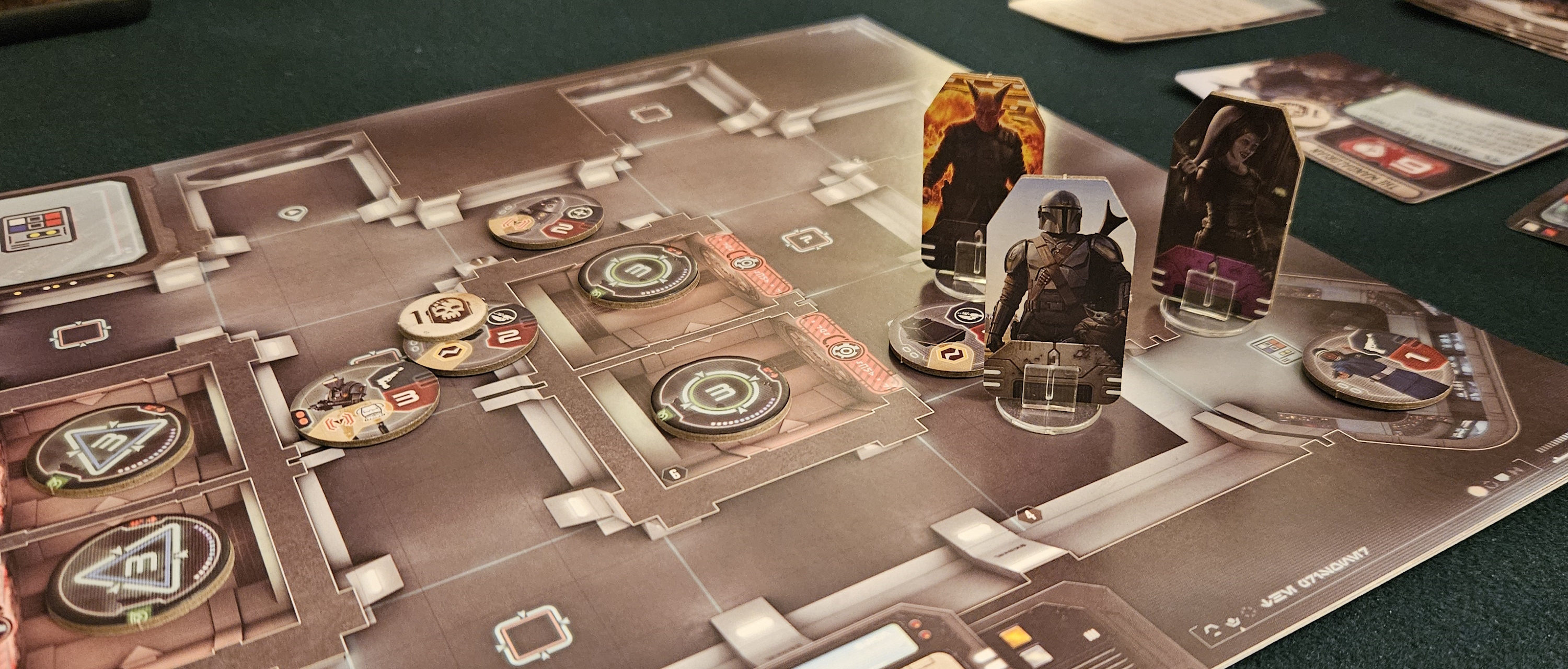
Three colorful beings walk into a high-tech prison barge…
First, a warning. Like a number of modern board games, The Mandalorian: Adventures is concerned with “onboarding,” worried that newcomers, perhaps those who appreciated the Disney Plus series The Mandalorian but who aren’t nerds for board games, might see the box on a shelf and decide to take a look, only to be overwhelmed by its wealth of options, icons, and everything else a modern board game offers. So it packs its best ideas behind a meta-progression system. After completing your first mission, you unlock more stuff. After your second mission, more stuff. Third mission, stuff. And so on.
There’s nothing wrong with easing the path for newcomers, but the approach here lends a false impression of the game as a whole. In its rawest form, players are presented with milk-run missions that offer little challenge. Amplifying this disappointment, there are only four scenarios in all. The mission booklet is deceptively thick, half of its pages occupied with comic-panel backstory that explain your motivations for saving instead of murdering an adorable muppet infant. Muppfant.
Remember the first episode, when Mando and IG-11 were dropped into a tough situation and had to use teamwork, their wits, and some truuueee grit to climb back out of the blue-milk basin? In the board game version, dozens of goons fell before us as grass before a scythe. A lightsaber scythe. Remember in the next episode, when another hopeless situation imperiled our favorite characters? I don’t. I didn’t watch the next episode. But I’m willing to bet it was cooler than the one-sided massacre the board game offered.
It does get better. New cards, new wrinkles. Tougher enemies. More icons. Not that icons are a virtue, but here they’re connected to the difficulty scaling. Eventually the game unlocks modifiers for each map, resulting in both a tougher version of the base game’s events and a series of randomized bounty missions. This adds significant life to the experience. I wish it had mentioned up-front that we could skip the tutorial mode. The five tutorial modes.

The card system is the real draw. Geddit?
The good news is that Konieczka is an old hand at crafting games that feel marvelous on the fingertips, and The Mandalorian: Adventures is no exception.
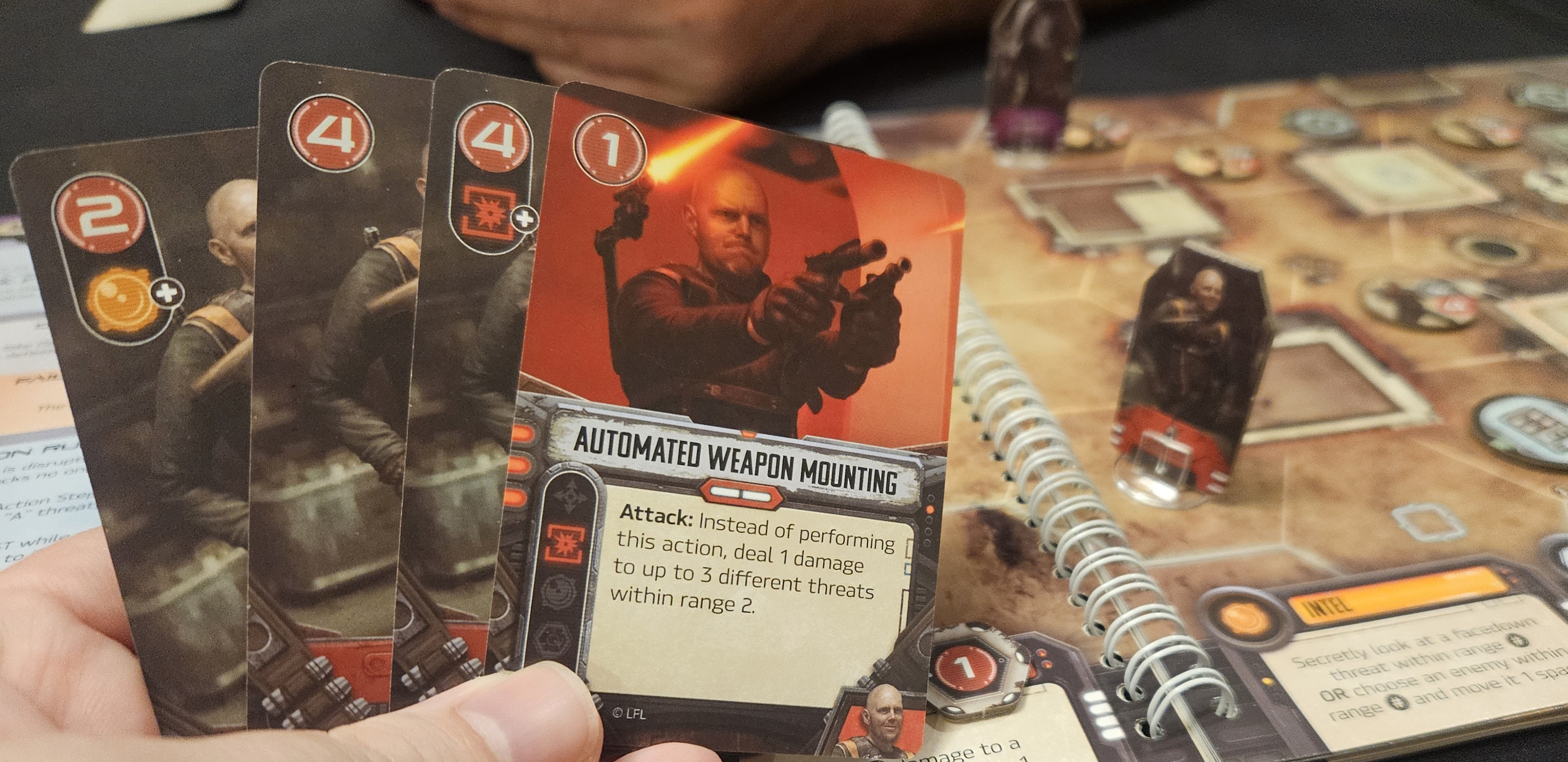
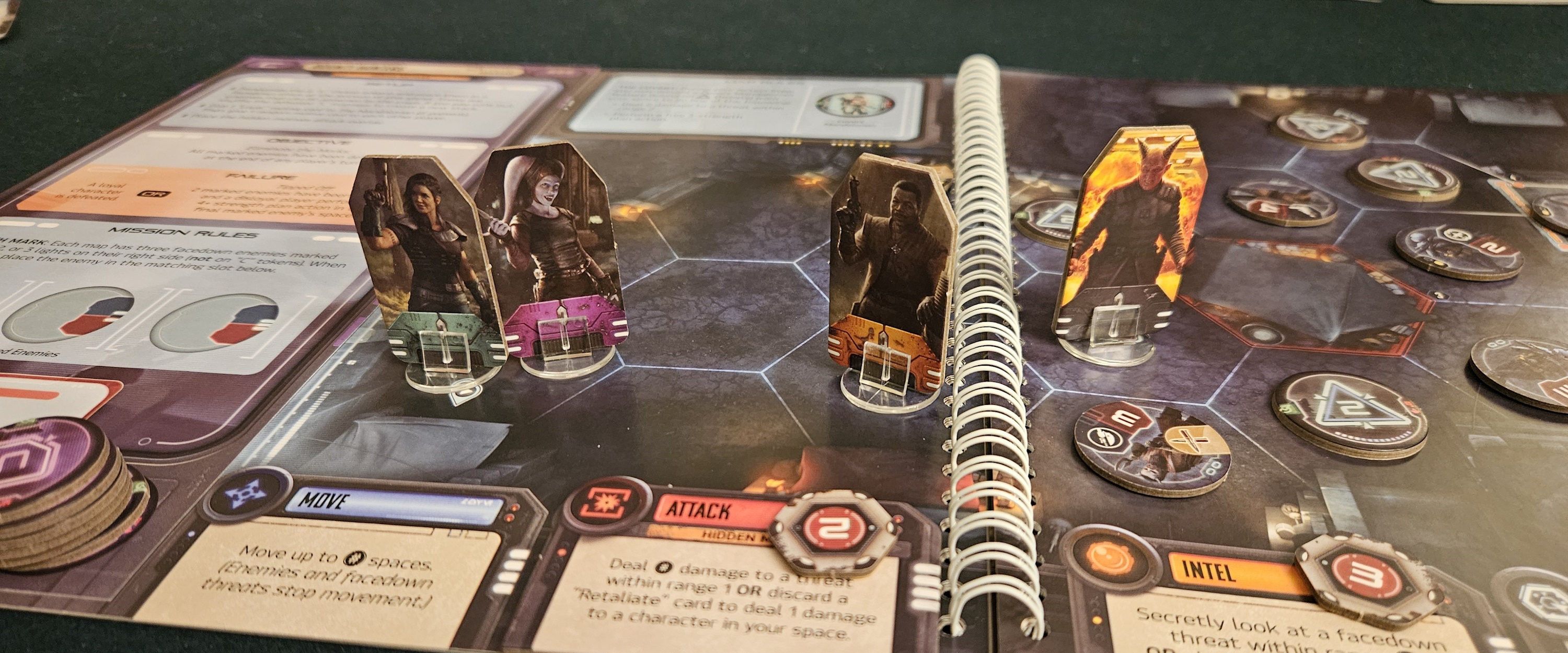
At heart, the game revolves around an action and event system that asks players to carefully meter out their resources. Most turns revolved around playing cards to two separate action slots. Higher-value cards result in more potent actions, letting you move farther, shoot harder, plan better, or tweak enemy positions with more tweakitude. The problem is that high-value cards trigger enemy events faster. Whenever an action slot reaches five total points, your enemies react. Now they get a chance to move, shoot, or otherwise disrupt your bounty hunters. Going over five points also triggers a crisis. This differs from one mission to another, but it’s always bad.
As card systems go, there’s some real cleverness on display. Unlike most skirmish games in Mando’s family tree, high numbers aren’t always a strict improvement over their lower kin. In many cases, staring at a hand of big numbers isn’t a good thing. You’ll be able to utterly scorch a baddie from the map, but you’ll also be inviting retaliation. The inverse is also true. Low numbers are presented as tactical opportunities to take more actions before those enemy events are triggered. Stringing together a series of turns that send your bounty hunters into an opposing camp, removing threats with all the precision of a scalpel without raising the alarm, feels great.
Which isn’t to say it feels entirely natural. Turns are numbers games, little puzzles to keep your digits under five. Or, if you must trigger an event, to hit five exactly rather than going over and starting a crisis. As the difficulty ramps up, enemies gain the ability to place number tokens on your action pools, making it all the tougher to stop events from happening. It reminds me a bit of Kevin Wilson’s recent Kinfire Delve series, with its emphasis on matching cards and hitting particular sums.
Boston is part of a galaxy far far away.
That isn’t the only Kevin Wilson touchstone. Playing the recent Escape from New York back-to-back with this title has been instructive. Both adapt much-loved material, reliving the sights and incidents that audiences expect from such a project. Both interpret their conflicts as geographical, conundrums to be solved via weapon ranges and movement distances. Both feature enemies that are largely static until set into motion by player activities, encouraging a sort of simulated stealth.
They both also include the possibility of betrayal, although I’m not convinced the system in The Mandalorian: Adventures is entirely functional. Certain missions can be played with a traitor in your midst, a fellow bounty hunter who will shock and surprise you when they pursue their own objectives instead of rallying around the flag. The easiest way for a traitor to succeed is by letting one of their teammates bite it in combat. But that’s not very exciting, so the game offers alternate ways for a traitor to win. These are tougher to accomplish, like letting an enemy convoy reach the exit or swiping The Baby for yourself. The rulebook calls these “legendary victories,” although they generally come down to luck more than deviousness. Whether a legendary victory is sufficient motivation to pursue such an objective rather than elbowing your teammates into danger at every opportunity may determine whether the traitor mode is worth the extra rules burden. Personally, the uncertainty that comes from teaming up with the galaxy’s scum was a nice addition, but it rarely made a difference in practice.
That’s where the contrast with Escape from New York becomes so apparent. Both titles are derived from the old Ameritrash label, games about movin’ dudes and shootin’ dudes and drawin’ cards and belly-laughing when things don’t go as expected. Instead of leaning into that particular ethos, though, The Mandalorian: Adventures plays its cards straight. More puzzle than pulpy adventure, its scenarios come across as exercises in optimization. It feels good. But I wouldn’t ever characterize it as exciting. My chest never tightened. My fist never pumped the air. My diaphragm never shaped a swear sword at somebody when they turned coat on me. Escape from New York had me doing all of those things.
Baby you got a stew going.
Maybe that’s this game’s own gesture at verisimilitude. Like a Mandalorian, it keeps its feelings locked away. It’s competent and clever.
But I prefer my rogues with more feeling. The Mandalorian: Adventures knows how to turn a card, but it doesn’t celebrate the flip. Like I said at the outset, I wouldn’t mind returning for another shootout or two. For now, though, I’ll be sticking to more evocative fare.
(If what I’m doing at Space-Biff! is valuable to you in some way, please consider dropping by my Patreon campaign or Ko-fi.)
A complimentary copy was provided.
Posted on August 13, 2024, in Board Game and tagged Board Games, The Mandalorian: Adventures, Unexpected Games. Bookmark the permalink. 8 Comments.

 SPACE-BIFF!
Yeah. People do like “this stuff.”
I totally didn’t get that title.
Not the smartest choice to disenfranchise all the fans of the show right off the start…
This is not the way
this is a guy who doesn’t understand Star Was at all the Mandalorian was the first Star wars media to prove we didn’t need Jedi or sith to have a good Star Wars series
Pingback: Wrex. Shepard. | SPACE-BIFF!
Pingback: Ode to the Depot | SPACE-BIFF!
Pingback: Some Rando Viking | SPACE-BIFF!
Pingback: “Cozy” Is a Four-Letter Word | SPACE-BIFF!