Hearts Adrift

Not many things sound as terrifying as drifting through outer space. Remember that scene in Alfonso Cuarón’s Gravity where Sandra Bullock was sent spinning head over heels, alone but for the stars in her visor and the percussion of her own panicked breathing? My heart. That was scarier than any thorny alien.
Mark McGee’s Tether isn’t terrifying — quite the opposite! — but it leans into the disorientation of not knowing up from down. A crew of retrofuturist astronauts has been set adrift. It’s your task to bind them into secure clusters. Prepare for brain burn, because this thing is hotter than rocket fuel.
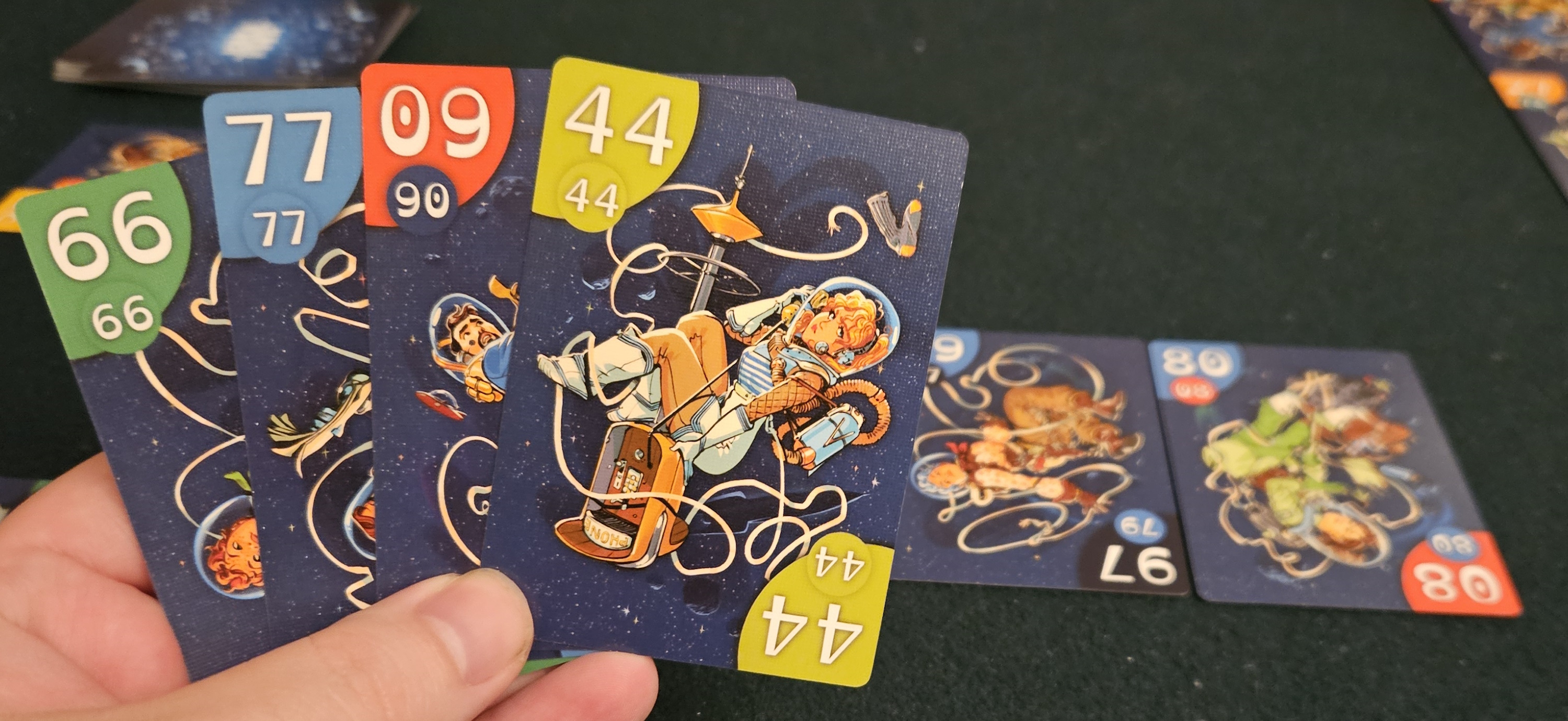
Save me.
The tricky thing about Tether is that it defies the gravity-based logic that we planet-borne organisms rely on. Reading the rules, I couldn’t make head or tails of what it was trying to tell me. It wasn’t until I saw it in motion that it clicked. Even then, it took a few minutes. Crud, a few plays.
Let’s see if I can do a little better. The first thing you need to know is that cards are mirrored. If a card shows a digit — picking one at random, let’s go with 69 — then its inverse will be printed on the card’s bottom half. So: 96. There we go. You’re free to use either side of the card, 69 or 96, when playing it to the table.
But cards can never be played on their own. When you play a card, it must connect to something else. More specifically to a consecutive card, whether up or down. Our example, then, could only be paired with 68 or 70. Or, using its mirrored side, 95 or 97. That second card can come from pretty much anywhere. Your hand, sure. Another card already on the table, yes. The “adrift” cards displayed to the side, those too.
Now for the tricky part. Both players — or both teams, if partnering up is more your speed — operate from their own perspective. On one side of the table, consecutive numbers are counted from left to right. On the other, they’re counted from bottom to top. As these numbers are linked , the table fills with multiple clusters of astronauts, each knotted together by consecutive digits. These clusters can also be merged, provided you can find the proper cards to bridge the gaps between them.

Tying these clusters together…
Your goal is to assemble large clusters. Not only because their constituent astronauts now have somebody to chat with, but also because they’re the pillar of Tether’s scoring. At certain thresholds — six cards, ten cards, fourteen cards — clusters grow big enough to score. Both sides earn points, but only counted from their own perspective. Spelled out, the horizontal player earns points for each card that a cluster is wide, while the vertical player earns points for each card that it is tall. Spelled out in even more detail, if I build a cluster that’s 5×2 in my favor, that’s five points for me and two for thee.
Maybe you should have tried to connect some additional astronauts to that cluster, hmm?
If this all sounds confusing, well, yes, the whole thing is rather disorienting. And it only gets tougher once you start examining your opponent’s options, an exercise that occurs not only upside-down but along a different axis. And along the side of the table, too! There’s a card market of “adrift” astronauts, which you’ll occasionally add cards to in order to refine your hand for bigger plays. These drifters can also be connected to clusters, resulting in an ever-shifting possibility space. After a game or two, it becomes second nature to assess the cards you’re setting adrift. Before you release one of your cosmonauts into the wild, it behooves you to first scan your opponent’s (upside-down, orientation-flipped) clusters for stress points. Because who knows? While Buzz Aldrin is hogging up space in your hand, it looks like your opponent could nab him to merge two large clusters and score big. Better to play it safe and keep ol’ Buzz hanging around.

Perspective is everything.
These considerations add up to quite the gravitational sum. You’re number-hunting and combo-building and card-denying all at once. It hurts. More than once, my brain has switched into standby mode, sending my gaze skipping over all those numbers and colors. The colors, by the way, are a masterstroke of visual design, shaded in increments so you can gauge numeric proximity via color wheel. Not that these cues stop my gray matter from dimming once there are twenty cards on the table.
The thing is, that brain-burn is also what makes Tether special. “Adrift astronauts” is more than window dressing; it’s a stellar example of how a game’s setting can contextualize player actions. During play, Tether’s wealth of information and contrasting perspectives produce a sort of static. Winning is about transforming yourself into a living antenna for resolving that static into a coherent image. It isn’t enough to see your cards. You need to see them from multiple angles. How they work when flipped. How they might link cards that are currently sitting opposite the table from one another. How your opponent could leverage them if abandoned.
Or how your teammate will respond to your own connections. Playing Tether with four people feels markedly different from playing it with two, even though the rules don’t actually change. The quantity of hidden information doubles, and the game’s moratorium on communicating the contents of your hand prevents teammates from collaborating too closely. This makes a deliberate, thinky game even more deliberate and thinky, but with the upside that you now have somebody to blame for your poor performance. Geoff.

I needed one more image.
Either way, Tether is perhaps my favorite small-box game so far this year. For such a tiny thing — not to mention for a deck that sticks to numbers rather than using fancy-pants abilities or even text — it forces me into an entirely new headspace. In this case, a headspace that’s tumbling noggin over ankles, only to feel clever when I somehow grab onto a handhold and come to a complete stop. I’m no longer afraid of zero-g. (Nope. I lied. Gravity is the best.)
(If what I’m doing at Space-Biff! is valuable to you in some way, please consider dropping by my Patreon campaign or Ko-fi.)
A complimentary copy was provided.
Posted on August 5, 2024, in Board Game and tagged Board Games, How to Steam Broccoli, Tether. Bookmark the permalink. 5 Comments.

 SPACE-BIFF!
Sounds like a blast, wow! Also reminds me strongly of Rummikub in your description. Does that redolence bear out in the play?
Not really. Like I said, it’s difficult to describe! There are a few parallels; some tiles are available to everyone and you’re trying to build consecutive runs. But that’s about it.
Makes me think of the brain burniness of Stroop. It’s a party game where you can practically hear the gray matter sizzle.
Pingback: Best Week 2024! Combined! | SPACE-BIFF!
Pingback: Broccoli and Sulfur Pizza | SPACE-BIFF!