Terrace Jerks

In the Urubamba Valley of the Andes Mountains there are extensive terraced earthworks. Located under the watchful gaze of Machu Picchu, itself a royal estate for overseeing the terraces, these were the principal growing grounds for the Inca Empire’s maize. The harvest was massive thanks to the valley’s careful arrangement of arable land, and much of it was fermented to produce chicha for the Inca’s many feasts and celebrations.
Very little of that comes through in Jeffrey CCH’s Sacred Valley. There are terraces all right, but they may as well be three separate fields. There are no earthworks, imperial-scale agricultural projects, or mountaintop citadels. There isn’t even any corn beer. Instead, Sacred Valley is about passive-aggressive farmers maximizing their yields while sabotaging their neighbors.
At least there are alpacas.

Hee-haw!
Despite the game’s omissions, it must be said in Sacred Valley’s favor that it runs smoothly on nearly every front. Turns are clippy. Decisions are immediate and impactful. Every detail has been shorn to a fine fleece.
Well. Almost every detail.
Take the game’s primary actions. There are three to consider, plus a fourth for anybody who seriously flubs multiple turns in a row. Each one is a breeze to enact.
The main action, planting a seed, lets you take any crop from your warehouse and place it onto one of the spaces on the terraced board. This moves you up the harvest track. Even better, the larger the field you connected this seed to, the farther you move up. A field consisting of one tile earns you a single space on the track. Four tiles? Four spaces. Five tiles plus a nitrogen-fixing alpaca? Six spaces. Agriculture, bay-bee!
This produces real tension. Once a seed is planted, nobody owns it. The result is a shared space that anybody can work to their advantage. If I’m working on a large patch of maize, there’s not much standing in the way of some rival farmer also purchasing maize from the market and adding it to my field. Indeed, that’s the surest route to success. Opportunism abounds, with farmers purchasing the game’s stockpiles of maize, beans, potatoes, peppers, and quinoa to snipe every last droplet of profit from somebody else’s hard work.
The same goes for blocking. If my tater fields are growing too rapidly, everyone else at the table can plant their own preferred crops around the edges, hemming in my patch and forcing me to start anew somewhere else. This can effectively tank my strategy, especially if I’m the only person who’s invested in tubers. Suck on that, potato man.

Investing in technology, seeds, and special laborers.
The other actions are similarly simple, emphasizing tough questions of timing. Harvesting lets you drop your marker on the harvest track to zero in exchange for a bunch of coins. Because this consumes your entire turn, it’s tempting to push the track as high as it will go, maximizing your payout while minimizing the turns you spend trekking your produce to the market.
The market, meanwhile, uses your turn to buy the necessary implements to continue farming. Seeds, of course, but also the green-thumb know-how to cultivate any given crop. Each player begins with their own specialized knowledge — the yellow player plants corn, the brown player plants potatoes, and so forth. As the game progresses, purchasing the ability to plant a second, third, and maybe fourth crop type is necessary to diversify your approach. It’s a poor farmer who lives on beans alone. Even if they’re yummy green beans and not farty cowboy beans.
There are also specialized laborers for purchase. These range from an alpaca handler who adds an additional poop-producing camelid to the board to a warrior who’ll squat on a patch of land to ward off rival farmers from cultivating it. Some of these are downright game-altering, like the irrigator who increases the value of any single-yield cultivations or the saboteur who dumps worthless vines onto the periphery or rival fields. There is no fermenter. So much for throwing a chicha party.
These player-driven decisions set the tone for Sacred Valley. I would even hazard to call it Knizian, with its light rules, shared spaces, and snitty avenues for undermining dominant opponents. It’s also prone to self-sabotage. If everybody plays nice rather than preying on rival fields at every opportunity, the entire thing collapses in on itself. That, too, is redolent of the Good Doctor’s nattier designs. Despite its airiness, Sacred Valley should not be mistaken for collaborative. Despite the notion that Inca agriculture is all about shared cultivation, make no mistake: good play demands that everybody be passive-aggressive. You aren’t friends. You’re terrace jerks.
This isn’t always the most natural way to think, and not only because the game’s rulebook introduces “ayni,” the Andean concept of mutualism and reciprocity, going so far as to use households splitting a harvest of potatoes as an example. The game even introduces a minor collaborative element for opening new terraces that, on its face, feels like a nod toward ayni. As a lower terrace fills up with crops, I can open a new terrace by paying some coins — more on that in a moment — and choosing another player to pay the same amount. This unlocks the next terrace for cultivation. We’re working together! Cool!

Not the most exciting market ever designed.
Except we are not working together. Oh no. The only reciprocity in Sacred Valley is that I’ll block your crops whenever you block mine. Paying to open a new terrace isn’t meant to spread around the burden. It’s something one rich player inflicts on another rich player, potentially opening the way for someone poorer to catch up. It’s weirdly gamey, not to mention anachronistic, not to mention mundane because it costs almost nothing. One coin for the second terrace! Two coins for the third! Scores don’t soar all that high in Sacred Valley, but it still doesn’t make much of a dent. That’s as much as some discount quinoa. Not even the stuff on the market’s top shelf.
It doesn’t help that this focus on specie is entirely anachronistic and out of tune with the game’s stated spirit of ayni. The Inca didn’t operate a money economy until the appearance of the Spanish, a detail the rulebook acknowledges. Another line: “This game reimagines the Inca society through the lens of a modern monetary economy while including traditional Inca concepts, culture, and ideas.”
Not the concept of ayni, though. Not Inca material or labor culture. Not the idea of shared cultivation. As thematic divorces go, this one is a whopper. There are terraces and region-specific crops and a few Quechuan terms, but we’ve exchanged the defining features of Meso-Andean agriculture for… wait for it… the same European monetary system that features in pretty much every other Eurogame. What a missed opportunity to actually explore a different way of thinking. Instead, Sacred Valley awkwardly contorts shared cultivation until it’s the precise opposite of shared cultivation. Swap out the terraces for selions, the maize for barley, certain terms for “knights” and “tax collectors,” and this game could be set in the same year in feudal Europe. It still wouldn’t be particularly accurate, but at least it wouldn’t feel like plunder.
On its own, this poverty of imagination might be enough to turn me off the game, but the reality is that Sacred Valley has other problems afoot. It’s too rapid for its own good, skipping over the second act’s laborer tiles so quickly that they hardly make an appearance. The same goes for its placement puzzle, which is thinly drawn, putting the burden of texture on its alpacas and little else. Despite its efforts to generate tough placement decisions, this mouthful is better suited to molars than canines.
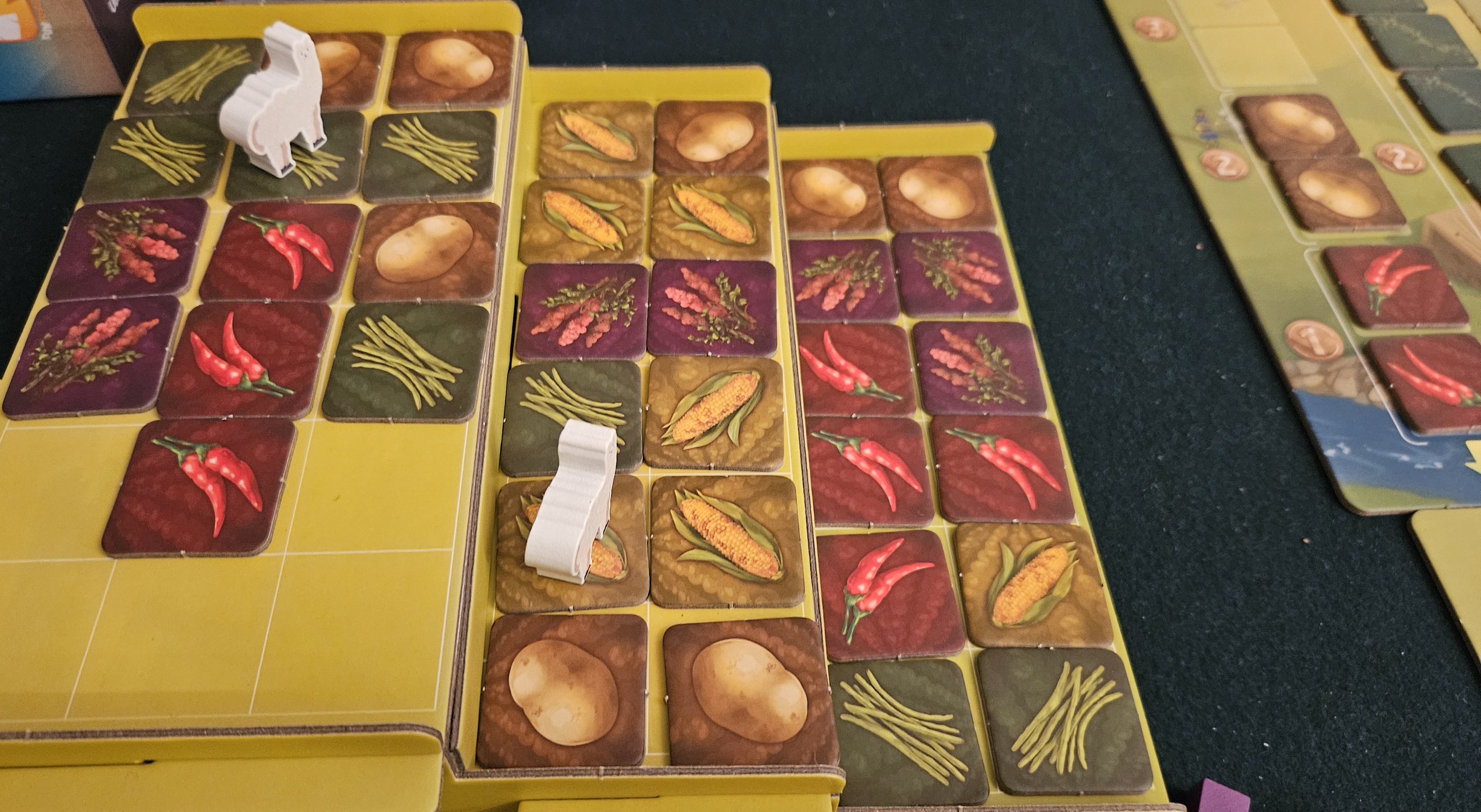
As the terraces fill up, your options become pinched.
Yet again, I’m perplexed by a Jeffrey CCH design. Although I’ve appreciated some of his work, notably Inheritors and Age of Galaxy, both Age of Civilization and Eila and Something Shiny gave me pause with their awkward systems and crass (if undeliberate) messaging.
Despite some clever ideas, Sacred Valley falls into that same category. Its rulebook talks the talk about Inca culture, only to reveal an unfortunate mechanical incuriosity once it hits the table. Because it cannot grasp a way of life different from the current standard, it fails to imagine at all. As minor Eurogames go, it’s serviceable enough. Board games can be so much more than serviceable.
(If what I’m doing at Space-Biff! is valuable to you in some way, please consider dropping by my Patreon campaign or Ko-fi.)
A complimentary copy was provided.
Posted on July 23, 2024, in Board Game and tagged Board Games, North Star Games, Sacred Valley. Bookmark the permalink. 2 Comments.

 SPACE-BIFF!
The actual Sacred Valley is a nice visit, although I encourage people to skip Machu Picchu itself. Moray and Ollantaytambo are both more interesting and impressive (although, sadly Moray is now look at, rather than walkabout, not that I blame them, I still recall a being in a hostel listening to a white tourist bragging about how he stole a piece of a wall from Machu Picchu).
It is very unfortunate when such a fertile culture is instead used to tell a typical European/Colonial story, just without Europeans in it. I mean, if you want to talk about European economy, just use Europe.
Thanks for the recommendations! I would love to visit Peru someday.