Caught in the Tangle of These Power Lines

The difference between a good stacking game and a truly memorable one is slender. Like the components themselves, every element needs to be weighted precisely, neither too heavy nor too light. Without a solid foundation, the merest wiggle or imbalance can send the entire structure tumbling down.
Nekojima, designed by Karen Nguyen and David Carmona, qualifies as a good stacking game. I’d even staple a “very” in front of that. But a keeper? It’s a few whiskers shy of that distinction.

This is how linemen work, right?
Nekojima draws inspiration from two sources: thickets of overhead power lines and cats reclining in improbable locations. As unlikely as this combination may seem, they fit together like machine-cut puzzle pieces.
As befits a stacking game, the structure of each turn is simple but front-loaded with tension. First, you roll two dice to determine where your municipality is ordering you to erect the latest power line. Most rolls are easy enough: red and green, say, signaling that you must plant two poles in the corresponding sectors of the circular foundation board. Sometimes an unlucky roll will prove more frustrating, such as the revelation that both poles must be placed in the purple sector, too close together for comfort, or that your neighbor gets to choose a sector. Spoiler: if you’re playing cooperatively, they will choose an easy spot; if competitively, they’ll pick the jerkiest patch of grass imaginable.
Second, you draw a cube from a bag. This determines the color of power line you’re placing, along with poles of variable heights on either end. These are Nekojima’s most visually appealing and tactilely pleasing offering, asking players to assess lengths and weights and heights all at once. At first, you’re required to place these poles directly onto the foundation. Eventually, with ground-level real estate swiftly disappearing, you will stack poles atop other poles, always careful to prevent those thick strings from touching either the poles or one another.
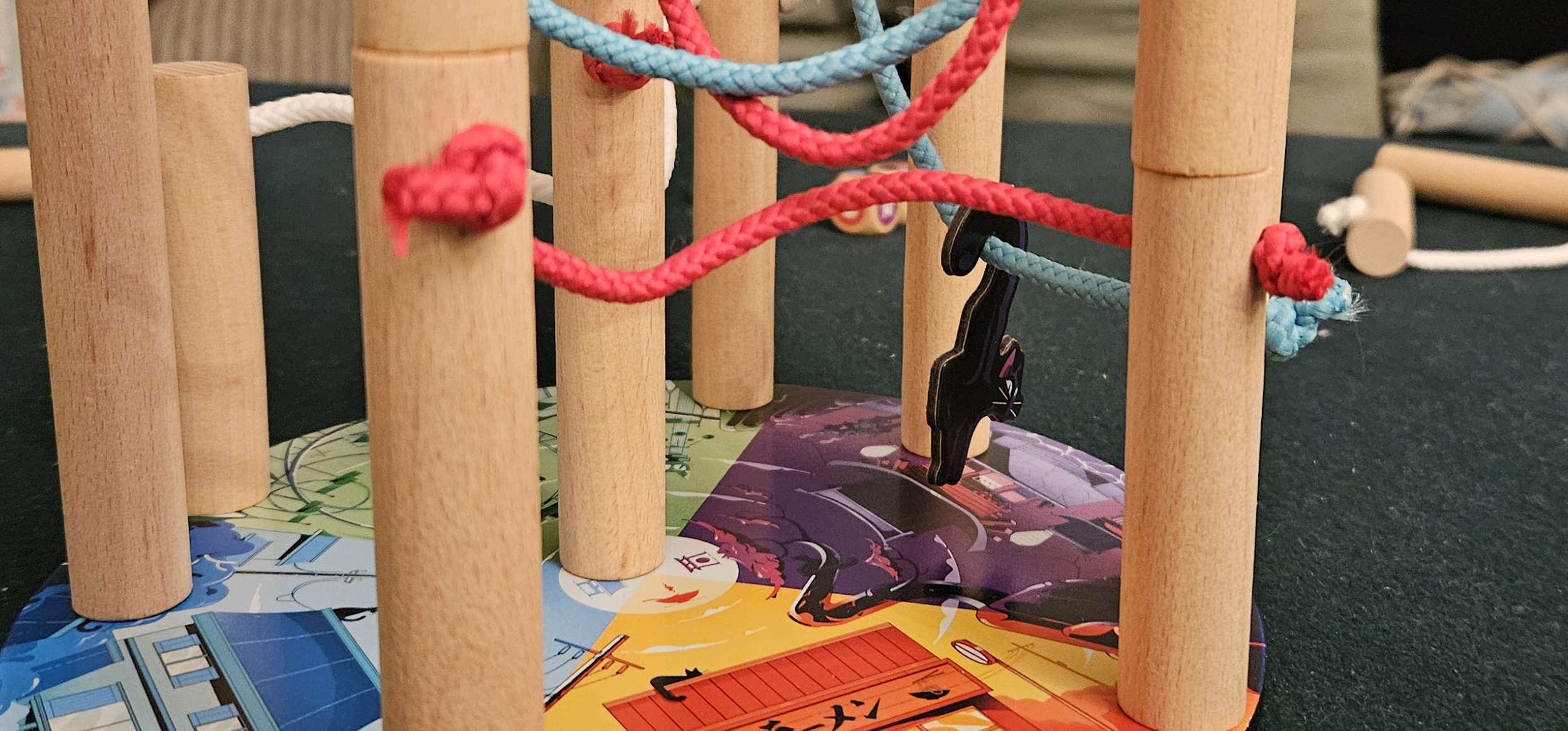
Good kitty.
There are also cats. Mixed into the draw-bag are black cubes; when drawn, players are tasked with suspending a cat from one of those suspended cables.
This is harder than it might seem. These cats recall the monkeys from Rhino Hero Super Battle, which clung to the side of that game’s skyscraper. Here, though, they’re more than silly additions to the game’s stacking. While some of the cats can lounge from wires with ease, others are, um, chunkier. The pure chonkiness of these cats pulls at a power line with such gravity that the poles themselves might be uprooted. These cats, usually held in reserve until the game’s later stages, are best placed on power lines strung between poles with other poles anchoring them in place.
As stacking games go, Nekojima is a strong contender. New poles and power lines and felines mass into an elevated copse until an errant placement sends the whole thing earthward. A steady hand is a must, especially when placing one power line atop another. Once the structure reaches a certain height, I find that my fingers cease obeying my commands. The pole I’m placing hovers a millimeter over the pole beneath, unable to quite settle into position, as though they were magnets with matching fields pushing them apart.
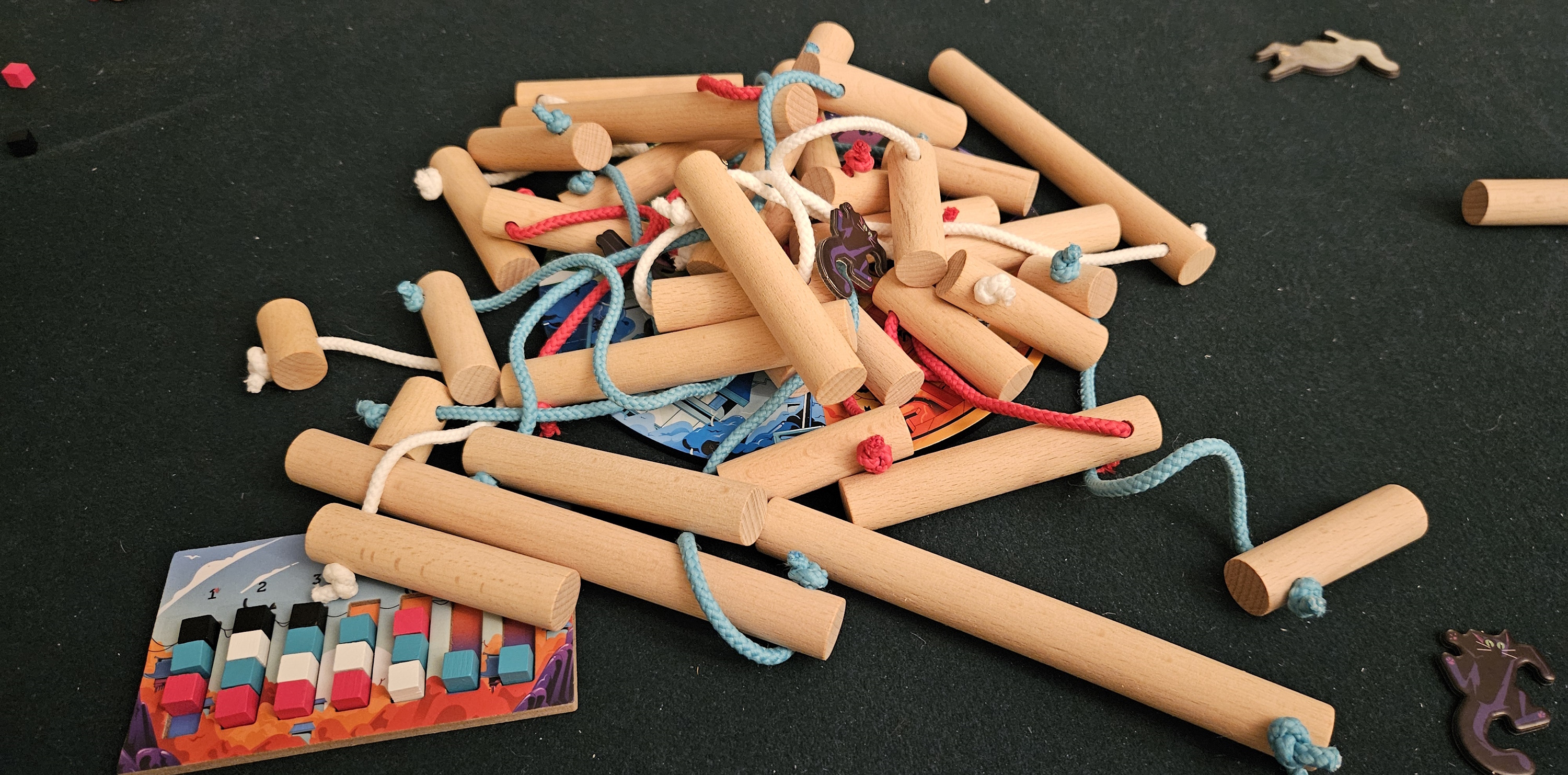
Crash.
But for all its feline cleverness, Nekojima doesn’t quite reach the same soaring heights as some of its predecessors.
I wouldn’t say that there’s any overt problem with the game, although there are a few missteps. The distinction between its competitive and cooperative modes is wobbly, for one thing. The default would seem to be cooperative, everybody striving together to place every single pole and cat. In versus mode, the game ends when the structure falls. But there’s no guarantee that it will. After a series of passive-aggressive placements, you might be presented with a completed tower. At that point, I guess you pretend you were playing cooperatively all along?
But the game’s more serious issues aren’t overt issues so much as they are absences. Compared to some of the best stacking games, Nekojima feels limited. I mentioned Scott Frisco and Steven Strumpf’s Rhino Hero Super Battle, which is fantastic not only because of the delicateness of its skewampus skyscraper, but because that skyscraper also functioned as a playground for dueling superheroes. Players were incentivized to erect a structure that was either (or both) precarious or sturdy, depending on their desired approach.
An even better example is Rita Modl’s Men at Work, which deepened its stacking with variable objectives. It wasn’t enough to stack things. Your goal was to stack girders and workers and bricks in increasingly improbable configurations, all while striving to reach previously unseen heights. It also helps that the game didn’t end the instant something fell apart. Instead, Modl transformed those inevitable collapses into an integral part of the game’s structure, tasking players with recovering fallen beams and bodies with a hook before continuing construction.
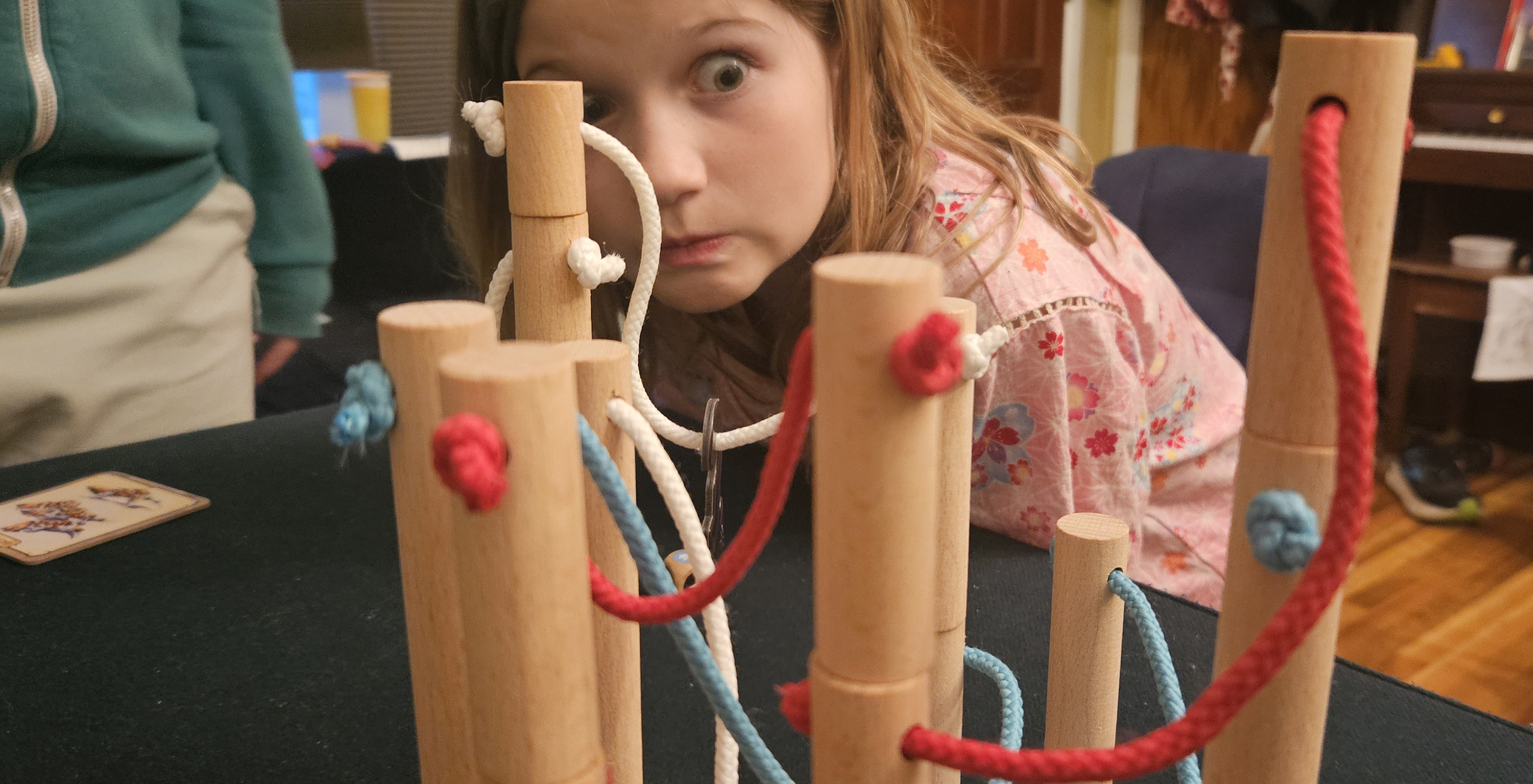
Steady hands and steel nerves are a must.
In both cases, those stacking games felt large because they used stacking as a backdrop for some other concern. Nekojima is purer, sticking to stacking alone, but it comes across as pinched. Each session is largely identical to the previous session, with scarcely any room for creativity.
Again, that doesn’t make it a bad stacking game. Nekojima is a very good stacking game. Its components are gorgeous and lovely to handle. It rewards steady hands and steadfast nerves. But I wish it had also let us flex our creative muscles, building a structure that was not only a joy to assemble and look at, but also a joy to conceive. It’s all assembly, not enough architecture.
(If what I’m doing at Space-Biff! is valuable to you in some way, please consider dropping by my Patreon campaign or Ko-fi.)
A complimentary copy was provided.
Posted on July 18, 2024, in Board Game and tagged Board Games, Hachette, Nekojima. Bookmark the permalink. 6 Comments.

 SPACE-BIFF!
Great analysis, I appreciate the perspective! The components here remind me of Villa Paletti, a favorite stacking game of mine, though definitely also in the vein of games where each time playing is basically the same.
I’ve never played Villa Paletti! Sure looks nifty.
In my opinion the all time best stacking game is Menara. My two plays of Nekojima just couldn’t compare at all.
Menara looks great!
Huh. That’s funny as, yeah, I love Menara and I am not really looking for more stacking games to play. But, I also think that cooperative stacking games fix a fundamental flaw of competitive ones dating back to Jenga. The game is more fun if you do not want collapse to happen than if you do. Even something as genius as Polarity is marred, for me, by sitting there hoping that the other player makes a mistake because that is the only route to victory. I like rooting for the other players to play their best, not for them to fail. I like to feel clever and if I win, I want it to be connected to that feeling, not to a feeling that other player made a mistake.
Nothing convinces me to avoid a restaurant more than a long menu. A restaurant with the guts to say we make these one to eight different things and nothing else today, that is a place I enjoy eating.
Similarly, I like games to have the guts to say this is the player count or this is the mode of play. I get the sense that I will waste my time playing a game that wants to please everyone. That says we support zero sum play (two players) AND shifting alliances (three plus) (and even worse, also supporting one player play, which by definition is pure heads down). In this case, coöperative and competitive play seem at complete odds and yet, the game wants to serve them both up. And then I end up saying to myself, how many sacrifices were made during development to make this a reality and would the final game have been stronger had those sacrifices not been made? Perhaps the target audience for such a game would have been smaller, but could we have had a truly memorable one as a result? I do not have enough time in my life to play all the truly memorable games out there, such that I feel slighted whenever I play a good one instead.