Spot the Difference

I’ve never seen a tutorial quite as apt as the one that begins Perspectives. Designed by Matthew Dunstan and Dave Neale, Perspectives is a detective game. You know the drill: across three cases you will assemble evidence, match serial numbers, and answer a string of questions to determine whether you’re the next Encyclopedia Brown or a brown paper bag. The wrinkle is that you can only see a portion of the evidence. Mayhap a perspective of the evidence. See where we’re going with this? As wrinkles go, there aren’t many quite this redefining. It’s less of a wrinkle and more of an origami fold, a crease that transforms the entire structure into something new.
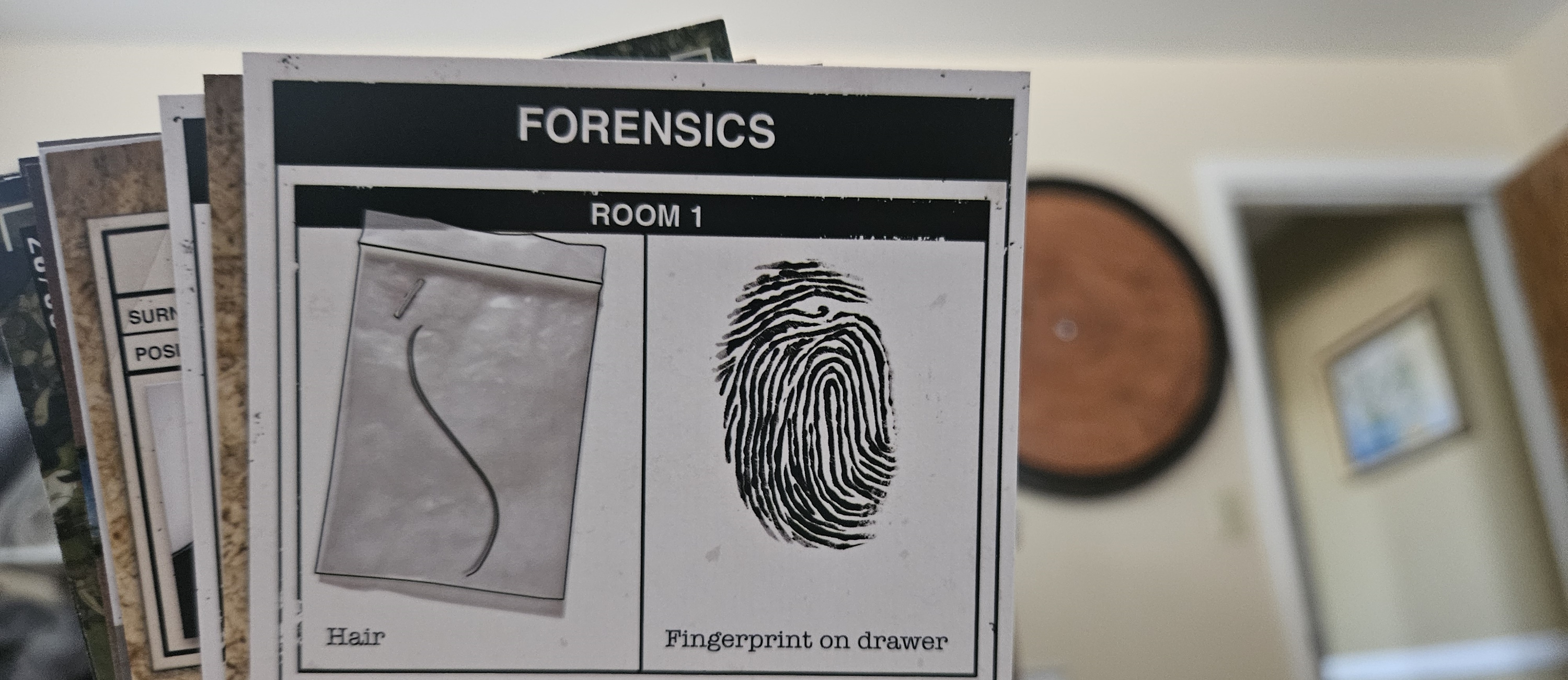
You can play this game lying down!
Which is saying something, given how boilerplate much of Perspectives’ structure is. Each of the box’s three cases feels like something we’ve seen before, and no amount of exotic locales or colorful characters can shake the déjà vu.
A case goes like this. After reading a brief introduction, everybody is dealt a hand of cards. This is your body of evidence. Again, you’re only privy to a small selection. Depending on the player count, you might have anywhere from a whopping six to a meager two cards to peruse. You start talking.
The advantage of this format is twofold. At the level of its players, Perspectives goes far in solving the alpha player conundrum that dogs cooperative games. Any would-be wunderkind simply doesn’t have enough data to highjack the session. It’s a minor benefit, one better solved by excising quarterbacks from your life than by asking game designers to mediate your relationships. All the same, it’s a deft solution.
The more impactful consequence is that Perspectives quickly establishes itself as a detective game about conversation rather than one about raw observation. You know that moment in a detective procedural when somebody gets their eureka moment because of something someone else said? That’s this game. Literally, that’s what you’re doing here. On its own, your evidence is fragmentary and incomplete. Put together, you have the complete picture. If only you could see it all. Oh, you’re allowed to reveal one picture, just one, letting everybody in on an additional slice of the pie. For a penalty, you can reveal additional scenes beyond that. The thrill of these moments is palpable, like a breeze in the desert. But figuring out which picture to share is a huge part of the experience. Usually, it’s one of the most discussed questions at the table. The stakes are simply too high to risk revealing some minor detail. So you talk. You describe. You forget details because you never saw them, so you circle back to previous descriptions.
At the table, we described Perspectives as one of those “spot the differences” puzzles, except you can only see one of the pictures. Or more accurately, you can only see a small fraction of one picture, plus two scattered glimpses of the other, possibly at a distance and with some obscuring element in the foreground. Now spot the differences.
That’s what it’s like most of the time, anyway. Which brings us to the tutorial.
I did this on purpose, okay?
The tutorial prepares players for what will be expected of them while also instilling the necessary skills to face its sterner challenges.
Put more simply, it literally asks everybody to play spot-the-differences. You put the box on the table, angled so that everybody can only see two of its four sides, and describe how its scene changes depending on the angle. A few minutes later, it introduces the elements on the box insert and deepens the mystery. It’s a synecdoche of the game at large, a reflection of how each case is told across four brief acts, doling out new evidence cards and asking players to begin the conversation all over again.
It also sets the tone for the type of mystery Perspectives is best at weaving. When this game is good, it’s good. Piecing together photographs from various hours of a party, or tracing a bullet trajectory based on architecture and a coroner report, or figuring out which camera aligns with which portion of a concert hall, that’s all compelling. When Perspectives offers cases that are truly about perspectives, it’s some kind of magic.
But it doesn’t always do that. Sometimes it gets a little too traditional. Assessing serial numbers. Checking names against fingerprints. Pretending you haven’t seen over a million episodes of Law & Order and can tell when a particular character is a little too suspicious. In those instances, Perspectives uses its wrinkle less as an establishing mechanism and more as a lampshade. Comparing information is incredibly hard when you can’t actually see the lines of data you’re supposed to be cross-referencing. And it’s significantly less interesting.
The result is a bifurcated design. On the one side of its dividing crease, it’s a brilliant take on the detective mystery, one that forces everyone to function as team players who must describe evidence rather than handling every last tidbit personally. In that mode, it’s a game about trust, about knowing how to ask the right questions, about learning how to sift through your friends hedging their uncertainty by saying, for the hundredth time in an hour, “Okay, I don’t know if this is important, but…”
But then there’s the underside of the crease. Down there, Perspectives is document review. It’s checking dates and addresses. Worse, it’s reading them aloud for your friends as they stare glaze-eyed at their own evidence cards. It’s asking whether we’re talking about February 18th or February 20th. Wait, March 2nd? How’d we get March 2nd?
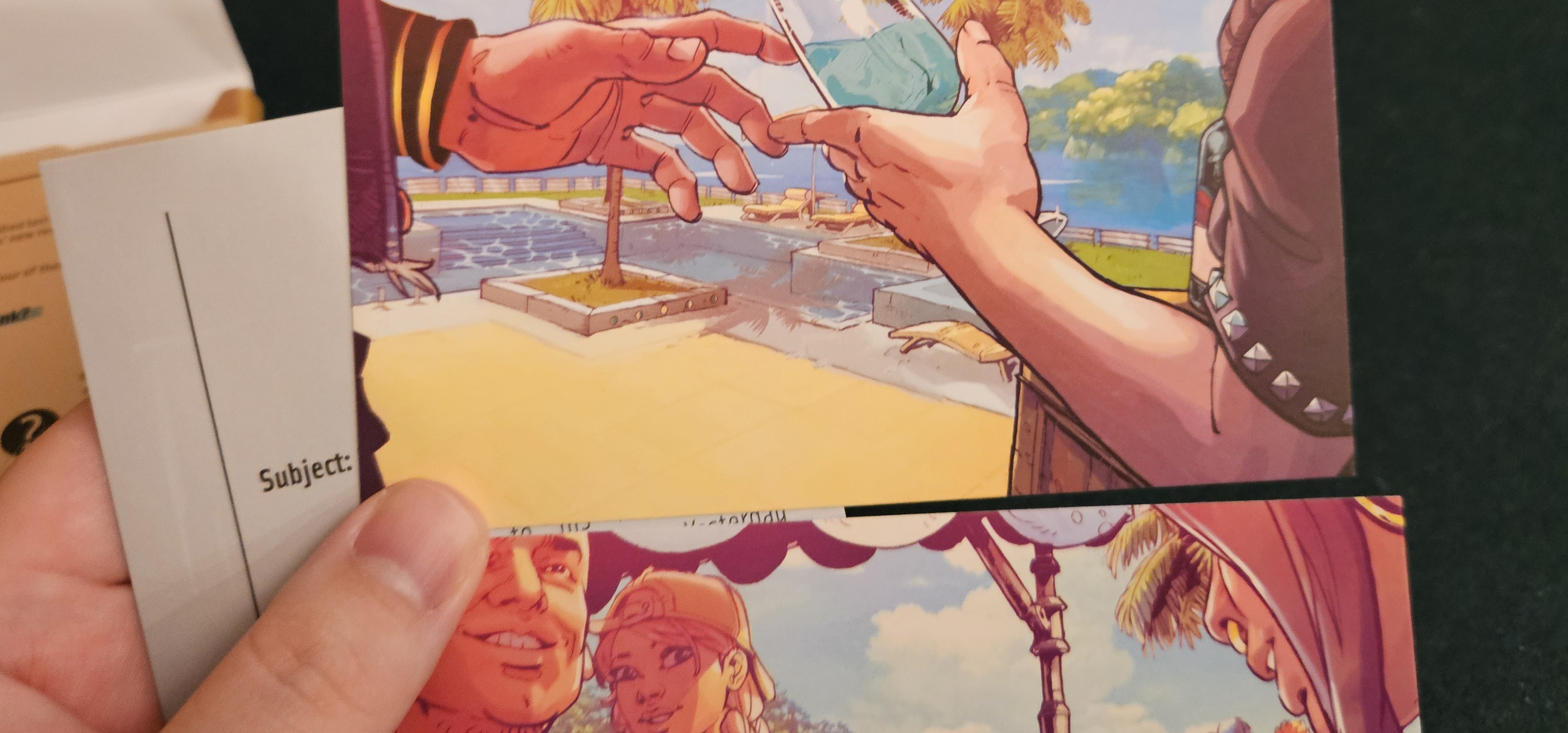
Sorting through the clues.
In other words, Perspectives is one smart half of a cookie. When it’s about examining images for small discrepancies, or following characters as they move between scenes, or any of its other efforts at living up to its name, it’s undeniably clever. The rest of the time… well, let’s just say I don’t have the kindest perspective.
(If what I’m doing at Space-Biff! is valuable to you in some way, please consider dropping by my Patreon campaign or Ko-fi.)
Posted on July 8, 2024, in Board Game and tagged Board Games, Perspectives, Space Cowboys. Bookmark the permalink. 9 Comments.

 SPACE-BIFF!
This sounds fascinating! Thank you for the review!
Thanks for reading!
Is this presented in a format where they could release expansions? Hopefully ones that support the “better” style of play?
Sure. I imagine they would be keen to release entirely new boxes, too. This is the “orange” box. It would be pretty easy to release other sets.
Thank you for solving “The Case of the Unfindable Puppy”.
He’s a good boy, even if you can’t see him.
I must protest your assertion of an invisible puppy, Dan. It took me about twenty seconds to spot a seated Spot in the PERSPECTIVES title art, in the negative space between the right-side “E” and “S”, muzzle and front legs facing toward the “E”, ears and back/hindquarters more in the direction of the “S”. With…maybe an exceptionally long tail curled around and pointing down into the gap between “E” and “S”?
Okay, that part’s admittedly a bit of a stretch. But does that abstract excavating/reasoning behind trying to find the hidden clue prove that I’m perhaps part of the target audience for this game? Or more that it’s time to see a neurologist? Either way, thank you for a review that made the game sound compelling enough for me to try.
Hey, it’s pretty much a game for those of us with overactive pareidolia, and I include myself in that category! If you spotted Spot in the header, Perspectives just might be the game for you.
I’ve generally found that quarterbacking in co-op games happens organically, rather than people being predisposed to it. My game group includes one per on who often doesn’t feel confident and asks for advice on nearly every choice in co-op games. Too much of that, and you might as well have a player who is dominant and dictating everyone’s strategies. Sure, I could boot the player who lacks the confidence, but that seems mean. Sure, I could boot the people who end up basically playing her turn for her as a result, but they aren’t really doing anything wrong. In either case, I would run out of players pretty quickly.
Even without the low confidence / low mechanic-comprehension player, I’ve found co-op games virtually always end up with some degree of quarterbacking, even with hidden information, because there’s usually people who perfectly understand the game and people on somewhat shaky ground who might know how to take the actions but not what to prioritize, or have poor memories and can’t evaluate options well as a result. Though, there’s still a big difference between full quarterbacking and someone who is just “facilitating” things by nudging people in a direction occasionally.