Hot Rook on Rook Action
Taiki Shinzawa is a well-known figure in the realm of Japanese trick-takers. He’s responsible for a thick catalog of formidable offerings, including American Bookshop, Inflation! and Charms, Maskmen, 9 Lives, and one of my absolute favorites, Ghosts of Christmas.
Tower Chess is not a trick-taking game. It’s a varietal of chess — bet you couldn’t see that one coming — and it’s eminently agreeable.
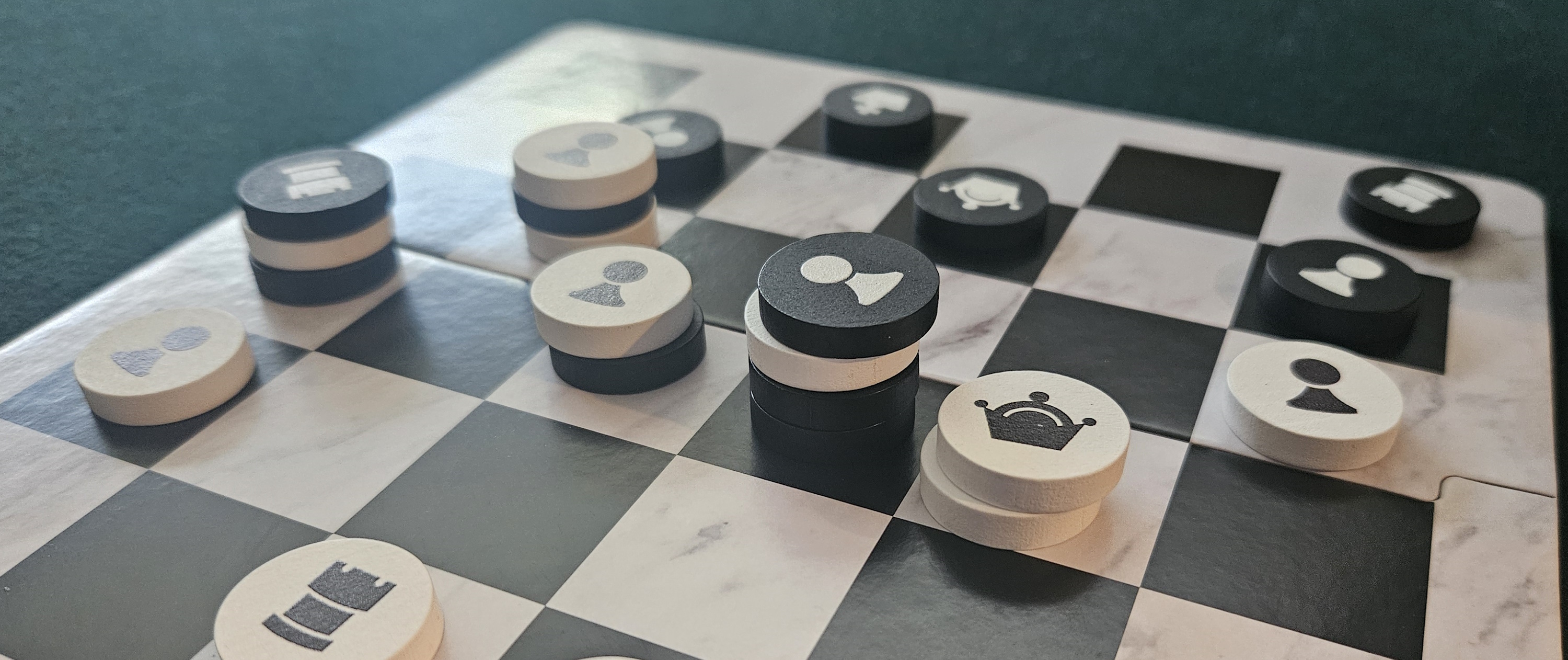
Chess. Just more vertical.
The gimmick: pieces can stack on top of one another.
That would be enough of a twist to power a handful of matches, but Shinzawa is shrewder than that. Indeed, multiple pieces occupying a single space might not be all that much of a riff, given that we’ve already seen pieces embrace one another in game-altering bear hugs. That varietal was called Paco Ŝako, “Peace Chess,” best known for its massive combo moves that saw piece after piece breaking up one hug after another.
Tower Chess is better than Paco Ŝako. There are a handful of reasons for that, but perhaps the plainest is that Shinzawa has altered more than how his pieces interact. He’s also shrunk the board. This is a six-by-six grid, significantly cozier (or more claustrophobic) than that of its eight-by-eight parent, and the consequences are immediately felt. Simply by stepping forward two spaces in their opening move, a pawn stands at the opposing front line. This effectively strips away the ponderous opening moves of a regular match; within two or three moves, significant captures are afoot.
These aren’t real captures, of course. Occupying pieces squat atop their prey, who will be sprung the instant their oppressor moves off of them. But you get the gist. Meanwhile, the subtraction of knights, always chess’s most mind-bending piece to begin with, also works in the variant’s favor, making a session feel more like a crush of pike-wielding tercios than an open battlefield where mounted troops and archers reign supreme. There simply isn’t enough elbow room for board-crossing slides, at least until some quantity of pieces have been dog-piled into a heap. Those humble pawns, for instance, come into their own as the inflexible but essential infantry they are, rather than, well, what the term “pawn” signifies. When captures are temporary lockdowns instead of permanent removals, there’s a far greater chance of a pawn emerging as the linchpin of one’s strategy, regardless of whether they reach the opposite side of the board.
Which might not make Tower Chess sound all that energizing. Nothing could be further from the truth. If anything, it’s electrifying. Matches are immediate and gratifying. Simpler, too, in their own way, although Tower Chess shouldn’t be mistaken for a slouch in the tactical department.
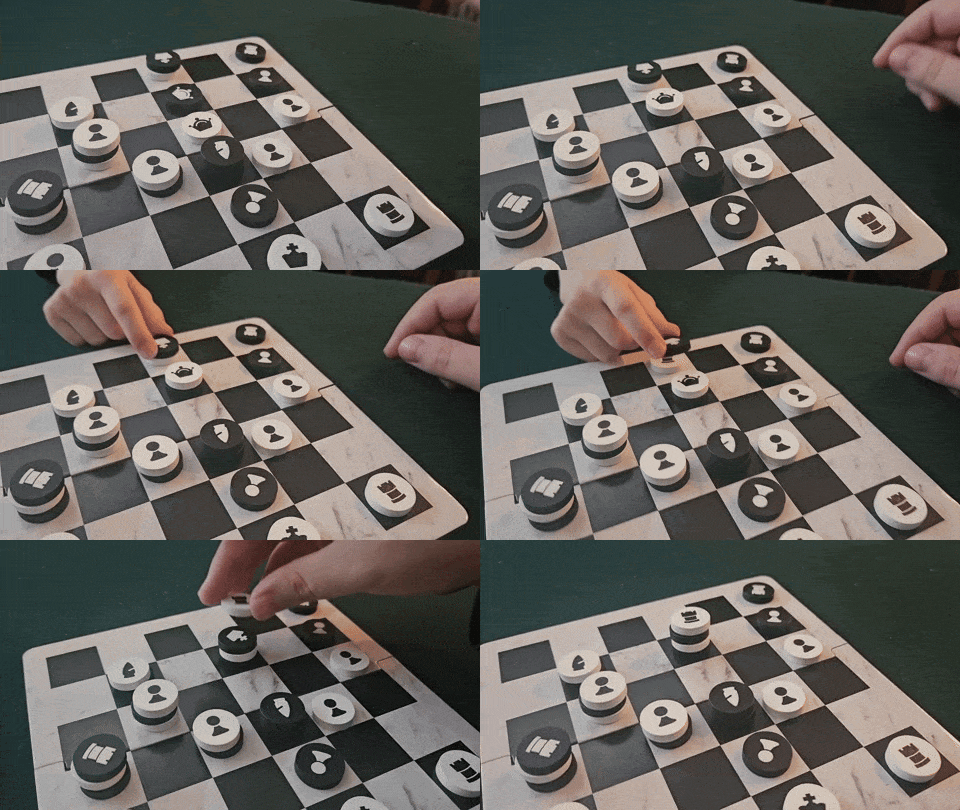
Take that, child!
The game’s tactical possibilities rely on players understanding the implications of stacking pieces on top of one another. It doesn’t take long before the possibilities clarify. For example, it’s often useful to stack two allied pieces together, then later move the top one away. This reveals both the attack potential of top and bottom pieces at the same time, thus threatening along two contrasting vectors simultaneously. In base chess, moving a piece so that it threatens two rival pieces is called a fork; here, a fork may sprout multiple sets of tines at once.
Of course, the inverse is also true. Covering an opposing piece is potentially dangerous. This is perhaps Tower Chess’s most significant departure from the default mode of thinking. One of my favorite tricks is to bully my opponent into covering a dangerous piece — say, my queen or a back-row rook — with their king. Now their king can never move freely again. Doing so would reveal the queen or rook underneath. They will have excavated their own doom.
Significantly, this introduces a couple of elements to Tower Chess that aren’t quite as natural as the board’s compactness or the way pieces stack. There’s an element of memory at play, for one thing. Touching a piece means you’re forced to move it. This is no mere quirk of etiquette; it’s to prevent players from glimpsing what lies beneath the top piece of a stack and not committing to a move. There aren’t so many pieces on the table that it’s impossible to keep them straight, but an ill-timed revelation could well turn the match in one side’s favor.
Similarly, there is no checking, and by extension no victory via checkmate. This is a game of honest assassination, not some courtly dance in which you must press your rival into a corner to preserve their dignity. But good luck not announcing check the first time you sweep a bishop into a sharp diagonal of the opposing king.
The effect is pronounced. Chess has always been an unusually thematic abstract game, one that speaks to our understanding of history. In the past year alone, it has appeared as a shorthand for the developing social castes of pre-medieval Sweden in Matilda Simonsson’s Pax Penning and the standoff between modern superpowers in Paolo Mori’s Match of the Century. Tower Chess does something different, flipping the social order on its head like some all-too-brief Saturnalia. Despite speaking the shared language of chess that nearly every schoolchild understands, its inversion is subtle but profound. Pawns are now unyielding threats, indefatigable, ready to spring back into action the instant they’re unpinned. The agents of their captivity, rooks and bishops and other pawns, are robbed of their previous freedom; indeed, stepping onto a dangerous peasant now often traps them in place like jailers who cannot risk turning their back on the bars for even a moment. And the king — oh, the king! — has become fragile, delicate, readily removed. He is unholy. His body is no longer sacrosanct, preserved against arrows and barbs by divine right. All it takes is a single inch of sharp metal, maybe two, and his reign is over.
In other words, this is chess as a social revolution. The early stages of revolution, to be sure, with kings arrayed on both sides. But the imagined contract that keeps the royals from butchering one another has been cast off.

Play anywhere!*
Or maybe I’m reading too much into it. It’s hard to say with a system that’s as much a cultural signifier as chess. Either way, Tower Chess shows that Taiki Shinzawa has range with more than suited cards and tricks. For now, this is the variant that’s occupied my attention like a rook squatting atop a pawn.
(If what I’m doing at Space-Biff! is valuable to you in some way, please consider dropping by my Patreon campaign or Ko-fi.)
Posted on May 7, 2024, in Board Game and tagged Board Games, Tower Chess. Bookmark the permalink. 9 Comments.

 SPACE-BIFF!
That was the article title I hoped you were saving for the Molly House solo review…
There are a few pieces left in chess… 😉
Great review as always Dan. Now the question is where can I buy it?
I wish I knew. They completed a Kickstarter campaign for it a while back, but I can’t find a place to buy it now.
Good news: It’s super easy to make your own!
I know a piece’s movement is stopped if it encounters an rival piece, does the same hold true if it encounters a friendly piece? Or can you jump over a friendly piece? I cannot tell from reading the rules on the Kickstarter page.
You stop at a friendly piece. Or climb on top of it. There is no jumping over anything. Only hopping off if your piece begins atop another.
It is available on amazon.co.jp !
Oh, good find!
Pingback: Magenta One: Fives | SPACE-BIFF!