Chewing the Scenery

There’s no hiding it: Earthborne Rangers feels like a gigantic leap forward for a particular niche of card game, a quiet revolution of contextualization and setting that effectively relegates its predecessors to the nursing home. Those predecessors, adventure card titles defined by the release model of Fantasy Flight Games — The Lord of the Rings: The Card Game and Arkham Horror: The Card Game, to name the most durable examples — have been defrocked, shown to possess creaking knees and prosthetic hips.
But while it would be possible to write a thousand words bemoaning the business model that trickled out those games one expansion pack at a time, it’s far more interesting to highlight what Earthborne Rangers gets right.
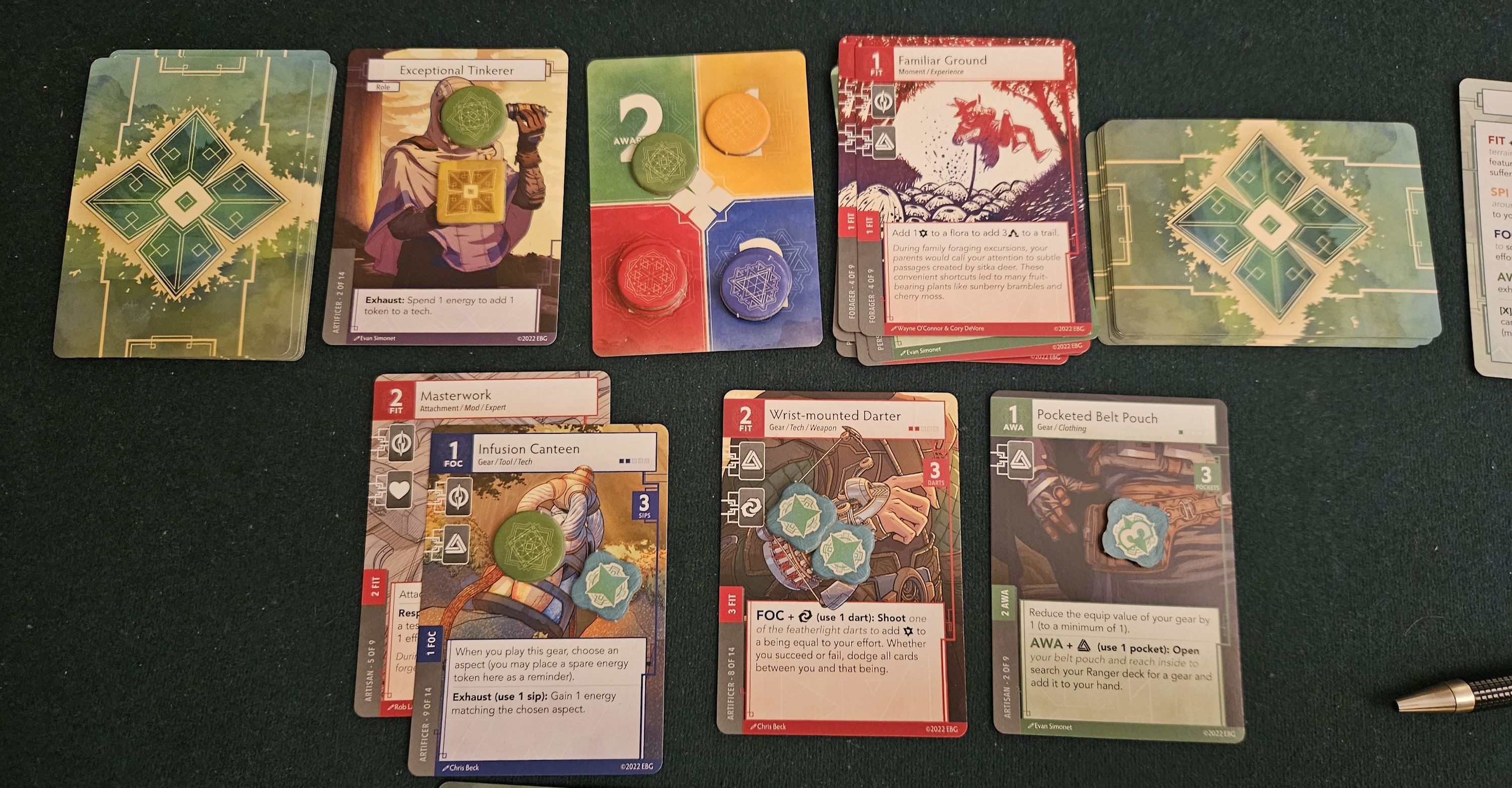
Tinkering. In the future. The ecofuturist future.
The world changed.
We don’t know the particulars of the former world, although its bones protrude from the ground as sinkholes brimming with ancient technology and genetically engineered “biomelds” that are alternately dangerous and indifferent to human activity. The obvious touchstone is the video game Horizon: Zero Dawn and its sequel Forbidden West; not only because this is an eco-conscious future where humans live in proximity to nature and the trees bristle with neo-Neolithic peril, but also in terms of aesthetic and outlook. More than one character binds chunks of ancient metal and plastic onto their shoulders as makeshift armor, and deftness and avoidance are often better determiners of one’s lifespan than brute strength. Weapons, such as they are, inhabit a secondary role to creeping around threats or, in some cases, connecting with them directly, transforming four-winged vultures and evolved coyotes into puppy dogs that wag their tails and leave you be.
While playing, though, a more obscure reference point niggled at the back of my mind: John Crowley’s 1980 novel Engine Summer, in which the planet’s descendants regard the past with neither nostalgia nor loathing, but a sort of passive curiosity, the way we might feel toward a stonework ruin poking from the grit like an erupting molar. Compared to so many sci-fi novels and films that preoccupy themselves with the fate of the ancients, it’s an outlook that’s both optimistic and fondly self-centered. The past is past, our concerns are here and now, why should we pine for a time and a place that had their chance?
There’s a beauty to this place. The Valley, it’s called, whether a last refuge or one of many bastions for humanity we cannot know, a place of towering plateaus and deep ravines, whitewater rivers and stretches of marsh where only the hardiest hunters venture. We are Rangers, bands or solitary adventurers who rove the Valley and tend to the needs of its inhabitants. Our training has recently concluded. And we’ve been tasked with distributing a basket of biscuits.

Little ecosystems emerge from the card interactions.
Don’t worry. Things get more serious before too long. That initial delivery quest is an overly twee introduction to a grand adventure, one that will compass nearly every inch of the Valley. There’s a reason for Earthborne Rangers’ caution. What’s coming is daunting, even intimidating, and I’m speaking mechanically rather than within the confines of the setting.
If you haven’t played those earlier adventure card games, they worked like this. Every scenario presented a conundrum. Say, your fellowship was traveling along the Anduin River, but orcs were harrying your progress from shore. Or you were investigating a cold case into an occult professor’s mysterious disappearance, but cultists kept popping up with sickles in need of bloodying. These adventures had a certain rhythm to them, one that started long before the game itself began. You would construct a deck, filling it with characters and tools and verbs. Then and only then the story began. Often, however, your deck would prove inadequate to the task. Defeated, you would repeat the loop, fine-tuning your cards, swapping out Merry for Gandalf, preparing with the benefit of hindsight.
As for the scenarios themselves, each one was a bottle, carefully bookended with opening cards and a final objective. There were always wrinkles and scenario-specific hurdles, but each one’s path tended to look much the same. There was a main objective that required a certain number of progress tokens before you could flip to the next goal or finish the scenario, and in the meantime enemies and obstacles appeared from a separate deck, one that didn’t belong to you, to slow your endeavors and wear down your heroes.
It was a good system. Sturdy. And Earthborne Rangers replicates it more or less intact. The big difference being that it takes those bottle episodes, those snippets of narrative, and pumps blood into their veins until they become a living thing, whole and healthy, one that occupies the entire neighborhood rather than lounging in its bed. It puts them on a map, the entire Valley, and asks you to solve the problem. Rather than saying, “Here is the Anduin River; you are traveling down it,” and abstracting the passage of time and miles, it shows you an actual river on a map, gives you a goal to reach some distant waypoint, maybe multiple goals that will take you in contrasting directions, goals that may take many sessions to accomplish, and trusts you to pursue them.
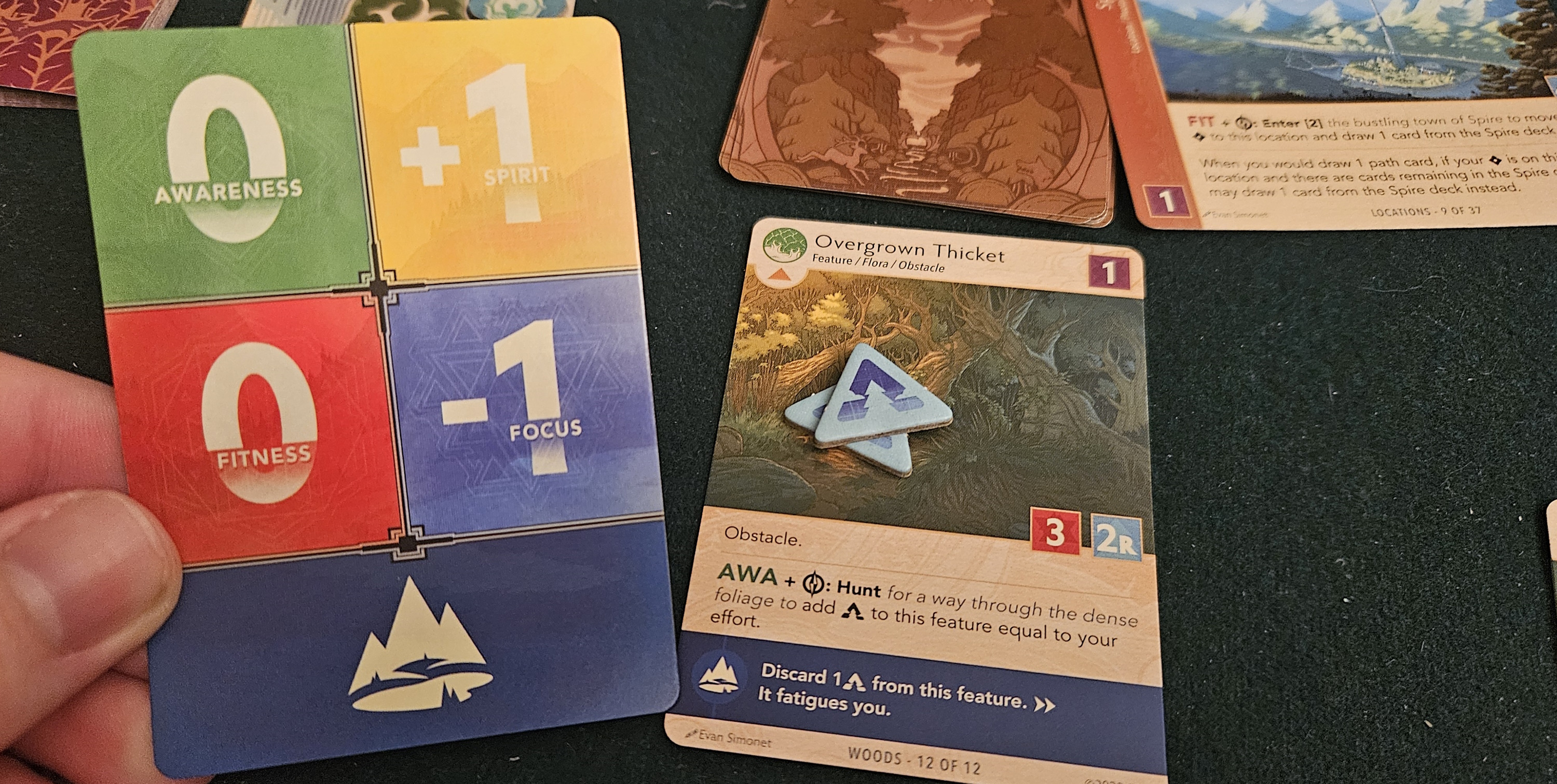
Checking the outcome of my actions.
There are necessary sacrifices. One of them is the whole “build and rebuild your deck ten times” thing, and good riddance. Fussing over the precise composition of my cards was never what I appreciated about those games in the first place.
Constructing a character in Earthborne Rangers is a holistic experience. At the outset of your very first session, you determine your makeup from a handful of traits. Your aspects, basically character stats, clearly and concisely printed on a single card, which will determine the four types of energy you can spend on actions. Your background in early adulthood, providing a handful of general purpose cards. Your ranger specialty, another set of cards, more synergistic and precise this time. Eventually your role, a character-specific ability that’s always available, and an outside interest, a few cards from beyond the confines of your background and specialty to patch any holes.
Put these together and you get a deck of thirty cards. Fifteen cards, really, with two copies of each. This is you. Over the course of the coming sessions, these cards will change. Finding new items or learning new skills lets you swap them out, one pair at a time, gradually becoming a wholler version of yourself. By the end of the campaign, these patchwork alterations won’t result in a full transformation. Your ranger will still be recognizably you, portions of your backstory still intact. But your strengths will be honed, your shortcomings rounded out.
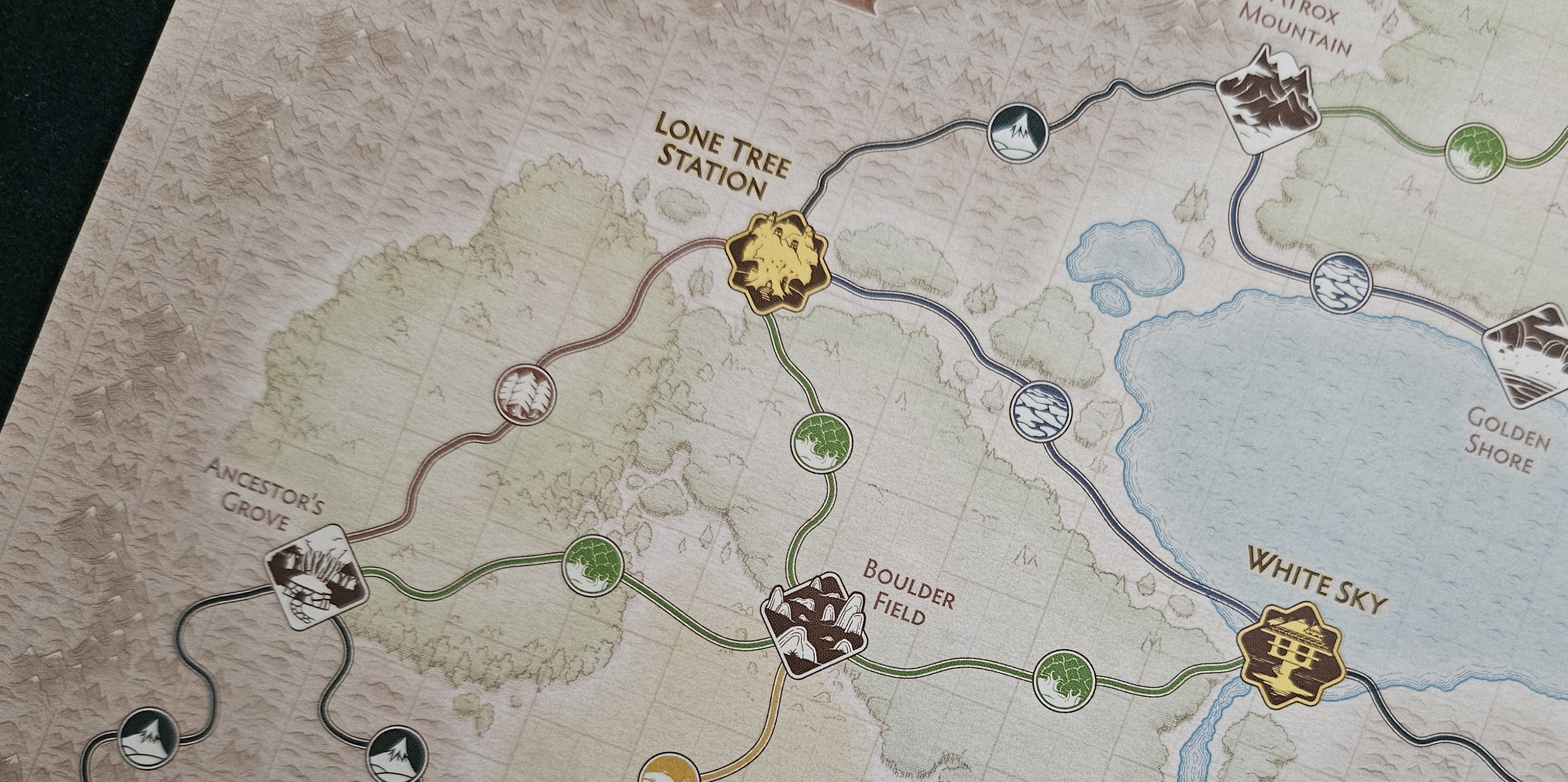
A small portion of the Valley.
The same goes for how Earthborne Rangers handles its sessions. Unlike its predecessors, challenges are handled on the fly, constructed from a combination of your location, your ongoing objective, and whatever path you’re traversing. It’s a lot to take in — hence the whole biscuit delivery quest — but once internalized it’s fluid and wide-open.
Let’s say you’re hanging out at Lone Tree Station. Your goal is to reach Spire, a town at least three locations removed. To travel, you need to add a certain number of tokens to your location card. In the meantime, you’re drawing cards from the path deck; these are the creatures and obstacles hampering your progress. After a while, you’ll add enough tokens to depart. Now you’re presented with a decision: should you travel to Boulder Field or Ancestor’s Grove? Both are equidistant from Spire, so it’s really up to you which route is superior. Such decisions aren’t blank; any number of factors can inform them. Maybe you’re shepherding a character who wants to stop at one location over the other. Maybe you haven’t visited a spot and want to see what’s there. Or maybe you’re just sick of traveling through woods, so you opt to go via the route that passes through the old-growth.
Regardless of the reason, the route you choose to travel establishes the path deck for the next leg of your journey. You shuffle the cards for your chosen route with those matching the destination. Maybe the weather or an ongoing quest tosses in another card or two. In some cases, you add a few generic cards to the mix, face-down so you can’t be sure what’s coming.
And then you’re off. On an adventure. One that isn’t quite like any other because it’s cobbled together from multiple sources.
Along the way, something wonderful happens. Two somethings. The first is that Earthborne Rangers feels wild, a stark contrast to the trimmed and hemmed-in scenarios that were its predecessors’ domain. Often, you’ll pursue multiple quests at once. In those instances, you’re given free rein over how to approach your tasks. Why be stuck traveling along the Anduin or investigating an eldritch cold case when you can do both at the same time? I won’t spoil any details, but there were moments in my campaign that had me poring over the map for a route that would deliver so-and-so to her destination, swing past a particular spot to investigate a sinkhole, and still uncover at least one site I had never reached before. By blowing up its decision space to fill an entire map, Earthborne Rangers doesn’t merely expand the scope of its quests. It treats the world like an actual living, breathing place. It rewards curiosity. It makes us care about its locales and familiar faces.

The four-color skill system works great.
Better than that openness, even, is the way those cards merge into something resembling an untamed frontier. Each of the path sets has its own ecosystem, cards that riff on one another. Or hunt one another. Or spring to one another’s defense. In the woods, bucks mark their terrain or grow aggressive if you linger near a doe too long. Along the riverbank, rapids threaten to slow your progress while hooked-tendril plants lurk beneath the surface. Traveling through the grasslands, some cards may be flipped face-down, hidden in the stalks, and must be scouted lest they ambush you. On the mountaintop, birds of prey circle, and may pursue you from one location to the next.
It’s this system’s capacity of surprise that pushes it over the edge. It’s one thing to happen across a floating biomeld that jitters your teeth with its dissonant humming. It’s another entirely when a wayward child from the nearby village appears on that same trail, shuffled at random into the path deck, vulnerable and in need of assistance.
In other words, it isn’t merely that Earthborne Rangers presents an open world to explore; it’s the very nature of that world, the ethos underlying its design, that gives it such texture. To dip again into the realm of video games, it’s the difference between the open-world approaches of titles like Far Cry or Horizon, where enemies and hazards are safely confined to their proper exhibits in the theme park, or the more vibrant approach of a game like S.T.A.L.K.E.R., Fallout: New Vegas, or, fine, Skyrim, where anything might happen, a deadly monster from a later zone intruding into a space that otherwise seemed secure. Some of my favorite moments in Earthborne Rangers had nothing to do with the quests as presented, but rather arose as emergent story beats thanks to those various decks being shuffled together. The predator that followed me into a cavern where I was studying entirely different predators; the huntress who aided me as I evaded spiky biomelds; the ornithoper I bluffed my way onto so I wouldn’t have to hike up the nearby hill; the damsel-in-distress artist who always showed up right when the wolves were closing in. More curated narratives might call these appearances incongruous. That’s precisely what made them special. This is a game that’s at its best when it’s chewing the scenery.
Of course, there are instances when these incongruities stagger into the uncanny. Investing in Earthborne Rangers requires a certain flexibility. While hanging around in the Valley’s safest human settlement, you might find yourself beset by a bear. In a buried ruin, a cyclone bears down on your position. Under pursuit by wolves, backed onto an unstable scree, injured and bleeding and unsure how you’ll come out of this scrape intact, your artist friend suddenly asks if you could pretty please help her paint a landscape. Lady. What are you doing here. Again.
There are other nitpicks. With enough experience and a sufficiently improved character, certain destinations take longer to shuffle together than they do to bypass. Sometimes so many triggers and conditional effects pile together that keeping track of them all becomes truly daunting. Like many campaigns, it’s somewhat long in the tooth. Relatedly, I’m very sick of wandering through the woods.
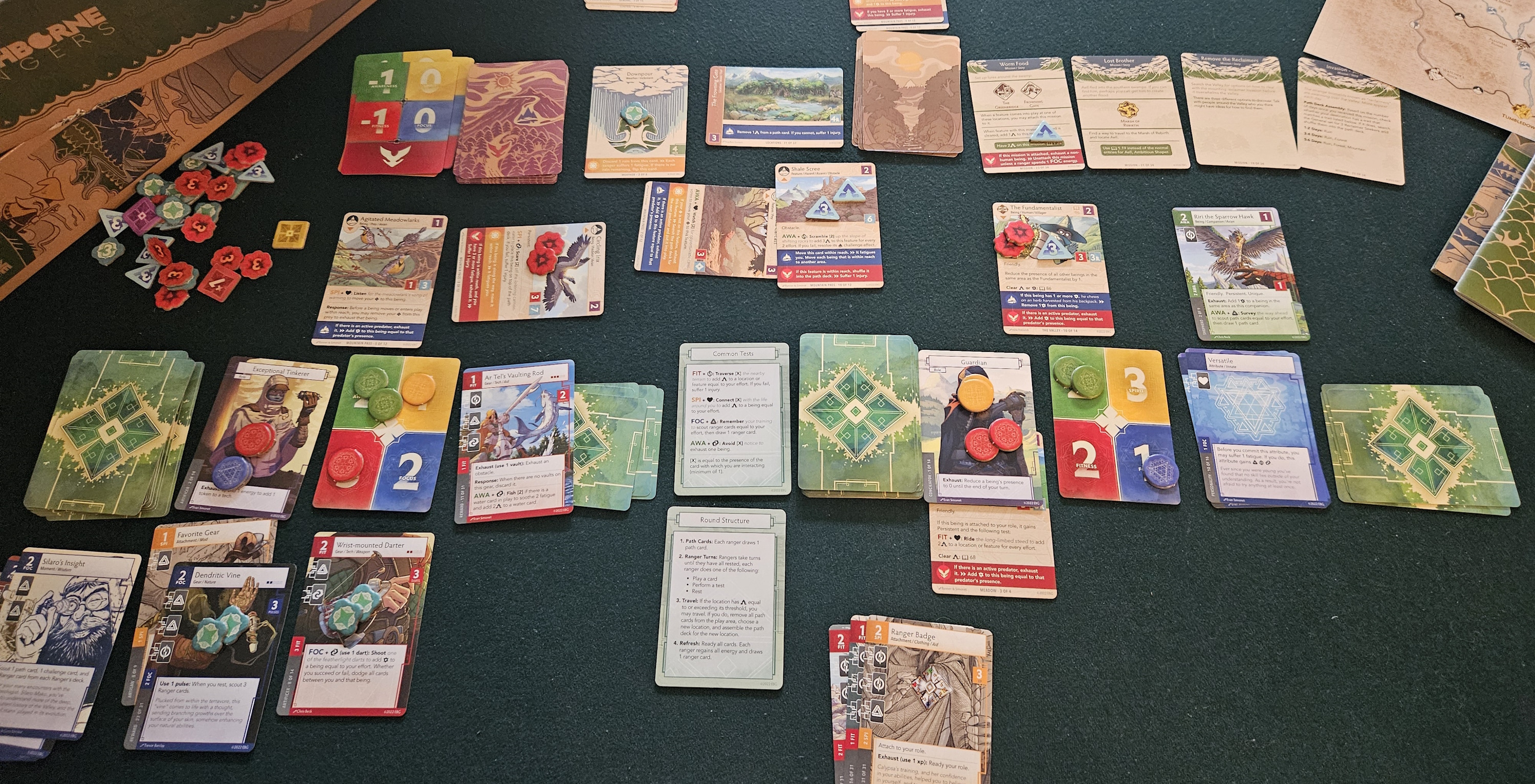
Things can get cluttered.
But these are a small price to pay for such an experience. Earthborne Rangers isn’t perfect. It’s better than that: it’s experimental and revolutionary and surprisingly smooth despite its newness. There are certain memories that will stick with me long after the main campaign has faded. Taming and then rescuing a stilt-horse from a prowling monster. Declaring a canteen my favorite tool so I wouldn’t collapse from exhaustion. Carving a canoe with my own hands and then racing between locations that were previously so far apart. Rescuing that artist lady. And again. Also once more.
She sure can paint a landscape, though.
(If what I’m doing at Space-Biff! is valuable to you in some way, please consider dropping by my Patreon campaign or Ko-fi.)
Posted on May 2, 2024, in Board Game and tagged Alone Time, Board Games, Earthborne Games, Earthborne Rangers. Bookmark the permalink. 18 Comments.

 SPACE-BIFF!
I’m in agreement about everything that you, Cole Wehrle, SUSD, and many others have said about have revolutionary the game is… I think fewer people will rank this their favorite game than for Arkham LCG because the latter’s scenario design reliably created incredible tension and the deck building was wonderfully meaningful for how simple it was (add one or two cards, usually). Yet, I’m challenged by how this game begs the player to give up on wanting tension from most of their adventures… and I want to love it more! Without a doubt reshaping the genre, and for the better.
That’s a fair perspective. Sometimes there’s a flabbiness to this game’s “scenarios” (for lack of a better word), although I think that’s a sign of its newness as well. I can easily imagine this formula being applied to a tighter scenario structure. The way key locations provide their own little decks could be expanded. It would be incredibly cool to see an Arkham Horror-style game that’s a little more open, letting you move between the locales of an investigation and add in randomized surprises or recurring cards. Revolutionary indeed!
The most recent three Arkham campaigns have all embraced a “non-linear” structure to varying degrees, with the second to last of them having a world map and having the most narrative openness. However, it has been criticized by fans for leaning on long passages of text overmuch and featuring a lackluster finale. Hopefully their release from this winter will be better.
Perhaps it’s good to remember also how mediocre most of the early LoTR and Arkham scenarios were, also… newness counts for a lot, especially with the most influential Arkham designer hopping over to Earthborne Games a couple months ago.
I hope to see the success of this title and Forest Shuffle encourage other publishers to take big swings at environmentally conscious productions, too.
I have backed the game and what excited me is that openness. How much in the game would you say the game lets you just pick a direction and go? This review seems to indicate it is telling you where you should visit most of the time and you are choosing your path.
I would almost want to see a a game that goes in the opposite direction and was like an open world game where you are encouraged to explore and figure out your own goals and quests. The dynamic elements of this game really seem to support that. Most of the time I do prefer a tighter structure but that is just because I don’t think anyone has pulled off true openness.
You can “pick a direction and go” quite a few times, but it’s always directed a little bit. As in, you’ll have an overall goal over there (waves hand) and you’re free to pursue it how you see fit.
If you want a game like you’re describing, check out Sleeping Gods. It’s incredibly open-ended.
I have played Sleeping Gods and think its awesome but I also love the emergent gameplay/narrative I see in this. I guess what I would like to see is the broad scope narrative be emergent as well and maybe thats not possible or maybe this is a stepping stone towards that. These are kind of the big design thoughts I’ve been thinking on lately. I do wonder if cooperative games are less suited though because it does have to be scripted in some way
I also think Sleeping Gods has a touch more pressure than I want for an open world game (I think you need something but a fair amount of time in Sleeping Gods is survival and the ticking clock is always there). Its tough because without pressure it becomes meaningless or too easy but I wonder if there is a way to balance that where you have some control over that (where you can ignore the pressure and just explore but it changes the game in subtle ways)
Anyways I also just want to say I greatly enjoy all your reviews and writing. The Arcs review was phenomenal and i’m excited to get my copy (some good emergent narrative in that game from what i’ve seen). I also picked up Vijayanagara recently somewhat based on your writing and that is a wonderful game (and a great intro to that style of game as it was for me)
Thanks for the kind words, Matthew!
I’m so confused by all of these reviews. The presentation and initial campaign looked great. But all the reviews seem to just describe it as a really light, narrative TTRPG. Its cute that you get little vignettes, but it doesn’t even sound like the writing is particularly inspired. I’m really not sure what this game offers that you couldn’t get out of a B-tier fantasy novel or going to the beach.
More seriously, I’m really not sure about the LCG comparison. The whole entirety of those games is about building decks to overcome challenges. If you get rid of the deck building and get rid of the challenge aren’t you just left with one player Uno?
The game isn’t ‘challenge free’ for sure, as you get further into the game challenges do certainly arise – though there’s almost always the option to try a task again the following day, and you’re typically gated by ‘how much you do in a day’ rather than ‘is this thing possible’.
For deckbuilding, there is, in my opinion, a ‘flatter’ competency and a multitude of ways around problems; Arkham (the LCG I’m most familiar with) forces you to play the scenario and campaign to meet the challenges it presents you with, and Earthborne takes the approach more of asking you how you would like to meet the challenges.
That all said – like Dan mentions in his review, a lot of the joy I’ve found while playing isn’t in overcoming the challenges like it is for many other games, it’s in the discovery and exploration and surprising interactions, seeing the world both move along without me and also react to my presence.
Finally, having met Andrew, I’m absolutely convinced he’d be flattered that you compared playing the game to having a nice walk on the beach…!
Interesting review, as always, of an interesting game. Going with a basket might be a little too much Red Riding Hood for me, though. But I take it that this is a cooperative game. How does it adress the issue of quarterbacking?
There are a couple of solutions there. First, each ranger has their own hand of cards. Second, each ranger inhabits their own “zone,” and is limited to interacting with things “within reach” — which may include stuff beyond your zone, but is often more difficult. Quarterbacking and alpha playering are still possible, but would require quite a bit of effort and attention from the offending player.
Quite a few people I respect seem to love the game so obviously there is something of value here, but I just can’t get a handle on what the game would feel like and whether it is for me or not.
It doesn’t help that I seem to have a very low tolerance for certain aspects of narrative games, but that I haven’t quite figured out what those aspects are yet. I absolutely love Arkham Horror the Card Game but got rid of Sleeping Gods after one session. I played through all of Legacy of Dragonholt solo and enjoyed it very much but got annoyed by 7th Continent and sold it.
What I think I want is for mechanics and the narrative to feel like parts of a whole, parts that enhance each other. With Sleeping Gods I felt like I was playing two games, either a mediocre resource manager with a lot of narrative fluff, or a decent choose your own adventure book whit a lot of upkeep and admin to make it last longer.
My hope is that EBR will speak to me the same way AHtCG does, but it’s very hard to tell.
Also, Dan, thanks for all your wonderful writing. This is my first time writing a response, but I check the site every day. I’m so glad that there still exists quality writing about games and not only video content.
Thanks for the kind words, Petter!
I want to echo Peter’s criticisms of Sleeping Gods. I was so excited by the reviews/praise and now am almost 1/2 through the second deck and I’m feel the exact same way.
Speaking of criticisms, Dan, I am wondering if you share Tim Choun’s (who does with videos/images what you do with words) criticism of Earthborne Rangers, especially the rulebook (which is something goodly Tim is a stickler about). Feel free to see the segment (and comment afterward) here: https://www.youtube.com/watch?v=1qTppU7jpNQ (starting at 1:39)
Having gotten around to watching Tim Chuon’s video… no, I do not share his criticisms.
When I read that this could replace LCGs, I was quite pleased. I play Marvel Champions, which I selected from the 3 as it seemed the most solo friendly and I despise all three of the IPs (for celebrating racism, sexism, and classism; although the MCU, seeing as the audience is different, is much better than the original), so none of them resonated with me on a setting level (and all three upset me on a thematic level). But, I play MC because I love to construct a deck, filling it with characters and tools and verbs. Then and only then facing it off against a scenario. That’s what I play those games for. To me they are much closer to Galaxy Trucker than this (but I realise that has a lot to do with what I want out of those games, constructing decks is not a chore, it is part of the fun, for me).
This Earthborne Rangers game might be quite fun, but it kind of sounds like another game trying to replace video games. Like that 7th something or other from a few years back.
Pingback: Ode to the Depot | SPACE-BIFF!
Pingback: Best Week 2024! Better Together! | SPACE-BIFF!