Violent Zornography

Talk about pedigree. The Struggle for Zorn: The Red Blight is a mouthful in more ways than one. Take its trio of designers: Hermann Luttmann, the creator behind Dawn of the Zeds and The Plum Island Horror, Fred Manzo of Escape from Hades, and Ryan Heilman, whose Brave Little Belgium took a big risk by centering wartime atrocities. Zorn is a three-way baby that bears strands of DNA from each of them. It’s big, long, messy, overcomplicated, and enthralling.
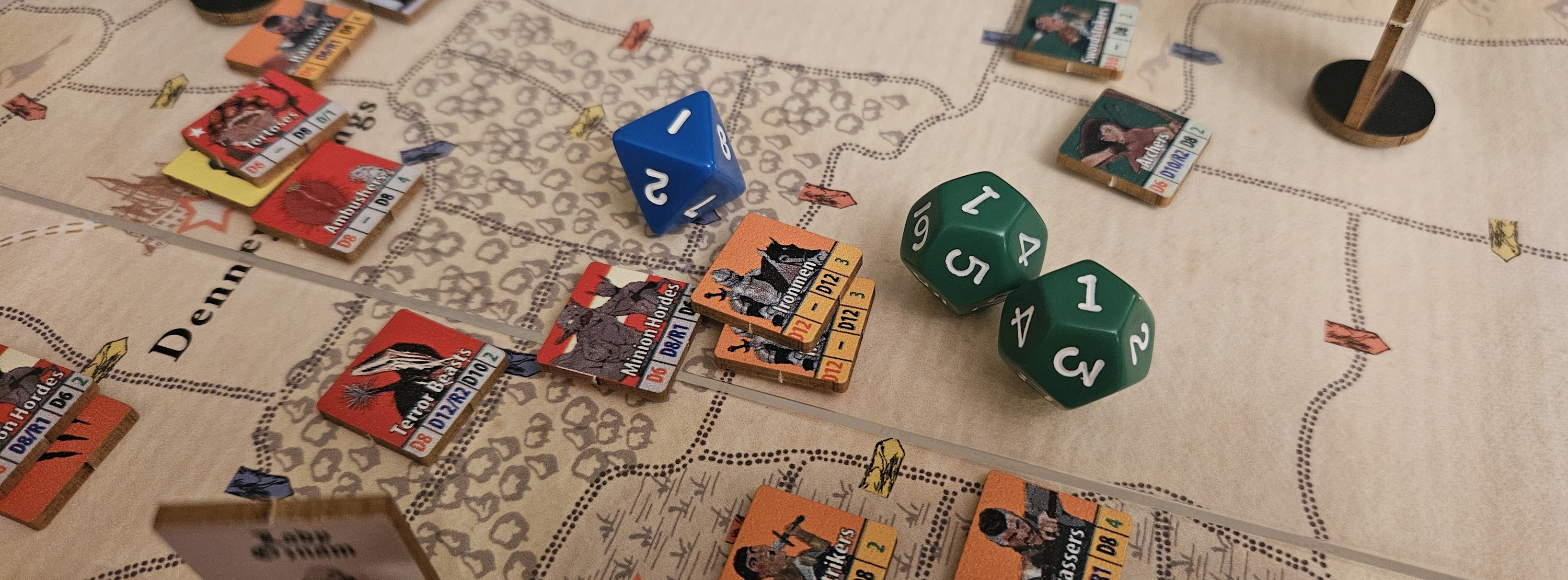
Things are getting… DICEY.
Given the game’s designers, maybe isn’t a surprise. Everything about Zorn screams throwback, from its fantasy-wargame setting to its contents. By which I mean its proliferation of dice, two-sided event table, terrain stacking limits and combat modifiers, combat chits replete with battle and movement stats, and chrome rules that don’t matter 99% of the time, until they do, all at once, very much. Compared to Luttmann’s The Plum Island Horror, which pulled too many of its fangs somewhere in development, this thing is downright toothy.
But I’m getting ahead of myself. The Struggle for Zorn revolves around an invasion of blight monsters into an otherwise peaceful valley, a distant corner of a kingdom where the grain grows tall and noble houses squabble for position. It’s the sort of place you’ve likely visited in a dozen board games, stringing roads between settlements or optimizing farm placements. Now the place’s holy relics have been stolen by tortoise monsters, mutated rats and snakes are preparing ambushes, and corrupted knights are on the warpath.
Where Plum Island and Dawn of the Zeds riffed upon and even modernized the States of Siege system, Zorn sprints the other direction. The map is a spaghetti bowl of encroaching lanes that the monsters use to march forward and eventually exit into the more sedate portions of the kingdom. The place is such a tangle, though, that you wouldn’t know it from a glance. That’s part of the game’s appeal; fighting in cities requires a different approach from conquering open plains, waging conflict in forests and marshes, fording rivers, or countering enemy ambushes. To succeed, you’ll need to do it all. That’s because your goal, as the head of a noble house, is to campaign into the valley, suppress the blight, and bring everlasting glory to your name.
That last clause is especially loaded. But let’s hold off for a moment.
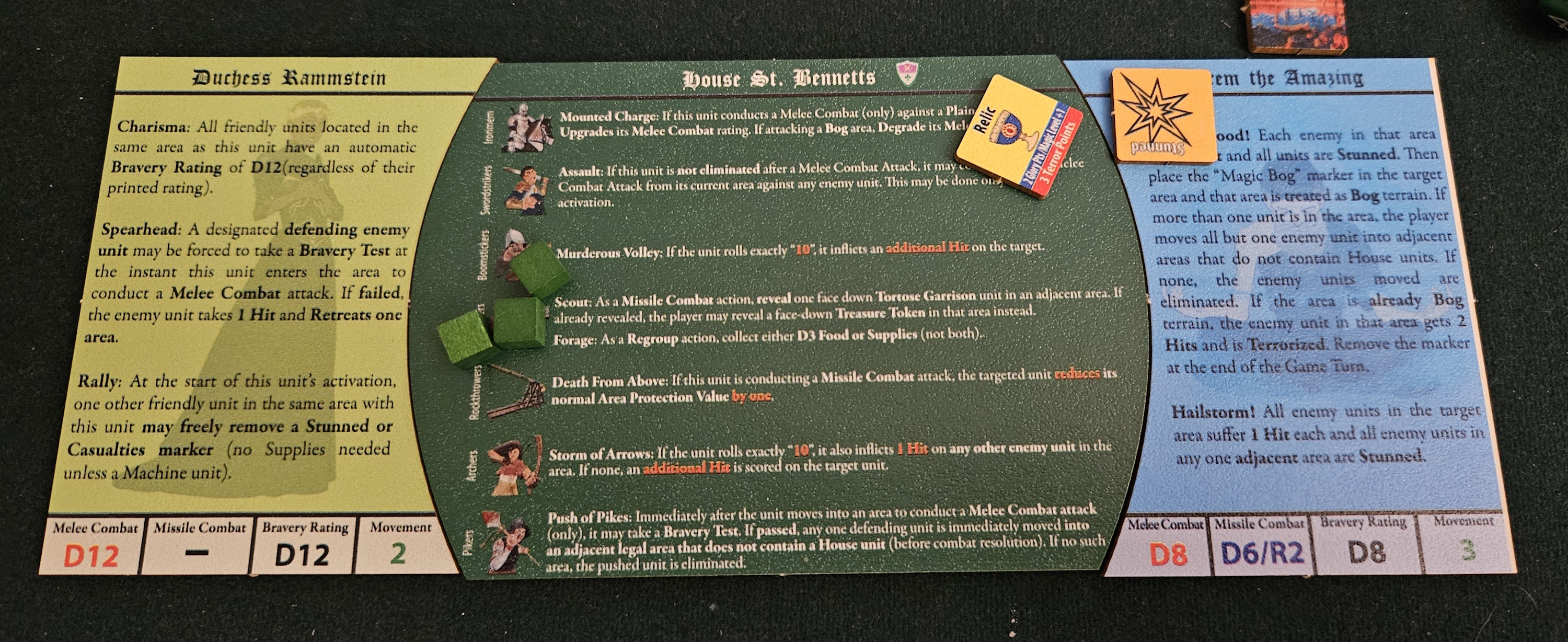
Between your House, Commander, and Magic Abuser, each faction is unique.
From its very first moments, Zorn treats itself to extra toppings. Everyone begins by choosing their force composition, a selection that’s more or less set in stone and will determine your approach to the coming fight. It’s tempting to load up on the heavy hitters: mounted ironmen who absolutely smash on level terrain, swordstrikers who can keep fighting until they’re put down, boomstickers and archers for inflicting wounds without risk of taking hits in return. This trio of designers is too clever to let such a straightforward composition prevail. Even the lesser unit types are considerable. Levies might not sound sexy on paper, but they’re easily replenished. Rockthrowers are painfully slow, but can slam stones into enemy positions from ridiculous ranges. Pikers don’t perform all that well in open combat, but can prod enemies onto unfavorable terrain, or even out of existence entirely if there are no avenues of retreat left. My favorite unit is even less glamorous, the humble harassers, who scout enemy positions to prevent ambushes and, even better, forage for food. Because without food, your army will soon find itself marching on neither stomach nor feet.
There’s more. Each house also receives two heroes, both a commander for leading troops and a magic user for… well, for flubbing die rolls and getting stunned when a spell explodes in their face, if my experience is anything to go by. Rather than a generic suite of abilities, each hero comes with their own perks. So where one commander might function as a sniper, another will boost their troops from the front lines. One magician brings down a halo of darkness on enemy positions, while another freezes them in place. There are no default cantrips that everybody has access to.
Even deployment is fraught. Troops are normally placed along the mountain passes leading into the valley, but there’s also an option to move some in along flanking routes. This keeps them off-map until they step onto the stage deeper in enemy territory. It’s a considerable option, especially for the more sluggish units in your employ.
This glut demonstrates a wooliness that defines the entire game. Nothing is baseline. The geography is a thicket, enemy lanes winding back and forth, changing depending on a roll at the start of each round. Monsters, whether ordinary defenders, attackers, or blighted champions, all have their own abilities as well.
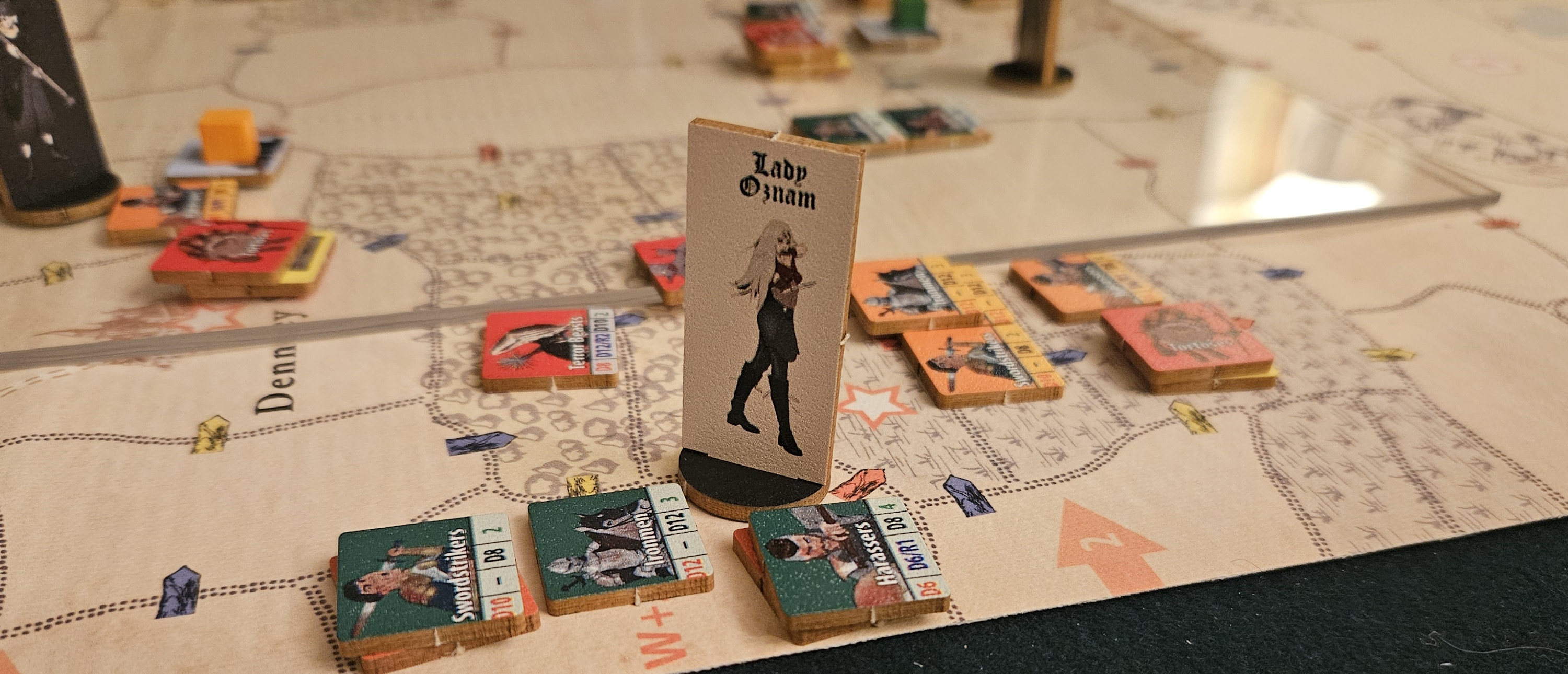
I dig the retro look.
That wooliness extends to the mode of play itself. At a nominal level, Zorn is a contest between the noble houses and the Red Blight. As enemies are slain and relics are reclaimed, your house’s glory ticks upward. The same goes for the Red Blight and defeated soldiers or, in the game’s closest resemblance to Dawn of the Zeds, for every monster they sneak or batter past you and into the kingdom. If the Red Blight’s terror exceeds a certain threshold, that’s game over.
Except this is no solitaire game. Or at least it isn’t solitaire only. Zorn shines brightest when played with teammates. That’s because your noble houses are, in the tradition of noble houses everywhere and everywhen, also locked in conflict with one another. Suppressing the Red Blight is only the first step. You’re also determined to prove yourself the sexiest house of them all.
This transforms Zorn into a race of sorts. Recovering relics and other misplaced treasure, slaying those monsters, and using as few supplies as possible all contribute to your overall glory. Because there are only so many caches on the map, it isn’t uncommon for houses to press themselves farther and faster than is strictly wise. Troves are guarded by tortoise defenders with variable stats, not to mention the possibility of unexpected ambushes. Whether it’s worth the time to bring up your harassers to scout the trove first or run headlong into danger is one of the game’s most durable questions. The same goes for the valley’s towns, which award much-needed food and supplies, but are also fortified against incursion and can be stolen by jealous friends.
Speaking of which, it’s possible to clash with your fellow houses, whether by dueling for that hallowed first turn or even waging outright battle to slow down a runaway ally. The cost of doing so is restrictively high, however, possibly inflicting an injury on your commander or incurring a wergild payment. It’s an interesting inclusion, and I don’t begrudge the game for including it. But while duels aren’t unheard of, actual combat is something of a rarity. There’s simply too much at stake to risk accidental death.
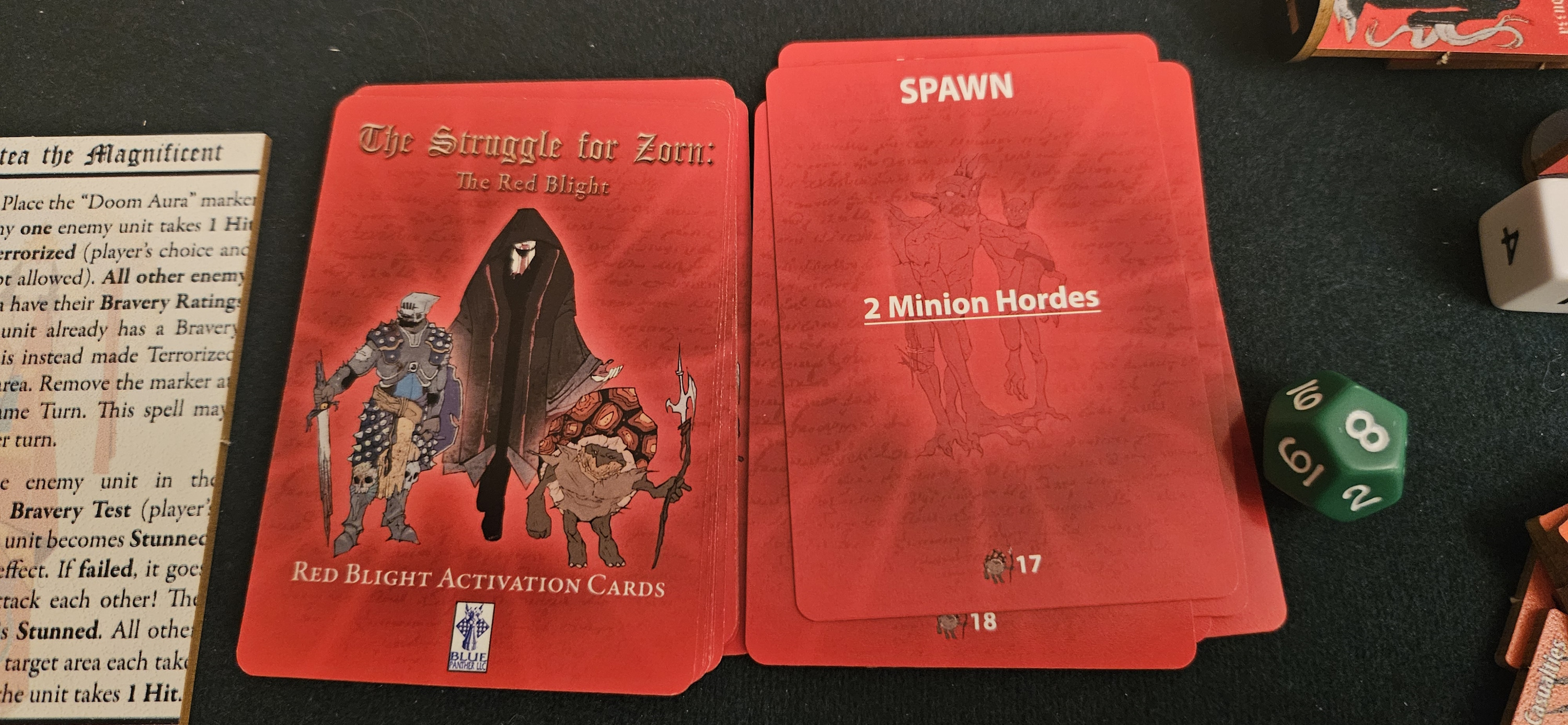
Are there enough baddies? I dunno.
Add all these possibilities together and you get quite the hearty stew. At its worst, Zorn is such a mishmash that it verges on awkward. It’s the sort of game where rules will go overlooked and be remembered a little too late to comfortably repair. It’s also about as dicey as they come, , although unlike some of my favorite dice games, which stick to conventional wisdom by ensuring their playtime is carefully trimmed, Zorn hogs an entire evening. A full play will likely require four hours, with plenty of quiet stretches and pauses to resolve battles.
Despite its complexity, duration, and a semi-cooperative emphasis that doesn’t always land on both wheels, I’m still caught up in an ongoing flirtation with this thing. To say there’s nothing quite like it isn’t the full story; see the other titles by the designers I mentioned above. On the whole, though, it’s worthwhile precisely for the ways it defies conventional wisdom.
Its dedication to randomness, for example, isn’t a downside so much as an enlivening upper. I’ve lost sure-thing battles and won against long odds. On one occasion, a bog ape appeared and chowed down on a crucial scout. Because that scout couldn’t preempt an ambush, I lost the ensuing battle. Because I couldn’t win that battle in time, my entire left flank failed to pivot against a pack of beasts that slipped past us in the chaos. What followed was a full in-game day of panicked wheeling, forced marches, chancy engagements on poor terrain, and an evening of empty bellies. My entire offensive stalled, then retreated back across the river. It was organic and reactive in a way that very few games manage, sending a cascade of repositioning troops across the entire valley, all thanks to a single unfortunate event roll.
Which isn’t to say it’s all good all the time. Zorn is an acquired taste, an old-timey wargame that thumbs its nose at modern trappings. One of those trappings is apparenlty editing. All three of its authors have left their fingerprints on the final design, but nobody bothered to make the rulebook comprehensible or ensure that the enemy bosses had their stats printed on the abilities sheet. Or anywhere else for that matter. Apparently that latter problem has since been rectified, but the larger hurdle remains. To play Zorn is to flip through reference materials for the specifics on whatever action you’re undertaking now. There’s a story in the telling, but it’s buried five feet deep under hardpack and you’re going to excavate it with your own two hands.
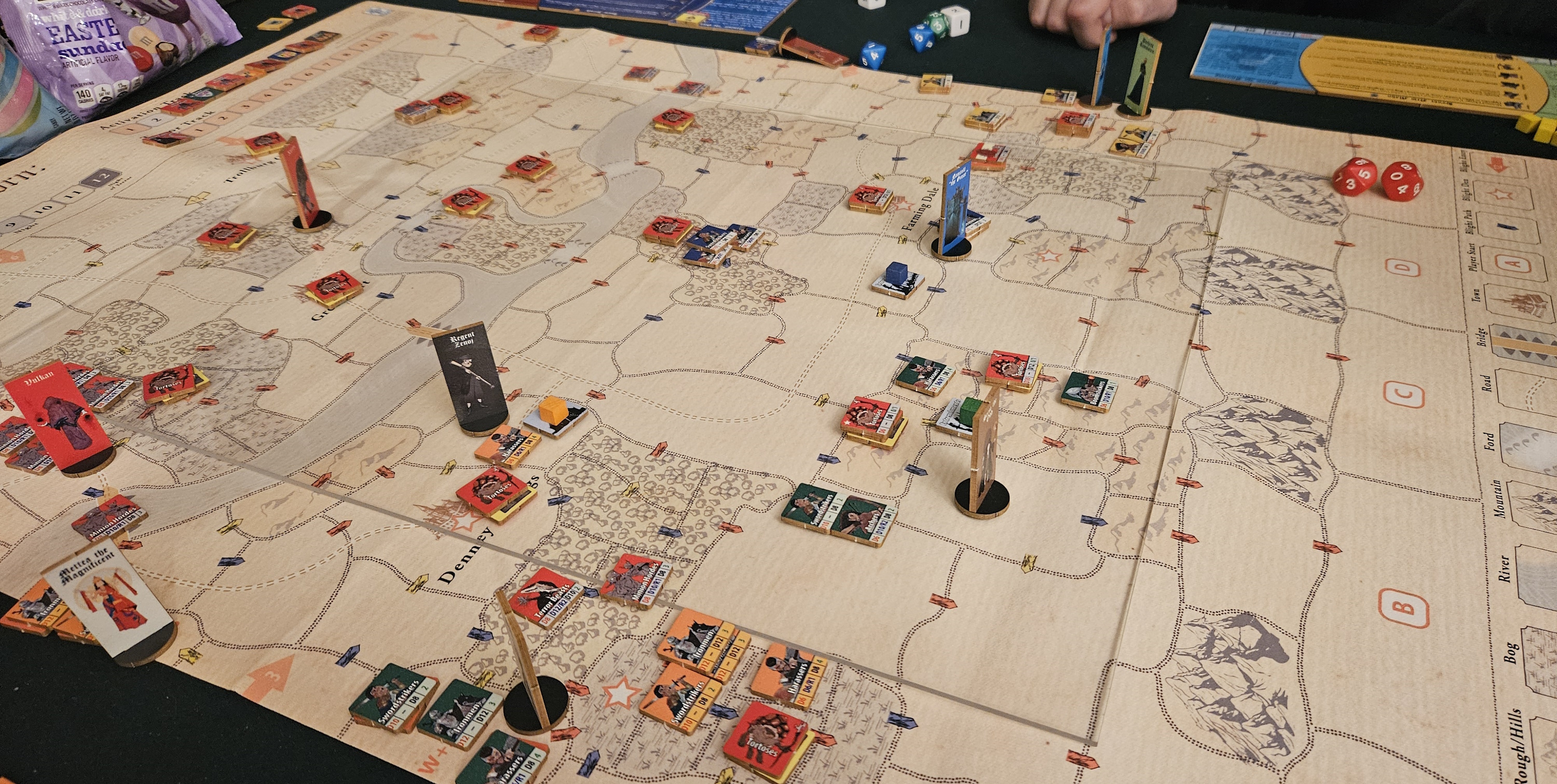
Plexi not included.
Here’s the thing. I play dozens of fine-tuned games every year. Many of them are good. Great, even. One or two are modern classics. But far more have had every jagged edge smoothed away until all that remains is a featureless plastic ball, uninteresting and uninspiring.
The Struggle for Zorn is the polar opposite. This thing is a rusted clod of earth with a horseshoe sticking out the side. It’s a petrified remnant of a former time. Unless one splurges on the cloth map, it requires a plexiglass to smooth out the paper sheet it’s played on. It takes all night to play, and doesn’t guarantee a frictionless experience. Even after three sessions, I very much doubt I got every rule right. It isn’t the sort of game I would recommend to most people.
But it’s also enchanting. The story it tells, of noble houses doing the right thing for the wrong reasons, clashing over petty pride, tussling for the gratitude of a king who would rather they all dissolve into a puddle, and still somehow vanquishing a walking plague anyway, is one I’m glad to have experienced. Sometimes the best stories are the messy ones. And Zorn is nothing if not a compelling mess.
(If what I’m doing at Space-Biff! is valuable to you in some way, please consider dropping by my Patreon campaign or Ko-fi.)
A complimentary copy was provided.
Posted on April 9, 2024, in Board Game and tagged Blue Panther, Board Games, The Struggle for Zorn: The Red Blight. Bookmark the permalink. 10 Comments.

 SPACE-BIFF!
Thanks; I was curious about the game. Mostly because it seems to cover A lot of the same themes that the recently published “Burning Banners” does, but at a more manageable price point and complexity ……Any thoughts?
I wish I could tell you! I would love to try Burning Banners, but unfortunately I can’t get Compass to talk to me.
I refuse to believe this was just a happy accident!
I’ll never tell. 😉
If it were a happy accident, however, I’m leaving it as-is, because that’s too perfect.
I love the idea of this genre of games—beautiful messes, like A Study in Emerald 1st Ed., or Merchants and Marauders, or Stationfall—could be called something like “rusty clod” games based on this article. But perhaps that’s a little too niche.
I am gonna start calling over-streamlined soulless game exercises “smooth plastic balls”.
That really is how they feel to me. Too smooth. Too textureless. Give me something I can handle.
Yup. Every good game good game (…piece of art?) requires a few spikey bits
Zorn sounds gloriously entertaining… as was this review!
Thanks, Clio!
Pingback: Ode to the Depot | SPACE-BIFF!