I Want to Go to There
Josh Wood is the designer behind what I consider the finest tableau-building game of all time: Santa Monica. What sets it apart from its peers is a willingness to let players not only create a scenic space, but also explore that space, moving tourists and townies along its beaches and storefronts. The effect is profound, elevating cards from mere stockpiles of victory points to textured terrain that must be traversed.
Wood’s next stab at the genre is Let’s Go! To Japan, a curiously titled game that feels like it’s trying to launch a brand. Like Santa Monica, Wood invests his players in scenic locales and tangible geographies. I’m going to do my darnedest not to draw too many comparisons between them.
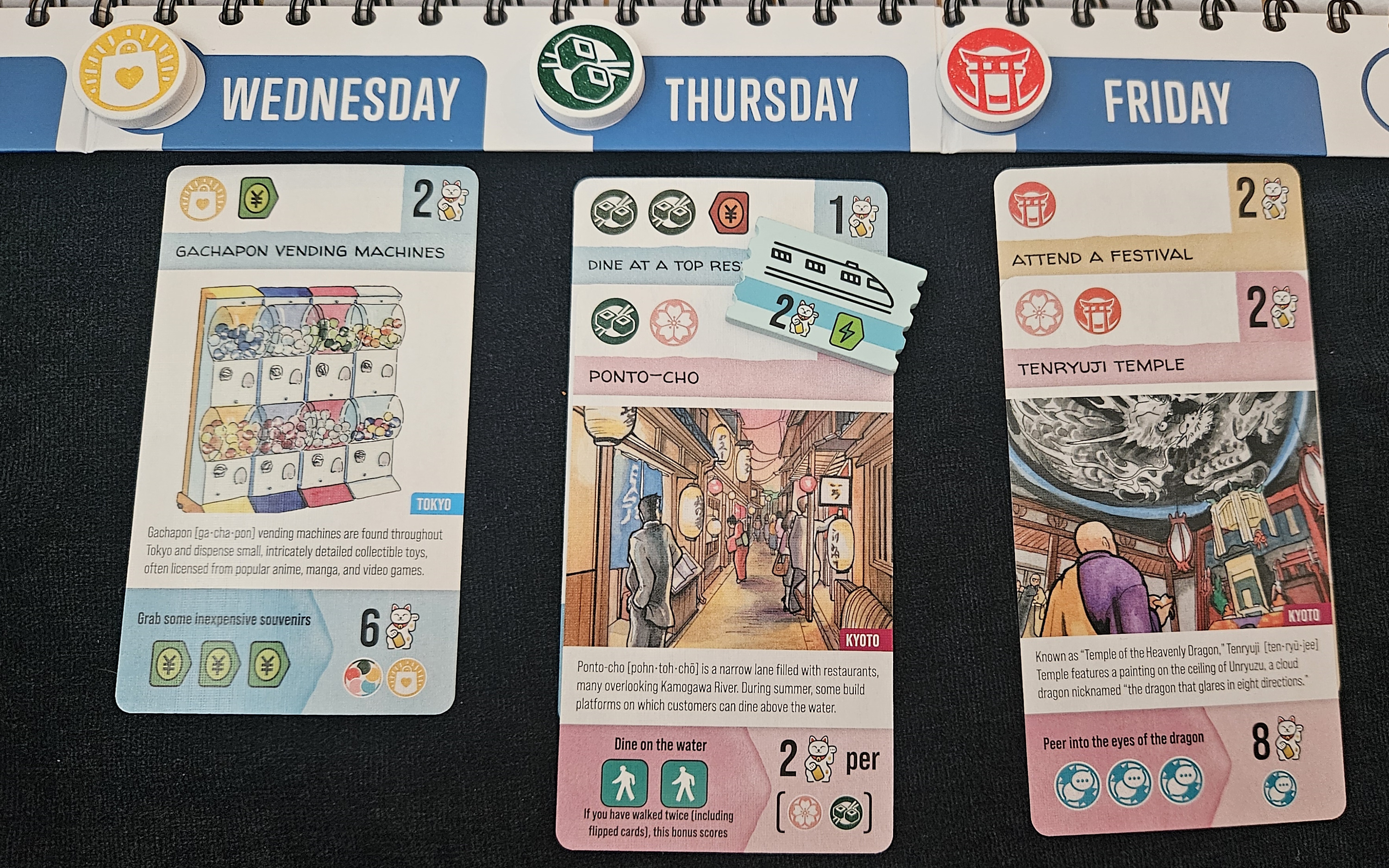
Planning a trip.
Right away, Let’s Go! To Japan forges its own identity, stepping away not only from Santa Monica but also from pretty much anything else out there. At the same time, its conceit will prove familiar to anybody who’s had to plot a vacation schedule, figuring out when to see the sights without overloading how much you can do in one day and thus making yourself miserable.
You have one week. Okay, six days. Unless you add in the Day Trips expansion, in which case we’re back to a full week. Neither amount is much time to visit Japan, even if we are limiting our trip to Tokyo and Kyoto. Your objective, then, is to cram in as many activities as possible into each day. There’s a method to this madness. When the game opens, everybody prepares a random but identical set of icons across those vacation days. This represents various opportunities for your trip, such as a day when all the shrines are open, an afternoon when the weather forecast promises to be especially pleasant, or a blowout sale at all the local shops.
From there, everybody begins to draft. Wood throws a few curveballs along the way, mixing up when players draw from the twin decks for Tokyo and Kyoto or when they pick up the undesirable junk passed on by their neighbors. For the most part, however, the drafting is straightforward. Depending on the round, everybody picks up either two or four cards, places one or two, and then passes along the cruft.
It’s what you do with those cards that matters. Like the best tableau-building games, it’s a rare moment when you only have a single criterion to consider. Unless you want to spend an inordinate amount of your trip riding between Tokyo and Kyoto, you’ll probably want to lump particular destinations together by the city they’re located in. Your bottom-most card on each day is also special, awarding bonus points and icons provided you meet certain objectives beforehand.
Perhaps the most immediate consideration, however, is those daily icons. You’re incentivized to pair cards with the appropriate days. If there’s one day that’s well suited for social events, that’s probably the best time to see a concert or take a wadaiko class. The same goes for everything else, from shrine visits to binge-eating days. This is crucial because matching enough icons awards bonuses when the day fills up with a full complement of three activities. And these are significant rewards. One is a day planner, which lets you draw a few extra cards during the draft, all the better for digging the best cards out of the deck. Another is a luxury train ticket, helpful when you want to hop between destinations without draining any points.

Some of the destinations you might visit in Japan.
But the most considerable reward is an extra face-down card on the day you’ve just filled up. These represent Wood at his sharpest. The gist is that whenever you have a card you aren’t willing to use, or when you’ve filled up a day with three matching icons, you’re allowed to go on a walk rather than taking a planned activity. Every card’s reverse side shows one of these walks, a generic block of free time for exploring the city.
This is a cool idea, permitting time for discovery and the unexpected. When the placement portion of the game wraps up, everybody goes through their schedule one activity at a time — in effect, “living” the vacation they planned over the course of eighteen cards. For the most part, there aren’t any surprises. Each activity awards its icons, usually nudging them forward along a track, sometimes tinkering with your overall happiness level for bonus points (or negative points) at the conclusion. That sort of thing.
But when you arrive at one of those face-down walk cards, you flip it up to reveal what you discovered while out and about. Maybe it will be something incredible, at which point you’re free to keep it on that side. And if not, you can simply keep walking, earning a single point and increasing your overall happiness.
These are the moments that set apart Let’s Go! To Japan from most tableau-builders. They’re also, unsurprisingly, the closest the game gets to Santa Monica. There’s something joyful about filling up your itinerary with a dozen-odd events only to slot in a few hours to simply bum around town and stumble upon whatever catches your eye. It’s rare that a discovery will mesh perfectly with that day’s plans. That’s hardly the point. The possibility of coming across a tea ceremony, or an out-of-the-way shrine, or an alleyway filled with restaurants and shops — that’s the good stuff. Now the game feels lived-in, a place brimming with possibility, rather than a laundry list of potential tourist destinations.
It’s also sorely needed, because Let’s Go! To Japan is often lifeless in a way that its spiritual predecessor was not.
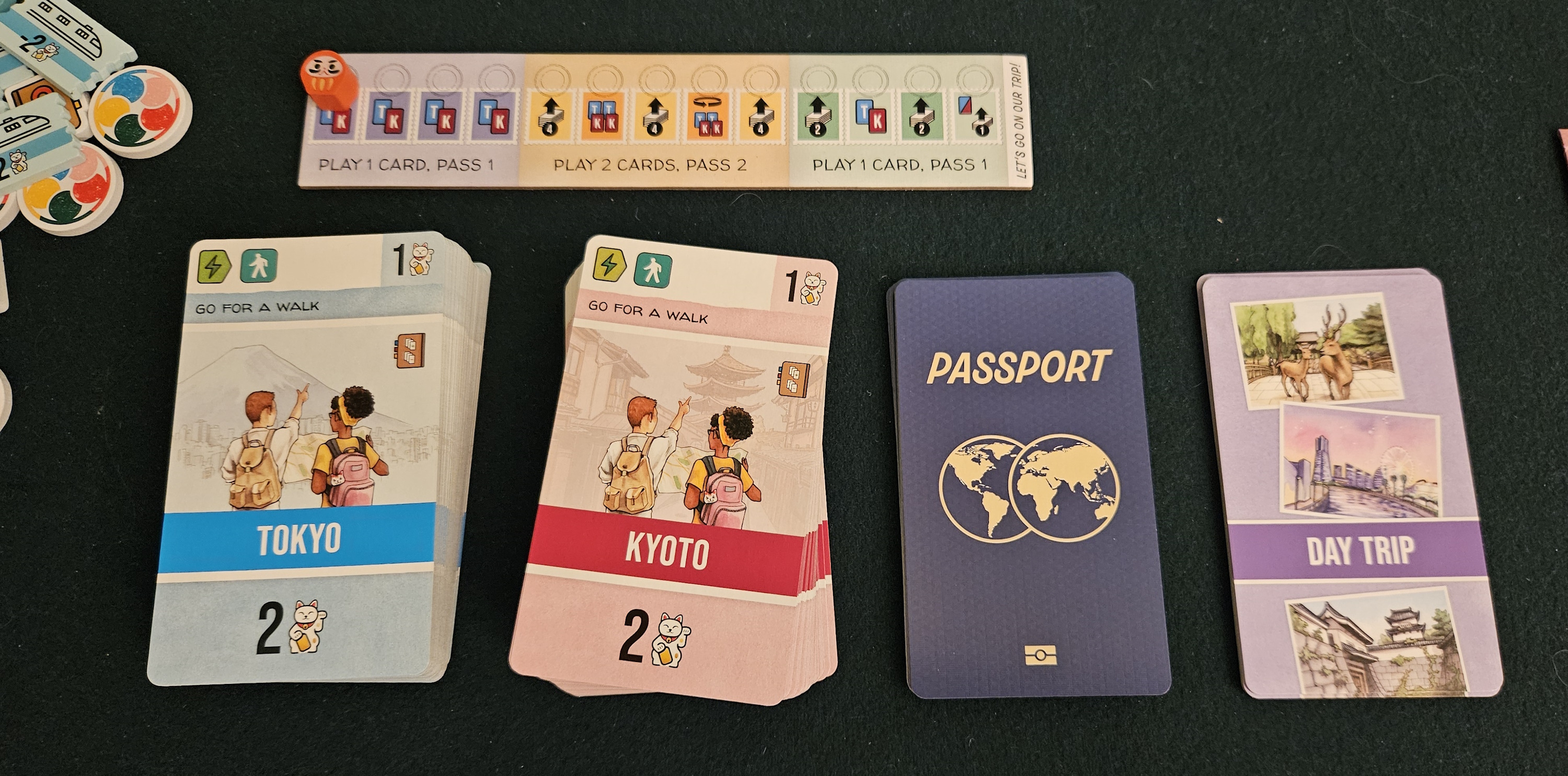
With expansions, there are four types of cards.
The first few plays of Let’s Go! To Japan are wondrous. The simple act of sorting through the game’s many cards is a vicarious treat. What’s more, there are moments of subtle humor peppered throughout the game. To give one example, certain icons deplete your happiness because their associated cards are expensive or physically taxing, while others bump your happiness forward thanks to affordable or energizing activities. In one session, my sister-in-law was having the most expensive vacation of all time. She’d dined at the nicest restaurants, stayed in a fancy hotel, and went into debt at the department stores in Ginza. So to prevent herself from shedding any further happiness, she elected to save money by visiting the Tokyo Metropolitan Government Building. Twice. In a single day.
But while those first two or three sessions are filled with excitement and discovery, subsequent plays are more strained. None of the cards in the game are true duplicates, but some of the activities and illustrations repeat. Not the end of the world, but disappointing nonetheless.
Worse, the game never quite breaks free of those daily icons. For the most part, a successful trip is all about filling your shrine-visiting day with shrines, your social day with social activities, your rest day with restful and cost-saving activities, and so forth. It simply doesn’t feel organic the way it might have. Speaking only for myself, I tend to prefer three great meals spread across multiple days rather than stuffing myself wretched thrice in one day. The same goes for other activities as well. A full day of shopping sounds like hell. An hour or two a day? Perfect! There’s something artificial about cramming every similar activity into the same span of time. With all of these marvelous destinations in such close proximity, can’t we mix it up a little?
To invoke the dreaded comparison, that’s precisely what Santa Monica did well, creating spaces that felt genuine and surprising and, above all, varied. By contrast, Let’s Go! To Japan comes across as hidebound by the need to attach the proper icons to the proper days.
I don’t want to overstate the problem. Even in its missteps, this is an above-average tableau-builder. That goes double once the expansions are mixed in, largely because they break away from the formula. Grab Your Passport adds individual abilities and scoring bonuses, while Day Trip extends the vacation to a seventh day to permit a trip to a neighboring city for, well, more points. Crucially, these latter points are contingent upon what you do in the days adjacent to your day trip, making it possible to shake up your schedule. In both cases, the presence of new avenues of scoring allows players to scoot away from those tyrannical daily icons, if only by a few inches.
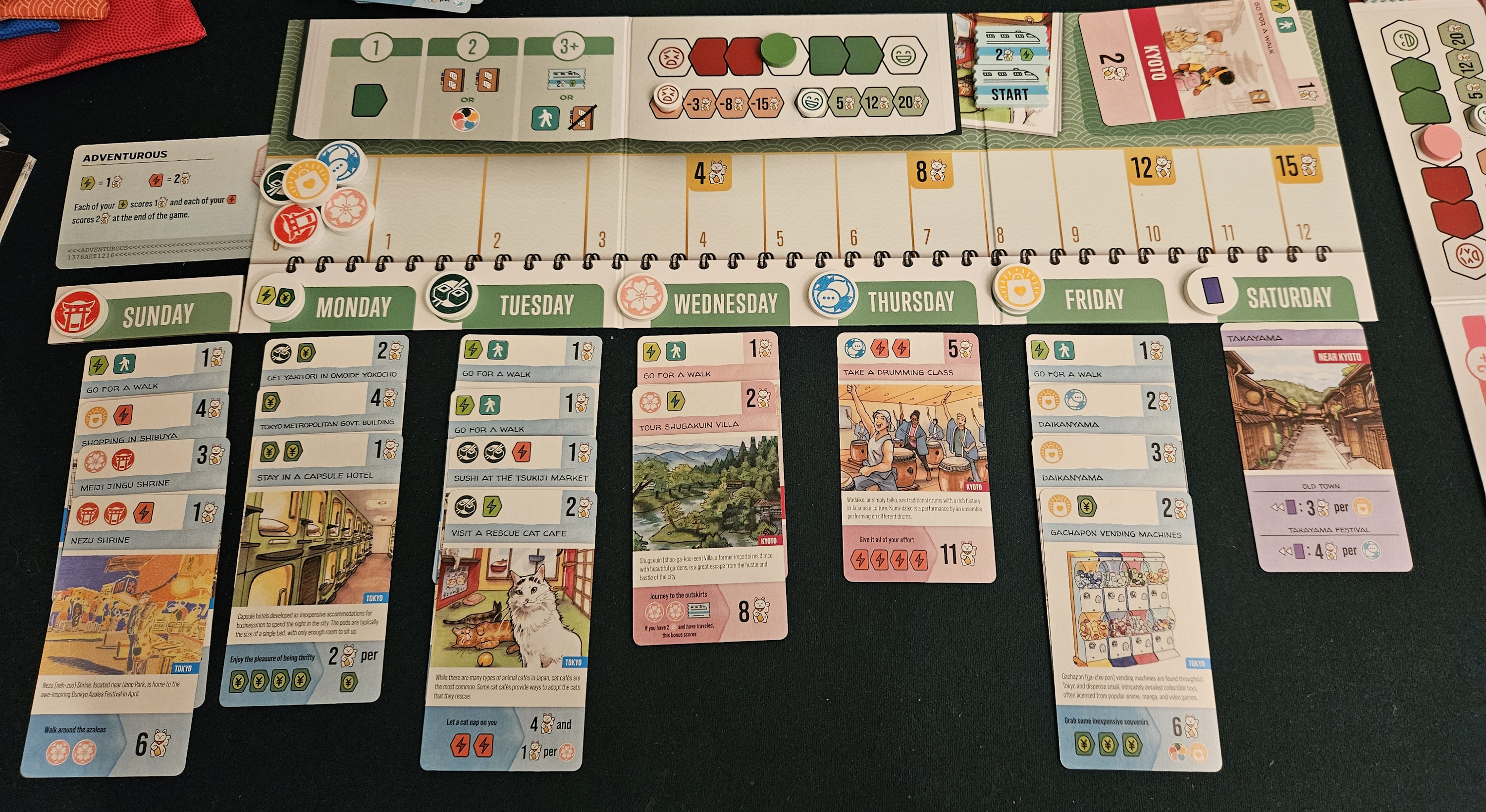
As your week fills up, placement becomes more difficult.
At its best, Let’s Go! To Japan evokes many of the same emotions as Wood’s previous outing, capturing something vibrant and alive about its titular locale. Those moments aren’t as replete as in Santa Monica, usually relegated to taking walks, catching a day trip, or the odd exciting combination of cards one hasn’t seen yet. But they are there, tucked within alleyways and unexpected corners. This one is good for a vacation, even if I doubt I’ll come back more than occasionally.
(If what I’m doing at Space-Biff! is valuable to you in some way, please consider dropping by my Patreon campaign or Ko-fi.)
A complimentary copy of the deluxe edition was provided.
Posted on March 19, 2024, in Board Game and tagged Alderac Entertainment Group, Board Games, Let's Go to Japan. Bookmark the permalink. 5 Comments.

 SPACE-BIFF!
That baseball dig is gonna cost you a like!
oh no!
Pingback: 5 on Friday 29/03/24 – No Rerolls
Pingback: 5 on Friday 12/04/24 – No Rerolls
Pingback: Hey! A Place I’ve Actually Been! | SPACE-BIFF!