Almost Me

It could happen to anyone. Your band of adventurers hit the tavern too hard last night. When you woke up, every member of your party was accused of a different heinous crime. For some reason we’re presuming you didn’t commit the deeds in question. Before the queen tosses your sodden bones in the clank, you’ll need to clear your good (eh) name. It’s detectin’ time.
That’s the premise behind Almost Innocent, Philippe Attali’s cooperative deduction game, which is best described as aggressively fine.
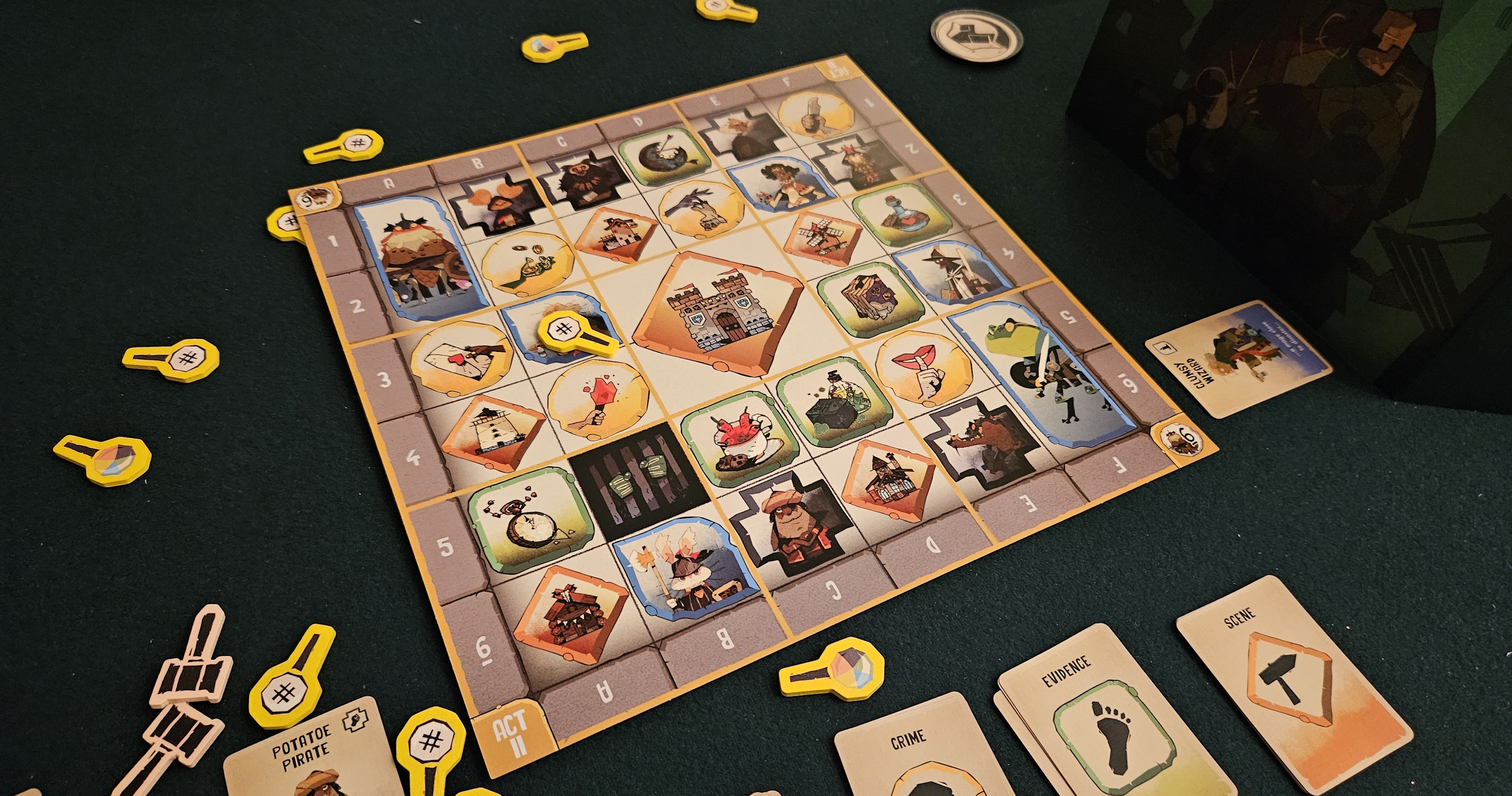
This is how real detectives solve crimes.
There’s nothing wrong with the premise. If anything, it’s a perfectly charming setup. The actual physical setup, on the other hand, quickly establishes Almost Innocent as a rather traditional approach to deduction.
It goes like this. Everybody draws a random card from a bunch of decks. Depending on difficulty level and scenario, there’s some variation to consider — how many cards are in each deck, how many decks there are total, that sort of thing — but most of the time there are five, a combination of victim, crime, evidence, scene, and offender. Crucially, the cards in your hand are the solution to somebody else’s crime. To be precise, that of the player sitting to your left. Your own solution is held by the next player, whose solution is held by the next, until you’ve wrapped around the table to create a human ouroboros. Nasty.
These clues correspond to sections of a grid, which is laid out on the table. Between this clue-map and your own private dry-erase board, your task is to ask questions of your fellow players (well, of the player on your right) and feed clues back the other direction (well, to the player on your left). The questions themselves are… well, they’re the sort of thing you may have asked before. There are two categories: “How many of my clues are in this row or column?” and “Is my victim/crime/evidence/etc. in this row or column?” Once asked, everybody answers the question for the adventurer sitting to their left.
As deduction goes, it’s entirely serviceable. If you’ve ever passed potty time by solving a sudoku, you know pretty much what to expect. After only a few questions, the vague location of your clues establishes the boundaries of the puzzle. Possibilities are whittled down. If you can isolate one part of your solution, chances are you can roll the rest up with ease.

Keeping track.
To his credit, Attali adds a few much-appreciated wrinkles. The game is divided into scenarios, complete with a branching narrative, and this trickles new ideas into the mix. It isn’t long before the clue-map receives spaces that loom larger than others, or clues that aren’t on the map get added to those decks. Your adventurers eventually unlock deductive perks, like addressing whether a four-square section of the map holds somebody’s clue or peeking at the leftover cards in a deck. Meanwhile, the queen steps onto the map to occlude certain rows and columns.
Even at its hardest, though, Almost Innocent never puts up much of a fight. Unlike many other deduction games, which crank up the pressure through competition, this one’s cooperative nature makes it breezy. There’s a certain trick to winning — the game is more about asking questions that will help your partner than it is about asking questions for your own benefit — and once internalized the various links in this sausage chain can merrily pass information around the table.
It’s simple enough, perhaps even for youngsters. That’s a non-negligible part of its charm. At the same time, it doesn’t feel wholly cooperative so much as a solitaire game everybody needs to solve at the same time. That isn’t a wholly accurate characterization — it is worthwhile to pay attention to the needs of your left-hand neighbor — but it stabs at the reason Almost Innocent hasn’t clicked for me. Playing this game is like playing a pen-and-paper puzzle book, but with the added step of receiving and giving input to whomever is sitting next to me on the bus. The character abilities eventually add some incentive to reach across the table and lend aid to a struggling player, but these opportunities are muted and all too rare.
Oh, and certain abilities are downright perplexing. One character lets you ask a question along the lines of “Is my evidence a liquid or a solid?” and “Is my offender an animal?” Except the image for one item displays both a solid bar of soap and a bottle of liquid detergent, while the latter requires adjudication to determine which creatures qualify as animals. I’m reasonably certain a barbearian is an animal, but is a “potato pirate” a pirate who is in fact a sentient ambulating potato, or a pirate who plunders potatoes? Are we animals? Who knows.
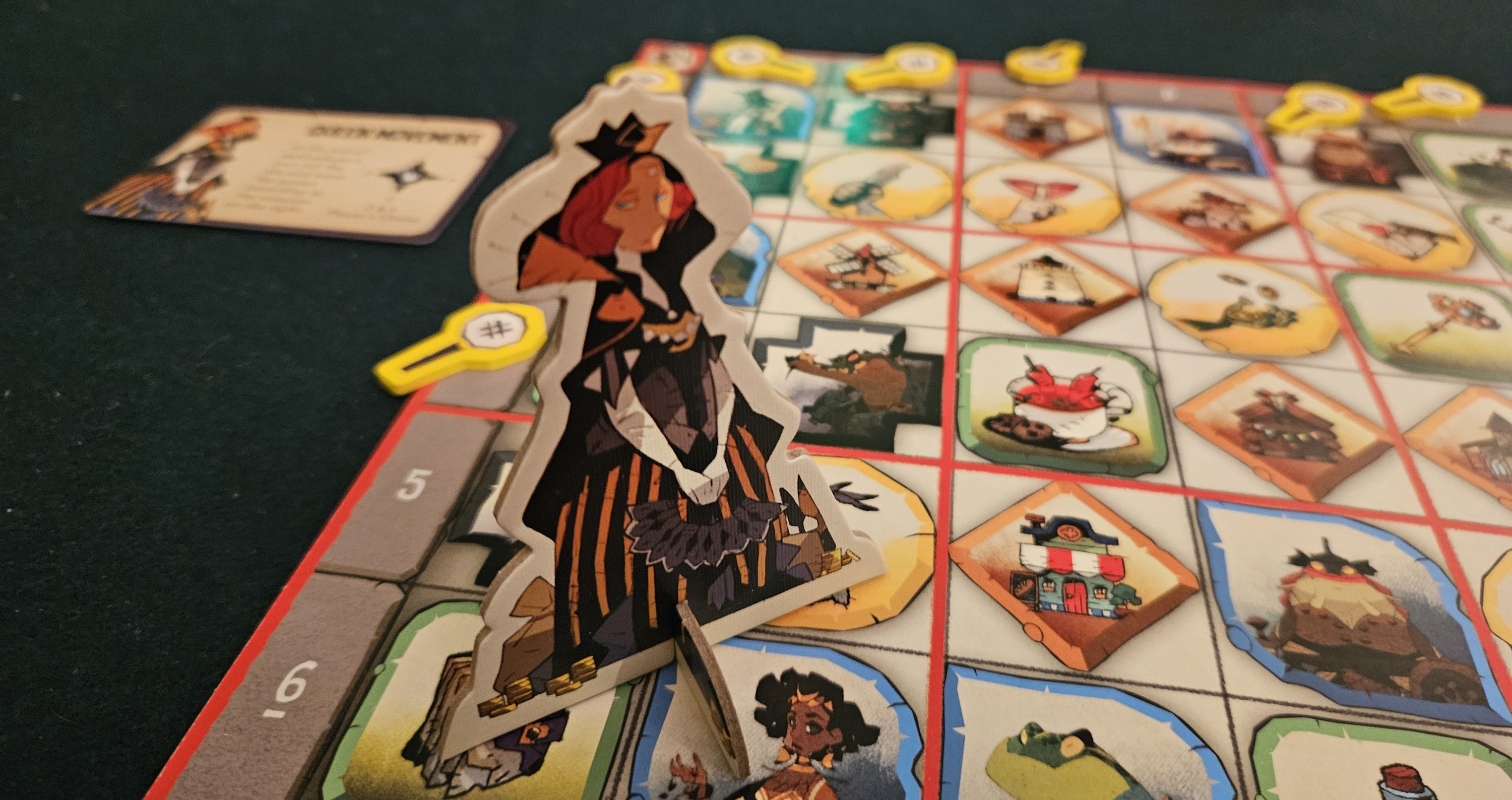
Later modules, such as the queen, add some marginal complications.
Add these variables together and you get a game that doesn’t require much deduction to determine whether it’s worth investigating. Almost Innocent, with the cardboard punch-outs, in the recycling bin.
(If what I’m doing at Space-Biff! is valuable to you in some way, please consider dropping by my Patreon campaign or Ko-fi.)
A complimentary copy was provided.
Posted on March 4, 2024, in Board Game and tagged Almost Innocent, Board Games, Kolossal Games, Matagot. Bookmark the permalink. 2 Comments.

 SPACE-BIFF!
This title is such a deep cut. Lol.
A Mariana Trench cut, maybe. I don’t even go by that old handle around here anymore.