I Sacrificed My Blood to NAWALLI

The first time I opened NAWALLI, the Aztec-themed card game from Gonzalo Alvarez and Will Rogers, I cut my finger. An occupational hazard, one might suppose, but this was no paper cut. No, the ruby scratch that marked my index finger had come from reaching too eagerly into the game’s baggie of tracker gems and obsidian stones. I soon found the offending piece, a miniature knife with jagged teeth and an unexpected bite.
I can’t think of a better stand-in for NAWALLI as a whole. Like that shard of volcanic glass, this game is jagged around the edges. It’s small and might nip at your fingertips. But it’s also so dang cool that I wouldn’t have it any other way.
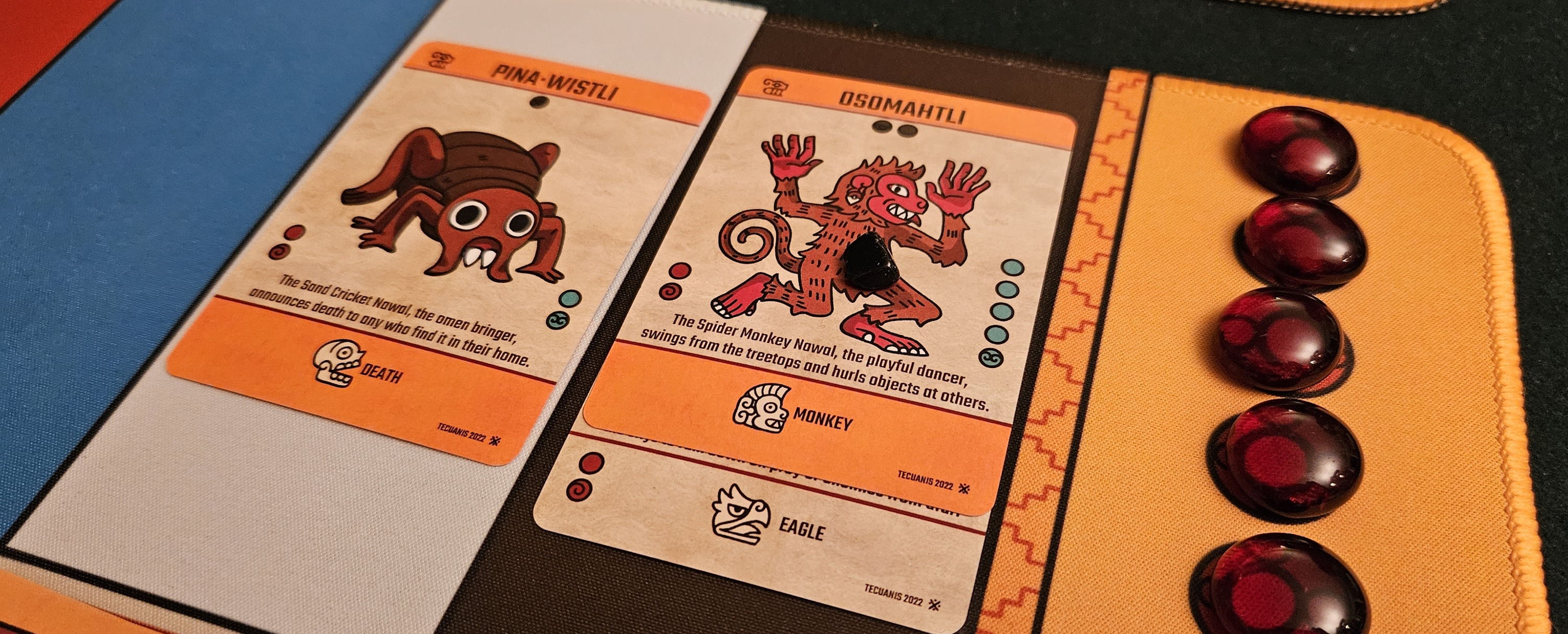
Aw. They’re almost cute! (deluxe playmat shown)
The premise behind NAWALLI will be familiar to anyone who’s played Omen: A Reign of War. You’re a powerful shapeshifter, the titular nawalli, capable of bending your form and calling supernatural allies to your side. As your rotten luck would have it, there’s another nawalli out there. Cue a massive battle for dominance.
Except that doesn’t quite sell it right. True enough, NAWALLI holds a lot in common with Omen and other lane-battlers. Indeed, it falls directly into that hallowed genre. There are four lanes to command. Your goal is to clear those lanes of enemy monsters in order to steal gems from your opponent’s side of the table, all while protecting your own lanes so enemy attacks don’t get at your own gems. Think of it as divine tug-of-war and you won’t be too far off.
But while the trappings may be familiar, I have yet to play anything quite like NAWALLI.
To give one immediate example, NAWALLI opens with a draft, either utilizing a few pre-built sets to get you started or going full-bore by laying out a bunch of cards and having players alternate picks. Okay, that’s not so different from some other lane-battlers. But here you aren’t cobbling together some massive deck. Instead, you’re building two tiny stacks of cards, each only eight cards deep. These are the nawalls (creatures, monsters, ghosts, animated stalks of maize, etc.) and spells you’ll use to beat your rival into submission.

Assessing my opponent’s lanes for weaknesses.
And that’s all you get. There are no reshuffles. Nor are there any ways to circulate your discard pile, outside of the occasional nasty ability. Which makes two of the game’s core concepts, shapeshifting and sacrifice, all that more toothsome.
Matches, then, have the very real possibility of ending quickly. Like ten minutes quickly. Or they might sprawl to last twice that long. Either way, they’re short and punchy and filled with punishing decisions. There’s a reason the rulebook advocates playing best of three. That permits some extra time with these decks, usually resulting in sessions that go from rapid failures to drawn-out slugfests as both sides get a handle on their selections.
This format also draws NAWALLI’s gameplay choices into sharp contrast. I mentioned shapeshifting and sacrifice. Sacrificing a card earns one or two additional obsidian stones, a real boon since your income is so paltry and your most expensive creatures, including your game-breaking guardian, are so mighty. Shapeshifting, on the other hand, lets you lay a second creature over the top of the first. This heals any damage the first creature might have had on it, but more importantly merges the abilities of both monsters onto the top card. There are other ways to accomplish such a merger, but the outcome is the same: a beefed-up monster with a wide range of abilities.
I should talk about those abilities. There are twenty in all, and you’d best commit them to memory. Every creature sports between one and three of the things, and piling them together can soon result in a rather impressive smattering. Oh, and duplicate abilities stack, letting your creatures heal or gobble or heal-gobble with terrifying ferocity. But. While NAWALLI isn’t afraid to put text on its cards, it scatters those crucial abilities across the table with nary an assistive sentence. Is the Deer ability how you duck away from an attack, or is that Rabbit? What’s the difference between Water and Rain? If Knife meets Death, which triggers first? There are ambiguities here, although fewer than one might expect. Either way, it’s useful to keep the helper cards close at hand if you want to play competently. Give it five minutes and you’ll curse how un-alphabetized they are.
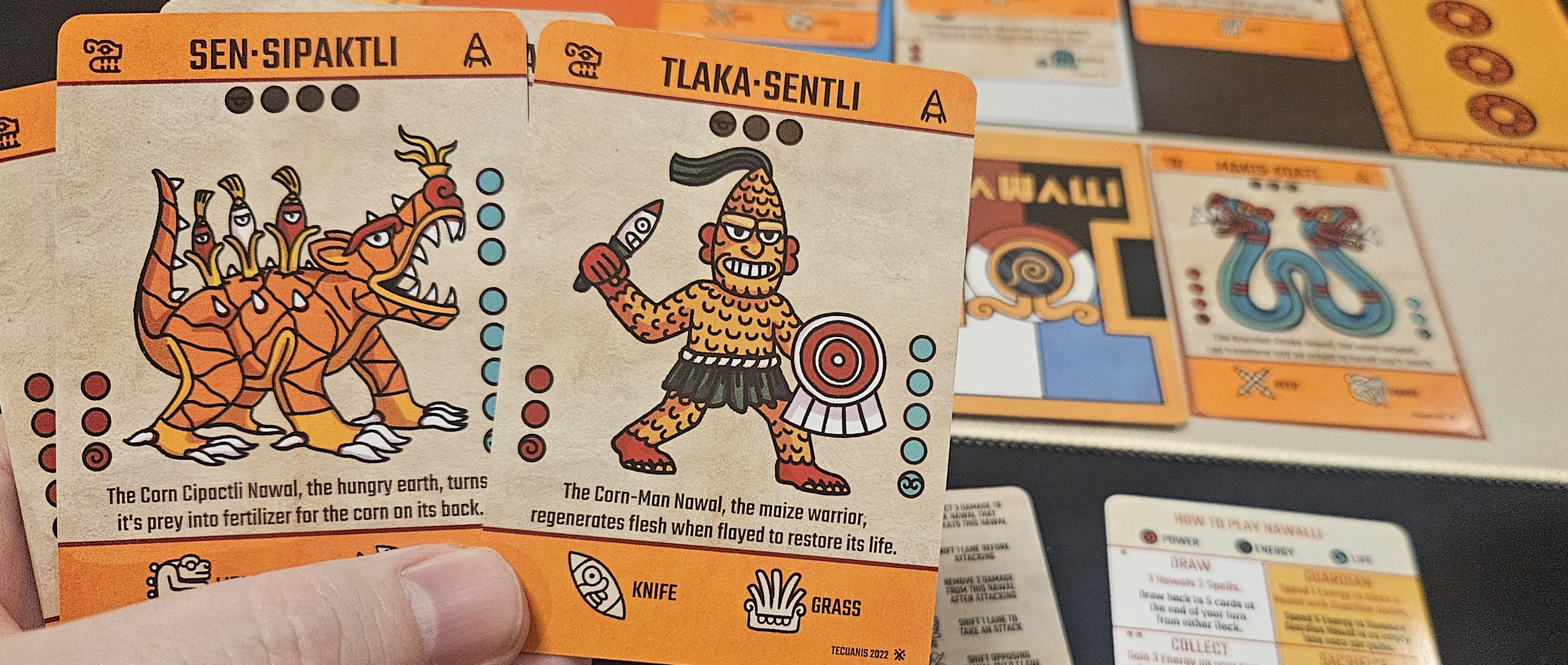
Fun fact: “corn maze” is a pun.
Once learned, these various abilities showcase NAWALLI at its best, especially when played as a draft. Some of these perks are downright ridiculous, as befits the game’s fiction. There are maize creatures that drink the blood of their foes and spring back to life with the growing season, dung goblins that dart between lanes and beg to have new weapons and armor attached to them, bound corpses that inflict damage when killed (okay, killed again) and step out in front of their foes, jump-scare-like, to ensure their own demise.
And then there’s your guardian. These are the starting point of any solid deck, powerful units that function as either enchantments or creatures depending on how much you spend on them. Longer matches tend to see them riding into play, getting killed, and then bouncing back all over again. My personal favorite is Xipe Totek, god of seasons and knives. Okay, flaying, but flaying presupposes a knife. When played in his empowered form, Xipe Totek becomes a giant knife wielding other knives. Mictlan yes.
Perhaps the highest praise I can heap on NAWALLI is that it uses its whole toolkit and rarely offers easy answers. It’s possible to flood your lanes with low-cost nawalls, quail and snakes and bats and raccoons, to secure as many gems as possible. Or you could leave some lanes open for abilities that require more elbow room. Or use shapeshifting, or deploy your guardian, or make careful application of your spells. The threshold for victory is low enough that big swings are possible, including surprise wins when you’re lagging behind.
In one recent match, I had my opponent on the ropes until he realized he could sacrifice a powerful unit, shapeshift one creature into another, summon his guardian, and turn the tables through raw inventiveness. I eventually regained my momentum and won through concentrated attacks on his one open lane, but it was an unexpected nail-biter. By the end of that match, we had both depleted our decks and were wringing our surviving creatures and guardians to the last.
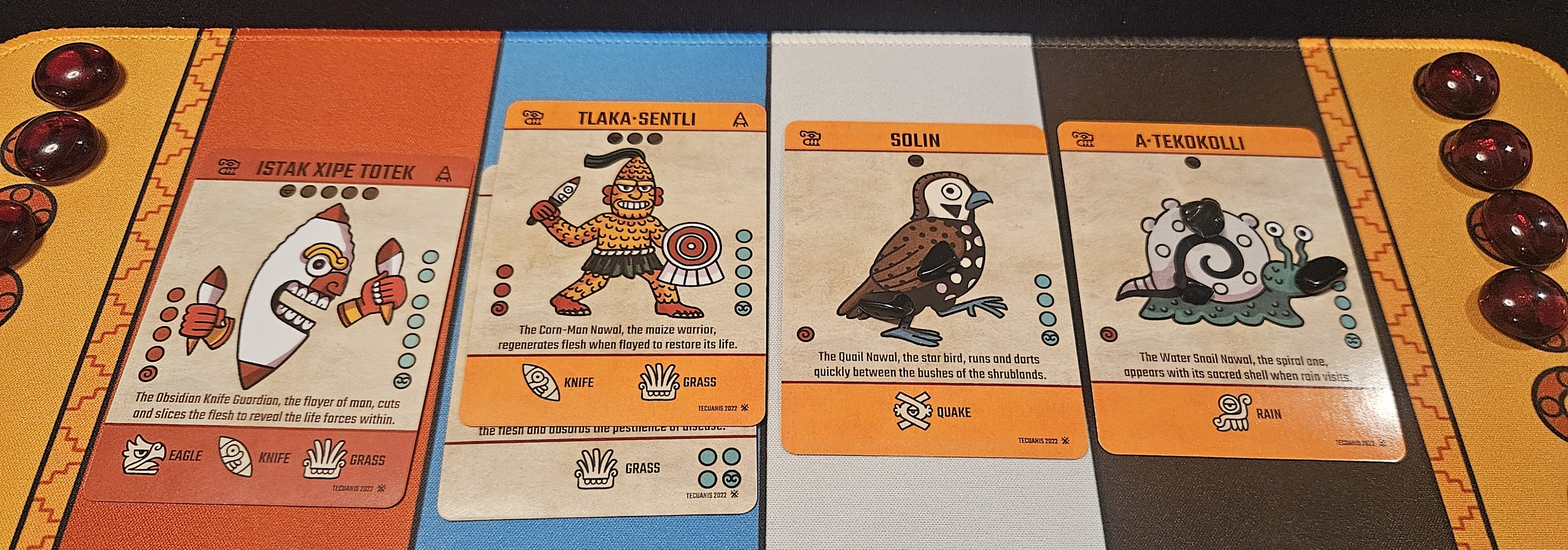
I love my weird family.
That’s precisely what makes NAWALLI so exciting. Apart from some unpolished edges and some freshman missteps, it’s brutal and immediate and clever, not to mention entirely unwilling to faff about.
To some degree, those jagged edges are also part of its charm. I’ve already made one minor blood sacrifice to NAWALLI. I would do it again. Like, obviously I would. It was a scratch. But this is one of those games that’s richer because it bites. Some creatures or spells are more potent than others. Some abilities butt up against others. But rather than detracting from the experience, these sources of friction are what keep me coming back. The result is a game that’s textured enough to explore, but still fast enough that a loss doesn’t sting too badly. It’s rare that I’ll play a game after I review it. Something tells me I’ll be returning to NAWALLI for a good while.
(If what I’m doing at Space-Biff! is valuable to you in some way, please consider dropping by my Patreon campaign or Ko-fi.)
A complimentary copy was provided.
Posted on February 13, 2024, in Board Game and tagged Board Games, NAWALLI, Studio Tecuanis. Bookmark the permalink. 3 Comments.

 SPACE-BIFF!
I feel like I can generally tell whether I’ll like a game from your reviews. I think this is the first time ever that you’ve given high praise for a game and I was super underwhelmed. Played with a friend tonight. While there are some cool aspects, the high summon costs make attacking and getting the red gems pretty easy, and there was pretty much never a point where shapeshifting or doing a blessing was worth it. Most of the abilities themselves (snake aside) weren’t super interesting.
I haven’t played Omen yet, but I picked it up with the recent KS. I hope I like that more; I do feel that the increased mechanical complexity there will make it more satisfying.
I just don’t see myself ever picking Nawalli over Riftforce or something else. It was OK, but all the cool stuff like shapeshifting & blessings just feel too situational. I thought maybe we’d misinterpreted something, so I reread the rulebook, this review, watched the official how to play video, and watched their playthrough. Seems like we did everything right, and our three rounds went much the same as the video.
I think part of the problem is there are a lot of nawals with high damage. While you can soak up the damage or kill a powerful nawal with a few good moves, the nawals generally were either barely scratched or dead, so why would we shapeshift over filling an empty lane? And since summoning replacements is both extremely limited and expensive, the game typically was over by like round 3 or 4 every time. No real back-and-forth or room for clever plays because the game ended before stacking abilities really comes into play.
I think giving larger decks would help some, but mostly, I was expecting the lane battling to be a contentious dance (like An Empty Throne), and instead it was just “fill lanes with dudes, oops they’re dead, hey now the game is over.”
For those who still don’t have, but want, Nawalli, a Kickstarter campaign is currently live! Ends apx Apr 23 2025.
https://www.kickstarter.com/projects/nawalli/nawalli-the-aztec-card-game-third-edition?ref=user_menu%5DKickstarter campaign
Pingback: Best Week 2024! Snacked! | SPACE-BIFF!