Annie Christmas vs. Motthew

I have such a soft spot for Rob Daviau and Justin Jacobson’s Unmatched series. That goes double when they’re producing sets like Cobble & Fog, adaptations that faithfully translate works of literature to the gaming table and let the Invisible Man slug Sherlock Holmes in his upturned snoot.
Unmatched Adventures: Tales to Amaze takes the series in a new direction. Designed by Jason Hager and Darren Reckner, this set is transformative in the literal sense, reworking those staple clashes into cooperative boss battles. In comic book terms, it’s the crossover event that sees all those ruffians and louts teaming up to topple an even nastier baddie. It’s such a shift of perspective that it would be a minor wonder if it worked at all. Instead, it comes off so perfectly that I’m tempted to drag my older sets out of storage.
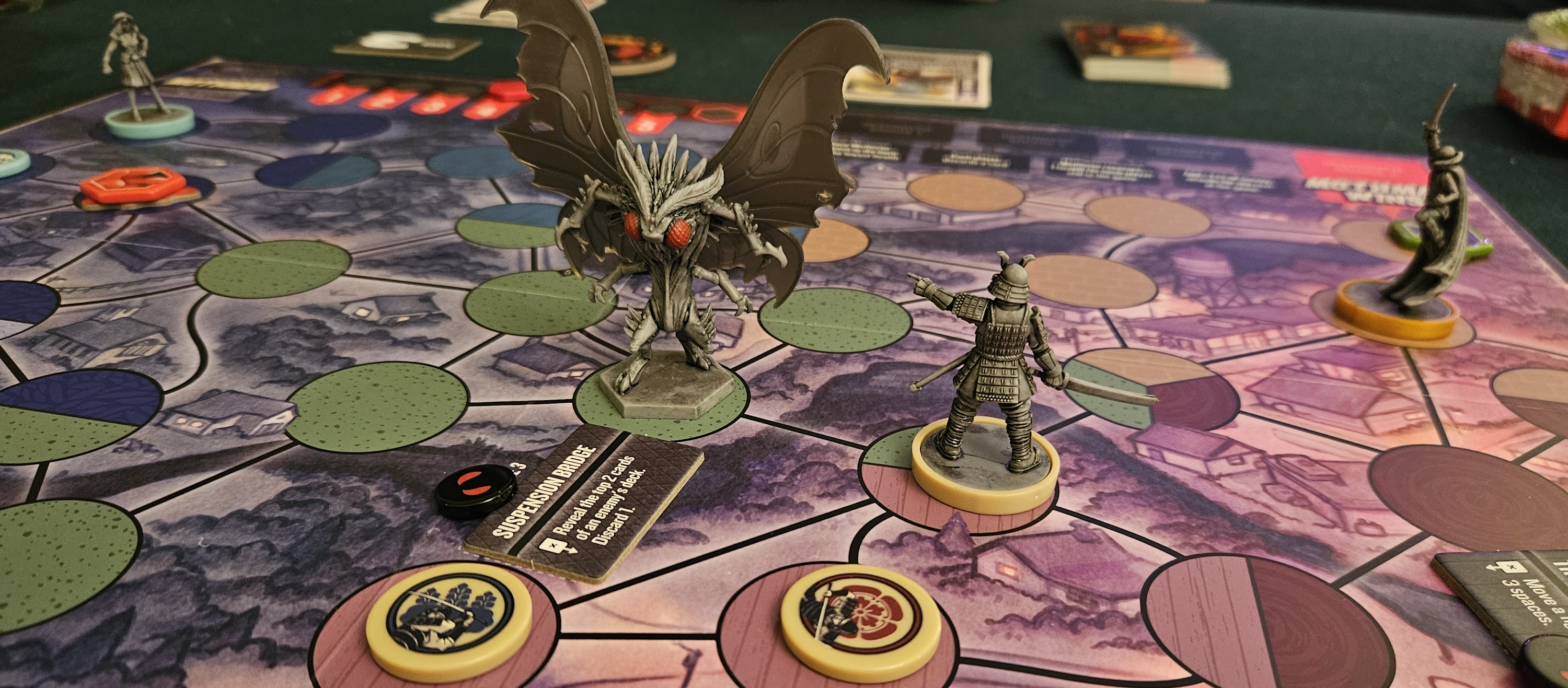
“There is the moth!”
The gist is easy enough to grasp. You are a hero of yore. Maybe even a literal superhero if you picked up one of the Marvel sets. Tales to Amaze includes four playable heroes, a diverse cast in which a resurrected Nikola Tesla is the mundane option on the roster. There’s also Annie Christmas, a Louisianan folktale keelboat captain who also happens to hang out with Ben Kingsley, a plucky gadget-maker and pulp icon by the name of Dr. Jill Trent, and the Golden Bat, a Japanese paper-theater superhero who strikes poses and enemies alike.
This time around, the heroes play second fiddle to the set’s baddies. There are two bosses to contend with, a gigantic Mothman who holds peculiar animus toward suspension bridges (it’s the cables) and a Martian flying saucer that wants to carve offensive geometric patterns into Earth’s cornfields. These are joined by a large cast of smaller cryptids such as the Jersey Devil, the Loveland Frog, and plus-sized insects like the Ant Queen and a Rather Big Tarantula. Your job, unsurprisingly, is to battle these monstrosities until either they or you have been pureed.
Right away, the principal reason Unmatched Adventures works is because it does so little work at all. When the concept was first announced, I was skeptical. Unmatched has always benefited from its compact rules; there are only three actions shared between characters, and they can be summed up as move/draw, attack, and play a card. Anything woollier is offloaded to the cards or characters themselves. So it was easy to imagine the burgeoning rules that would be needed to turn those slugfests into coherent cooperative battles, not least of which would be the automa for governing the movements of anyone not directly controlled by the players.
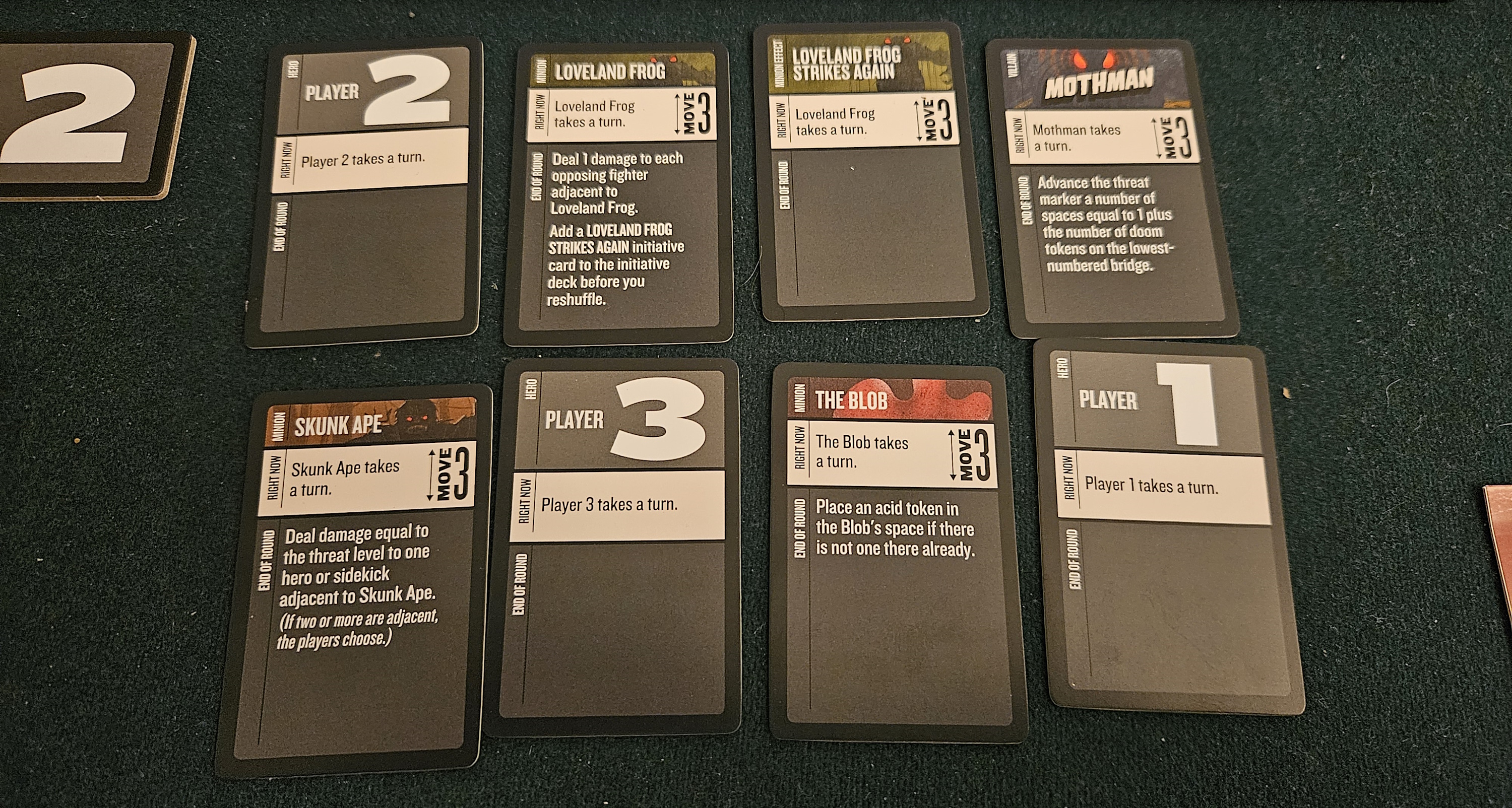
The initiative system is a breeze.
Hager and Reckner’s answer is to simply let the players make most of those decisions. Of course, not everything is under your control. Enemies and heroes alike take turns via a simple initiative system. Everyone gets a card that’s shuffled into a deck and then dealt one at a time onto the table. When a hero’s card appears, they take their usual two actions. When a monster card flips, they’re gonna punch something. It’s simple and effective, giving you an impression of what’s to come while also keeping everyone on their toes.
These instances of combat, by the way, are resolved in exactly the same manner as the rest of the battles in Unmatched. Each enemy has its own deck for both attack and defense, while other abilities are offloaded to their initiative cards. These soon establish each creature’s personality. The Skunk Ape isn’t so tough until the end of the round, when his natural perfume wallops anybody standing nearby. The Loveland Frog lashes the heroes with weaker attacks, but gradually tucks extra cards into the initiative deck for additional turns. The Blob splashes pools of hero-burning acid onto the board. That sort of thing.
The bulk of the decision-making arises from resolving ties. This is where Hager and Reckner loosen their grip. When a monster takes a turn, it beelines toward the nearest target and attacks. But because you’re the heroes, every split decision is made according to your discretion. Will the Jersey Devil attack Annie Christmas or the Golden Bat? Which route will it take to reach them? That’s up to you. Given the system’s emphasis on adjacency and ranged attacks, these are no small decisions.
It might sound like this yields too much control to the heroes, but the advantages are considerable. For one thing, the rules are dead simple. There’s no such thing as thumbing through the rulebook to resolve some corner case. For another, allowing such decisions gives the impression that your heroes are, well, being heroic. They’re luring these monsters out into the open, or pressing them into a corner for a flanking attack, or cowering out of sight behind some rubble, or whatever. Everyone at the table is engaged in every single decision, not only the ones require them to assess their hand of cards. In some cases, resolving a monster’s turn can be more significant than what you do with your own character.
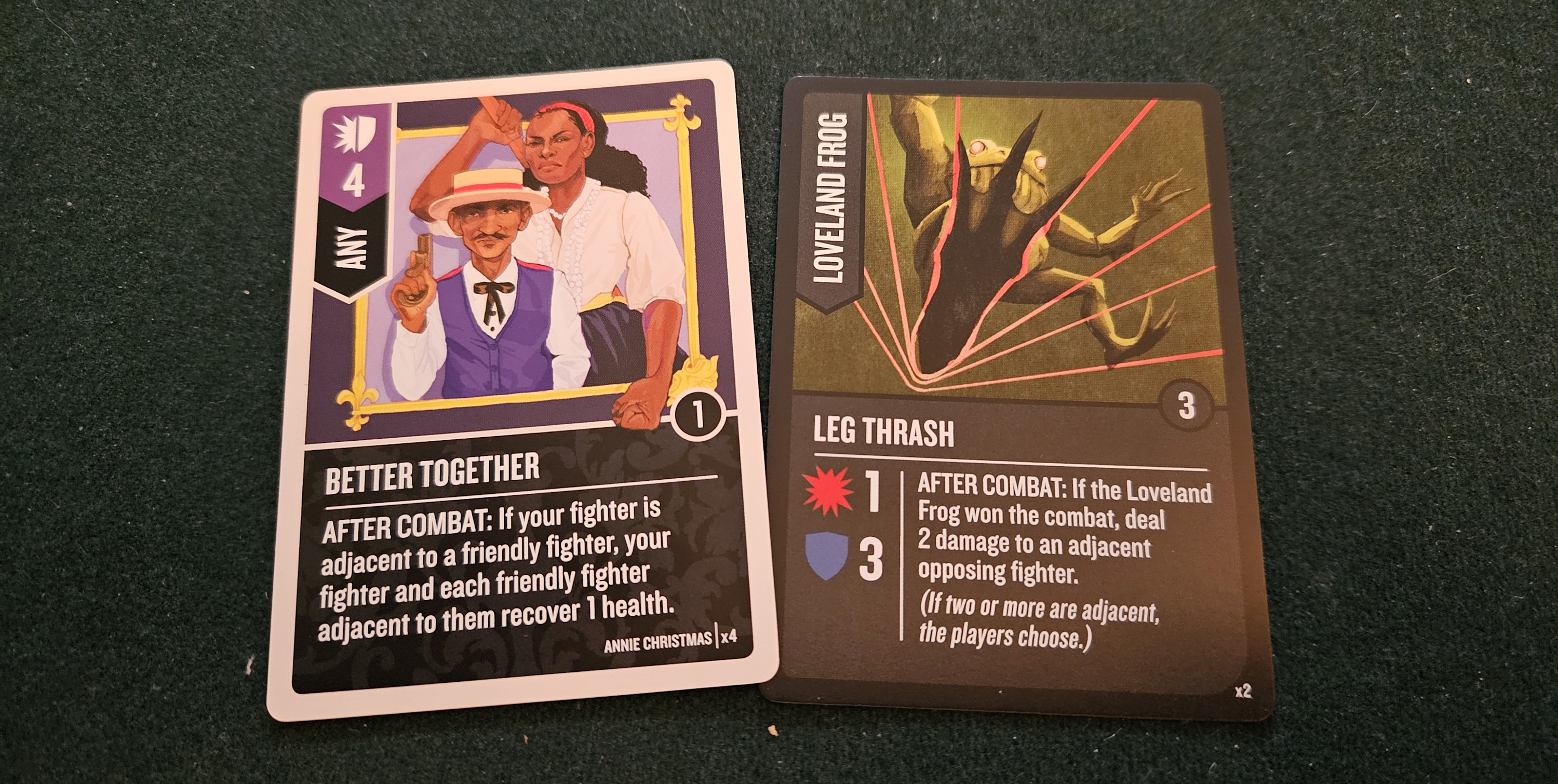
Card clash!
To some degree, that’s due to the inbuilt limitations of the system. As in its default competitive mode, Unmatched Adventures is more about hand management than anything else, and players may struggle to keep their supply of cards stocked. It doesn’t help that the big bads, Mothman and the Martian Invader, both have a tendency to raid your hand. Keen players would do well to pace themselves, absorbing rather than blocking some hits and spending a healthy number of actions on card-giving maneuvers. Still, it’s sometimes a bummer to go multiple turns without attacking or finding yourself relegated to the team’s support staff.
Those big bads, by the way, aren’t interchangeable the way the smaller cryptids are. That’s because they’re tethered directly to their maps. Mothman is dismantling the city’s bridges while the Martian Invader burns crop circles into the local fields. Both are metered by “threat” tokens, which gradually appear courtesy of their initiative and battle cards. These have various effects, but they’re both dangerous. Good thing, then, that they can be removed by timely maneuvers, giving players more to do while shifting around the map and drawing cards.
Meanwhile, other heroes can get in on the action as well. We had the Sun’s Origin set on the table, letting us deploy its two heroes to the fray. These showcased both the flexibility of the system’s transition to cooperative play and, perhaps, some of the hiccups these crossovers might present. The warlord Oda Nobunaga is all about flanking his target, crowding in close with his loyal honor guard, while the onna-musha Tomoe Gozen slays enemies from afar — and better yet, deals damage when they leave her zone. In our sessions, Oda was one of many melee fighters who struggled to survive proximity to the Skunk Ape and other hard hitters, while Tomoe took advantage of our team’s ability to shove around enemies to whittle the UFO down to nothing. I don’t think she absorbed a single blow.
But while the game’s difficulty can be uneven, both of these sessions were dynamic in their own way. Oda Nobunaga sacrificed himself at the last moment to slay Mothman, a rather cinematic ending for a daimyo, while our match with Tomoe was a masterclass in careful positioning and board control. These showed off Unmatched at its best.
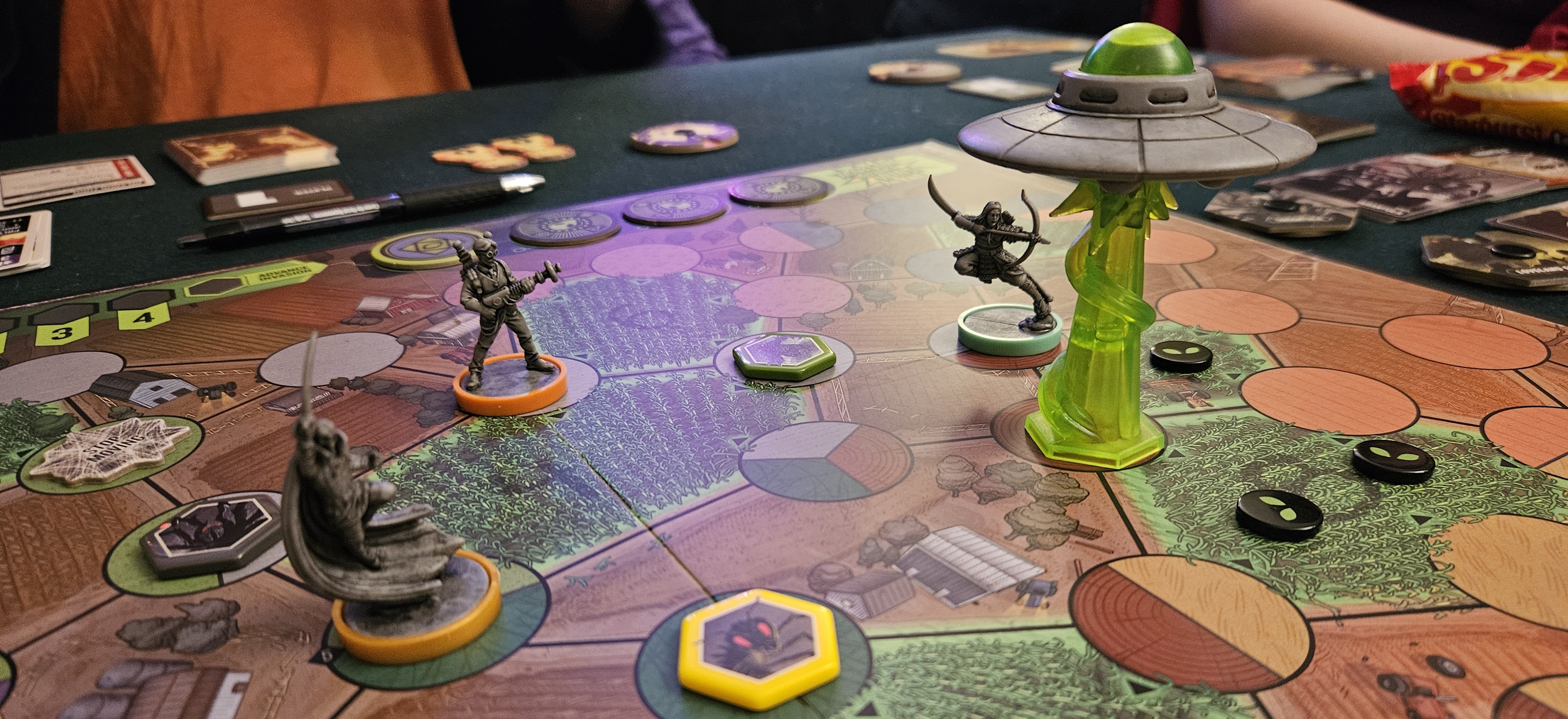
Bring it down!
I mean that. On a certain level, Unmatched Adventures is more likely to hit the table thanks to its flexible player count. Sure, Unmatched has always been able to go up to four players, but its competitive sessions become too messy when they aren’t duels. By scaling to various counts, this approach isn’t quite so straitjacketed.
More than that, playing cooperatively feels good. My Unmatched-agnostic sister-in-law declared this one of her favorite cooperative games, while my nine-year-old insisted on checking out a second combination as soon as our first match concluded. I mentioned a comic-book crossover earlier. Unmatched Adventures gets the appeal of such an event. What happens when Sinbad is pressured to team up with Count Dracula and Bloody Mary? I have no idea. But my interest in Unmatched as a system has roared back to life. For the first time in a while, I can’t wait to find out.
(If what I’m doing at Space-Biff! is valuable to you in some way, please consider dropping by my Patreon campaign or Ko-fi.)
A complimentary copy was provided.
Posted on February 8, 2024, in Board Game and tagged Board Games, Restoration Games, Unmatched, Unmatched Adventures: Tales to Amaze. Bookmark the permalink. 11 Comments.

 SPACE-BIFF!
Nice to hear it was so well received! This was an auto-back for me but I’ve yet to play it. Looking forward to trying out different combinations of characters myself.
Cool! Anyone you have lined up first?
Deadpool, a T. Rex, and Houdini walk into a bar (specifically, The Bronze)…
NICE.
This sounds like a cool twist on a solid system. I was a big fan of Star Wars Epic Duels (the pre-cursor to Unmatched) back in the day, but I never jumped onto the newer franchise. But this new entry might just change that.
I can’t wait to play this again. The last game was T-Rex (me), Spiderman, Cloak and Dagger, and Tesla. It was a close finish (due to threats from Mothman on the bridges).
Sounds cool! I don’t even have three of those.
Pingback: The Plum Island Park Stroll | SPACE-BIFF!
Pingback: Catapults, Mostly | SPACE-BIFF!
Pingback: Best Week 2024! Better Together! | SPACE-BIFF!
Pingback: Unwitched | SPACE-BIFF!