Name Your Zombies
I’ve never been satisfied with the concept of the tone poem. If anything, it feels like a descriptor we resort to when there isn’t anything better at hand. When it comes to But Then She Came Back, the horror board game by Amabel Holland, well, there isn’t anything better at hand. Unlike most of Holland’s oeuvre, it’s an impressionistic lament to the toxic relationships we left behind, probably well after we should have. Very much like some of her work, it’s also a game that gives back what you bring to it.

She’s coming back.
Imagine the most toxic person you’ve ever known. Somebody whose bullshit, for lack of a better word, you have been all the healthier for leaving on the side of life’s highway. But there’s still a connection there, a tendon, a filament, a fleshy piece of yourself strung between you and they. Your friends say it would be better if you didn’t see this person anymore. You know deep down that they’re right. But you’re holding on until your knuckles feel like they’ll pop from the strain.
But Then She Came Back is about that relationship, and by extension it’s about the portions of ourselves we know we should excise but can’t quite manage to snap the shears home. It’s such a human experience, raw and naked, that it’s tinged with a voyeur’s shame. I once wrote that Holland’s Kaiju Table Battles was like accidentally reading a passage from a friend’s diary. But Then She Came Back is like cracking that diary open for another look, and then deciding to observe as that friend tends to their personal hygiene.
Except this isn’t voyeurism. Not when we’ve been invited in. Nor can it be voyeurism when the creature we’re observing is ourself. But the discomfort remains. It’s like using a bathroom other than your own, where the lighting and the mirror are canted in such a way that they show you from a fresh angle, and an unflattering angle at that. Pores open, eyes sunken, hair limp. This is you, but not as you prefer to be seen.
As an object of gameplay, Holland undertakes this dissection with cold fingers. She — the titular she, whoever she should be — has come back to slowly consume you and everything that matters to you, herself included. There are allusions in the text that read like epitaphs for anyone at all. “The two of you had a secret language, single words that implied whole stories,” reads one card. Others are more specific: “She brings out the chess set. She remembers the pieces with her fingertips, and how she always beat you. She makes mistakes now, bad ones, but you haven’t the heart to win.” The effect is ghostly, like reading snippets from Poe or Ellison.
Your friends know better.
The play is more concrete, but only just. The rules function as both primer and prose, anchoring the physical actions of flipping cards and placing tokens within the larger dirge. If games had soundtracks, this one would unsettle and then startle. There’s a steadiness to the play, an inevitability, like spending the day in the hospital as you watch someone you love waste away, only to wonder how the hours could stretch on so long. In the morning, you select one of her cards. Then you assign tokens beneath it — your feet, your hands, your eyes, your weary heart — along a track. Because this is a board game, it would be easy to conceptualize this in terms of what we’ve experienced before, “action selection” and “worker placement” and “resource gathering.” Like I noted earlier, this is a game that gives back what it gets from you. What you’re really doing is deciding how the story will end.
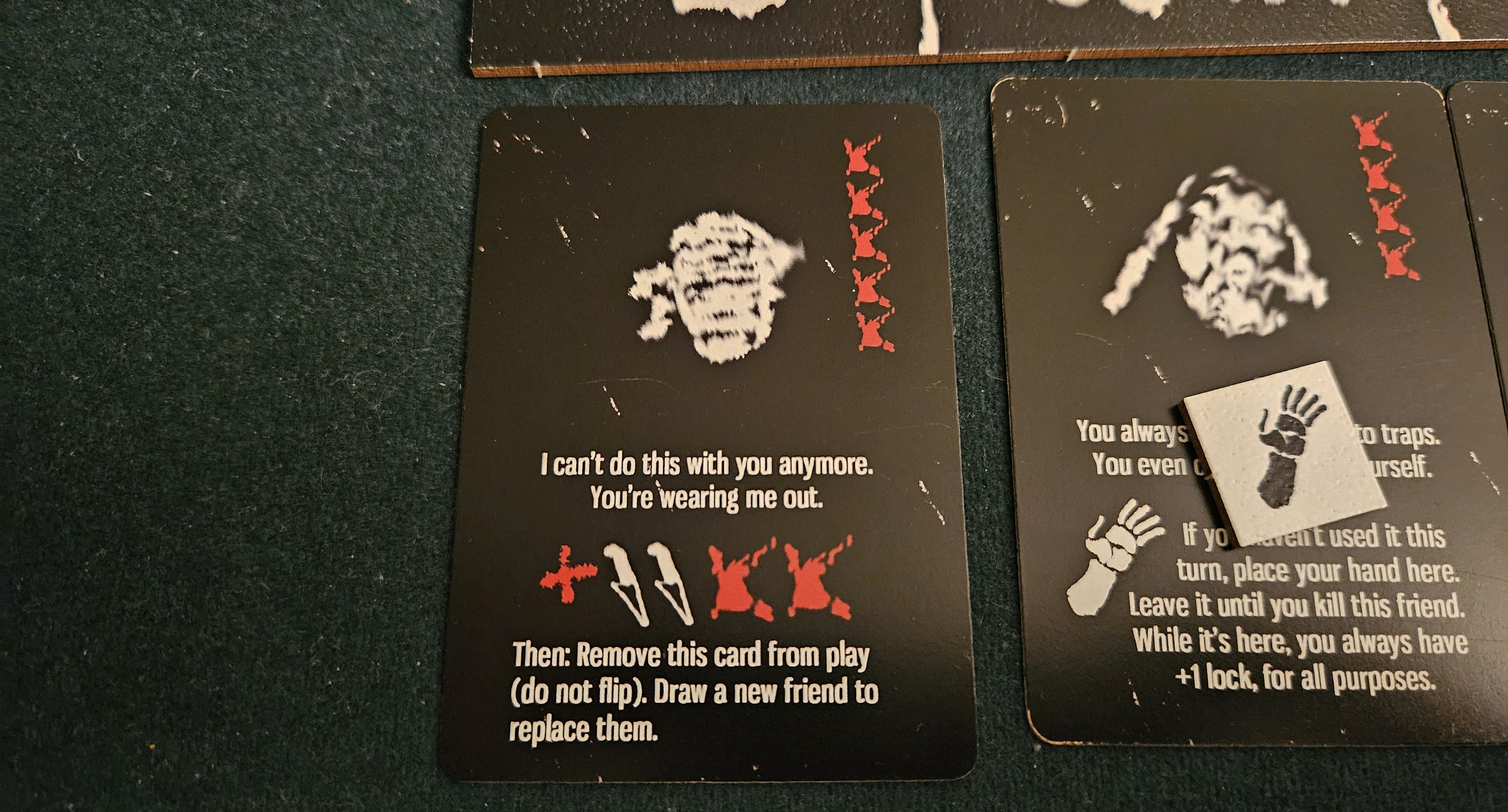
If the game’s suffering were quarantined, it would be one thing. But like an infection the toxicity spreads to your other relationships. This is the second row of cards, where your friends offer their support. Sometimes unconditionally: “We’ve been so worried about you. Are you sure you’re okay?” one asks. Others have started to realize that maybe she isn’t the only bullshitter here. “You pretend that you don’t have a choice, but you do.” Another friend is ready to do the smart thing. “I can’t do this with you anymore,” she says. As soon as you use her card, she disappears from your life, unwilling to become a sacrifice on the altar of your doomed relationship.
Before long, those sacrifices become literal. As she grows restless, she begins to feed. First on your blood, then on your friends. Eventually on you. Those tokens, the ones representing the essential digits of your body, disappear from the game, gobbled up by her monstrous appetite. When night comes around and you’re tasked with fending off those who come hunting for vengeance, when you lock the doors against her looking for more pieces of you to chew off, it’s almost a relief. Direct violence is so much cleaner than the parasite’s proboscis.
There are multiple ways of looking at this. As a set of components on the tabletop, But Then She Came Back walks familiar terrain. Knives protect you from revenge. Locks are for bolting her into her dungeon. Droplets of blood are the foodstuffs of the cancerous undead. These are resources. They hold no meaning. We have played a hundred games about gathering and spending tokens.

These are your icons.
But looked at with a different perspective, perhaps with the right lighting and the canting of an alien mirror, there’s a reason we set board games on farms and battlefields and banking houses. Because these invocations, despite the best attempts of their authors, do hold meaning. Because we, we apophenia-riddled mammals, who see faces in branches and angry overlords in the clouds, we understand that sometimes the face is real.
The toughest mouthful of gristle is found at the game’s conclusion. To some degree, it’s a trick Holland has pulled before. In Endurance, she declined to establish a threshold for victory. This had a range of effects on the design, foremost among them a refusal to qualify some lives as more important than others. With But Then She Came Back, Holland goes one further. When it comes to this long-condemned romance, there is no way to win the game, only various states of conclusion. Moreover, all are cast as failures. You are unable to protect her from your friends. You cannot protect yourself from her nocturnal fury. She withers to nothing. You rip out your bleeding heart to provide her one last meal.
As an inversion of the hero’s journey, itself a reduction of countless traditions into a single formula, your character begins at peak performance and slowly lops off portions of themself to feed this beast. This is no grand journey. It’s decay. It’s the realization that we will either conclude prematurely or wane until we are a burden.
But while that’s interesting, it doesn’t cut to the quick of what Holland accomplishes here. But Then She Came Back is strongest when it functions as an evocation. Most of us have left people behind. Friends, family, strangers who might have been more. This is a horror game, but there are no jump scares. There is some gore, but only observed from that essential remove configured by counters on a table. The artifice itself — the cards, the tokens, the tactility of commanding where everything will be placed, even the “bad art” — is a reminder that this is make-believe, but that hardly dulls its bite.
Because this is a horror game, but it isn’t about the horror unfolding on the table, or not only about that. It’s about the horror of memory, of touching dangerous recollections. It’s about confronting the shades we deposited in our wake. The friend who hurt our sister-in-law so grievously that we had to make a call between acquaintance and family. The sibling who injured our child and forced a similar reckoning between two degrees of family responsibility. The old girlfriend, the two of us, so goddamn toxic about everything. To leave someone behind can be essential, like sawing through a torn-up limb. But it hurts. But it can be a privilege. But not everybody can do it. But having to do something doesn’t make the doing easy. But. But but but. So many buts.
Butts. Ha ha.

An essential bleakness.
Amabel Holland has designed more than her share of challenging playthings. In the past year alone, she confronted the tobacco industry and queer transformation and highfalutin’ vocabulary. But Then She Came Back is one of her smaller designs. That doesn’t mean it isn’t challenging. It hurls sand in the face of the usual reasons people play games, things like comfort and fun, and does so with intent to dig a fingernail into the memories we’ve encrusted and armored. In one sense, I begrudge the memories it brought to the surface. I wouldn’t recommend it to anyone who isn’t in the right headspace.
But it’s a healing begrudgement, like loathing the doctor who reset a broken bone. Board games are rarely good at horror; the format is too remote, too commanding, too aware of its artifice. But Then She Came Back succeeds because it’s also aware of those limitations. Holland doesn’t intend to frighten us. She intends to help us mourn. In her hands, the magic circle — which, remember, is no inviolable space, but one we must willingly foster and enter — becomes a secure chamber or a weighted blanket. These are the places we retreat to not so that we can hide from our emotions, but so that we can express them more fully, name them, and, in expressing and naming them, carry their weight more lightly. Of all the things I expected to find in But Then She Came Back, the last thing I anticipated was a lacrimarium.
(If what I’m doing at Space-Biff! is valuable to you in some way, please consider dropping by my Patreon campaign or Ko-fi.)
A complimentary copy was provided.
Posted on February 6, 2024, in Board Game and tagged Amabel Holland, Board Games, But Then She Came Back, Hollandspiele. Bookmark the permalink. 11 Comments.

 SPACE-BIFF!
This game looks so unsettling. I can’t quite figure out if it’s meant to be taken literally or metaphorically (or perhaps both?). In any case, thanks for the review, I will be looking for this when the print and play comes out.
And I learned a new word: lacrimarium 🙂
It’s a good word!
Damn Dan, another fine write up. Consistently impressed, entertained and thought provoked by you with your writings. Keep going, sir.
Thank you for the kind words, Bryan!
Excellent review and excellent mention of the tear-catcher!
Thanks, Jeff!
Thanks, Dan.
Your review is as always beautifully written. Not only that: it introduced me to a game that I would never have discovered on my own.
Reading your blog allows me not only to discover new games but also to understand the limits (of topic, rules, ideas) to which our hobby can go
Thank you for the kind words, Martino!
Wow, I don’t think I’ve ever been so scared to play a game. I was tempted to play Meltwater. I don’t think I have the heart to play this one.
I’ve been enjoying Amabel Holland’s games whenever they come up here, but starting today I’ll be keeping an eye out for her games specifically. They’re always such unique beasts that tell novel stories. Thank you for your wonderful reviews and for spreading the word of these games.
Happy to do it! Thank you for reading!
Pingback: Space-Cast! #35. But Then She Spilled Tea | SPACE-BIFF!