Gnobody Gknows

All I play anymore is trick-taking games. Except I’m not so sure Gnaughty Gnomes really qualifies as one. Like Matthias Cramer’s Pies, the card-play is closer to an auction than anything resembling a trick.
But never mind that. I’m having such a good time getting these gnomes high as a kite that I couldn’t care less about where it hangs within some ill-defined genre’s orbit.
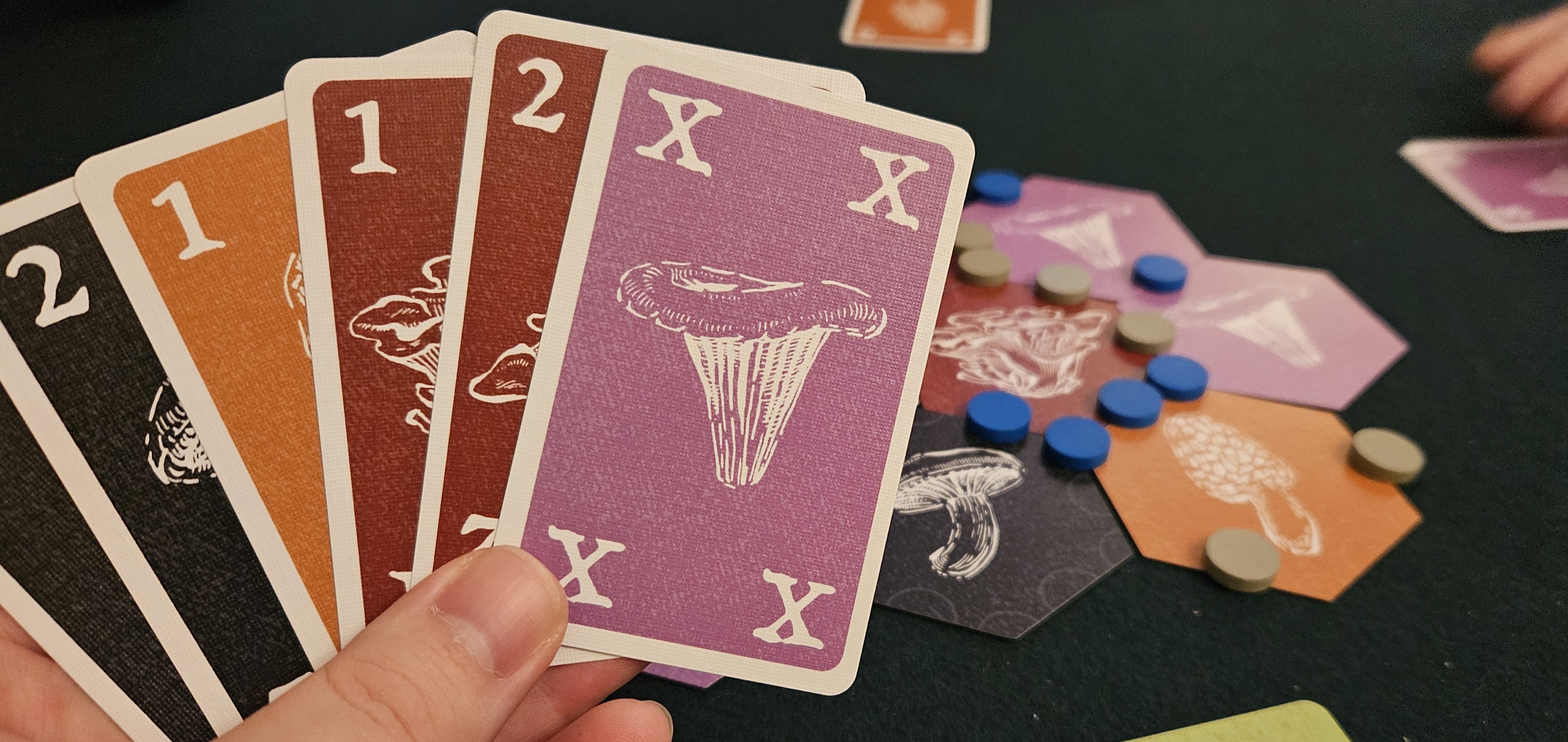
Ah! The trick-taking shot!
At a glance, one might mistake Gnaughty Gnomes for an ordinary trick-taker. Specifically a team trick-taker, playable only at four, with teammates sitting across from one another. It’s got four suits. Cards are ranked from one to eight, plus another X-ranked option in each suit that functions as a limited wildcard. There aren’t trumps, exactly, but the suits are ranked in order of preference off to the side of the play area. And yeah, you play tricks.
But those tricks function a little differently from what we’ve been trained to expect. For one thing, following suit is entirely optional. That’s a small enough departure. There are plenty of may-follow trick-takers out there. Other differences loom larger. You’ll only play a single hand, for instance. Eight tricks and the game is finished. Which might sound hasty until you realize what those eight tricks are used for. Rather than claiming cards the way you might in a more traditional trick-taker, your standing in any given trick awards a turn order card.
But in order to explain those, we need to step back a little bit.
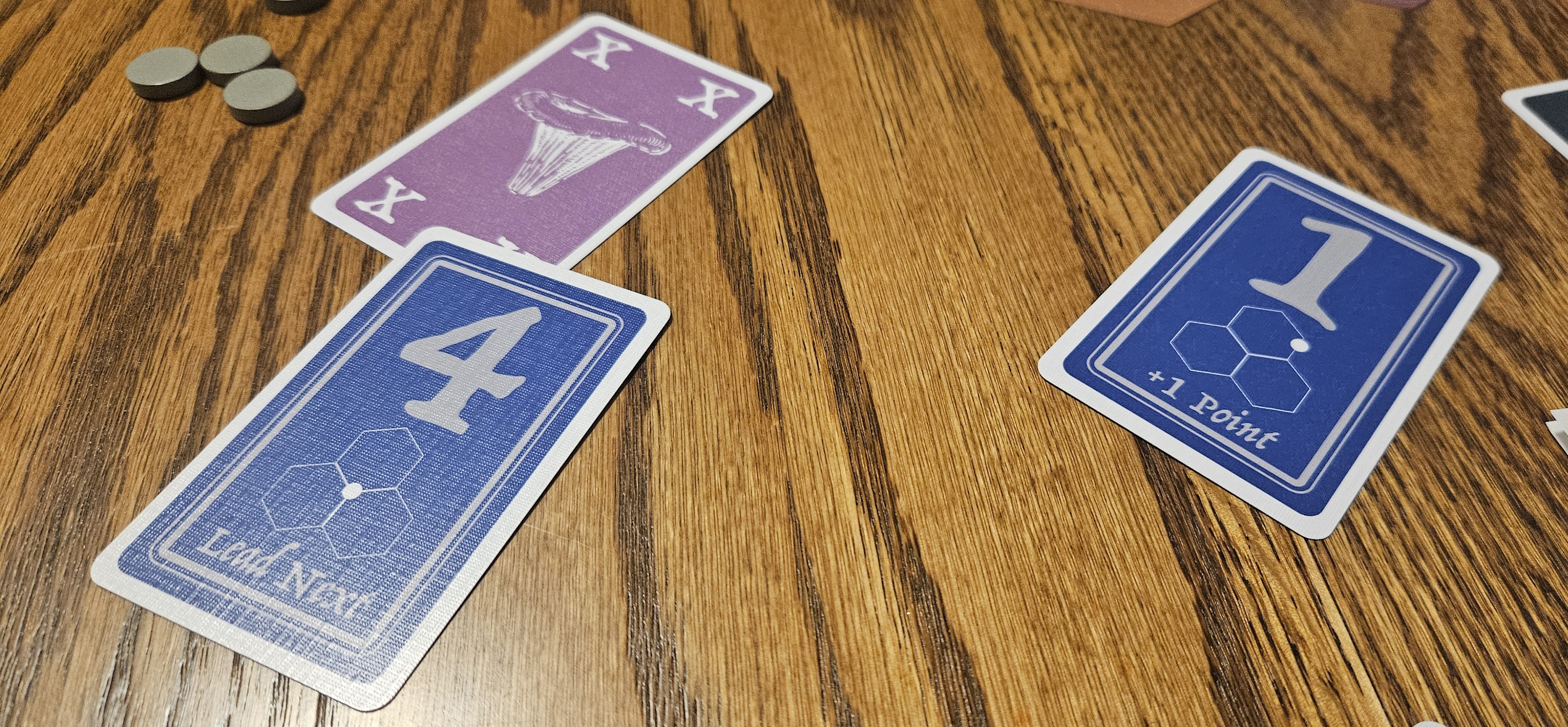
Winning tricks allows you to harvest select patches of mushrooms.
Right from the get-go, the table is dominated by a field of mushrooms. There are four colors of hexes, corresponding with, you guessed it, the four suits in your hand. These mushrooms are no ordinary puffballs, but psychedelic treats that all right-thinking gnomes are greedy to get their hands on.
Claiming a turn order card determines how you’ll place a disc onto that hallucinogenic field. The sequence players act in, of course. That part is self-explanatory. But also where everyone can place their discs. Earning the first turn order card by winning the trick awards your team a point. Very quickly you’ll realize that this is a pity prize. That’s because going first only places a disc on one of those mushroom’s outer edges. Going second or third is better, letting you place a disc in between two mushrooms. Going fourth is the best of all, plopping your disc onto the interstice between three mushrooms. And yes, it’s a good thing to be touching as many mushrooms as possible.
Except there are a few other considerations going on that prevents this from being a straightforward situation of loser-takes-all. For one thing, you can only place your disc on a mushroom that matches one of the cards played into the trick. Claiming a card flips it face-down, preventing anyone else from using it later. Going first therefore presents a wide array of options, both for placement — even though that placement is limited — and for preventing the opposing team from having free rein over the rest of the cards.
More importantly, there’s your score to consider. Mushrooms score varying amounts of points depending on their suit’s current standing. This changes over the course of the game, so while a black mushroom might be worth five points now, next turn it could fall to only two points. But you don’t score a mushroom merely for touching it. No, you need to create a majority. A new majority. So there’s no heaping discs around the same mushroom over and over again. At the same time, you can’t harvest a mushroom alone. The opposing team also needs at least one disc on the appropriate hex.

Suits change value over the course of the game.
That’s a rather painful and frustrating requirement indeed, but it’s also what elevates Gnaughty Gnomes from a wonky trick-taker into a delectable tongue twister of scoring considerations. The mushroom patch is busy and difficult to parse. That’s very much part of the appeal. Like determining whether a mushroom is benign, edible, psychedelic, or toxic, the distinctions between a good placement and a great placement are often minute. Picking through them is a joy.
At the same time, this is also what keeps the game focused around a single hand of eight tricks. That’s thirty-two disc placements, each representing a pause for consideration, and those pauses grow denser and therefore lengthier as the game presses into its later stages. It doesn’t feel long, but there are considerable stretches that see everybody poring over the mushroom patch, the turn order cards, and all available placements. Complicating matters — in a mostly good way — clever play requires that you take your teammate into account, leaving cards or positions open or maybe setting up a powerful majority. That said, a lot of thought often results in small but crucial differences in scoring. In most cases, a good placement will net five or eight points, while another might yield only two or three. Anyone phobic of incremental moves need not apply.
It’s all very clever, but there are gaps. The rules don’t address the issue of communication, a cavernous omission for a genre that’s often clear about keeping teammates in check. We’ve played both with and without communication, and silence is the superior method, forcing teammates to guess at their partner’s intentions and make suboptimal placements when their intentions fail to align.
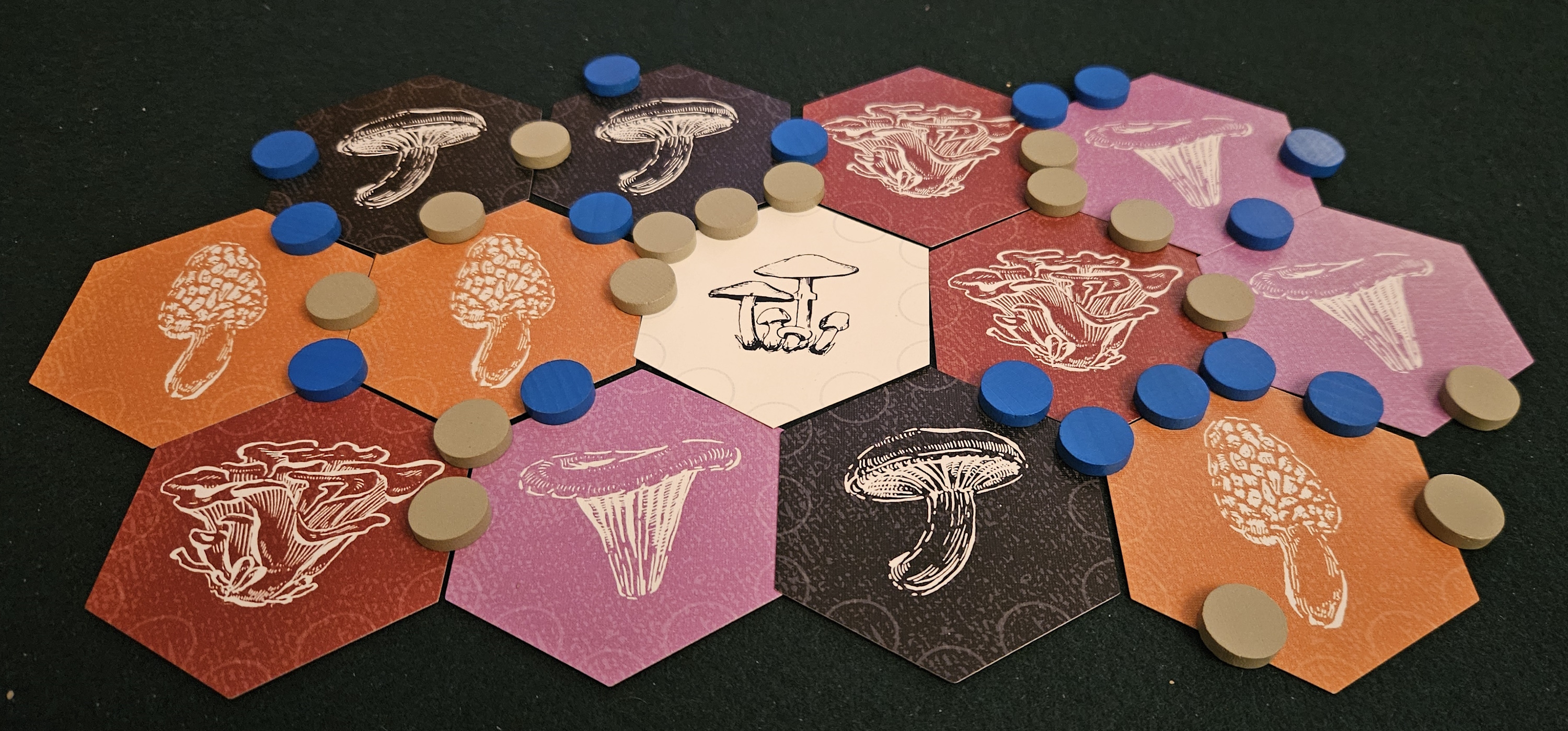
The outcome of a session appears organic. Even fungal.
Misgivings aside, Gnaughty Gnomes is one heck of a way to spend half an hour. I wasn’t expecting a trick-taker played over the course of a single hand to be this gripping, this organic, this prone to flashes of brilliance, but there it is. Daniel Kenel has created something atypical but well worth a little mycology.
(If what I’m doing at Space-Biff! is valuable to you in some way, please consider dropping by my Patreon campaign or Ko-fi.)
A complimentary copy was provided.
Posted on February 5, 2024, in Board Game and tagged Board Games, Gnaughty Gnomes, New Mill Industries. Bookmark the permalink. 1 Comment.

 SPACE-BIFF!
Pingback: Trick-Taking Tranche | SPACE-BIFF!