It’s Not a Lake
Every so often, a board game will produce a firecracker of an idea, even if its execution doesn’t fully make good on that promise. Maps of Misterra, designed by Mathieu Bossu, Timothée Decroix, and Thomas Cariate, is one such title. An untouched island has been discovered. Nice. Now it’s time to map the thing. The only trouble is that your patron has some rather harebrained ideas about what an untouched island will look like.

Exploring this untouched isle.
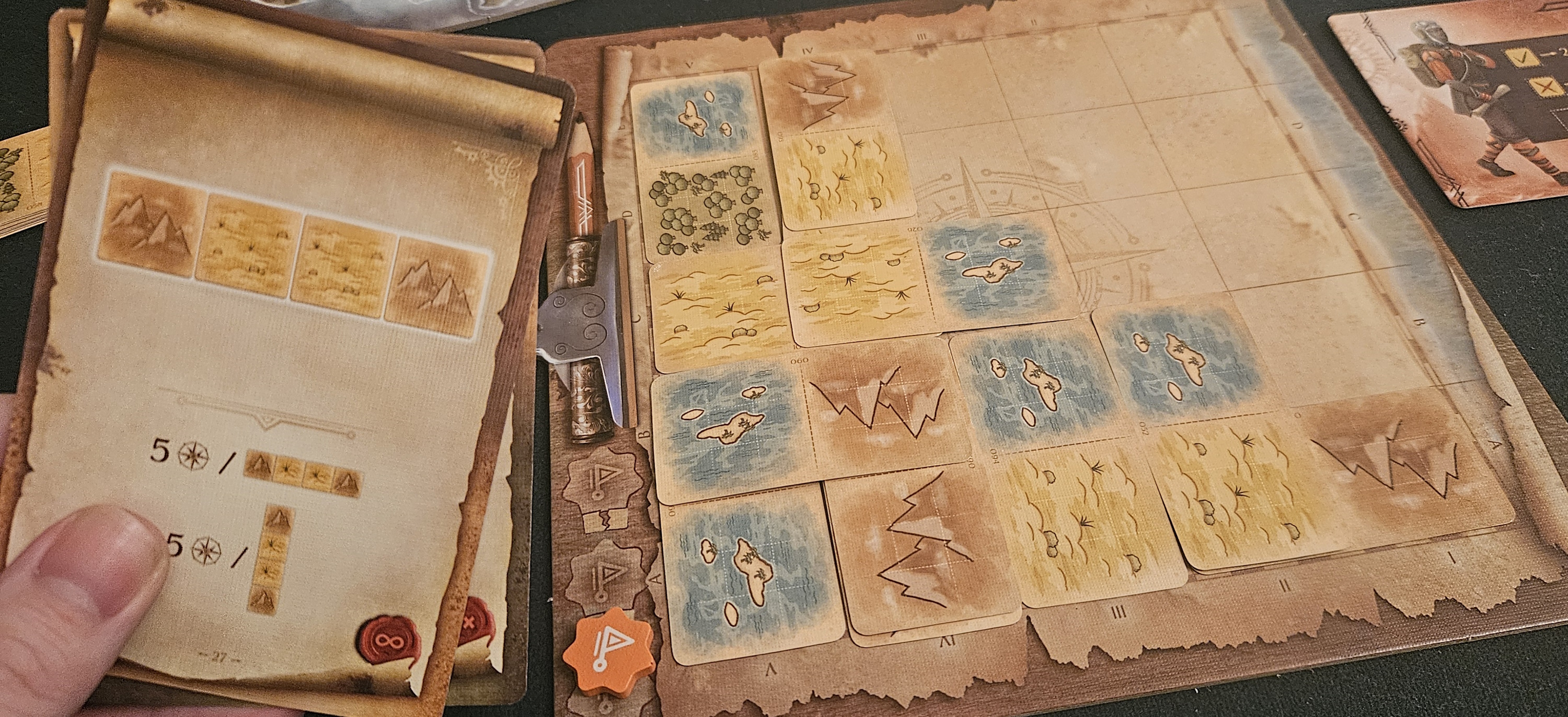
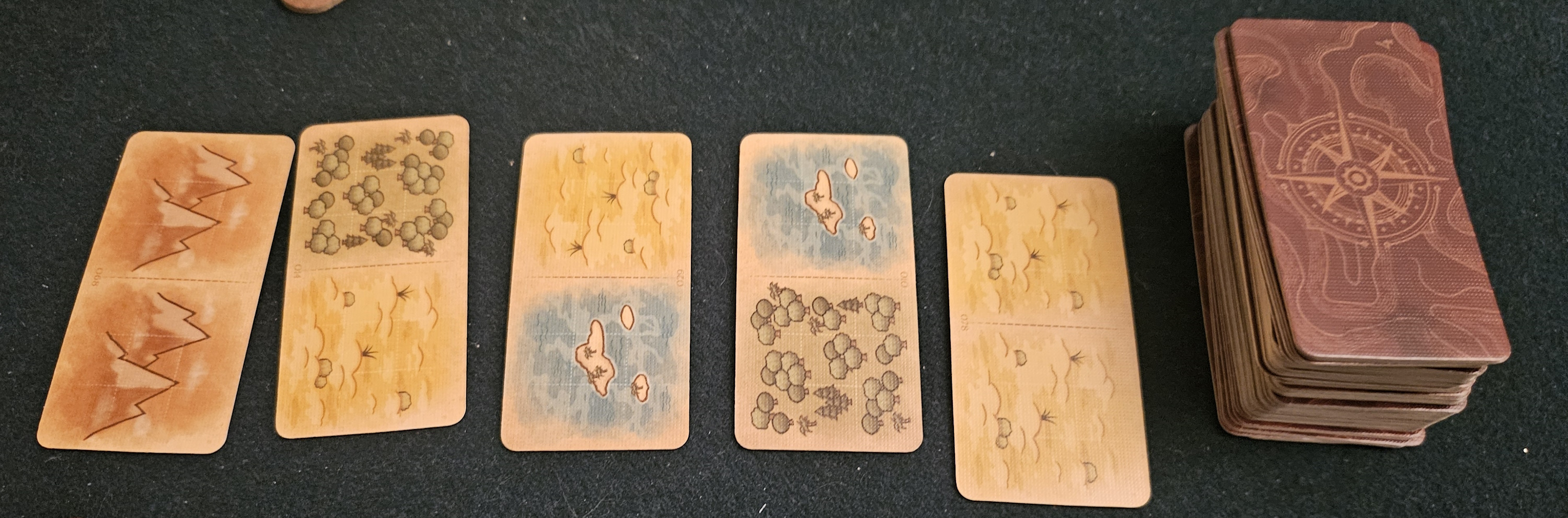
What follows is a race of sorts, although it’s run across three contests simultaneously. You move across this island, uncovering sections of the landscape by penning them onto a personal map. There are four flavors of terrain, each with their own peccadilloes. Mountains let you see farther, a useful trait since you can only place new terrain based on your character’s limited vision. Lagoons are navigable, letting you redraw a terrain card before assigning it to your map — also useful, given the game’s tendency to provide stinkers that don’t align with your personal vision. Steppes are for moving around more easily. And then there are jungles. Jungles are bad, preventing you from mapping at all while blinded by the foliage.
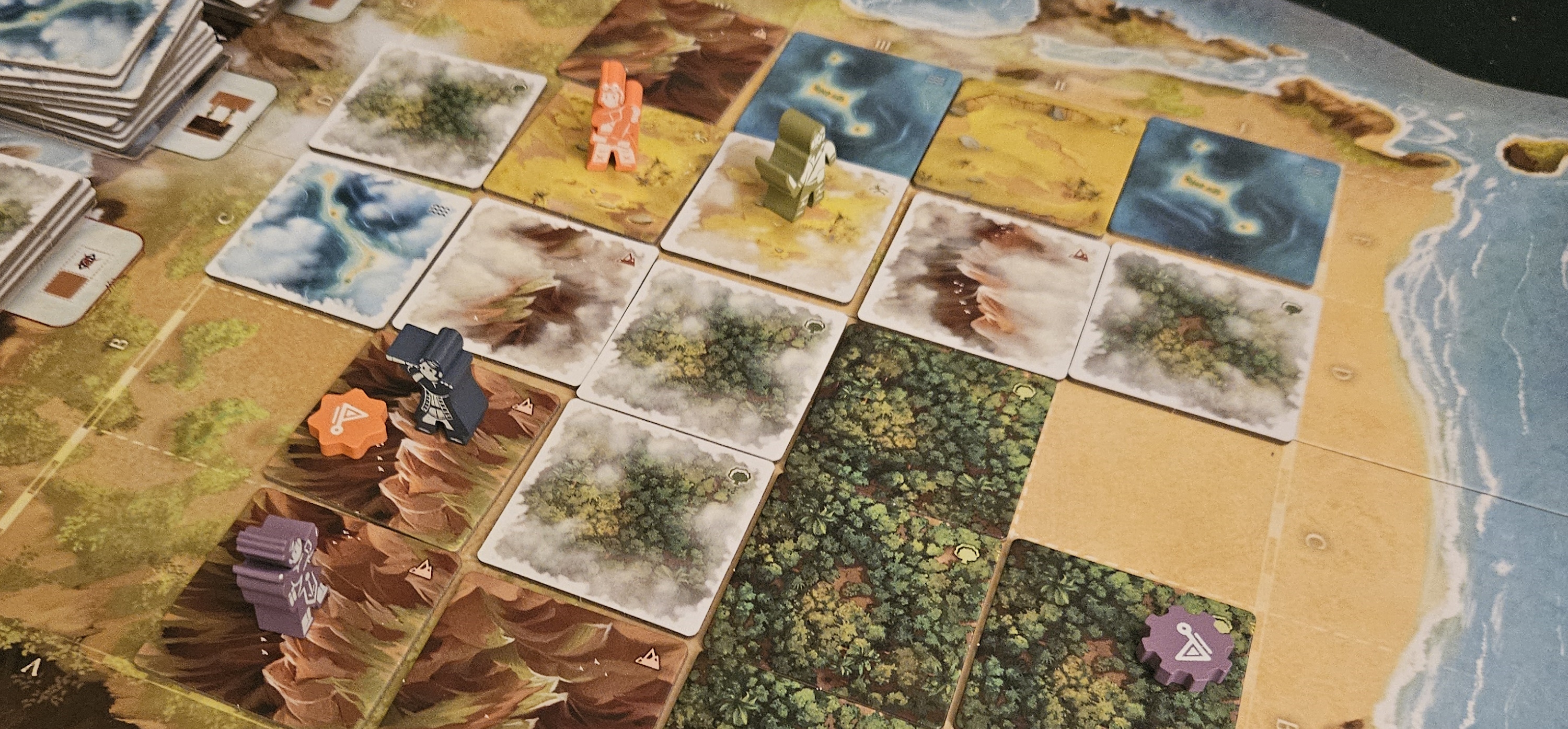
As actions go, there’s really nothing too complex or befuddling here. There are only three actions in the game, with the trickiest being the process of mapping itself. This requires players to pay keen attention to the state of both their personal map and the state of the larger board. When you add terrain to your map, it deploys matching terrain to the island — first as cloudy “unconfirmed” terrain, and then, once the lay of the land is confirmed either by you or another player via a second card, is flipped to its more resolute, unchangeable side. Bit by bit, the shape and composition of the island are summoned into being.
In theory, mapping is about negotiation and willpower rather than about faithfully transposing what lies over the next hill. This proposes a sordid state of affairs in which cartography is less about accuracy and more about expediency — who arrives at a place first, whether a land’s so-called discoverers apply one label or another, never mind questions of ownership. Maps of Misterra touches upon each of these questions in turn.
Will your map conform to real-world geography, or the whims of your patron?
Take, for example, the clash between one’s personal map and the wider geography. Neither of these are “real” or “definitive,” even within the game’s representation of the island. If I declare that a square is a steppe, and use that steppe to travel an extra space, and then you come along and declare that, no, it is a mountain, and use that mountain to observe a far-off location, we are both “right.” Neither of us have broken any physical laws. Your perspective from a high vantage doesn’t erase the fact that I traveled along a straight flat surface. Perhaps, even, we are both right — there is such a thing as a plateau. But it isn’t until that square has been confirmed via a second terrain card that it solidifies into a singular terrain. In a sense, we’ve boxed reality, packaged an untamed sliver of the globe into a more digestible form.
This isn’t the most natural thing to conceptualize in our era of satellite photos. Thanks to GPS and airplanes and instantaneous navigation assistance, we default to a bird’s eye view of our surroundings. It’s easy to forget that the vast majority of humanity’s maps have been impressions, even impositions, of imagination over terrain, not the other way around. Take a look at the Babylonian Imago Mundi, or Ptolemy’s world map, or, my personal favorite, the Tabula Peutingeriana. As much as their cartographers strove to represent the real, they also engaged in acts of imagination, rounding down the world’s corners, speculating, creating boundaries where previously none existed. These were negotiated spaces, not zoning charts and building permits measured down to the centimeter. Even those are imaginary, albeit imaginaries that people and governments tend to agree upon.
Hence the friction between the game’s three main sources of points. Once the island has been mapped, we settle in to tally our performance. The first objective is accuracy — how well our personal maps conform to the wider geography. That one is simple and straightforward, awarding points for every corresponding square.
But the second is entirely subjective, even political. At the beginning of the game, each player selects a pair of cards that represent their personal patron’s expectations for this new world. Maybe my patron has a pet theory that islands of this type, having been untouched since the week of creation six thousand years ago, will appear as parallel stripes of contrasting terrain. Or maybe they’ll expect to see many lagoons not adjacent to jungles, or loads of terrain squares that don’t expand into larger regions, or persnickety arrangements of steppes and mountains. Whatever their expectation, it behooves us to flatter their egos by producing maps that conform to their expectations. It’s a very real possibility that my final map will look very little like yours, even if we both have an identical accuracy score. We have negotiated the terrain of the island into existence, but still can’t agree on what it really looks like. It’s the coastline paradox as a board game.
And that’s before we even consider the final scoring goal. As we move around the island, we aren’t only occupied by mapping. We can also deploy research claims, little flags that mark a stretch of terrain as belonging to us. This encourages us to chart large blocs of matching tiles. This is Maps of Misterra at its most perceptive, a reminder that maps are not only representations of reality, but claims on reality. We aren’t mapping this island for curiosity’s sake alone. We’re mapping this place so we can possess it.
This is exactly how maps are made.
This is exciting stuff. So exciting that I’m averse to breaking the spell.
The thing about Maps of Misterra is that it’s a wonderful idea. As an illustration of the millennia-old problem with mapmaking, it’s unparalleled. For the past few months (okay, the past two years), I’ve been noodling over a piece on how the representation of geography in Cole Wehrle’s Oath critiques the European enthusiasm for maps, both as artifacts and as political impositions, by instead utilizing the mandala system, in which political entities gauged ownership and importance not by strict boundaries but through spheres of influence and nearness. This is only counterintuitive until we think about it a little. As creatures that travel and migrate and eat at new restaurants, we tend to conceptualize destinations by proximity and ease of access, not by how the crow flies. As anyone can tell you who’s found themselves on the wrong side of the freeway without a nearby underpass, sometimes accurate maps can be misleading. And that’s before we even ask whether every GPS map is truly accurate. Have you ever followed a line on your phone only to discover that the road suddenly terminates? As our maps get closer to the real, such intrusions back into the imaginary become all the more jarring.
Maps of Misterra centers that jarring effect. Glancing at the ratings for the game on BoardGameGeek, more than a few players have struggled to settle the discordance between their personal maps and the negotiated terrain of the island. This isn’t surprising. As our maps become more accurate — again, in one sense but perhaps not others — it becomes harder to understand why players might produce such wildly divergent representational spaces.
But while Maps of Misterra is conceptually incisive, it doesn’t quite cohere as a plaything. There are vast possibilities here, but many of them go unrealized. Those little flags, for instance, can be contested, but only when two claimed regions are bridged into one. There’s something happening here, a ludic statement on colonial claims being brought into collision, that isn’t wholly realized. The map, ironically, is too tight for the necessary breathing room, too constrained by its scoring goals, maybe even too limited by those four terrain types. It doesn’t feel tuned right, although it’s difficult to pin down the precise reasons why. On the one side, it’s ambitious and perceptive. On the other, it wants to go down in two or three bites, hastening to its conclusion before developing a proper arc. It’s as at odds with itself as its maps are with one another — which may be tragically appropriate, but doesn’t quite make it a game worth hunting down.
At four players, this island gets crowded.
But there’s something to Maps of Misterra I can’t set aside. Not as a game. I doubt I’ll play it again. But as a concept and as a critique, I hope its designers chase these ideas further. It was standing on a mountaintop until somebody came along and declared that, no, this is a jungle. There are greater vistas this current incarnation only gestures at. I’m eager to see what it could have showed us.
(If what I’m doing at Space-Biff! is valuable to you in some way, please consider dropping by my Patreon campaign or Ko-fi.)
A complimentary copy was provided.
Posted on January 30, 2024, in Board Game and tagged Board Games, Maps of Misterra, Sit Down!. Bookmark the permalink. 9 Comments.

 SPACE-BIFF!
“Glancing at the ratings for the game on BoardGameGeek, more than a few players have struggled to settle the discordance between their personal maps and the negotiated terrain of the island.”
Wow, amazing metaphorical transition.
It’s a very naughty pond!
Dissapointment is what I feel when brilliant thematic statements are not backed up with compelling gameplay. Which is true of all art I suppose. When style does not match substance, we almost feel like the theme, the substance, was wasted. That it should have been saved for gameplay that would delivered the statement more powerfully.
I can see that. There are times I feel similarly. But I’m also grateful to see this trio trying to create something different, even if in the end it didn’t quite accomplish its ambitions.
That’s… a good point. I mean, usually to produce amazing works of art, we must work our way up from producing something less. In order to build the skills necessary.
I have to compliment you, Dan, on writing an article about a game you didn’t care for, but still making it thoughtful and engaging on its own terms. I can’t think of anyone else who’s doing that, not only for board games, but for any field.
Thank you for the kind words, Probst!
The concept reminds me a bit of Remember Our Trip by Sasha & Saashi. I highly recommend that one if you liked the core “confirmation of memory” puzzle!
You aren’t the first person to recommend it after this review! Guess I’ll have to seek it out somehow.