Baconator

Where last year jump-started my appreciation for trick-taking games, perhaps 2024 is the year I’ll bumble into an adjacent genre: the shedding game. I’ve played a handful over the past few weeks, dominated by designer Sean Ross. My launching point for this introduction has been Bacon, one of his more recent shedders.

Let’s open with the reference card for a change.
Right away, it’s easy to see why many folks put shedding games in a parallel category to trick-takers. To the casual observer, they might even seem identical. Everybody has a big hand of suited cards. Teams are often featured. Going around the table, somebody leads and then everybody else follows.
There’s a crucial distinction, though. Rather than trying to win tricks, your goal is to get rid of your cards first. That’s the “shedding” part. As such, hands diminish in size at differing rates. That’s where combos come in.
Bacon opens with a menu of such combos. You can play a single card, sure. But if you want to drop a whole bunch of cards at once, it might be more favorable to build a run, or a triple, or something like a “stair,” tube,” or “plate,” little sequences that build together. After you’ve revealed those cards, the next person at the table has the option to follow by playing the same combo but in a more powerful form. If I open with a stair of 2s and 3s, maybe you counter with a stair of 5s and 6s. Around the table you go until nobody can add to that combo.
Three points. First, these combos are (mostly) binding. If I play a single, everybody else is required to also play a single. You can’t simply bump that into a pair. So there’s an all-important tempo, another parallel with trick-takers, where it might be wise to hold onto a big play until later in the round.
Second, bacon. Everybody begins with two bacon cards, which — you guessed it — are wilds. This affords some flexibility to each hand. Maybe too much flexibility. More on that in a moment. Point being, there’s a good chance someone at the table will be able to improve on your combos. But! It’s also pretty easy to keep track of how many bacons everyone has left over, allowing some minor card-counting that goes a long way.
Third, though, I mentioned that combos are mostly binding. That’s because anybody can trump a combo with a special. These are ultra-tough sets that can replace combos and even each other. Leading with a single may seem like it traps everybody at the table, and might go around once as everybody ditches a card that doesn’t fit into anything better. But it’s entirely possible that somebody will break out of that bind with a special, suddenly altering the dynamic entirely. Now the game shifts into overdrive, with everybody striving to play a better special.
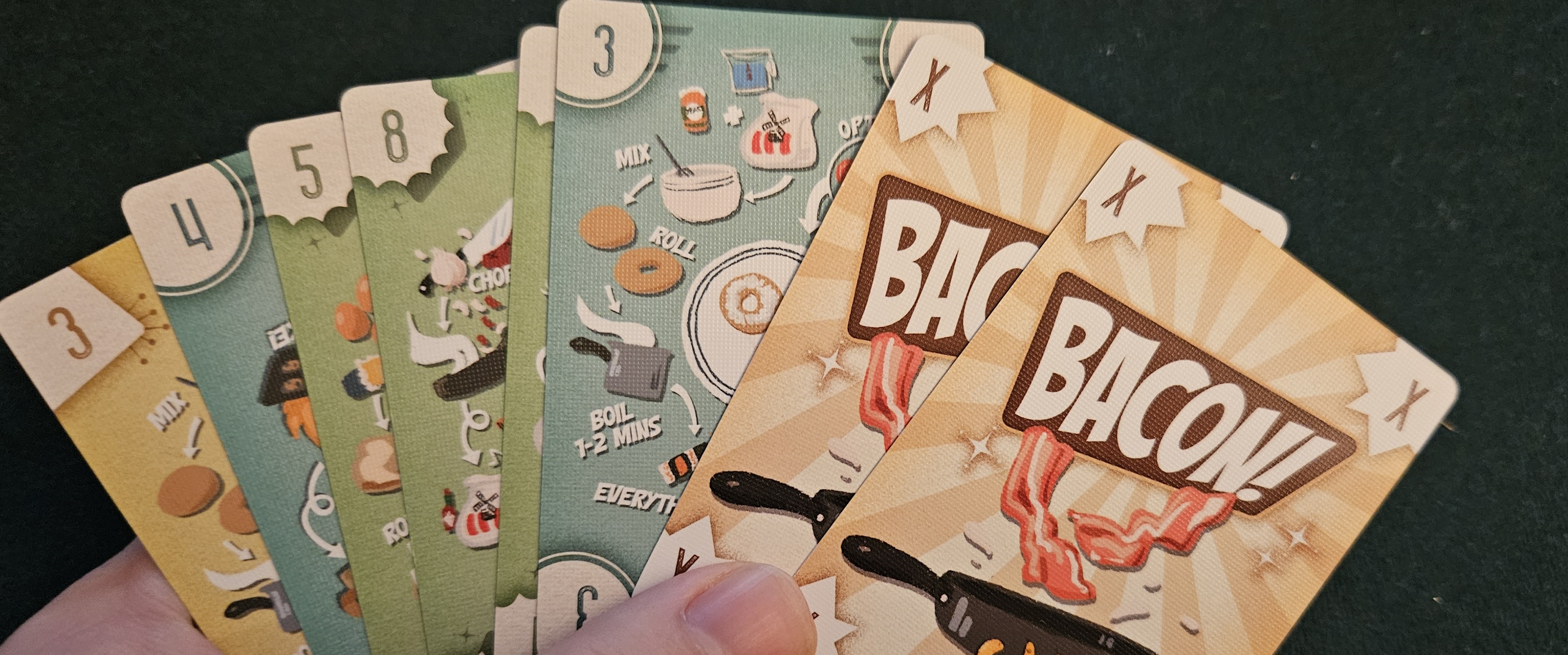
Does bacon enhance every meal? The game of the same name thinks so.
If that sounds like a lot, rest assured, it isn’t too bad in action. For all its ease of play, however, there’s a lot to think about, especially thanks to those wild bacon cards. Every hand conceals at least a few powerful combos and specials, and unlike some shedding games there’s really no such thing as an outright bad hand, only hands that are more challenging to work with.
If anything, that’s true to such a degree that it swings the other way. Because everybody is holding a pair of those titular bacons, specials are a little too easy to deploy. There’s still timing to consider, and someone can lead with a low combo to undercut players with larger hands or who’ve been hanging onto a big play. But there’s a good chance a following player will break out of the combo anyway.
This has a mixed effect. Bacon is thinky, sometimes to such a degree that it grows sluggish. At the same time, it’s disappointing to see some of its most considered plays get broken almost flippantly thanks to wild cards. The degree of the problem depends somewhat on how Bacon is played. It’s possible, when playing with an odd number, that everybody will be looking out for themselves. But this is a team game at heart, with pairs of players working to empty not only their own hand but also that of their partners. This hones Bacon’s strategic edge all over again, forcing players to think beyond the confines of their own hands.
Even then, the result is a hash of clashing ingredients. There’s no denying that this is a clever game, and its few problems don’t overturn the frying pan altogether. But there is some spillage.
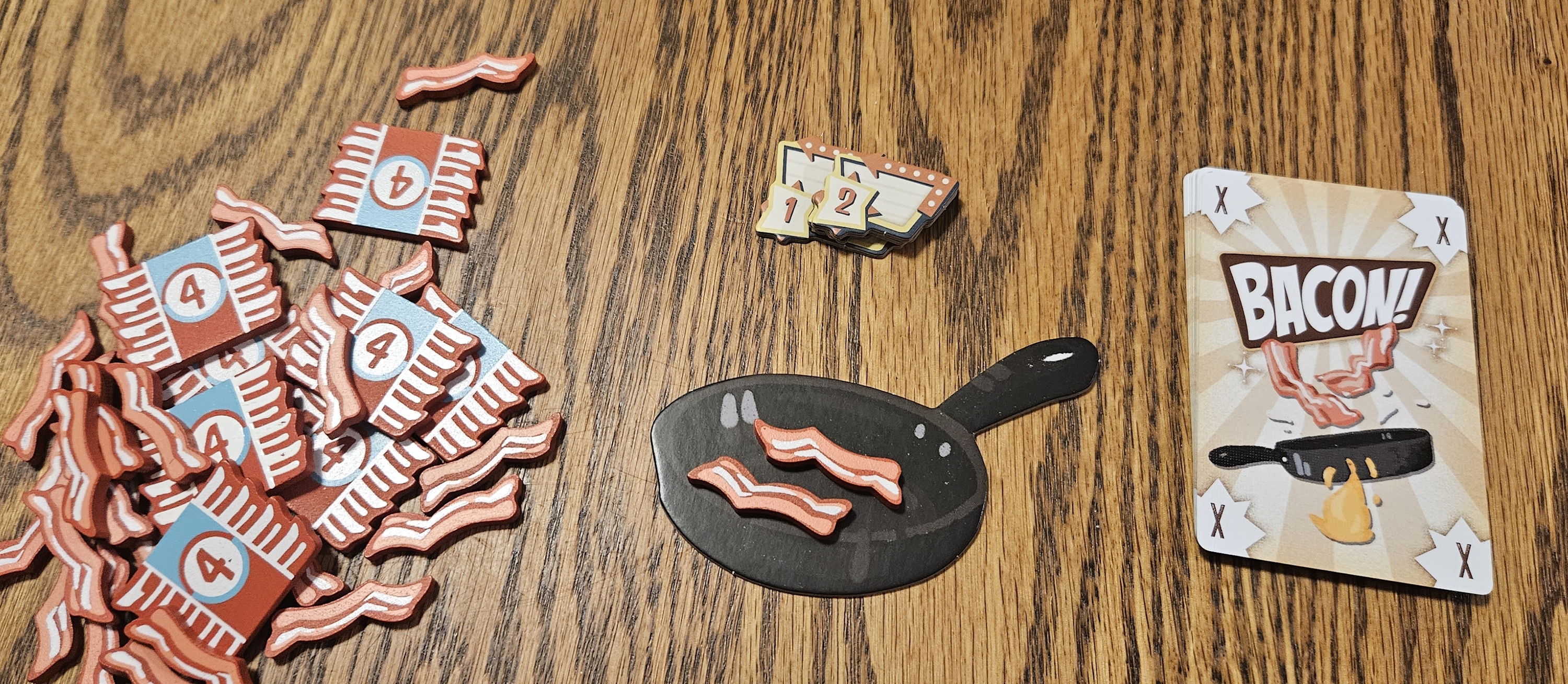
Deluxe bacons.
Does Bacon bring me around to a whole new subgenre? Not as such. Ross has a few other shedding games under his belt, such as Haggis and Greasy Spoon, that do a better job of that. There’s plenty to consider here, but in this dish the ham’s flavor proves too overpowering for my tastes.
(If what I’m doing at Space-Biff! is valuable to you in some way, please consider dropping by my Patreon campaign or Ko-fi.)
A complimentary copy was provided.
Posted on January 17, 2024, in Board Game and tagged Allplay, Bacon, Board Games. Bookmark the permalink. 1 Comment.

 SPACE-BIFF!
Great to see you applying your game genre thinking from trick-takers to shedding games.
Have you played Tichu or Scout?