I Prefer Henotheist, Actually

When the Witch Hunter bangs on my door to accuse me of paganism, I hope he won’t mind listening to some internal debate over whether that’s a suitable designation. I prefer to think of myself as a monolatrist, you see. Maybe a henotheist. I’m torn, really, over how to identify my relationship to these heathen deities that adorn my home. We don’t insist on labels like your mainstream god.
Pagan: Fate of Roanoke is positioned to ask such questions. Designed by Kasper Kjær Christiansen and Kåre Storgaard, Pagan places itself not only on the physical frontier, but also along the raggedy edge of our theological understanding. Only rather than debating the finer points of ecclesiastical law, two players are caught up in an existential debate over whether the colony should be forcibly stripped from the landscape via magic. That’s right, it’s a New World religious debate. No knowledge of Latin required!

The locals endure visit after visit from unwelcome guests.
The first thing to note about Pagan is that it fits in the overlap between two very different types of card games. On the left are your bespoke dueling games. Pagan has been built with a singular clash in mind, between Witch and Witch Hunter, both with their own considerations and card types and paths to victory. Yet in spite of their differences, these varied interests are intertwined. Every play not only advances your own position, but also touches your counterpart — and can be countered, removed, pushed back against. There’s a tale being told, one that’s tangible in a way most board game narratives don’t even bother attempting.
On the right side of things, however, Pagan is also curious about all those customizable card games you played as a kid. It doesn’t quite stoop to the level of blister boosters or having to duck into your friendly local game store to purchase a card from a drawer, but it still niggles about broader card pools and increased villager options. There are a few expansions available, each whispering that they’ll fulfill the promise, like some new-age version of Netrunner. But it never quite gets there. Even after a diet of new cards, Pagan is a stomach that is never fully satiated.
What a stomach it is, though. The core gameplay loop is bewitching. Every game opens with nine villagers in a line. These are the notable figures of Roanoke, the colony on the verge of vanishing from the world. Each villager offers their own action: drawing cards, playing cards, earning “influence,” first and foremost among the game’s myriad resources. Every turn allows your character to place three pawns on the table, some or all of which will visit these villagers to both trigger their personal action and sow your interests among them. As you accumulate tokens on these villagers, the efficacy and spread of your actions increases. The Witch, for example, eventually doubles the potency of her visitee’s actions, while the Witch Hunter eventually exonerates or executes them.
It’s a worker placement game, then, but one with a few tricks up its sleeve. First is the villager composition itself. I mentioned there are nine in total, but after a few exploratory plays one might consider which villagers should be included in any given match altogether. There’s a clever tournament-style system at play, wherein the Witch picks the first set of three, the Witch hunter picks another, and the third is selected via whichever scenario you’re currently playing. The thinking is that both sides are able to select villagers that mesh well with their style of play, while still needing to maneuver around those selected by their opponent.
Meanwhile, the identity of those nine villagers is all-consuming not only because they offer a wide range of benefits, but also because one of them is the Witch. When the game begins, the Witch draws a random card that designates which identity she’s assumed. That pile of cards then becomes the source of the Witch Hunter’s exonerations, a slow trickle of information about who the Witch is not.
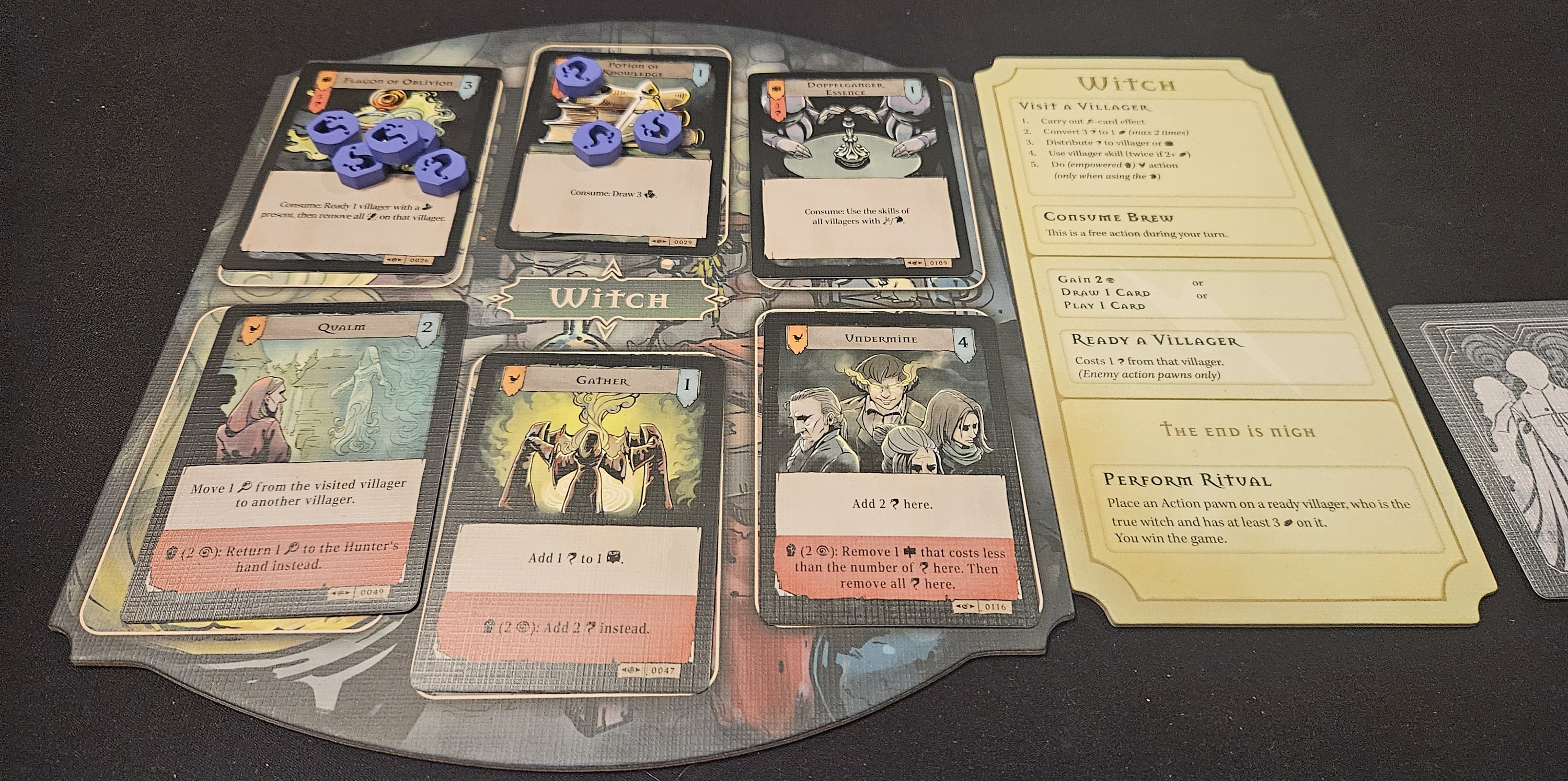
Both sides have their own card types to leverage.
What a setup. There aren’t many like it. Nor is there any card game quite like it. I invoked Netrunner earlier. At times, the comparison is apt. Like that game’s contest between Corps and Runners, Pagan leans into its sense of identity. When playing as the Witch, you’re fully invested in the role. You duck and hide, you sow doubts, you try to lead your pursuer on a wild goose chase. The Witch Hunter, meanwhile, surveys the board like a grand inquisitor trying to ferret out sin. Everyone is a suspect. It would have been one thing to parrot Netrunner’s success, but the roles in Pagan manage to stand apart on their own.
Take the Witch. She’s all about building toward explosive turns. One of her three pawns is a familiar, which can trigger a special power. Now she isn’t merely visiting the locals; she’s also henpecking at her rival’s clues or unleashing surprising amounts of power around certain households. On its own this might prove effectual enough, but she can also cast enchantments that stick around from one round to the next, hindering her pursuer until he gets around to dispelling them. Most impressive, though, is her ability to brew potions. These take some time to percolate, but can be quaffed as a free action, transforming her into… well, into a whole range of things. Perhaps every one of her pawns will become a familiar. Perhaps she’ll draw a bunch of cards. Perhaps she’ll influence every villager on the board at once.
The Witch Hunter, on the other hand, marches inexorably forward with steel-toed boots, preferring steady turns that prohibit the Witch’s movements little by little. He gathers allies to modify his actions or deploys locations that provide new actions altogether — with the tradeoff that by sticking to his own destinations he surrenders some control over the villagers, thereby granting the Witch free rein over where to visit. To smother his quarry’s newfound freedom, he can also seed the village with little edicts that penalize the Witch’s placements or reward his own. The Witch is still free to visit anyone she likes, but now she risks giving the Hunter a bunch of resources, or she can’t take that villager’s action, or whatever.
What works so well about these identities is that they aren’t merely asymmetrical cards; they’re entirely different outlooks. The Witch is organic, always changing, difficult to pin down. She’ll go through three or four small turns, each unimpressive on its own, only to unleash a turn that accomplishes more than the previous handful combined. By contrast, the Witch Hunter is methodical. He steadily improves his actions, blocks off portions of the village, and gradually clears one villager after the other.
He’s also something of a bummer to play.
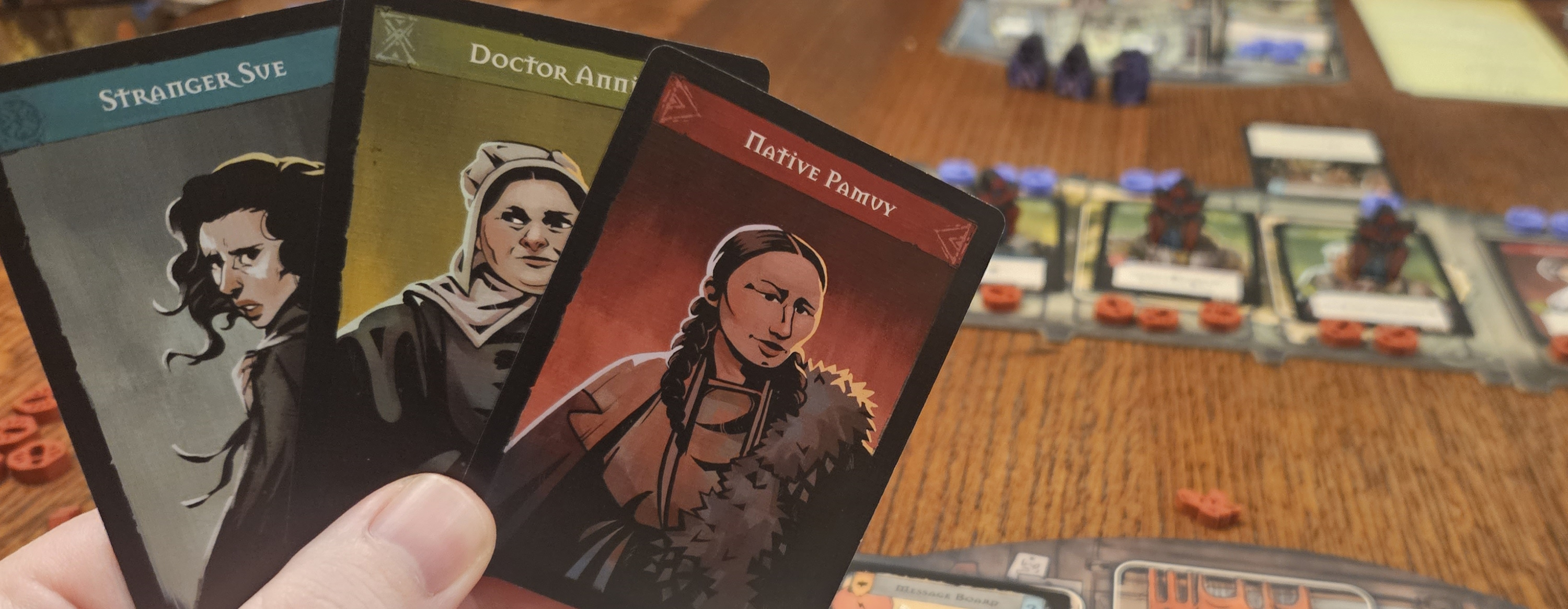
Weighing the evidence.
I don’t like to comment on balance. Not only is balance overrated, but worse, nobody can agree on what it looks like. It doesn’t help that every time I mention that such-and-such faction might be underpowered, some guy comes along to insist that his dog always wins with that faction, so take that. All we have are anecdotes and vibes.
So when I say that I’ve never seen the Witch Hunter win, take that with a grain of salt. It doesn’t matter how many sessions we played, or that we split our plays between Witch and Witch Hunter, or that we eventually tried our hands at deck construction and villager selection. It doesn’t matter that we were loving everything about Pagan until our appreciation for the game curdled over perceived balance issues.
What matters is that the Witch Hunter’s slow-and-steady approach doesn’t hit the same emotional highs as the Witch’s brews, enchantments, and familiars. Pagan is a game of deduction as much as it’s a game of deck management and worker placement, but its tools for deduction aren’t weighty. The Witch Hunter has two main tools: exoneration and observation. In the first case, working through the stack of innocent villagers takes time that the Hunter may not have; in the latter, the Witch can reliably spread around her corruption in such a way that the Witch Hunter is left with a fifty-fifty shot, at best, before she unleashes her final spell.
Of course, this is a simplified statement. There’s board position to consider. Because pawns block villagers, it isn’t always possible to stack tokens in the right places. And there are quite a few card effects that alter the course of the game. The Witch Hunter needs to go on the offensive and do everything possible to disrupt the Witch’s access to both the villagers and any resources.
Even then, however, despite excellent play in the moment and some truly formidable narrative cohesion, Pagan never feels entirely complete. The jankiness of its balance aside, it yearns for stronger deck construction, for a better pool of cards, for a few nips and tucks around the edges. As we played our final session — one that yet again favored the Witch and proved dissatisfying in its last stages — the thought occurred to me that Pagan is a game that deserves to be remade a decade or two down the road.

More visits.
Because despite its problems, Pagan is special. Like some of its peers — Netrunner springs to mind — there’s so much here that works, including an interplay between Witch and Witch Hunter that leaves both players sweating over which trap will clamp shut next. It’s the ludic equivalent of a prickle down your spine as you await a sharp jab between the shoulder blades.
Sadly, its tendons can’t quite bear the weight of all that muscle. For now, Pagan provides a better first impression than a second look. Or a third. Or a fourth. With every play, it reveals new problems. The prickle becomes a throb, then an ache. I sincerely hope that this isn’t the end for Pagan. But for me, until it gets a serious revamping, I won’t be pounding on any villagers’ doors to debate the finer points of heresy anytime soon.
(If what I’m doing at Space-Biff! is valuable to you in some way, please consider dropping by my Patreon campaign or Ko-fi.)
Posted on January 15, 2024, in Board Game and tagged Board Games, Pagan: Fate of Roanoke, Wyrmgold. Bookmark the permalink. 24 Comments.

 SPACE-BIFF!
Maybe before criticising a game so harshly you should ask in some forums about how to play right with the hunter, by the way I had the same problems as you in my early games.
Most forums on bgg claim that winning with the witch is harder or even impossible which led me to ask directly to the game creators about the appearing balance issues.
As I said I was having rough times with the hunter and they gave me an essential tip which is going always hard on clues. If you control de 2 assets villagers you will get about 5-6 clues per round, so you’ll be able to get evidence fast enough to exonerate and be ready to do raids when needed which are another essential part of the game. At the same time you are slowing dow the witch as she will be gaining between 3-4 secrets per turn. Then when the witch attempts to do the ritual you will have managed to rule out most of the villagers as suspects. In this case scenario the witch bluffing is much harder to do because she won’t know which suspects the hunter has drawn. Conversely it may even go down for a winner killing for the hunter as he would be able to ignore the suspects he’s already got.
I hope this tips serve to anyone like us who doesn’t know how to play with the hunter and may make you revisit this game which is a brilliant one
No. What a very silly prerequisite to being able to talk about a game.
You didn’t get me right, you can always talk about any game if what you are saying is based on something proved.
To make a statement such as “this game needs to be remade” or “it reveals new problems with every play” when you have only played some games and didn’t care about the winning rate of the rest of the community that’s what I call silly.
I’ve had the same problem as you with pagan loosing over and over with the hunter so I looked for help from other gamers and its creators to enjoy the game at its full and now I like it much more. Instead you’ve made your statements by some games played by yourself and then rushed to say that the game it’s not worthy.
So don’t try to terjiverse my words I didn’t set any prerequisite. What I insist on is that whenever someone is making reviews that the whole community may read should to be carefull of what is saying. This game is a really good one certainly way above average
“I didn’t set a prerequisite. I only set a prerequisite!”
Begone.
I just checked in with my dog, he’s pretty upset that you couldn’t be ARF’ed to check in with him either.
And he’s such a good boy!
While I always appreciate Dan’s skills at critique, I never released he was also a skilled clairvoyant. Although, if he was a skilled clairvoyant, then he would win as the witch hunter. The only conclusion I can come to is that this is actually part of the performance and was planned ahead of time. Well played Thurot. Well played.
On a more serious note, beside win percentages, I get the sense that you did not find both sides equally fun to play. Am I reading that right? Because, one side is easier to win at than the other is one thing, but one side is more enjoyable to play is a very sticky problem.
Personally, I very much prefer to play as the Witch, and don’t much care for the Witch Hunter. But hey! I’m sure there are others who feel differently on that score.
Dan, I have to laugh. You can heap praise on a game, talk about how discussions of balance are always contentious and wrap up with a nuanced take, and someone will instantly shout at you about how your balance concerns are wrong.
BTW, there is no “win rate” meta for this game. The BGG forums are a mess of people complaining about balance. Something is off about Pagan. Your review is 100% accurate.
Something is fishy about it. I think the problem isn’t “balance” so much as that it doesn’t quite provide the right tools to actualize your plans. Decks are too flabby, churn is too light. Something.
Of course there is a win rate of you ask the right people. For instance there are discord channels with some players reporting over 200 games. I bet mattsharp11 that you hasn’t even played one game of pagan, you just limit to follow the blog writer’s opinion and take it as better than hundreds of votes on bgg. And you just praise this review as 100% accurate? Again, based on what?
As for “the decks are to flabby” you have a pool of 300 hundreds cards to make it suitable for you and “actualize your plans”.
It doesn’t hurt to recognise that you may had jumped to conclusions. If anyone would try the game with the tips I gave I am pretty sure it would be appealing for most.
I wouldn’t argue with anyone who says this game is not for me o I just don’t like it, that’s 100% acceptable but not to affirm false facts about any game without knowledge
Fabio, you’re sounding increasingly unhinged. Either you can start behaving yourself or your comments will be deleted. Simple as that.
I didn’t mean no ofense, just another point of view from someone with a little more experience with the game. I also think that there’s no need in saying I sound that way, it’s a gross exageration Dan. I’ve made my point and I have no further interest, as I said I was just trying to explain why the game its actually really good if you play it the right way. Maybe that’s its biggest fault, that you can get lost on the intricacies of it and don’t see the useful actions which lead to winning and enjoy this game for sure.
Fabio:
I’ve logged 30 plays, you jackass.
Dan this guy sounds unhinged enough to delete his comments?
Sounds like this could be a great example of why I rarely back, and never purchase, games with crowd-funded content-related exclusives.
Yeah, it’s tiresome. But it’s even worse in a game that wants people to construct decks.
“Pagan is also curious about all those customizable card games you played as a kid”
ouch
I was into the Star Trek CCG! And the Star Wars CCG! Both of them! Before I even saw Star Wars!
Some of us were already well into our 20s when the CCGs even rolled out 🤪
Oh nooooo. Now your comment makes too much sense.
Good write up Dan, been anticipating your review since you mentioned you’ve been playing it. I pre-ordered a copy last March and it only just arrived and for what it’s worth, only the Witch Hunter has won in our games so far.
That being said, I want to add a further criticism which has frustrated me for months, and no doubt annoyed the people in the Homo Ludens Discord group more, as I’ve continued to rant and rave there.
The production. I can see through your photos that you’re playing the second printing (SP) of the game. The main cause of the production issues I’ve had over the last couple of months relate to the fact that the first printing (FP) and the SP are not the same in quality. When Wyrmgold launched the reprint crowdfunding campaign they changed one very minor word. On the cards section they changed “All cards are 350GR, matte, linen” to “All cards are 350GR, matte”. I don’t believe they made note of this anywhere (I may be wrong). Removing the linen finish is very noticeable.
In preparation of my pre-ordered copy of the base game coming (SP), I decided to buy some of the mini expansions (months earlier). Only now that my SP base game has arrived do I realise that the mini expansion packs I bought are from the FP. Ultimately, this doesn’t make the game unplayable. However, the SP Kickstarter campaign specifically mentions that if you own the base game from the FP you can just pledge and get the new stuff. So
I wonder what happened to those people. Perhaps people who pledged at this level were given the quality of cards in line with the previous printing, I don’t know the answer to this. It seems like the type of thing a publisher should tell their backers.
In addition, despite these substantial quality changes in the cards, it mentions no where on the box that this is a SP. I find this incredibly frustrating. While I was waiting for my SP base game to arrive, I saw an opportunity to buy second-hand all the gameplay content for Pagan at a decent price. The seller listed it as SP and since there was no way to see any text on the front of the box I trusted them to know what they were selling. Now that massive bundle has arrived, I realise that this is in fact not the SP and is actually the FP. If Wyrmgold decides to do more expansions in their “evergrowing card game” who’s to say what card quality they will continue with, perhaps they’ll use a third one!
Personally, I feel that publishing a deck construction game which has the ambition to produce more expansions and then yet changing the card quality on the 2nd print run is a sign that Wyrmgold has not taken the production seriously. Changing the quality due to how components are affected by wear and tear is fine. However, if this were the case then surely Wyrmgold would announce this (they actually might have, but I haven’t seen it). The final nail which tells me that the production was a second effort is how the playmats were delivered. The retailer I pre-ordered the SP playmat from mentioned that it had been delivered to them all folded into a little square and that, as a result when unfolded it didn’t lie flat. It’s pretty normal to pack neoprene mats into tubes and so as a result the retailer sent me the aforementioned mat in a tube made for Descent. These are all kinks you’d think they’d have sorted by now.
Overall, I don’t find any of the mishaps to be particularly bad. However, when combined together and with a little sprinkle of a lack in transparency, it makes it really hard to want to explore the game further when I’ve had to go to so much effort just to find out what the differences are between printings (Wyrmgold do mention that the SP has different wooden tokens, 10 errata cards and an errata changed rulebook). Either way, I do feel comfortable in that I know almost everything there is to know about the differences, so if someone has questions feel free to reach out (BGG wasn’t super helpful)(Twitter: @clyne90)! Keep up the good work Dan!
Oh shoot, that’s frustrating. I don’t normally fret too much about component quality, but an expanding card game with deck construction really requires consistent quality, or at the very least an open disclaimer that everyone will need to invest in sleeves. That stinks.
Great review, as always. You got my hopes up that there might finally come a game to be worthy of Netrunner comparisons. Someday…