Gazette Trucker

It will surprise nobody to learn that I was one of the layout editors of my high school newspaper. There’s an art to fitting everything on the page — just don’t ask me to demonstrate that art or what any good examples are. Mostly I remember working late after school to meet deadlines.
In that regard, Peter McPherson has transcribed the topic accurately. This is the third of McPherson’s published titles, after Tiny Towns and Wormholes, and it’s the strongest of the three in no small part due to a frenetic nature inspired by Vlaada Chvátil’s Galaxy Trucker. The secret to Galaxy Trucker’s success is that it, like its sister title Space Alert, grows funnier as its players fail. It’s the hobby’s equivalent of slapstick. Fit to Print follows that tradition. It’s at its best when everything is falling apart.

Hunting for stories and putting them into some semblance of order.
You deserve everything coming your way, starting a print newspaper in this day and age. Fit to Print sets itself in an anthropomorphic woodland — imagine a plucky vulpine photojournalist chronicling the never-ending struggles of Root and you won’t be too far off — but its pulpy business model is no less fraught for taking place among so many trees. It opens much the way Galaxy Truck opens: on a sprawling tumble of face-down tiles. There’s a little more definition here than in that game, with tiles of various sizes ranging from big squares to tiny rectangles.
That speck of information soon becomes crucial. Your goal is to snatch up as many pieces as possible, examining them over your desk to determine their precise contents, before opting whether to hold onto that tile or toss it back into the heap. Because your broadsheet has limited space, it’s incumbent on your editorial oversight to assess when you’ll need narrow pieces versus centerpieces, arranging a vague mental map of what your final paper might look like.
It’s tough. There are so many little things to consider. How to fit everything onto the page, for one. The entire timed phase, a single ticking clock of between three and five minutes, covers both the journalism portion, when you gobble up all those tiles, and the laying out of those tiles on your page. This transition is awkward at first, but it’s an intentional sort of awkwardness, forcing players to gauge when they want to stop grabbing tiles and begin arranging them. New players tend to make the understandable mistake of thinking that they can continue to select new tiles even after they’ve begun on their layout. But they cannot, and should receive a dressing-down by the table’s most J. Jonah Jameson-voiced player at the table when they do.
From there, further considerations arise. Similar tiles cannot be placed adjacent to one another, whether we’re talking about matching styles of article, or photographs, or simply advertisements. Photographs in particular benefit from having specific articles next to them. Your centerpiece adds a quirk of scoring unique to your paper. Articles show whether they’re happy or sad. When the paper’s value is tallied at the end of the round, any imbalance between good and bad news results in subtracted points. Ouch.
The most interesting and incisive twist is advertising. These are tallied across each of the game’s three rounds without altering anybody’s score. Instead, whichever paper has received the fewest advertising dollars at the end of the game is shuttered entirely. Since ads otherwise represent dead space, there’s an ongoing competition to have as few of the things as possible without seeing your paper snapped up by a predatory venture firm. It’s a brutal but compelling tether that binds everybody at the table together.
Which is great, because like Galaxy Trucker, Fit to Print is a game of two halves bound together. Here, though, those two halves aren’t equally compelling.
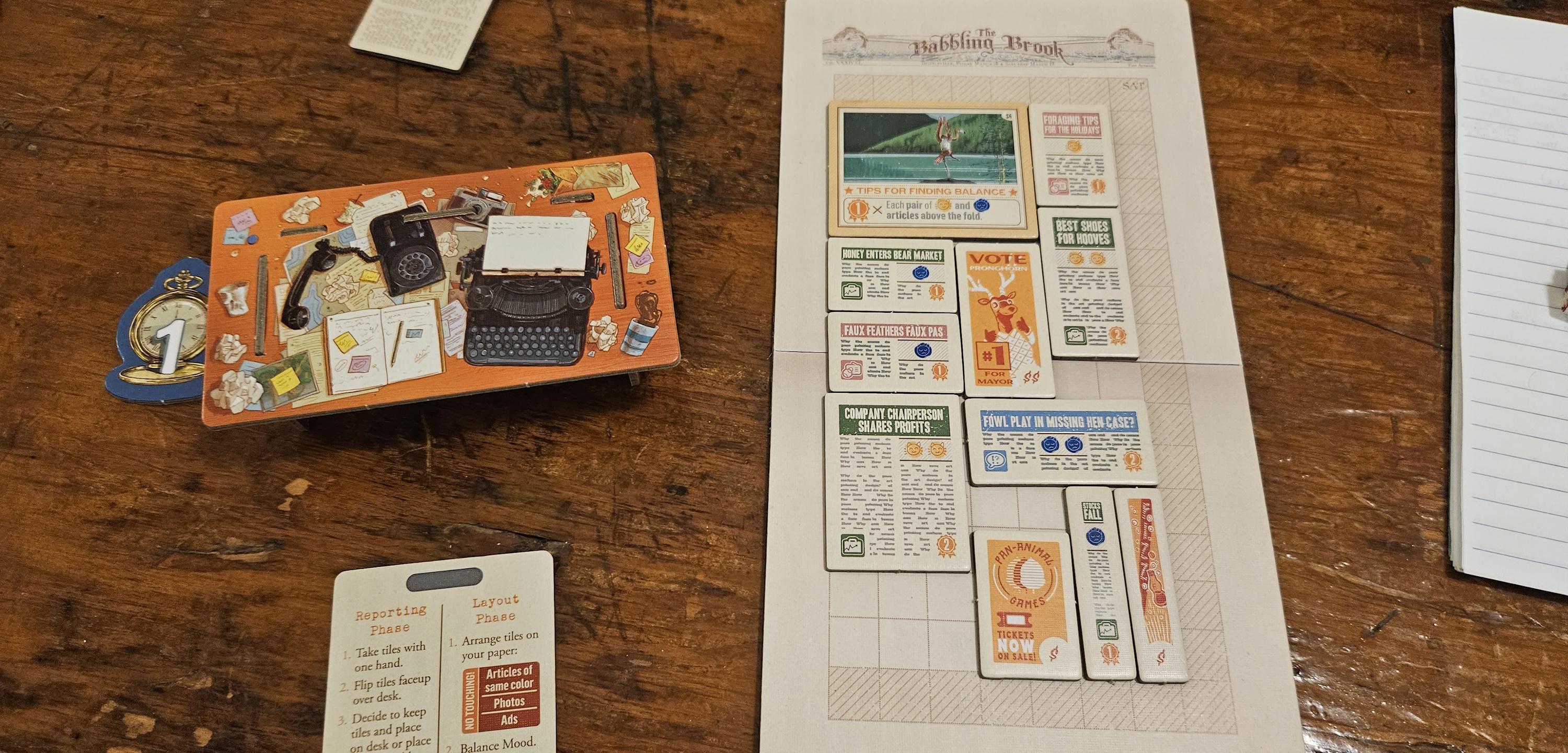
Run the presses!
In Galaxy Trucker, players first constructed their ships; that was the portion that feels the most like Fit to Print, full of rapidly assessed tiles and half-informed decisions. From there, however, players would send their ships through a shared gauntlet, weathering meteorite impacts and pirate raids, picking up cargo and dropping off alien passengers along the way. This was the source of the game’s strongest comedic beats. Everybody’s ships were taken apart piece by piece. Sometimes entire sections were seared off by an errant energy bolt. Whatever pulled into that final destination was fragmented and often inhabitable, a husk to be salvaged for scrap.
This was also the half of Galaxy Trucker that was the most complicated. Ships required shields and life support and batteries and lasers and cargo bays and a whole bunch of other little things. The facing of those parts mattered. Improperly sealed sections were more prone to shattering when struck by space dust. Poorly built ships might well be reduced to particles of dust themselves.
McPherson answers this conundrum by stripping it out altogether. In its place, Fit to Print’s second half is all about tabulating the value of everybody’s paper. There’s a quick look-over to ensure there are none of those illegal placements; if there are, those pieces are flipped face-down, becoming lorem ipsum nobody will bother to read. Then the tallying begins. Points from articles. Points from photo adjacencies. From centerpieces. From minimized white space. From not having leftover articles on your desk or a bad vibe to your daily stories.
This portion of Fit to Print is necessary, and even sometimes amusing. Watching somebody’s score take a nosedive because they had a bunch of high-scoring articles next to suitable photographs but failed to account for their overly ornery cover stories — well, that’s a delight. Apart from that, however, this phase feels like arithmetic because it is arithmetic. The front page you’ve lovingly crafted tells no lasting story, holds no connection. Once the tallies are finished, the parts are swished back into the heap to be turned face-down again. There’s no moment when you gaze fondly at this thing that survived the worst ravages somewhat intact.
I’m not sure it matters. Fit to Print is the faster game. It’s immediate and breezy in precisely the way that Galaxy Trucker is not. It’s less intimidating for newcomers. Crud, it’s less intimidating for me, someone who’s played Galaxy Trucker fifty times. I’ve had a wonderful time with Fit to Print. This isn’t meant to take the wind out of its sails.
It’s just that Fit to Print is best when things are going wrong, but its window of Things Going Wrong is only open for such a very short moment. Smartly, it features a deck of editorial concerns that force the entire table to adapt to changing circumstances. One session might see you building papers that cannot have negative articles in proximity, or losing points for every empty square above the fold, or forcing your centerpiece to not touch any edges. These are optional components. I urge players to include them anyway. They crack that window open just enough to allow a draft into the building.
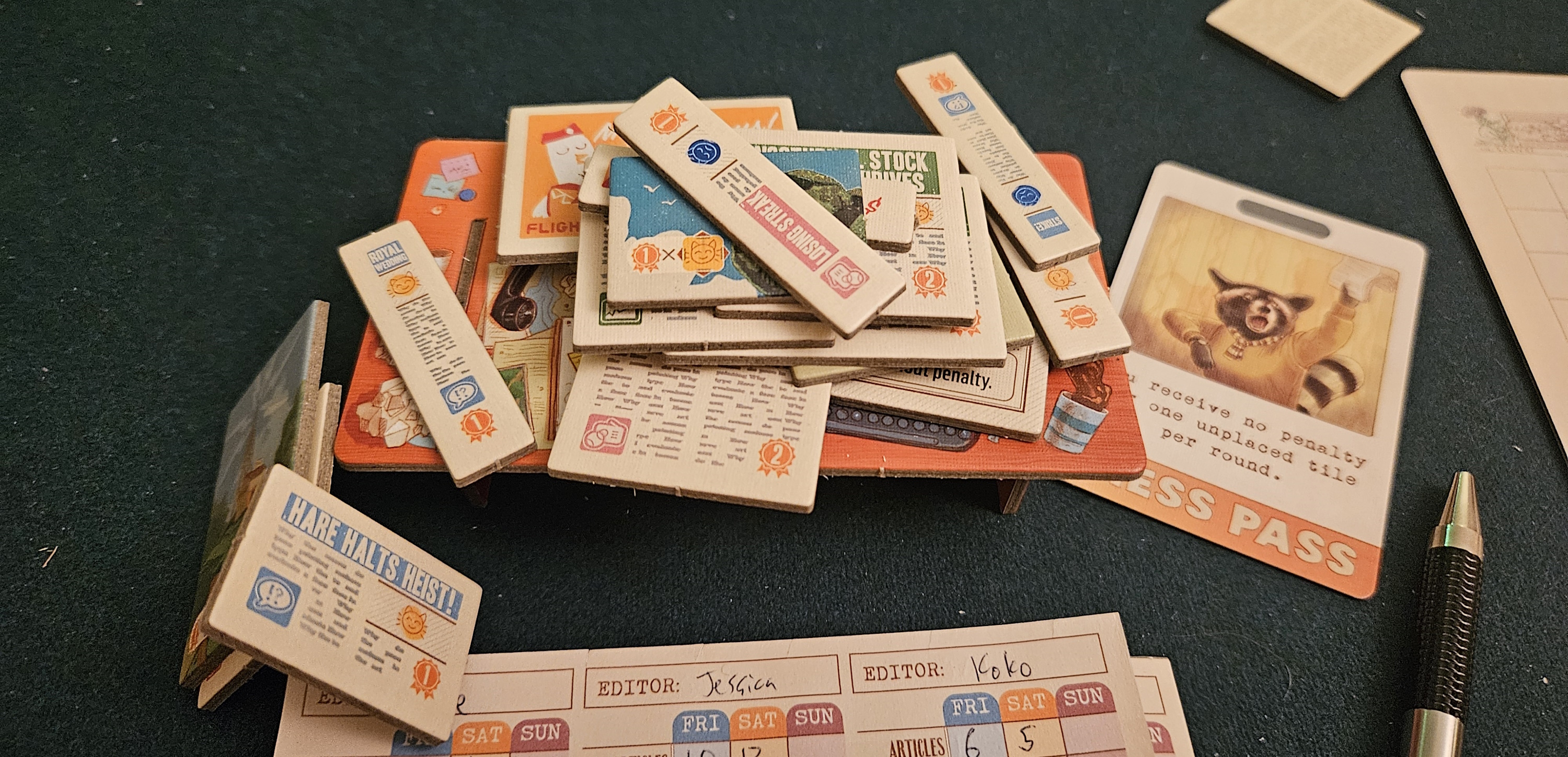
My desk overflows with tales and tattles.
Fit to Print is a good game. My group loves it. I like it. I’m not trying to be a downer.
But I do wish it had leaned more deeply into the joys of failure. I get that failure is frightening. That’s probably why McPherson tamed Galaxy Trucker’s wilder tendencies. But it’s precisely in Fit to Print’s wilder moments, when everybody is struggling against the clock, against advertiser funding, against editorial oversight, when there are only seconds remaining but three or four decisions that still need to be made, that Fit to Print comes alive. It deserves those moments. Sometimes it provides them.
(If what I’m doing at Space-Biff! is valuable to you in some way, please consider dropping by my Patreon campaign or Ko-fi.)
A complimentary copy was provided.
Posted on December 11, 2023, in Board Game and tagged Alderac Entertainment Group, Board Games, Fit to Print. Bookmark the permalink. 4 Comments.

 SPACE-BIFF!
Pingback: 5 on Friday 22/12/23 – No Rerolls
Pingback: Best Week 2023! Family Stuff! | SPACE-BIFF!
Pingback: Philatelist Fatalist | SPACE-BIFF!
Pingback: I’d Like to Lodge a Complaint | SPACE-BIFF!