Beads?

There’s an obvious appeal to Connie Vogelmann’s Apiary, if only because “space bees” is such an evocative pair of words as to bend light waves. Also, bee puns are really, really easy. “Bee” sounds exactly like the letter B. Come on.
But I want to set that aside, because Apiary excels at making difficult things look easy. This is a fine-tuned example of optimization gameplay and speculative fiction. I suspect there was nothing easy about designing it.

Buzzing about outer space.
From the outset, Apiary makes itself known with a single line: humankind has disappeared and honeybees have evolved to fill their niche. Now the humble Apis has graduated from the gravity well to the boundless realm of outer space.
What would such a culture look like? There’s a strand of speculative fiction that asks that sort of question. “What if horses evolved super-intelligence and wanted to reach the stars, but couldn’t because they have hooves rather than opposable thumbs?” The answer to that one, according to the short story I read as a child, is something like, “They would evolve telepathy and influence lemurs to build rocket ships for them.” Cool. Glad that’s that sorted.
Just as humankind’s journey is marked by limitation as much as by possibility, Apiary is structured around the limiting biology of the honeybee. This limitation becomes the framing device for the entire game: hibernation. Unlike the warm-blooded mammals they once shared a planet with, bees adhere to a frantic rhythm, bouts of gathering cut short by a long cold sleep. This suits the species to interstellar travel, a rhythm that alternates between prestissimo and the silence of the grave. The silence of winter.
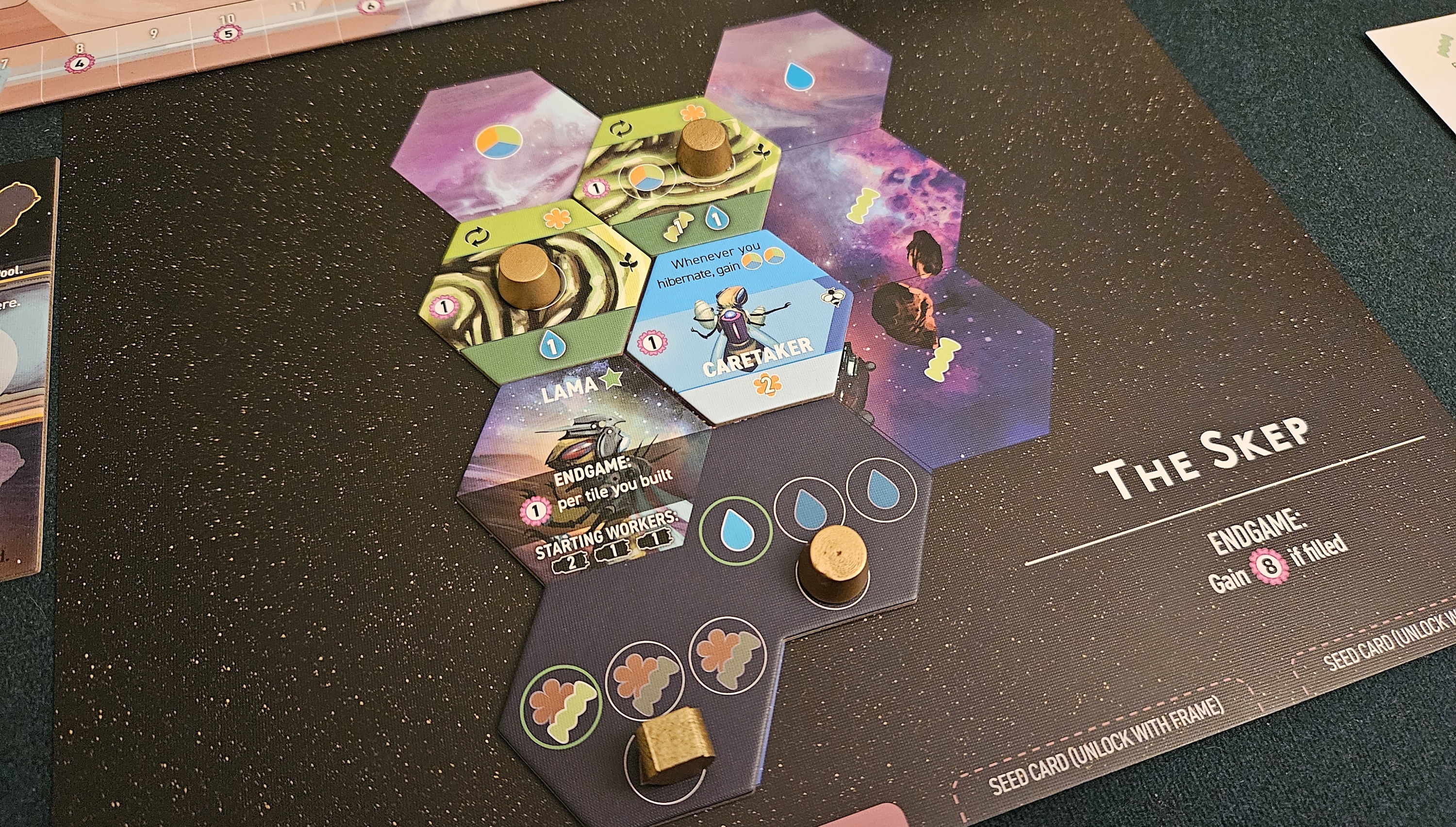
A player’s hive, stocked with wax and some honey.
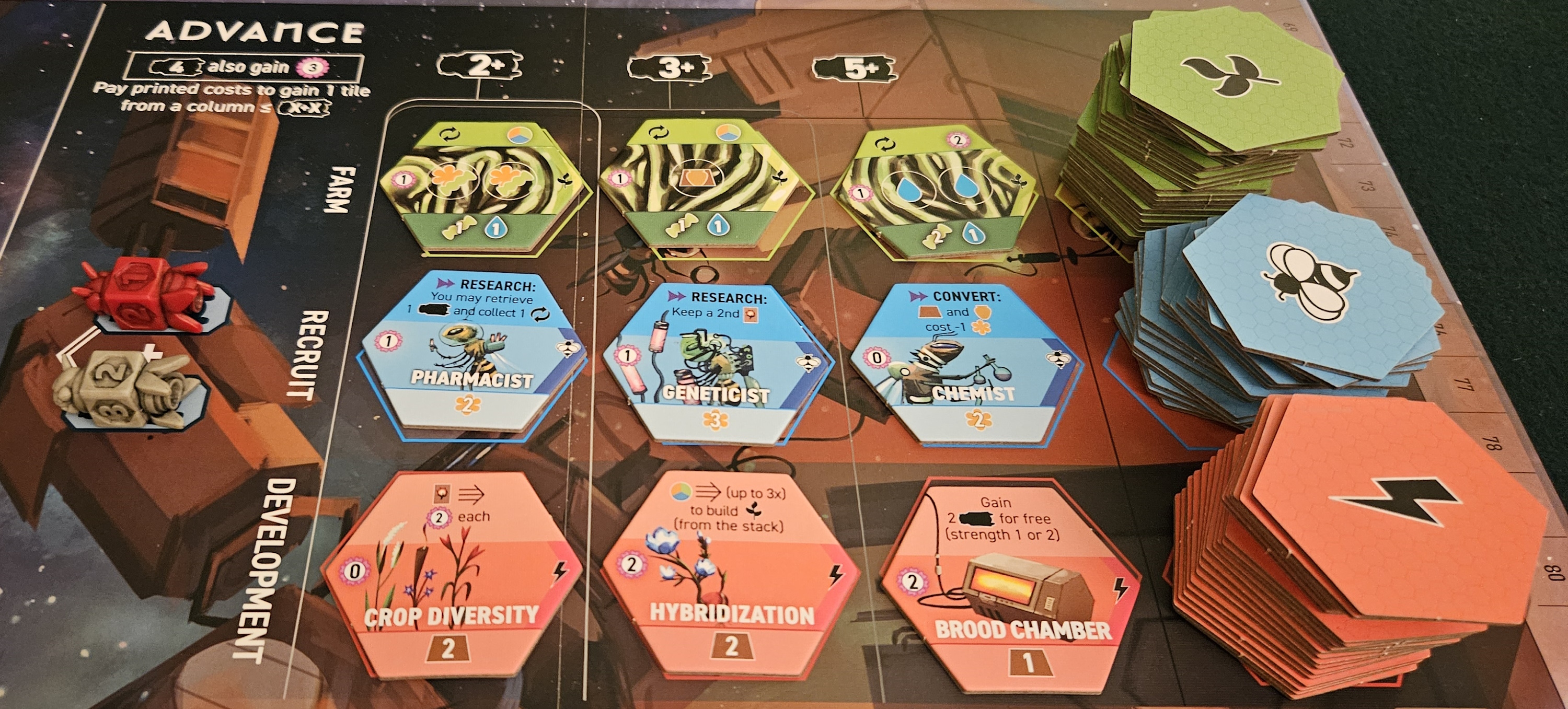
Genre-wise, Apiary is a worker placement game, a cozy fit for a species of literal workers. Here your workers, drones, are sent out to perform a wide range of actions. This cluster of planets needs exploration, which in turn taps into seemingly bottomless supplies of water, fiber, and pollen. These can then be developed at a market into farms and specialized occupations, represented by a river-style market of tiles that can be built into your personal hive.
There are other actions, too: gathering the seeds of local flora and adapting them to your purposes, growing your population or expanding the boundaries of your hive, carving monuments to your accomplishments, performing the bumbling dances that are your people’s form of communication and expression. That latter option is a method of conversion, developing over the course of the game to help players transform stockpiles of excess resources into more desirable stores or rarer types, such as wax and honey for constructing more advanced structures.

Drones become more effective as they age, but also approach hibernation.
Unlike most worker placement games, Vogelmann invests her drones with personality. The strength of any given action is determined by a drone’s age. Sometimes two drones can cooperate to achieve more together than they could alone, reinforcing the notion that even though everybody’s cliques are striving to set themselves apart, you are still a cooperative species at heart. When drones return to the hive from the board, usually because they are bumped by another drone — there’s no blocking here — they move onto the next rank, improving the value of any upcoming action they take. Eventually drones retire completely, entering suspension and disappearing from your pool of workers.
This is the source of Apiary’s unique rhythm. The effect is seasonal: drones start out small, taking minor actions that require collaboration to reach their greatest effect, and gradually develop their skills with time and repetition. Eventually, at the apex of their talent, they withdraw into hibernation. This represents both a sacrifice as you lose access to your most proficient drones, and also an opportunity, unlocking resources and points and driving the game toward its conclusion.
We’ve seen this system before in Jamey Stegmaier’s Euphoria: Build a Better Dystopia. Vogelmann’s expression of the concept is the smoother of the two. Her drones cap out sooner, giving them more personality than Stegmaier’s d6 proles, and a tighter board directs the action with a firm hand. It was always a shame that Euphoria wasn’t more widely imitated.
Drones work together to amplify their effects.
Vogelmann does better than imitate. In her hands, the system evolves. It’s a friendlier version of worker placement, sans the blocked spaces that can make the concept aggravating, without shedding its stinger altogether. Because bumped drones level up, it’s worthwhile to pay attention to the state of everyone else’s hive and maybe not rub thoraxes with someone who can use that now-empowered drone to steal a desirable tile out from under you.
And high-level drones are crucial. Every space awards a bonus when occupied by a proficient drone. Exploration, for example, triggers the special effects of the planets you’ve discovered rather than merely strip-mining them for resources. Gathering seeds normally lets you draw cards that serve as tidy bonuses; sending a veteran drone now plants one of those seeds in your hive, unlocking some of the game’s most tantalizing scoring opportunities. Higher levels allow drones to access harder-to-reach tiles in the market, not to mention those precious carvings.
This, by the way, is one of the principal ways Apiary uses a similar mechanical backdrop to tell a different story from that of Euphoria. In that game, your laborers met skill thresholds to maximize the effect of certain spaces; because their value was rolled at random, chancing into high numbers or sets of like numbers conferred an advantage. However, their level was a dangerous thing too, a measure of their growing independence, potentially resulting in defection. To keep the dystopia running, a certain skill was desirable — but not so much skill that anybody began writing treatises about class consciousness.
By contrast, Apiary makes wider use of its workers. Every space’s effectiveness increases apace with your drones’ skill level. This results in its own telling, still rooted in the needs and desires of its laborers, but one where the species’ eusociality has begun to butt up against its developing sense of individuality. These various hives are incapable of open hostilities. Indeed, certain board spaces rely on teamwork. But the honeybee superorganism exhibits rifts, manifested as competition for the queen’s favor. Where Euphoria tells of a dystopia of suppressed knowledge and drug-addled masses, Apiary demonstrates a more optimistic outlook, one where workers seek satisfaction through a job well done and rivalries are channeled for the good of all.
Or maybe they’re just space bees. Space bees are cool.

Dances offer more effective conversions, and award favor to their choreographer.
Of course, that this is a resource-converting and -optimizing Eurogame limits Apiary’s range of expression to well-established confines. It shows a level of polish native to Stonemaier Games, but also a degree of security. For all its weirdness, it’s easy to see how Vogelmann might have run wild. The genus Apis is known for its vindictiveness — a honeybee will rip out its own guts to inflict a sting, albeit nondeliberately — but these bees have been tamed by millennia or publishing format or both.
Fair enough. I’m free to daydream about a version of Apiary that covers not only the fascinating organization, seasonal shifts, gentleness, and sociality of honeybees, but also their capacity to smother an unproductive queen to death with their superheated bodies. Now that would be a game about collective labor action.
But Apiary does so many things well that it’s hard to pine for a theoretical alternative. It hits the high notes of worker placement, not only focusing everybody’s attention and making your rival’s moves matter, but also allowing players an unusual means of interaction through the bumping and aging of all those drones. Whether you’re seeding drones into choice positions because you’re hoping somebody will bump you, keeping them in reserve to withdraw all at once and produce at your farms, or building the best hive anybody has ever seen, Apiary feels good on the fingertips. If I had one complaint, it’s that graduating every last one of your drones to the hibernaculum grants you a single freebee. Free bee. Sorry, that’s my pun for the afternoon. Anyway, that part stinks. At least subtract a point from Geoff’s score for running out of drones, because he does it every time.

Hives eventually sprawl outward.
All told, Apiary is a polished and evocative worker placement game that not only draws inspiration from the right sources, but improves on them as well. In some regards it has been polished too smoothly, ending sooner than I’d like and only sometimes offering surprising combos from its ample tile market. But these are complaints that speak to how well I like it otherwise. After all, one doesn’t customarily complain that they aren’t spending enough time in a game’s company. In this case, the company is exemplary. I’m eager to get to know it even better.
(If what I’m doing at Space-Biff! is valuable to you in some way, please consider dropping by my Patreon campaign or Ko-fi.)
A complimentary copy was provided.
Posted on December 7, 2023, in Board Game and tagged Apiary, Board Games, Stonemaier Games. Bookmark the permalink. 3 Comments.

 SPACE-BIFF!
I had the pleasure of playing this twice and teaching it twice at PAX Unplugged, and while everything you said is true (it’s a joy) it’s also a challenging teach for its weight. I found a good teaching flow, but there were still questions that came up during the game that players couldn’t grasp until they saw it demonstrated.
Interesting! I’m not sure I’ve found it hard to teach. But fair enough — my group may be somewhat inoculated against learning new titles.
Pingback: Space-Cast! #34. Bees & Dragons | SPACE-BIFF!