Observe, Feyd-Rautha

Arrakis. Dune. Desert planet. Warner Bros. property.
It’s not every day that a game I genuinely love hits it big in this hobby. I’ve been pleased to watch Paul Dennen’s Dune: Imperium thrive, earning two expansions in Rise of Ix and Immortality. That said, I’ve been as perplexed as anybody at the latest offering. Dune: Imperium — Uprising has a surfeit of subtitles and a questionable provenance, functioning neither as an expansion nor as a totally fresh start for the series. At a glance, it’s not all that far removed from the original game.
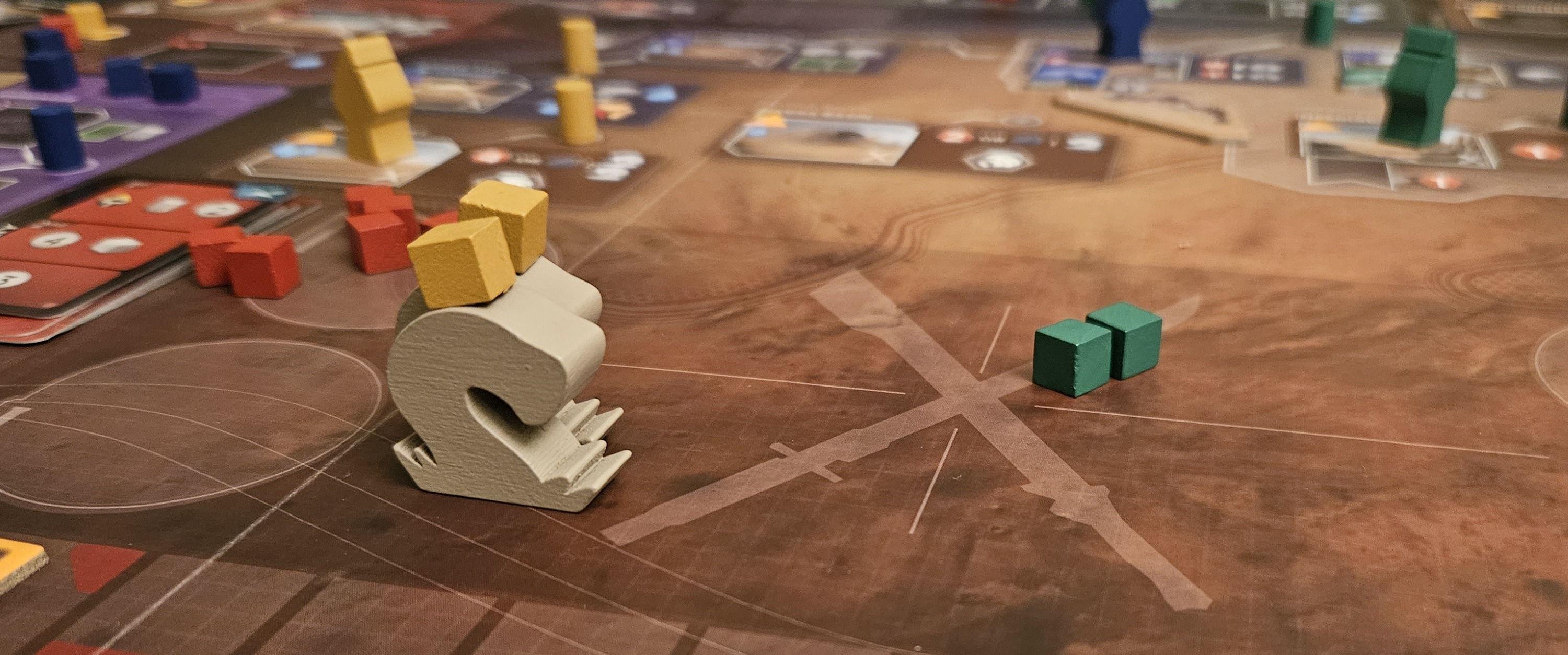
“Worm rider” is an unfortunate euphemism.
Indeed, even seasoned eyes might not catch much difference right away. Oh, sure, there have been some rejiggered abilities on the board, but this seems to be the same chairdog of deck building and worker placement that captured our fancy only three years ago. As before, players are asked to walk a knife’s edge between deploying agents to the surface of Arrakis and various centers of power, influencing powerful allies to join their cause, and all-out battle in each round’s conflict. I got a little bit bored just typing out that description. Not because the gameplay has grown stale — it’s as clever as ever — but because it’s the fourth time I’ve described how Dune: Imperium functions.
By looking closer, a few key alterations emerge, like a needle placed under the skin of the Baron Harkonnen’s… you know what, let’s not go there. There is good reason for an entirely new board, it turns out, as Dennen’s changes are more far-reaching than a few stickers or side boards would permit. Nearly every space on the map has received a tune-up. To some degree these function as a patch on the original title, making it more playable and less prone to certain dominant strategies that have crept into Imperium’s metagame over the years. It’s easier to draw cards, churning everybody’s decks more often and preventing a late-game acquisition from feeling worthless. Hiring a swordmaster, your third agent, is now more expensive for whomever first makes the leap; a discount for subsequent swordmasters acts as a valuable rubber band, turning that purchase into a minor act of brinkmanship as everybody hopes somebody else will take the hit before them. There are also contracts, tiles that require you to visit another space in order to earn some bonus.
More impactful than these sniffs of melange are spies. Every now and then you’ll be instructed to add one of these little cylinders to the map, where they occupy connections between regular spaces. These have a few uses. You can remove one to permit an agent to infiltrate a connected space even if it had already been occupied by another player. Or, should you arrive there first, you can use it to draw another card. Some of the market cards also turn spies to your advantage, whether by letting you remove them from the board for some bonus or deploy your agents to attached locations.
However you choose to use these covert operatives, they’re intuitive and rules-light additions that alter how the game is played. Where the ability to boot an agent from a space was previously a game-altering event, now it’s comparatively commonplace, easing the game’s emphasis on blocking without robbing it of its acid altogether. To demonstrate how commonplace, the space that used to give you access to the mentat pawn for an extra placement is now more barbed, withdrawing an already-placed agent. You may now place that agent elsewhere on a future turn — but the space you removed them from is open for other players to use.
The result is a board that sees greater shifts within the span of a single round. Those shifts translate into greater deck churn, which tends to make the game feel punchier as a whole. Hitting additional spaces and triggering cooler cards is a big plus.
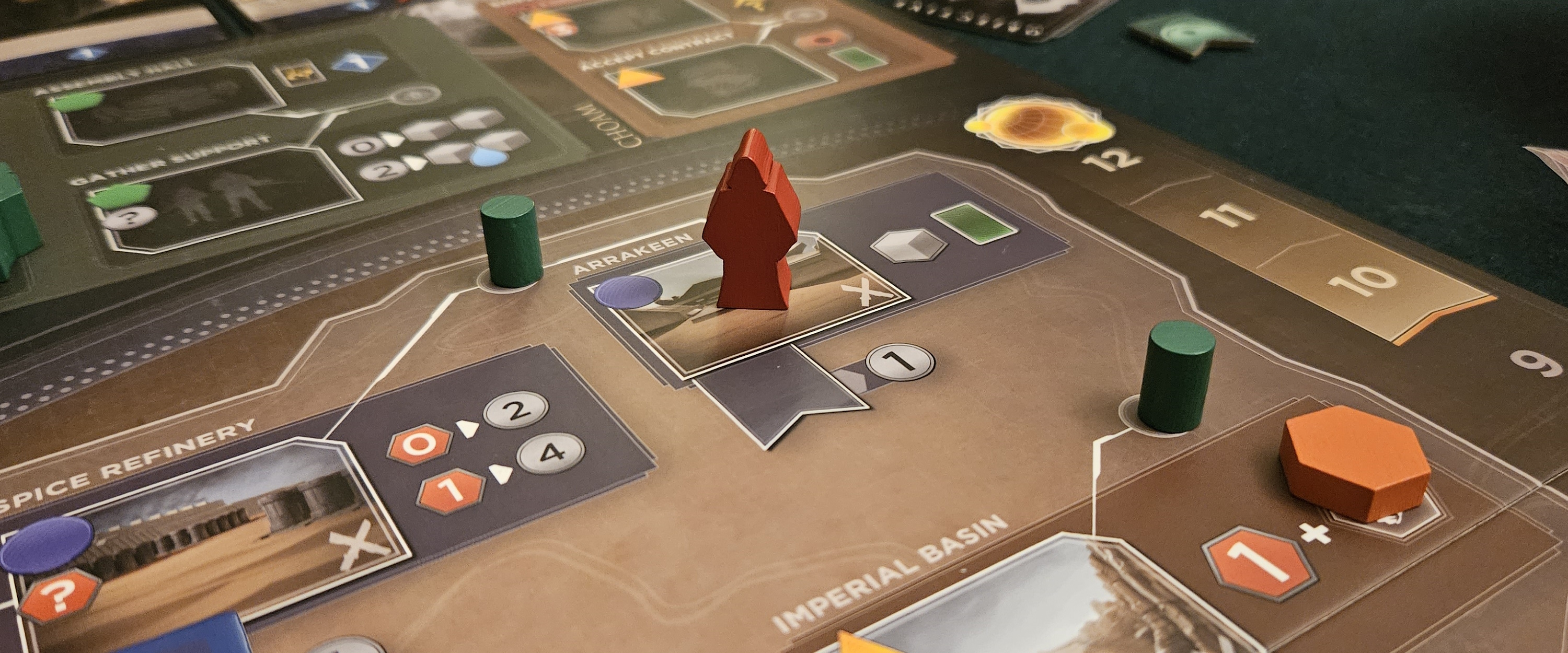
Spies make it easier to get your agents where they need to go.
At the same time, Uprising funnels players toward a tighter endgame. There are still quite a few sources of points. Earning the loyalty of the board’s great powers, buying one or two The Spice Must Flow cards, and the occasional point converter on a market or intrigue card are still all valuable.
They all pale in comparison to the points one can earn from battle. For one thing, every conflict card has the potential to earn half a point. This is thanks to certain combat icons that, once earned from battle, can be combined with another icon to move up on the victory track. These turn even minor fights into a scrimmage for long-term position. And that’s before we consider the sandworms.
Yes, at long last the Old Man of the Desert has found his way into Imperium. Sandworms are powerful inclusions in combat. Powerful-ish. At three strength a pop, they’re tougher than regular fighters, but not as overwhelming as one might expect from a 400-meter behemoth. Further, they’re difficult to acquire. Players must first learn to ride the things, earning a maker hook token from Sietch Tabr, and then visit one of the spice blows and foregoing the usual income of melange to earn sandworms instead. These are instantly added to battle rather than being held in reserve — Shai-Hulud is notoriously persnickety to billet — adding a consideration of timing to the process. That’s if you can play them at all; certain battles are located behind the Shield Wall, where sandwoms cannot reach. However, like Paul Atreides, you can nuke the Shield Wall to wriggle them right into the capital city. (Spoiler.)
The advantage of sandworms isn’t only their contribution to your combat strength. That alone wouldn’t justify the many hoops you must jump through to tame them. Rather, they’re a big deal because they double the value of whatever you earn from the conflict. Early on, doubling a reward likely isn’t worthwhile. An extra intrigue card or a couple of spice probably doesn’t justify sending in the big boys. As the game progresses, though, and conflicts ramp up in intensity and value, a sandworm can propel somebody up the victory track.
On the one hand, new tricks are welcome. Conflicts have always been the focal point of Dune: Imperium, drawing everybody’s attention toward a single event rather than spending the entire round on inward concerns, like tinkering with their cards or conversing with their genetic ancestors. Sandworms add an exciting new dimension to these struggles.
At the same time, it seems like most sessions of Imperium tend to conclude with blowout sandworm battles. Conflicts loom even larger on the horizon than before. This also tends to elevate certain other cards, like point converters, simply for their ability to bypass the need to win at warfare so often.
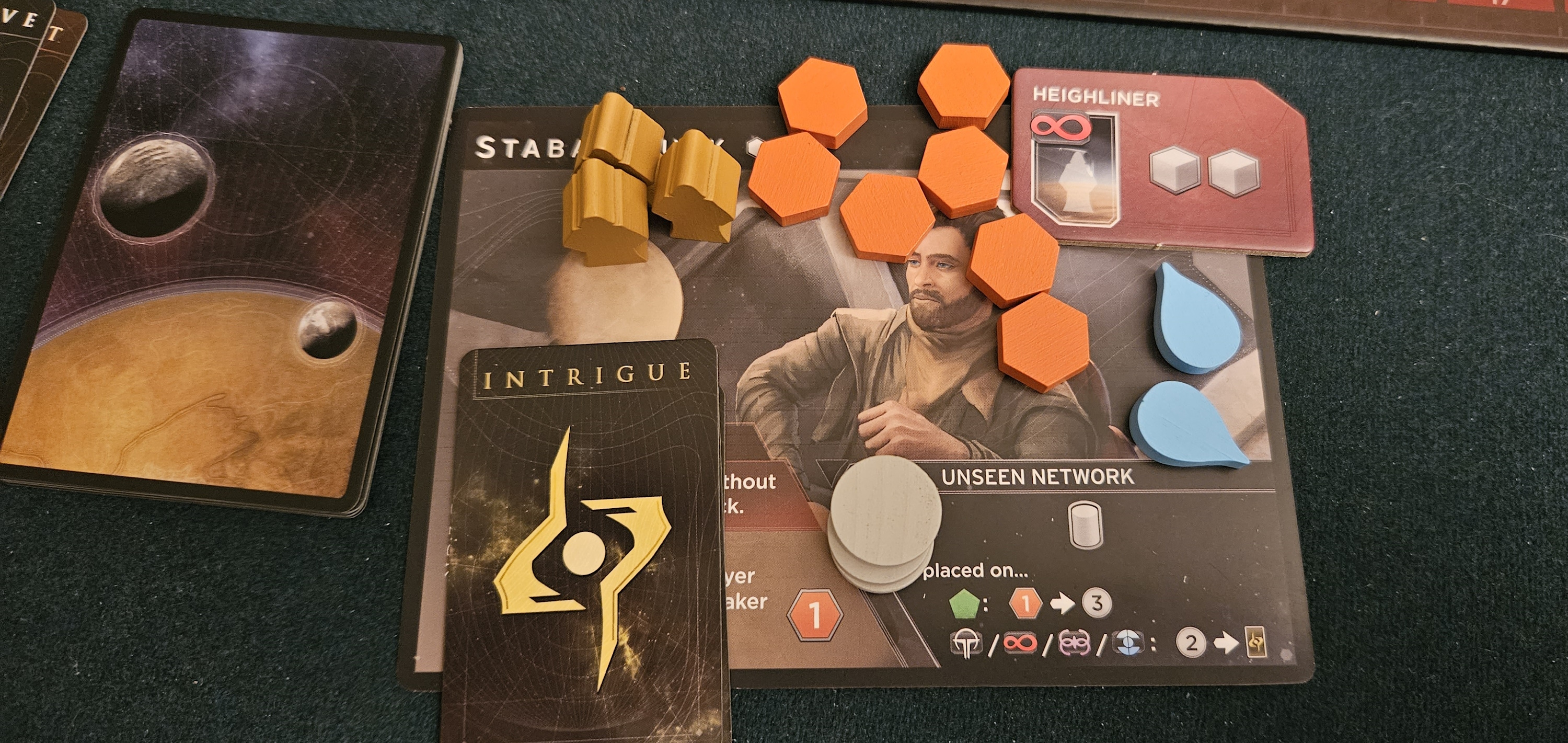
You’ve always wanted to play as this guy from the extended Dune universe.
This is characteristic of Uprising as a whole. In solving some of the original game’s problems, new quibbles have emerged from the dunes. As thematically suitable as that may sound to anyone who’s read Dune Messiah, the gameplay it produces isn’t always a clear improvement.
I don’t want to misrepresent what Dennen has accomplished here. Uprising is still a tighter experience on the whole. To some degree, that’s the nature of my concern. But it’s anything but a straightforward concern. Faster deck churn means I’m seeing cards more than two or three times per game (if that), which gives me more time to tinker with potential combos and trigger cool effects. A more dynamic board state means it’s tougher to freeze somebody out entirely, but only if they put in the work to infiltrate spies into the right positions. It’s even more common to swap out intrigue cards, allaying the complaint that the luck of the draw is all-important. Uprising feels like a fuller game, a more complete experience, even if it emphasizes direct military conflict more than before.
It’s also a game I’m still getting a handle on. There’s a team game I simply haven’t found a big enough group to tackle, and the solitaire mode is still as functional and boring as ever. Meanwhile, mixing in the expansions is a daunting process. All but one card from the original game can be included. Immortality is easier to fold in than Rise of Ix; the latter requires some interesting shenanigans with the CHOAM board in which players make-believe there’s a space for a spy to deploy in. Disappointing, but not game-breaking.
The bigger question remains. Uprising takes Dune: Imperium in a new direction, and adding too many cards could easily dilute the market with cruft players would rather not add to their decks. It’s different enough that it wants expansions of its own. Does it feel like a cash-in? I wouldn’t say so. Does it struggle to stand apart and only integrate with previous materials awkwardly? You betcha. Please don’t throw any newcomers into Uprising plus Immortality plus those select portions of Rise of Ix. It’s hard enough to learn this game’s strategies without having to imagine a spy post.
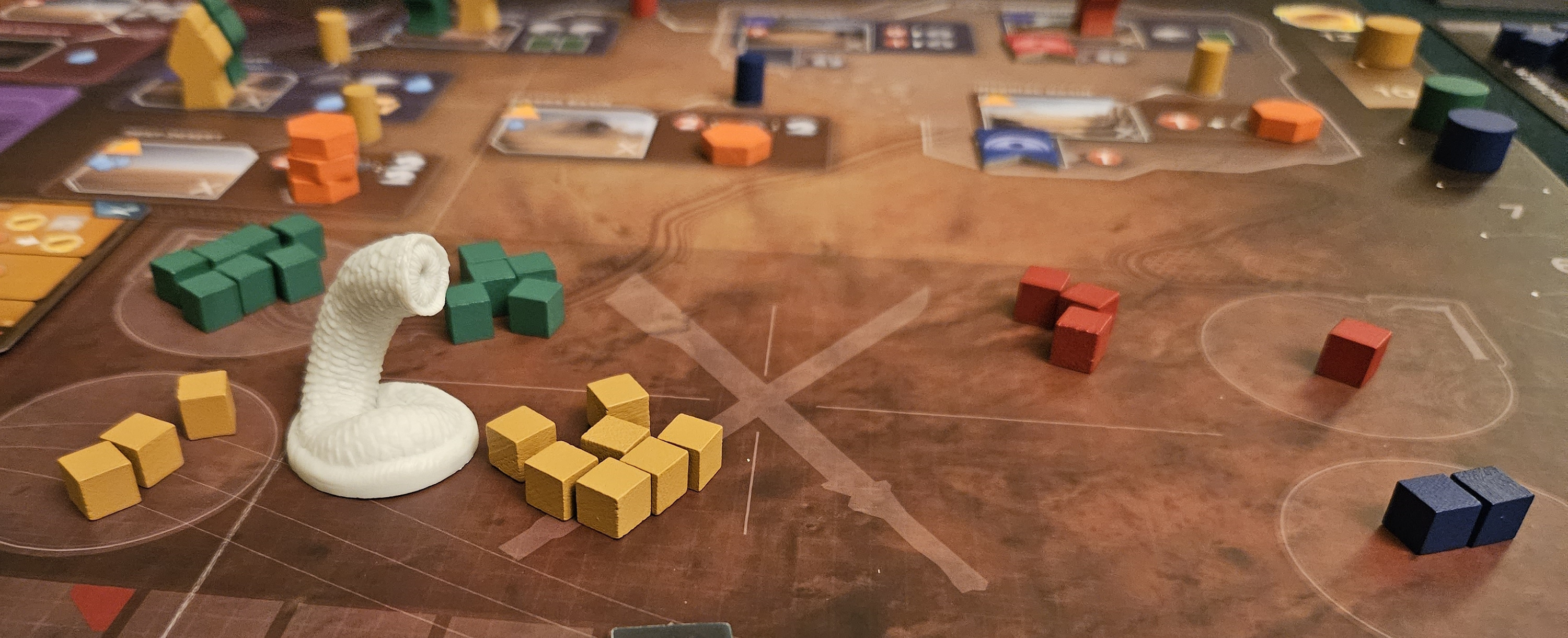
These worms are, ah, uncut.
On the whole, Uprising puts itself across as a complete, and I would even say superior, version of the original game. After playing it, I’m unlikely to go back to the slower decks and more confined map of the original. There are more wheels inside these other wheels, which is a very Dune thing to have. At the same time, I both miss and am wary of including the materials from the expansions. The result is mixed, a splitting of the original game that feels like two tides of prescient thought colliding in a minor mess. Another example of Dune: Imperium hitting all the right thematic notes, even when it doesn’t necessarily mean to.
(If what I’m doing at Space-Biff! is valuable to you in some way, please consider dropping by my Patreon campaign or Ko-fi.)
A complimentary copy was provided.
Posted on December 6, 2023, in Board Game and tagged Board Games, Dire Wolf, Dune: Imperium. Bookmark the permalink. 9 Comments.

 SPACE-BIFF!
“Faster deck churn means I’m seeing cards more than two or three times per game (if that), which gives me more time to tinker with potential combos and trigger cool effects.”
This. This is why I traded D: I away, despite enjoying its overall approach to the deckbuilding/worker placement fusion. It was so difficult to not only churn through your deck, but especially to purge starter cards from it that I had multiple games where I lost based on drawing a hand full of starter trash, while everyone else drew the cool stuff they’d bought from the market. One space on the board and a couple cards enabling purging was way too low. Of course, as you say, they would only see those cards a couple times a game, too, which meant buying from the market later in the game became pointless. It just felt like I was running into too many dead ends, as opposed to favorites like Tyrants of the Underdark, where every half-deck is replete with methods to purge (promote) weaker cards from your hand so that you can actually BUILD your deck and shape it as you like. It’s amusing, then, to see you highlight the inclusion of spies in Uprising, which sounds almost exactly like spies in Tyrants. Imitation -> flattery, etc.
So, this sounds tempting as a way to give Imperium another try, since it sounds like he addressed most of what I considered its insurmountable flaws. Interestingly, when I brought this up during an AMA on r/boardgames a few months back, he said he thought he’d included enough draw in the original game to compensate for the inability to trash cards. My experience did not mirror that claim. Thanks, again, for a great review.
Thanks for reading!
At this point of time, considering there are no tailor-made expansions for Uprising, would you rather play vanilla uprising or imperium + expansions (actually, I only own rise of ix)?
Good question. Probably Uprising right now, but that could change.
We have mixed in the IX and the Original and playing the “to12 points” variation and found it to be a great experience.
We never warmed to Immortality, so do not include it.
was scratching my head at first when they announced a stand-alone expansion that was backwards-compatible with all other previous content (only to learn that this was true with multiple caveats), and amused by the BGG post about how the new deluxe plastic worms look like male genitalia from a certain angle. Imperium and Uprising seem to reflect the atmosphere and tone of Dune Part 1 and 2 respectively, and so I don’t lend much credence to the accusations of a “cash grab” posted on various forums.
It’s both familiar but different enough that one should not feel shame at owning both. The tempo around Uprising’s gameplay is certainly more swingy and disruptive than original Imperium- you’ll likely need to win one or two key battles with worms to have a reasonable chance of victory. One of the house rules suggested to help mitigate the disproportionate effects of Shai-Hulud is to gain the 1st & 3rd place victory rewards rather than just doubling the 1st place goodies.
Will be interesting to see if future content is Uprising-exclusive or not, but I can only imagine that such balancing between two distinct titles and previous expansions gets to be migraine-inducing.
I’m definitely curious about the same thing.
I don’t know why… but your spoiler tag after the spoiler just really tickled me 😂
Tee hee!