Shiny and Chroma

One of this hobby’s great pleasures is coming across a designer whose creations adhere to a logic that’s unlike anything else. Jorge Zhang is one such designer. I’ve been obsessively playing and replaying his latest release, Chroma Mix, scouring it for new gems and cracks alike. It’s been a rewarding process, unfurling a game that touches on highlights from other titles — Cieslik and Chudyk’s Red7 springs to mind — without, it turns out, being very much like them at all.

Can’t Touch This // Orp: The Market for Space Merchant Translators
This seems to be a hallmark of Zhang’s approach. He’s sent me three games over the past couple of years, all illustrated by Nikolaj Jesper Cyon, and although the first two didn’t warrant a review of their own, they both left an impression.
Take the first one, Can’t Touch This, as an example. The smallest of the three, Can’t Touch This is all about sliding colorful paperclips onto a card. There are elements of area control and set collection, as players simultaneously strive to secure valuable icons, avoid bombs, and block off sections of the card to prevent their opponent from, say, scooping up so many dog turds that they somehow become the most valuable icon in the game. It also happens to be one of the fastest ditties I’ve ever played, requiring maybe two minutes from start to finish. It’s more of a concept than a full-fledged game, perhaps, but there’s an undeniable cleverness underlying the whole thing.
The same goes for Orp: The Market for Space Merchant Translators, which shows both Zhang and Cyon coming into their own. This one casts players as proxy shoppers for a wealthy client. Also, that client is an extraterrestrial. Sounds like a preem gig, right? About that. Rather awkwardly, since Orp is a shopping hub for dozens of alien cultures, you can’t make heads or tails of the various aisle signs. It’s not unlike staggering through a supermarket when you don’t speak the local language. So you’re looking for a kimono, some beetles, and two original Game Boys, but you can’t be sure which item is a norp and which is a dorp.
Yes, really. The items are called norps, morps, snorps, forps, dorps, and glorps. It’s an added dash of ambiguity that’s both suitably thematic — recall, the word for “barbarian” literally derives from the Ancient Greeks thinking all foreign languages sounded like barbarbar — and adds some humor to the questions players will be asking one another. Because in addition to placing orders in an unknown tongue, you’re also deducing the identity of those items by asking those at the table what they’ve deduced. “Are you holding a norp?” “Norp.” “No, a norp.” “Morp.” It’s a little bit too plain other than that, with relatively obvious deductions and unexciting item-gathering, but it’s clearly gesturing in an interesting direction.

Color market.
Flawed as they are, neither Can’t Touch This nor Orp commanded my attention for long. Chroma Mix, on the other hand, has become a minor obsession.
True to its word, Chroma Mix is about mixing colors. Beginning with three of the four color plates used in modern printing — cyan, yellow, and magenta — these gradually permit access to either more basic colors or new colors entirely. This latter option requires mixing, the game’s most involved action, in which two cards become a new color from the game’s generous market rows.
This is anything but a straightforward process. Mixing a new color requires that you remove the two cards used to create it. It’s a simple enough thing to mix, say, coral, since coral is composed of one part magenta and one part yellow. You toss those two cards back into their stacks and pick up your new color. But the difficulty soon skyrockets. Because you must mix exactly two colors at once, printing a three-tone color, such as orange (two parts yellow, one part magenta) or slate gray (one part of each basic color), requires a higher-grade color to begin with. You could, for example, mix your newfound coral with yellow to create orange.
But this is a tremendous sacrifice. Every card is valuable not only for its colors, but for the abilities it bestows. I’ve used coral as an example because it’s one of my favorite cards to pick up early on, letting me mix with colors I’ve played to my tableau instead of only those hanging around my hand. This means I’m liable to hold onto coral even when there’s a tantalizing color I could mix with it. The potency of its ability is simply too much to part with.
That goes for other colors, too, to varying degrees. Cerulean is ace at rapidly filling your hand with basic cards. Raspberry breaks the game, letting you mix with three or more cards and thereby tossing out stacks of basics to create complex colors. Prism permits some gambling via blind draws. Even the basic colors are essential. As anyone with a printer knows, letting those CMY cartridges run dry means nothing gets made.
And that’s before we consider the victory conditions. There are six in all, although only four will appear in any single game. The basic approach is to squirrel away seventeen points, but that’s not nearly as interesting as those that depend on printing an especially difficult color. Sapphire Blue lets you win by bloating your hand until it resembles a miniature deck of its own. On the opposite end of the spectrum is Burgundy, which requires exactly six cards of specific ranks and no more. Mustard, meanwhile, is all about sacrifice, requiring you to tuck away high-value cards whenever you “refill” your hand from your tableau.
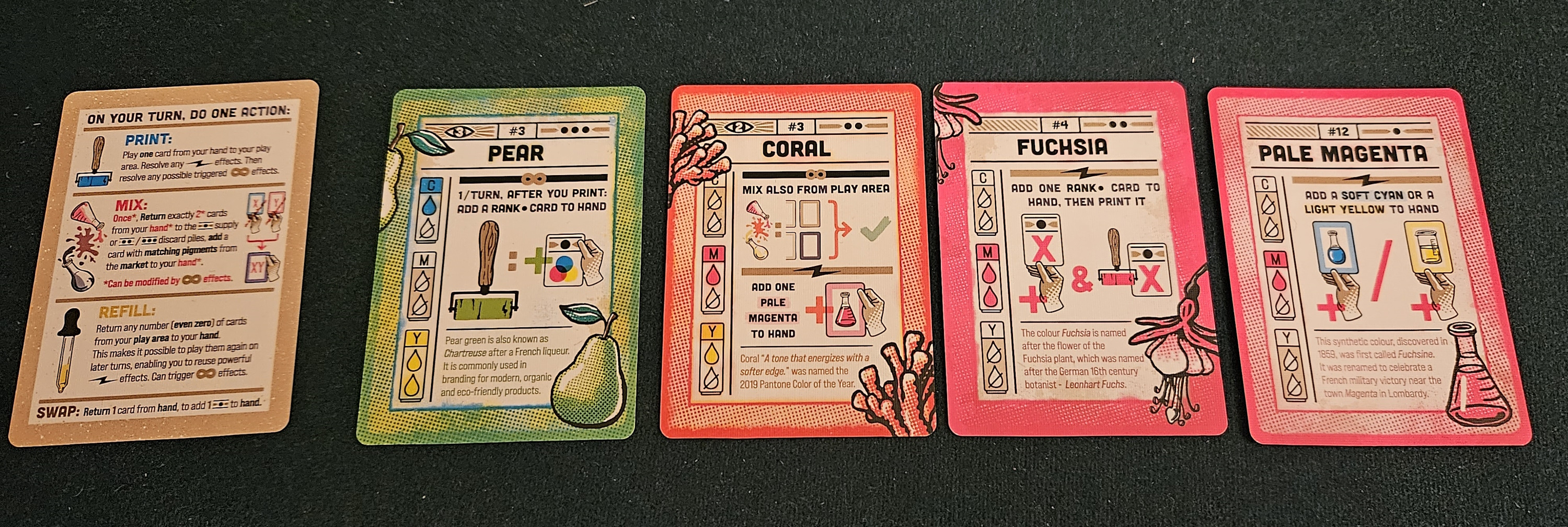
Cards permit powerful abilities.
Part of what makes Chroma Mix such a delight to play is the way cards bounce into and out of your hand. To use a chess metaphor, some games emulate pawns (slow, incremental, only occasionally permitting non-obvious moves) while others capture the smooth glide of a rook or bishop. A very few are queens, doing whatever the heck they want but doing so with vicious grace. Chroma Mix is a knight: always bounding here and there, stepping into secure zones that aren’t immediately obvious, and sometimes vaulting into peril.
Which is to say, there are cataracts to tumble into. It’s possible to get stuck holding the wrong cards or find yourself trapped with a color that doesn’t suit whichever victory condition you’re chasing. This is nearly always your fault, the result of some chemical mixture you didn’t give enough thought to, but that doesn’t always lessen the sting. Because of the way the game is arranged, with players stepping forward and backward as they add and then mix colors, this is a planner’s game that nevertheless requires flexibility.
To be clear, these possibilities are as appealing as they are prone to frustration. They also bleed away with further play. Despite the abundance of cards, repeat appearances and an unchanging deck result in certain obvious combos. The aforementioned Coral is one of them. Another is Fuchsia, Jungle, and Yellow, which allow the player to gain a basic card, play it, refill part of their tableau into their hand, and then gain another basic card. These are a joy to discover, and I’m sure there are plenty I haven’t found yet. But while the game never becomes rail-bound, it does come to resemble a flowchart, with readily identifiable ideal pursuits based on the state of the market and your hand.
Does this diminish the appeal? To some degree. As familiarity with the cards increases, the game becomes more of a race than an exploration. Which is fine as things go, despite hurrying past these wonderful cards rather than spending time in their company. I wouldn’t mind seeing a wider pool of colors, although given the game’s generosity of abilities and multiple paths, not to mention Cyon’s lovely illustrations and the factoids Zhang has appended to the bottom of each card, such an endeavor would be daunting. Did you know that chlorophyll evolved to reflect green light because it’s so energetic that it might damage the plant’s pigments? I sure didn’t.

Racing to the end.
Like Zhang’s earlier titles, Chroma Mix isn’t quite like anything else. It also manages to be a complete game, albeit an idiosyncratic one. Since I’m more invested in such things than more common board game virtues like balance and smoothness, that’s fine by me. Better than fine. This is an exquisite and beautiful way to spend half an hour.
(If what I’m doing at Space-Biff! is valuable to you in some way, please consider dropping by my Patreon campaign or Ko-fi.)
A complimentary copy was provided.
Posted on November 30, 2023, in Board Game and tagged Board Games, Chroma Mix, JayZee Games, Jorge Zhang. Bookmark the permalink. 1 Comment.

 SPACE-BIFF!
Pingback: Best Week 2023! Puzzle Time! | SPACE-BIFF!