Winds of Change, Part Two: Malaya

In the West, it’s all too easy to blind oneself to the long-term consequences of colonialism. As we examined last time, the reverberations of British Imperial promises in the Middle East continue to be felt a full century after they were made. Today we’re looking at a conflict — euphemistically called an “emergency” — that was far bloodier and more pressing to the Crown than the logistical colony of Mandatory Palestine: the communist uprising and subsequent imperial deployment on the Malay Peninsula.
The Malayan Emergency is the second of four insurgencies included in Stephen Rangazas’s The British Way, and it’s by far the most robust of the multipack. Were players to pursue these scenarios in order of complexity, this would likely constitute the final installment. Unfortunately, history doesn’t gently ramp up its level of complexity for our ease of play. Cinch up that rucksack, because this one is going to require some explanation.

The Malayan Peninsula.
Much as in Palestine, when it comes to Malaya there’s no escaping the watershed that was World War II. The big difference is that Malaya was so very far away from Britain itself. Palestine had been threatened by Rommel’s drive across North Africa, but remained firmly in British hands for the duration of the war. Malaya, meanwhile, was swiftly conquered and occupied by Japan for its rich deposits of rubber and tin. British holdouts were caught waging a jungle insurgency and naturally turned to their subjects for assistance. Through training and arms, these commandos helped shape the Malayan People’s Anti-Japanese Army.
Despite the camaraderie between British and Malayan fighters, this had all the hallmarks of a temporary alliance. The MPAJA was principally composed of ethnic Chinese “squatters” who resided on ungoverned rural lands. These squatters had existed in legal limbo for years, more easily brushed to the margins than given landowning status. Even more awkwardly, the army was an extension of the Malayan Communist Party. While the Empire and Communism were bedfellows for the duration of the war against Germany and Japan, neither side anticipated that the warm feelings would last.
Which is why, when the war ended, both the British and the Malayan Communist Party laid preparations for the next conflict. For the Empire, the question was principally economic. Burdened by terrible debts and ongoing repairs to its tattered global networks, the peninsula’s resources became a staple of recovery. Malayan rubber and tin were exported heavily to America to pay off British war loans, and constituted an immense portion of the Sterling Bloc’s valuation. At the same time, it was obvious that the British didn’t quite know what to do with the place. Their military administration attempted to consolidate the various states and ethnic groups into a single union, but these efforts drew protest. The Malayan Communist Party, meanwhile, was excluded from discussions along both ethnic and ideological lines. Rather than turning in their equipment and disbanding the old MPAJA, they began establishing bases in the countryside and attacking landowners whose standing orders maximized extraction over worker safety and compensation. With global attention turning against the Empire in places as far-flung as Palestine and India, it seemed Malayan independence might follow.
In The British Way, much of the conflict revolves around economic zones. These are not new to the series, having appeared as three spheres of conflict in Cuba Libre. They function as abstracted representations of the peninsula’s main industries, here rubber and tin, which the British must safeguard in order to ensure that the country is a profitable investment and the Malayan Communist Party must sabotage to effect the direct opposite.
What makes these economic zones stand apart from their usage in Cuba Libre is that they are enormously valuable, far more so than the map’s sole city of Kuala Lumpur. This highlights the Malayan Emergency as a rural conflict. Unlike the Irgun in Palestine, the MCP ignored urban settings, instead focusing on carving out liberated zones in the jungles and mountains that could then be used as a springboard to contest the rest of the peninsula. In game terms, this allows the MCP to focus on infiltrating and sabotaging plantations and mines. It also tends to give the British free rein to emerge from Kuala Lumpur and engage on MCP turf.
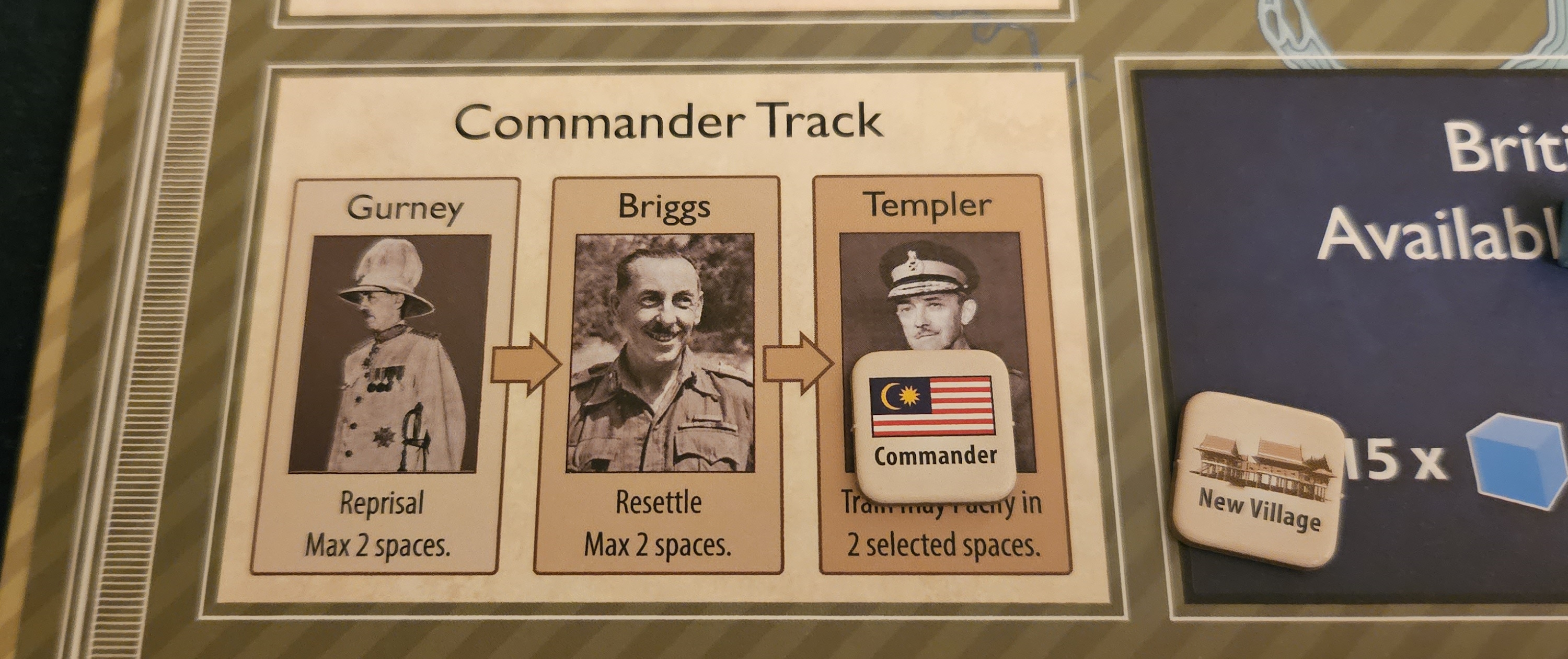
Successive British commanders bring their own approaches to the emergency.
The COIN Series has always thrived when it digs into procedure, and the same is true here. While communism was a reliable villain in British propaganda — and appears as one of the crisis cards they might draw when playing the overarching campaign — their only significant military engagement with communism took place here in Malaya.
Yet Malayan communism was far removed from the perils fought by the United States in Korea and Vietnam. The MCP may have been invested in the Communist International, but they were too isolated to receive assistance from Russia or other members. China was in the middle of its own revolution. Even the ethnic makeup of Malaya, with the Chinese squatters largely excluded from the workings of power, left the MCP unable to secure much internal support. This was a battle of attrition, one that left the MCP isolated and perhaps doomed from the start.
In game terms, Rangazas reinforces this notion by reintroducing resources to the system. Where the Palestine scenario allowed both sides to take actions more or less freely, here they’re limited by both operational considerations and cold hard cash. Or perhaps more accurately for the MCP, food. British resources come easily enough, provided they maintain their economic zones. For them, the issue is more one of long-term rationing. Since their operations are so expensive, it’s possible to blow through their funding prematurely and have to wait until the next influx. Historically, this is accurate enough, as Malaya was crucial to British trade but so remote that any investment was costly. It was only the eventual outbreak of the Korean War that solidified their position, diverting more attention and resources to the Pacific. The MCP, meanwhile, is required to extort local farmers for subsistence — a squalid state of affairs that did indeed become the norm when their rural networks proved too flimsy for coherent logistics.
British operations highlight a strategy of starving out the MCP. In a test case for the Vietnam War, Agent Orange appears on an event card, and was deployed extensively to defoliate stretches of jungle and especially farms that were suspected of feeding communist bellies. Unlike their total isolation from the locals in Palestine, the British also begin to tinker with actual hearts and minds approaches to counterinsurgency. They offer bounties on weapons and known communist leaders, saturate mountains and jungles with propaganda leaflets, and train Malay policemen to secure the countryside. Rather than staying bunkered in Bevingrads, they school their soldiers in jungle warfare and head out on patrol.
Of course, this shouldn’t give a false impression that the British are the gentle colonial overlords they like to present. Their troops also engage in massacres, poison farmers with defoliants, conduct mass deportations, and turn a blind eye to extrajudicial killings and torture. And that’s before they get down to the dirty business of concentrating a tenth of the country’s population in internment camps.

“New villages” sound nice on paper.
These are the “new villages,” a precursor to the Vietnam War’s strategic hamlet program and a horrifying collective punishment that resettled approximately half a million people into ramshackle open-air prisons. In their quest to starve out the MCP, the British quickly identified the ethnic Chinese squatters as their primary source of support. To sever this support, the idea was to build fortified villages to protect the villagers from the communists who preyed on them. “Protect” belongs in doubt-quotes, in case it wasn’t clear. These villages were fortified from the outside in, secured with guard towers and rings of barbed wire. In some instances, they were locked down with curfews that lasted twenty-two hours of the day. Some were shot for daring to use the latrine at night.
Raganzas shows the problem with these new villages at a more systemic level, although it requires some explanation. Returning to the Malaya scenario after going absent in Palestine are states of support or opposition in relation to the British, a COIN Series staple. These varying degrees of support are central to both sides’ long-term objectives, ticking the Empire’s political will upward or downward according to the population on either side. If more of the population supports Britain when a propaganda card emerges from the deck, its political will goes up. If more of the population is opposed, it goes down. Easy.
There’s one glaring exception: opposing population doesn’t count if it’s located in a new village. Naturally, it’s very likely that anywhere with a new village will be opposed to British rule. Resettling the locals means burning their homes and forcing them at gunpoint into an internment camp. But now that they’re safely tucked away, their opinion no longer matters. Oh, sure, the British could gradually increase their standard of living. That avenue is open to them in-game as well, a method of gradual improvement that will prove familiar to anyone who’s played a COIN game in the past. You know, actual hearts and minds stuff. But that’s a slow and costly process. It requires police and troops, not to mention relative safety. It also requires the British to keep the area secure afterward, lest terror swing the loyalties of the population away again. Far easier to just resettle and forget.
In other words, the British player is actively encouraged to foster opposition to their rule. This aligns with the historical function of the new villages. Although some of them eventually received benefits, most were dirty and dingy right up until the country achieved independence. In sharp contrast with some of the series’ other portrayals of counterinsurgency, the British are only intermittently interested in courting local opinion. Sure, they’ll keep Kuala Lumpur happy. Other than that, it’s more efficient to tend to the country’s economic zones and transform every dissenting region into a new village.
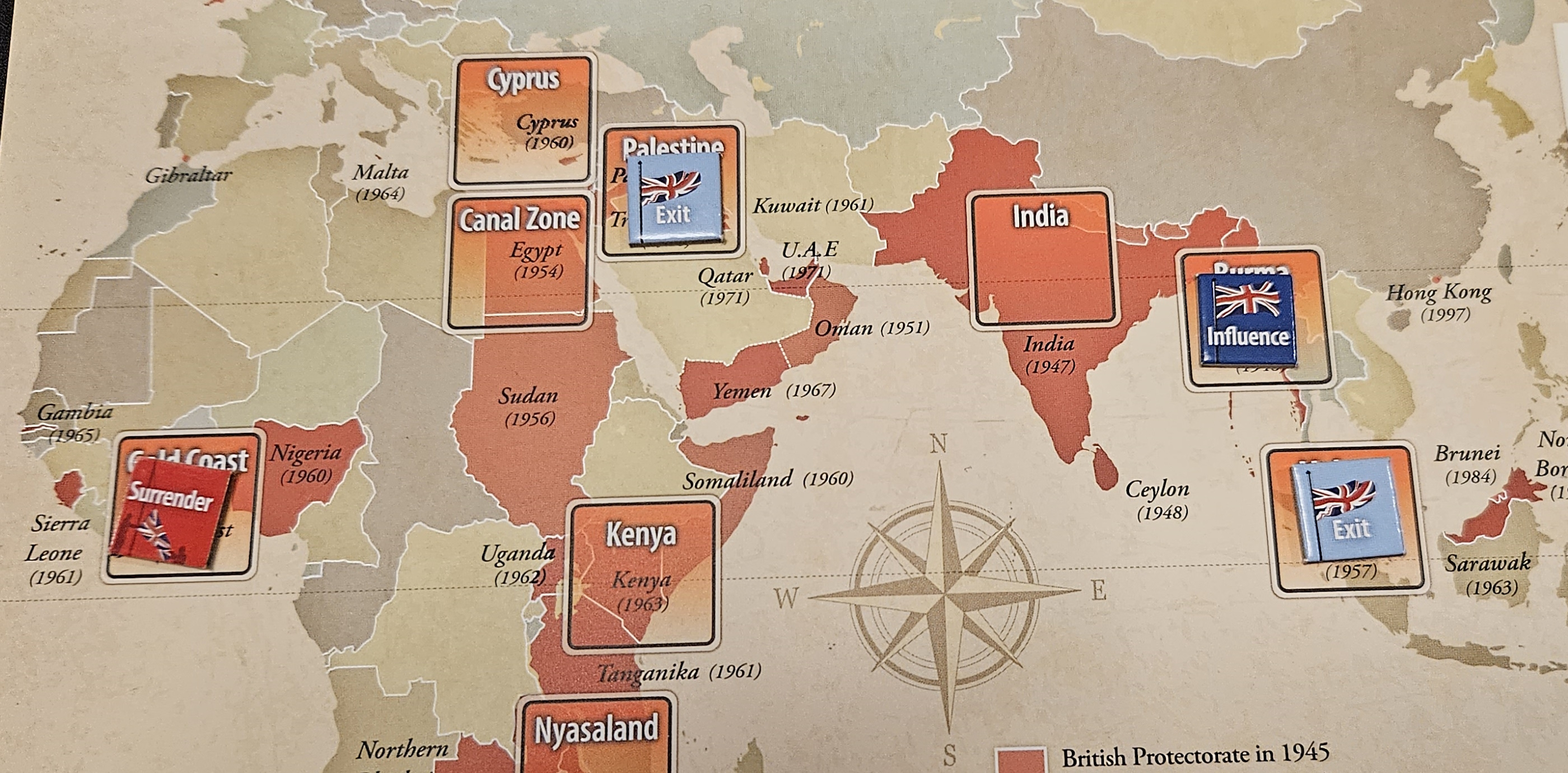
My Empire is holding strong. Maybe?
This is the strongest and most complex of The British Way’s scenarios, providing a crisp portrait of an Empire that has no interest in governing well. Even in success, they leave behind a country with more of those angry red opposition chits than they inherited. And it’s a tradition they’re determined to continue. Because the British considered the new village program a success, and would go on to employ a similar strategy in Kenya, not to mention finding emulation in Vietnam.
At the same time, there are severe limitations to what the scenario is capable of showing us. Much like how the Palestine scenario exhibits a notable absence of any Palestinians, the work of non-communists in achieving Malaysian independence goes unexamined. This is, after all, a game about British colonial emergencies and the sins of an empire in decline. But it bears mention nonetheless that the British were still pressured into granting independence to Malaya in 1957. Even the MCP had only been temporarily suppressed. As it helped draft the new Malaysian constitution, the Empire abdicated the peninsula with a reputation that had been much overstressed as benevolent. Thousands were dead. Hundreds of thousands had been forcibly resettled. The worst was yet to come.
(If what I’m doing at Space-Biff! is valuable to you in some way, please consider dropping by my Patreon campaign or Ko-fi.)
A complimentary copy was provided.
Posted on October 30, 2023, in Board Game and tagged Board Games, COIN Series, GMT Games, The British Way. Bookmark the permalink. 11 Comments.

 SPACE-BIFF!
Thank you for revisiting The British Way! The game is still sitting on my shelf in shrink and this is your second reminder to finally get it on the table.
Care to divulge a bit on your last sentence please: “The worst was yet to come.”? I’m unsure if this is a reference to Malaysian history or to other scenarios in the box?
The next scenario. Kenya.
Looking forward to part 3 and 4!
A great review. This game in particular was a real eye-opener for me. Malaya is often touted as a great success for the British, while ignoring the human cost. This game really brings these costs into sharp focus and started making me question the larger principles of counter-insurgency.
I had thought the New Villages were generally considered a success, but I had only ever heard one side of the story (as is so often the case in these struggles). The simple mechanic of New Villages causing opposition really conveys a lot more information than I could have imagined.
Agreed. Turning the population to opposition — and then not having it matter! — does a huge amount of in-system storytelling.
Well, almost not matter. The locals don’t seem to mind letting the MCP roam freely after you stuff them in villages. With the MCP able to intimidate away support and villages in areas they control.
Great post- It is the only game from the quad I’ve played so far. Seems a tought one for the MCP to win….
Cheers,
Pete.
I have won as the MCP! I don’t know about balance (or really worry about it), but it is possible.
Pingback: Best Week 2023! Making Memories! | SPACE-BIFF!
Pingback: Winds of Change, Part Three: Kenya | SPACE-BIFF!
Pingback: Winds of Change, Part Four: Cyprus | SPACE-BIFF!