A Very Civil Schnapsen

Nobody is doing historical board games quite like Fred Serval. That’s a tall claim, considering that only one of his designs, Red Flag Over Paris, has even been released. However, between that and a few secret projects — seeecreeet — Serval has demonstrated a talent for cutting to the heart of a historical topic with straightforward mechanisms.
A Very Civil Whist is currently the best example. Originally designed as a convention gift consisting of only two sheets and a deck of cards, this two-player trick-taker was recently picked up by PHALANX, where it currently sits in the preorder queue.
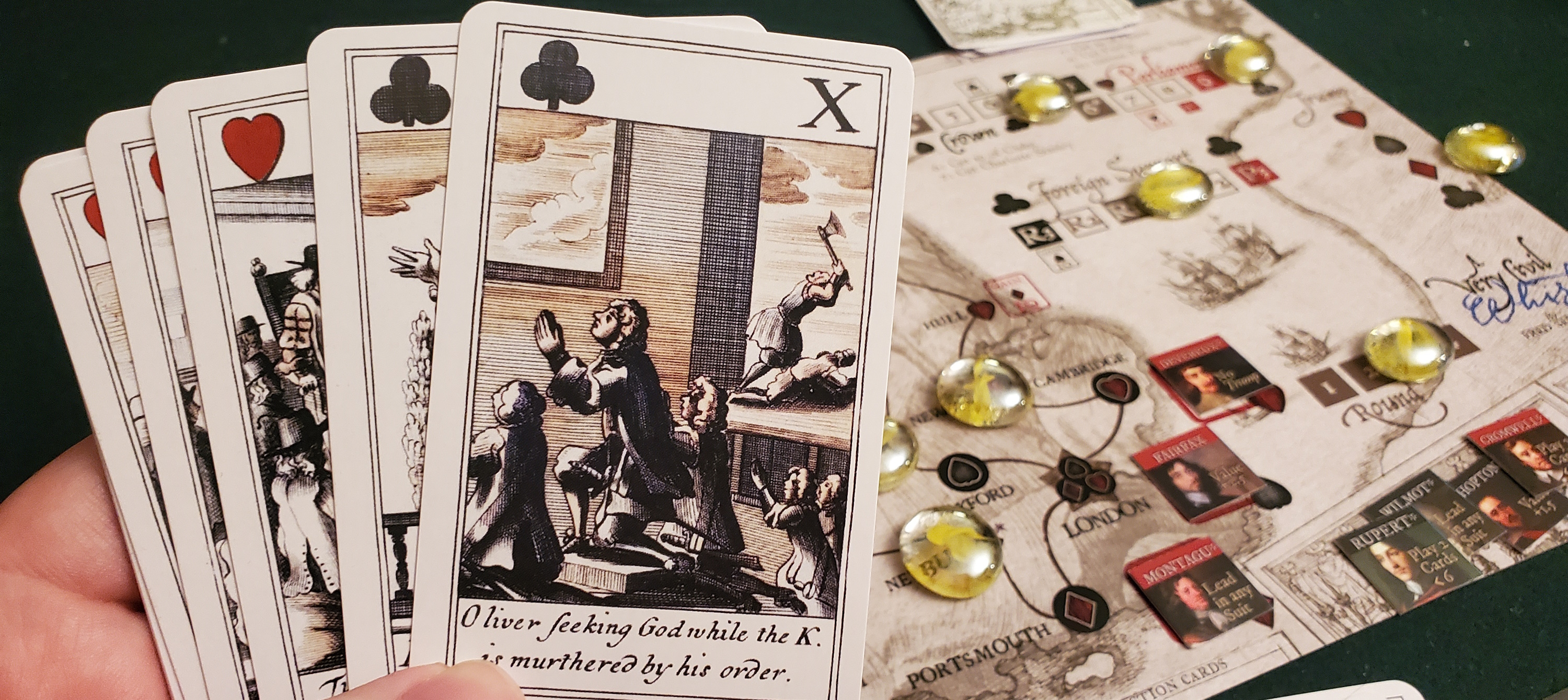
The cards don’t splay well, but you can’t beat that period woodblock look.
Welcome to the English Civil War. The King and Parliament have come to scraps. Both sides are raising troops. The cities and countryside of England are contested. Also, nobody is entirely sure which suit will constitute this round’s triumph.
Oops! We’ve jumped from setting to system. It’s an easy mistake to make. A Very Civil Whist is a nautilus of a game, coiling in and around itself in pursuit of that golden ratio. In plainer terms, it’s a game where the immediacy of its tricks are so dominant that they’re never far from mind, while the larger picture of the ongoing war makes it easy to forget that you’re playing a relatively straightforward trick-taker.
This isn’t to call it unadorned. Here tricks are usually simple affairs. I play a card, you play a card, and the higher value in the led suit wins. Of course, that heuristic must be applied to everything else on the map. Take trumps, for example. The player who possesses the greater measure of foreign support gets to choose the trump suit. But foreign support is also determined by playing tricks. Truly, that extends to everything. Foreign support is a trick. The opening preparations that provide some light hand drafting are tricks. The three battle tracks, arrayed like a non-solitaire version from the venerable States of Siege line, are tricks. Improving your faction’s standing… okay, those aren’t tricks, but they require you to expend a card, and increasingly potent values at that.
But within those tricks, there are some devious upsets to contend with. The biggest are your generals, little chits that occupy the battle tracks and alter how cards are played. To give one example, the battle track that runs along the eastern side of the map, tracing from London up to Edinburgh, must be fought with hearts. If you don’t have any hearts in hand, you’d better have some trumps to fall back on. And if not that, then you may well find yourself ceding ground from one location to the next, resulting in a wild swing that could well cost you the war.
Unless you’ve prepared the right general for that theater, that is. Parliament might give command to Edward Montagu. Now, rather than being straitjacketed to hearts, you can lead with any suit. Of course, Montagu is only one possibility. If you’re holding plenty of hearts and don’t want to be defeated by opposing trumps, Robert Devereaux cancels them altogether. If you’re holding flimsy cards, big britches Oliver Cromwell himself can combine two cards into a single mega-number, blasting through even the sternest counter-charge.
At the same time, it pays to demonstrate a modicum of caution. A Very Civil Whist is handled with an ordinary playing deck, but not every card is used for regular actions. Face cards function as events, adding little kinks to the proceedings, such as letting one player observe the drafted cards in secret before players bid on them, or adding Royalist snake Jane Whorwood to the King’s arsenal at a key moment to switch the trump suit mid-round. In a game where trumps are extremely potent, that’s a big deal. Meanwhile, low cards are shuffled into their own casualty pile. Whenever a campaign fails, you’re forced to draw two cards from this deck. If their sum doesn’t total four or greater, your general has gone the way of all earth. (That means he dies and is buried with the worms, where they shall enter through his sockets and chew through the meat where once thoughts of heaven dwelt.)
Yeah. The stakes are pretty high for a trick-taker.
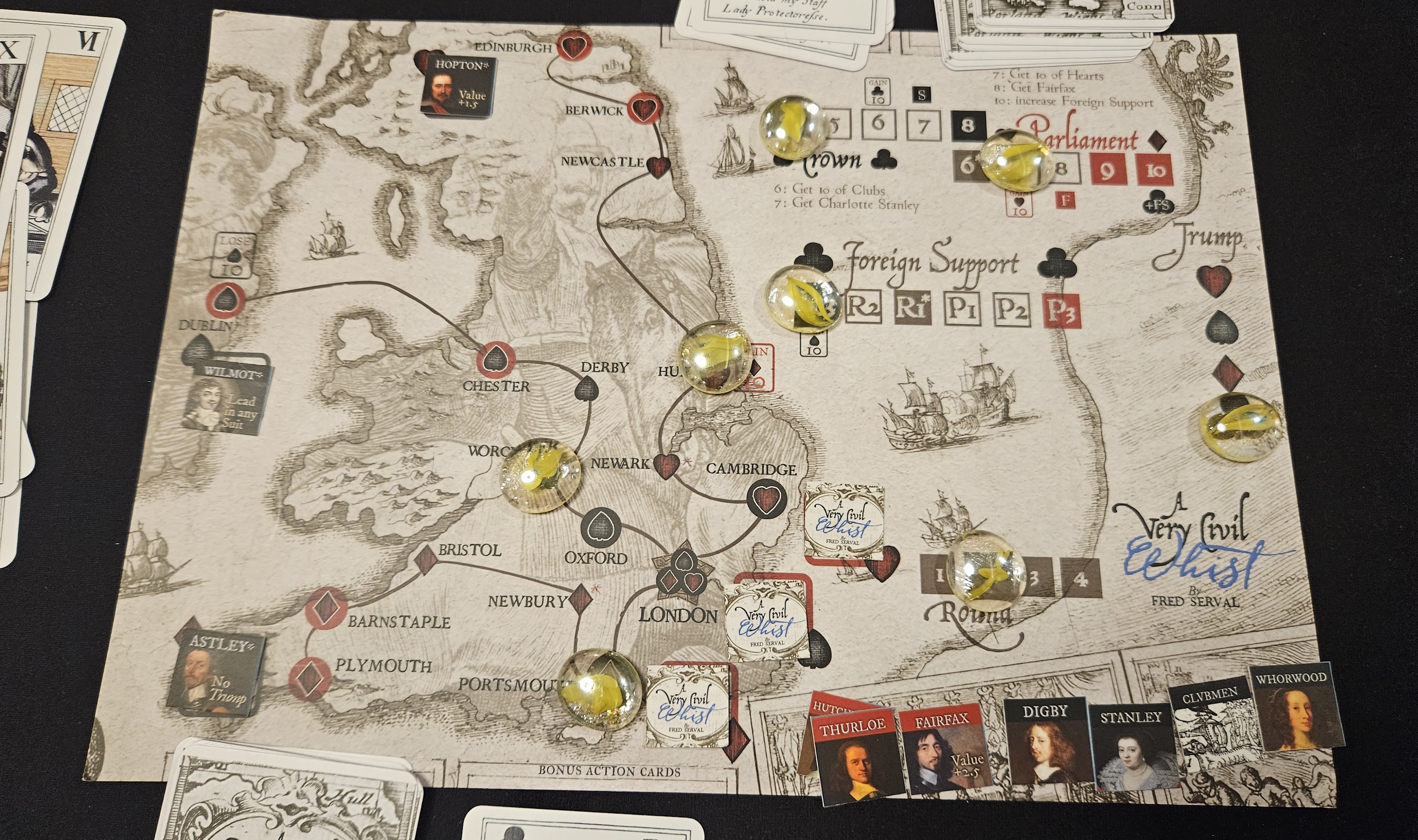
It’s going great. Just great.
As a model, A Very Civil Whist defies easy categorization. Most wargames are ill-defined things anyway, which makes this doubly difficult to sort. As portrayals go, it’s neither procedural nor ideological. Players won’t learn the first thing about how English militias in the 17th century stabbed and bludgeoned one another. Nor, really, is such a limited scope capable of discussing the clash of political and religious doctrines that caused the war. One event potentially sees Charles I losing his royal head. But his royal privileges? Nah.
Instead, Serval has produced something closer to a history of anxiety. There is simply never enough room to get everything done. At any given time, players are fighting multiple stubborn campaigns, building their bases of support, courting foreign influence, and on occasion spending a turn on a special action. The preparation phase of each round, in which both sides evaluate their hands, draft cards, assign generals, and select the trump suit may well consume as many minutes as the campaign phase itself. Its pacing is furious. Sometimes Roundheads and Cavaliers will bash away at one another, keeping the progress of a campaign stagnant for multiple rounds, only for one side to slip through and turn the tide of the entire session.
It works precisely because the game’s central mechanism is so familiar that it occupies hardly any headspace. Rather than poking through the proper sequence of actions, the import of every single play is immediately obvious to anyone who’s played a trick. There are no fiddly battle resolution sub-steps to forget. Rather, the rules hurry out of the way. All that remains is raw apprehension.
If I had a quibble, it’s found in the game’s name itself. A Very Civil Whist is distinctly un-whist-like. But a more appropriate trick-taker, such as the player limitation and drafting of Schnapsen, wouldn’t sound suitably English.
So why quibble at all? It’s more enjoyable to marvel at how smoothly trick-taking fits the setting. Contrast this with any other track-based game and the benefits are obvious. Unlike Alex Knight’s Land and Freedom, where track movement is more or less automatic, the ability to counter an opponent’s card adds a dimension of strategy. Unlike any of the States of Siege titles, where moving along a track is a matter of making the right roll — I’ll pick Dawn of the Zeds because I like it so much — there’s such tangible agency in selecting a card and then having it countered. Both of these are tremendous board games. But trick-taking mimics the logistical and even emotional beats that either go missing or are only modeled via the fiddliest of rules. Here, the chrome is polished down. The effect is not unlike a game set in the Wild West that asks players to assemble poker hands. Only trick-taking, by limiting every play to a single card per player, is the more elegant and fast-paced solution.
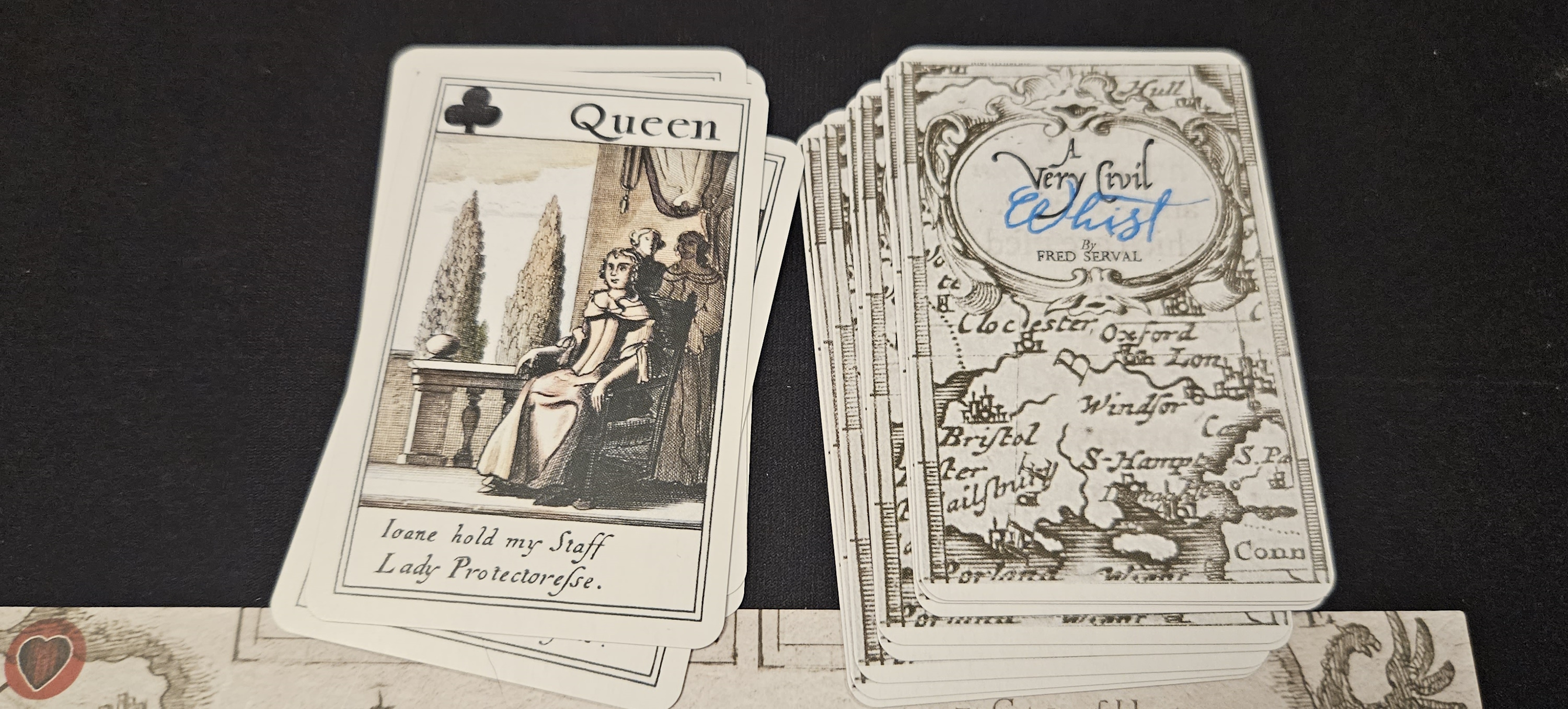
Getting rinsed by the events.
After seven plays, I have yet to win A Very Civil Whist. I’ve never lied about being awful at trick-taking. The surprise, though, is that I still can’t help but appreciate Serval’s historical trick-taker despite how poorly it treats me. This isn’t deep history. Nor is it deep trick-taking. But it’s something special all the same, a game that understands the appeal of both history and trick-taking. Better yet, it knows how to combine them into a hand-wringing thirty minutes. Like I noted last year, Fred Serval is a designer to keep an eye on.
(If what I’m doing at Space-Biff! is valuable to you in some way, please consider dropping by my Patreon campaign or Ko-fi.)
A complimentary copy of the convention freebie was provided.
Posted on September 26, 2023, in Board Game and tagged A Very Civil Whist, Board Games, Fred Serval, PHALANX. Bookmark the permalink. 11 Comments.

 SPACE-BIFF!
He is indeed!
The approximation to history is borne out by Fred’s choice of a Restoration deck of cards mocking the Cromwellian Commonwealth
Thanks Dan for the excellent review! 🙂
I am so happy to see a mention of Schnapsen in the wild. It’s probably my favorite two-player trick-taking game.
I have a few decks of cards I bought in Budapest to get that sweet authentic feel.
Nice! I wish I’d grabbed some decks when I was in Budapest…
The name derives from the ‘preparation phase’ where you play tricks to draft cards for later tricks, which is explicitly modelled on German Whist.
The more you know!
German Whist is pretty cool, give it a go some time! 🙂
Pingback: Femkort in the Woodland | SPACE-BIFF!
Pingback: Best Week 2023! Tricksy! | SPACE-BIFF!
Pingback: A Rather Whistful War | SPACE-BIFF!