Join in the Restivities

Let’s see if I can do this correctly: Real men are always thinking about smashing the state. Have I gone viral?
The 35 cards in Brendan Hansen’s Unrest edge it out from being considered a microgame, but it’s about as short and tidy a game as I’ve seen. With one player controlling a dystopian empire and the other seeking to overthrow it, a full session last maybe ten minutes. The rules are similarly light, taking all of a minute to explain. Even so, it feels like it’s wasting the time of one of its players.

Me, a baby: Is this netrunning?
For the Resistance, Unrest is a gripping experience. Each round is streamlined to a cutting edge. You pick two adjacent city districts at this turn’s area of interest. Then you examine your hand of five cards. From these, you’ll place three on the table, two of them face-down and the other visible. In a moment, after the Empire has had its say, you will add these cards in any combination to the city districts you selected earlier. If you happen to make the right combination, that portion of the city rises up against their taskmasters. You’re one step closer to victory.
Simple. Dead simple. There’s an elegance to it. Every game has its own objectives. There’s always the big one, where a district will revolt if your cards there add up to 21 or more. That’s a tough ask. You’re more likely to chase one of goals you picked at random at the start of the game. Like getting one of each suit into a district. Or having at least a value of 8 red cards and no yellow cards. Or having more yellows than purples, with a floor value of 3 on the latter.
Okay, that’s enough talk about colors and digits. The point is this: as the Resistance, you’re always scheming. If you don’t overthrow the Empire before your cards run out, the future will be a boot stamping on a human face — for ever. So you plan and you execute and you keep track of your cards and you try to trick your rival into focusing on the occasional misdirection card instead of disappearing your high-value cards.
Exciting. Immediate. A whole lot more engaging than playing as the Empire.
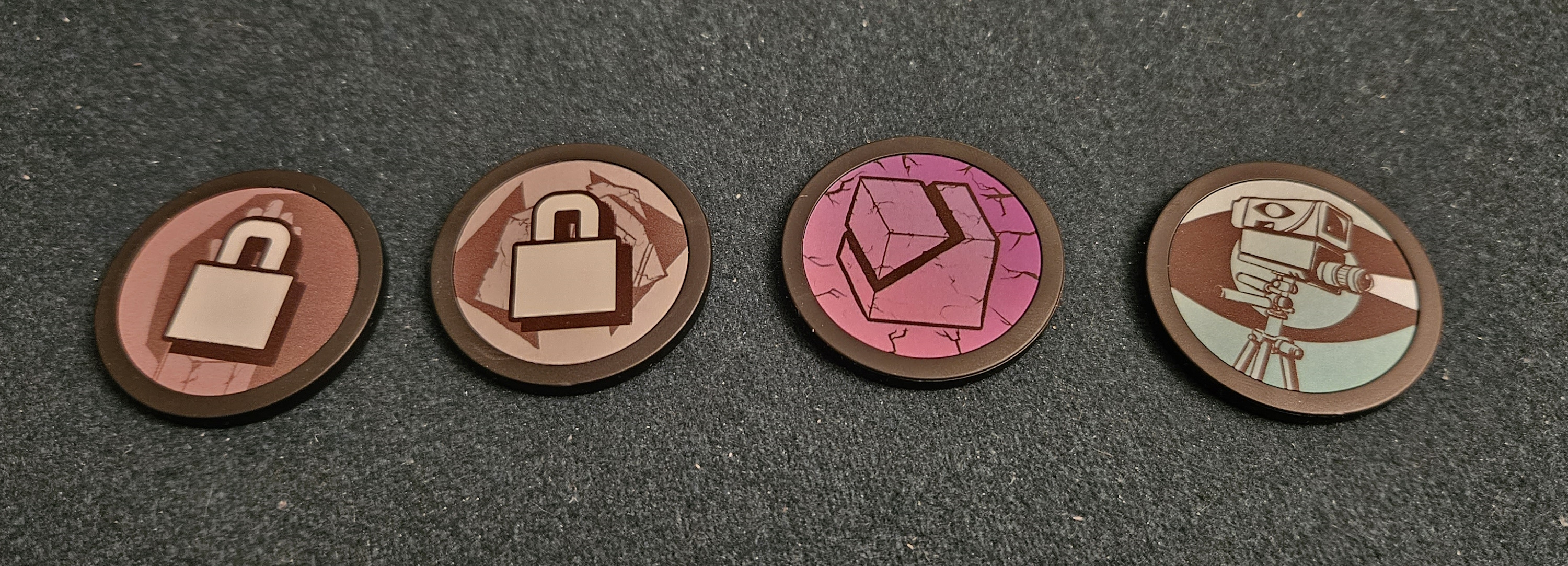
Tokens of the Empire.
That isn’t a good thing. Playing the Empire is entirely reactive. When the Resistance shows their line of three cards, you respond. This, like everything else in Unrest, is dead simple. The problem is that it’s as thrilling as stamping passports.
It comes down to four chips. Each turn, you will use two of them. The ones you use are flipped over, becoming unusable until the last one has been turned down and they reset. The most exciting chip lets you blast a card entirely. Bye bye, gone. Another is for revealing one of the Resistance’s face-down cards. There’s one that lets you shift a card into a district of your choice, and the last blockades one of the Resistance’s chosen districts for that round, squeezing all their cards into one location.
In theory, these tools are enough to prevent the Resistance from winning. Sure. I’ve seen it happen. Not all that often, compared to my Resistance wins. But sure, now and then the Empire forges a future in which every human is a CCTV star every moment of their waking and sleeping lives.
But even when the Empire squeaks out a win, there’s no joy in it. Maybe there shouldn’t be. Maybe the tedium of playing the Empire is a nod to the banality of evil, the paperwork and long hours that rule the surveillance state. If it is, it doesn’t quite come through; Unrest doesn’t evoke the grim reality of a game like Steve Dee’s The Rent or John du Bois’s Heading Forward. It’s far too cartoony for that.

Chasing objectives.
It is, however, redolent of those games in that it feels like a solitaire game. A solitaire game with a plus-one tagged on. The Resistance is the game. They’re the ones making decisions and bluffs and living with the consequences. By contrast, the Empire operates as little more than a facilitator, a string of barbwire for its pluckier counterpart’s coattails to catch on.
In other words, it comes across as half a game. Maybe even half of a good game; it’s hard to tell. Right now, the whole thing is faintly awkward. When a session wraps up, the state in all likelihood smashed, the Resistance player tends to clear their throat, as though on the cusp of apologizing to the Empire player for putting them through the past ten minutes. In playing a game that all but excluded their partner, they have become the oppressor, a tyrant of play, like a child on the playground who insists her friends adhere to her rules and bend to her dictates. This is perhaps not the message the designer was going for.
But it’s what Unrest produces. Playing the Resistance makes for a fine time. If only it could have offered a little more to the recipient of their smashing.
(If what I’m doing at Space-Biff! is valuable to you in some way, please consider dropping by my Patreon campaign or Ko-fi.)
A complimentary copy was provided.
Posted on September 21, 2023, in Board Game and tagged Board Games, Pandasaurus Games, Unrest. Bookmark the permalink. 2 Comments.

 SPACE-BIFF!
I have always detested Mastermind for pretending that it was a game for two. And yet, it seems that so many people actually feel it is. It baffles me. But it seems that they exist and continue to do so.
When I played Mastermind (ages ago), we usually played with two sets: you would make a guess on one board and give a clue on the other for each move. It then became a race to see who was able to crack the code first.
This may also work for Unrest: with two copies you would play the Empire in one subgame and the Resistance in the other subgame. Basically, playing the Empire then means delaying the other player’s Resistance to buy time for your Resistance to push through. Clearly, this assumes that the goals you pick at the start of the game are roughly comparable (haven’t played the game yet, so I don’t know if this is the case).