Emergence

It’s an easy thing to draw comparisons between one game and another when they share mechanical underpinnings, but I often prefer to dwell on those parallels that aren’t immediately clear. Take, for example, Adam DeYoung’s Emerge, the recent release from Pandasaurus that, for all intents and purposes, is another generic points-chaser. It’s a dice game at heart, and feels bland for precisely the same reason it feels rewarding in the moment, thanks to a core gameplay loop in which nearly every action awards roughly one point. It doesn’t immediately stand out from the pack.
But while playing Emerge, the strangest comparison kept springing to mind. That title was Jon Sudbury’s Ortus Regni.

Well, that’s delightful.
If you haven’t heard of Ortus Regni, it’s a peculiar card game about medieval fiefdoms doing what medieval fiefdoms do. Namely, attack one another. It’s compelling despite its shortcomings for a few reasons, among them its willingness to dispense with text and iconography altogether. Instead of asking players to decipher a minuscule language, Sudbury requires his players to remember the role of the cards themselves. A castle behaves like a castle. Land, which is illustrated as a tract of land, connects to those castles. Knights are tougher than infantry, and we don’t need to be told that via a number on a card. Iconography is art in its own right, but Ortus Regni elevates its illustrations to such a degree that they replace iconography altogether. To look at the game is to understand the game, if only incompletely.
The same is true of Emerge. This isn’t a game without iconography, but it gestures in that direction. The main board is where the parallel becomes apparent. Islands have begun to emerge from the deep, quickly populating with crabs and birds and vegetation. To glance at one of these islands is to understand its relative value at an instinctive level. Sure, these islands and their inhabitants will be tallied when the game concludes. There’s a formula: island size multiplied by island inhabitants equals victory points. But as in Ortus Regni, none of that is necessary in the moment. If an island is big, it’s worth more. If an island is filled with tokens, it’s worth more. To look at the game is to understand the game, if only incompletely.
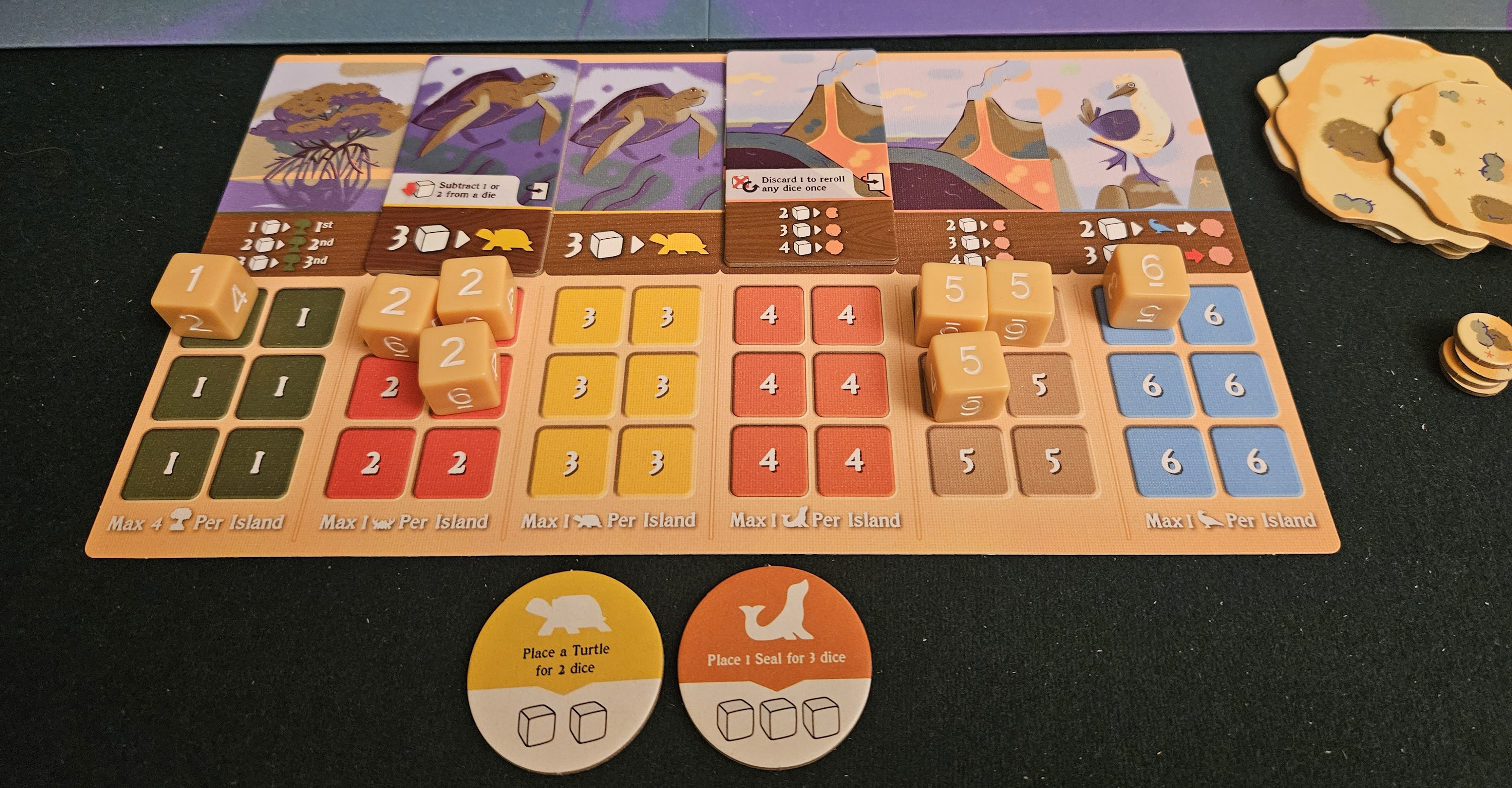
At its heart, Emerge is a dice game.
In a hobby where aesthetics are often valued as highly as gameplay, and sometimes rightly so, it’s a smart impulse. I wish DeYoung had leaned into it further. As soon as one’s eyes wander afield of the main board, the iconography comes roaring back. Perhaps this was necessary. There are, after all, so many details to consider. But I still wish for a version of this game that was all aesthetics, one that relegated its crasser considerations to the subconscious rather than barging them into player’s awareness at all times.
Emerge is a dice game, and as befits a dice game there are a half-dozen ways to manipulate their tumble. At the outset, there are six actions, each tied to a die’s digits. Rolling 1s, for example, lets players cover their islands in greenery. Other digits add crabs, turtles, and seals, each more costly and each dependent on the former for sustenance. Another sprouts islands from the sea. Another flits birds between bubbles of earth, along with the seeds they carry.
But these numbers can be altered. Over the course of the game’s eight rounds, players add tiles to their boards, changing the makeup of what their numbers mean. Now, rather than a certain roll placing a crab, perhaps it grows an island. These tiles add abilities, too. These follow the usual conventions. One tile lets you discard a die to assign a second die to any face. Another lets you turn a die’s face up by a pip or two. Before long, the phase in which everybody rolls their dice becomes the longest of the game, everybody gazing at their personal collection, heads down, tinkering with values and faces until they arrive at the optimal outcome.
It’s all so very expected. The dice in Emerge can be manipulated because, hey, that’s what you do with dice. In the process, the dice are pruned. Defanged. Robbed of their sacred aleatory stature. This, I would argue, was a mistake. The end result is that everybody’s islands come to resemble one another. Final scores cluster together. In making Emerge adhere to convention, it becomes exactly like every other game.

Each session has new objectives, though they fall into a few categories.
The same goes for its other aspects. There are scoring cards. These are different each game, drawn at random, providing little races between players. There are bonus tokens. These alter the value of its dice further, letting you place a crab for one die rather than two, or grow an island via some other method. There is nothing wrong with these inclusions. According to conventional wisdom, they are what’s right with the game.
But I think they also signal an identity crisis. Emerge functions best when it operates in proximity to instinct. Placing a tile on your board alters its makeup. When you place a seagull tile over a turtle, now that turtle’s roll has disappeared. In its place is a seagull. That alone alters how the dice operate — and in a more interesting and intuitive way than by letting players alter the outcomes of their rolls. This also happens to be each round’s most interesting decision. Which number will you replace? Which opportunity will you cover for the sake of a different opportunity? There’s an entire game in there, one unburdened by convention and modifiers and even iconography.
I’ve recently started asking myself, “What would Reiner Knizia do?” Knizia has inserted himself into the language of games. Even his detractors can’t help but admit as much. Many of Knizia’s games identify a core experience and then mercilessly cut everything away until that experience is brought to the surface. There’s an anecdote, for all I know apocryphal, about how Michelangelo, in fashioning the David, noted that the sculpture was already complete within the marble, if only the superfluous material could be chiseled away. At his best, Knizia’s designs feel like they were always complete, if only the superfluous rules could be subtracted.
Emerge is a game about two perfect and symbiotic elements — visual islands and mechanical dice — that happen to be crowded by chunks of marble that have yet to be removed. It is so very nearly complete. It’s a game that verges on greatness. At times, it grazes fingers with what it could have been. In those moments, it’s all about crafting these pleasing aesthetic things, these islands with their trees and turtles, even the birds that can perch on any other figure, and using the random distribution of dice to accomplish that.
But it bogs down. It carries so many extra considerations that add player agency. That probably sounds like a good thing. How can a player have too much agency? But these considerations also add time, and weight, and extra minutes spent with everybody staring at their own little corner of the table, and also — and this is the part that’s very difficult for modern game designers to understand — too much control over the proceedings. It loses sight of the fact that games are not only about permissibility, but also about restriction. If our dice are so manipulable that they can be any digit at all, then why did we roll them to begin with?
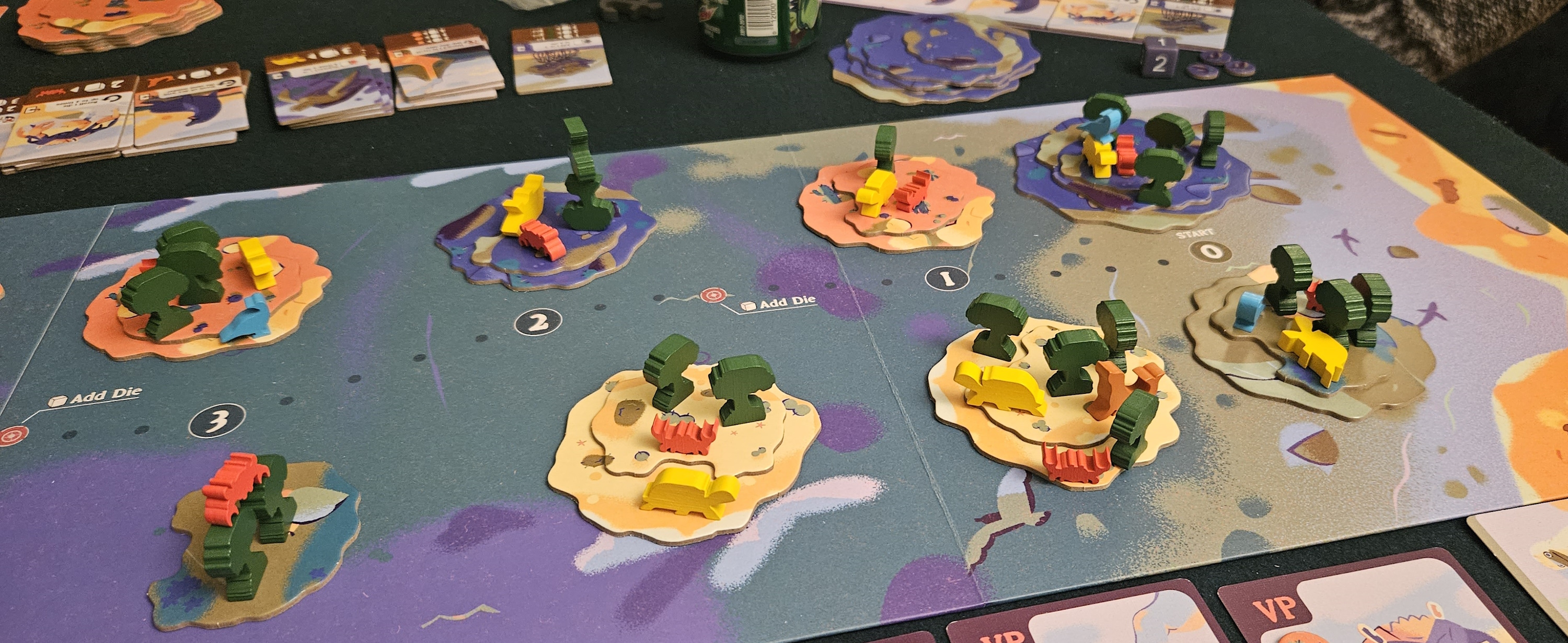
Aesthetics go a long way in this hobby.
The funny thing about Emerge is that the game it could have been is already there. It just happens to be surrounded by extra stuff. At its best, Emerge is a game about altering what our dice rolls mean, rather than altering the rolls themselves. This is accomplished each and every round, when the game lets us add a single tile to our personal boards that transforms something useless into something useful. And then, when we roll the dice, the roll’s meaning has been altered.
The rest — well. Emerge is a game that needed no iconography. Nor did it need the considerations the iconography heaped onto its own shoulders. The resulting burden makes it a beautiful and serviceable game. It could have been a beautiful and excellent game.
(If what I’m doing at Space-Biff! is valuable to you in some way, please consider dropping by my Patreon campaign or Ko-fi.)
A complimentary copy was provided.
Posted on August 22, 2023, in Board Game and tagged Board Games, Emerge, Pandasaurus Games. Bookmark the permalink. Leave a comment.

 SPACE-BIFF!
Leave a comment
Comments 0