Know Your Woods

The beauty of stacking games is that they’re at their most best when they’re failing. Yes, I’m talking about things falling down. Whether we’re talking about a classic like Jenga or the best stacking game, Rita Modl’s Men at Work, they thrive in that middle space between striving to succeed and the relief of giving up.
Moku Tower, designed by Louis Hsu and Ivan Kan, presents a frenzied take on the genre. It also presumes I know a lot more about dendrology than I ever will.

Stacking. On a time budget.
To glance at Moku Tower is to understand Moku Tower. The gist, anyway.
So you’ve decided to stack some wooden shapes. On its own, this is no big deal. I expect that most of us have stacked wooden blocks at some point in our lives. Or perhaps stones. Because the wooden shapes in Moku Tower are shaped to resemble stones, that’s not so far off.
But the heart of Moku Tower isn’t the wood. Oh, the wood matters. We’ll talk more about the wood in just a moment. But that doesn’t change the fact that there’s something more important. Here that all-important artifact is a sand timer. When you touch wood, you’re doing so under time pressure. Despite its generous appearance, the timer is a fugacious ally. It never quite contains as many seconds as you’d expect. Or hope.
And that’s only the first problem. The timer doesn’t present a consistent quantity. When somebody finishes stacking their tower, they flip it over. Now that’s your timer. Which can be a very big problem if they were quick. Or if they drew well.

I hope you know your woods.
Drawing well is a tremendous part of Moku Tower. The particulars of your tower are dictated by four types of cards. When your turn rolls around — scratch that, when it barrels round, when it crunches unexpectedly into your nose — you’re required to draw at least one. This is your “starting position,” a combination of wooden base and somewhere between three and zero wood pieces. “Sapele, Mini Pine, Maple,” it might announce. You gather up those pieces and stack them in order, one atop the other, hoping that the whims of the draw conform to the contours of your selection of woods.
For bonus points, you can optionally add other cards. One deck offers extra pieces. Another appoints little tasks, like clapping in between each stack, holding the base aloft in one hand, or stacking with crossed arms. And then there are the cards other players can hit you with, deploying punitive effects like flipping the timer prematurely or forcing you to draw another pair of those extra pieces cards. It’s a hoot. Sometimes a nasty hoot, like when somebody announces that the tower you just painstakingly balanced will be worth a grand total of nada.
A few thoughts. First, the wood. As expected, the wooden pieces in Moku Tower have personality. They look nice. They smell good. They feel pleasant under the fingertips.
They’re also irascible. Smaller than you might expect, they tumble easily, not quite as subject to the binding pressure of gravity as, say, the stones of one of those cairns TikTokkers are always piling together on trails and in creek beds and in my front yard.
Also, Moku Tower excels at demonstrating the differences between woods — and, sometimes, that the distinctions between cuts aren’t always as plain as a professional woodworker might insist. The game includes reference cards, but these are only helpful to a point. Rosewood has a rosy hue, got it. Walnut is darker than the rest, sure. Pine sports a sickly jaundice, ew. But sapele and maple? Birch and ash? Mid-rush, even the shades between camphor and walnut can seem too proximate. Perhaps that’s part of the game. Moku Tower isn’t only a stacking game, isn’t only a timed game, isn’t only a game with nasty effects. It’s also a game about identifying your woods. At speed.

Card effects are sometimes zany.
But even if this is the case, it highlights a significant fuzzy spot in Moku Tower’s vision. As a game, it’s designed around speed. I complete my tower, then flip the timer. You complete your tower, then flip the timer. Around it goes.
Except it’s not entirely clear what’s happening in between those flips. Do we scatter the woods back into the center of the table? Set them on their cards again? Pause when the birch falls to the floor? If the pieces aren’t rearranged, is there a penalty for mistaking our woods? Do we jeer at someone who hasn’t internalized the wood grains of sapele? Or is there some measure of grace here? Party games can get riotous. That’s part of their appeal. But given Moku Tower’s unbending rules in certain sectors, the undefined nature of these gray areas becomes all the more pressing.
There’s a chance I’m making mountains of molehills. Like other party games, there’s some degree of flexibility at play. When playing with my kids and parents, we flipped the sand timer onto its side in between turns. This gave us a brief moment to reset the woods onto their reference cards and permit certain arthritic limbs (mine) to reach the cards across the table. Did it still capture the manic spirit of the game? I think so. It also captured that manic spirit to force another friend, one who wasn’t a child or a grandparent, to retrieve a piece that had rolled under the couch.
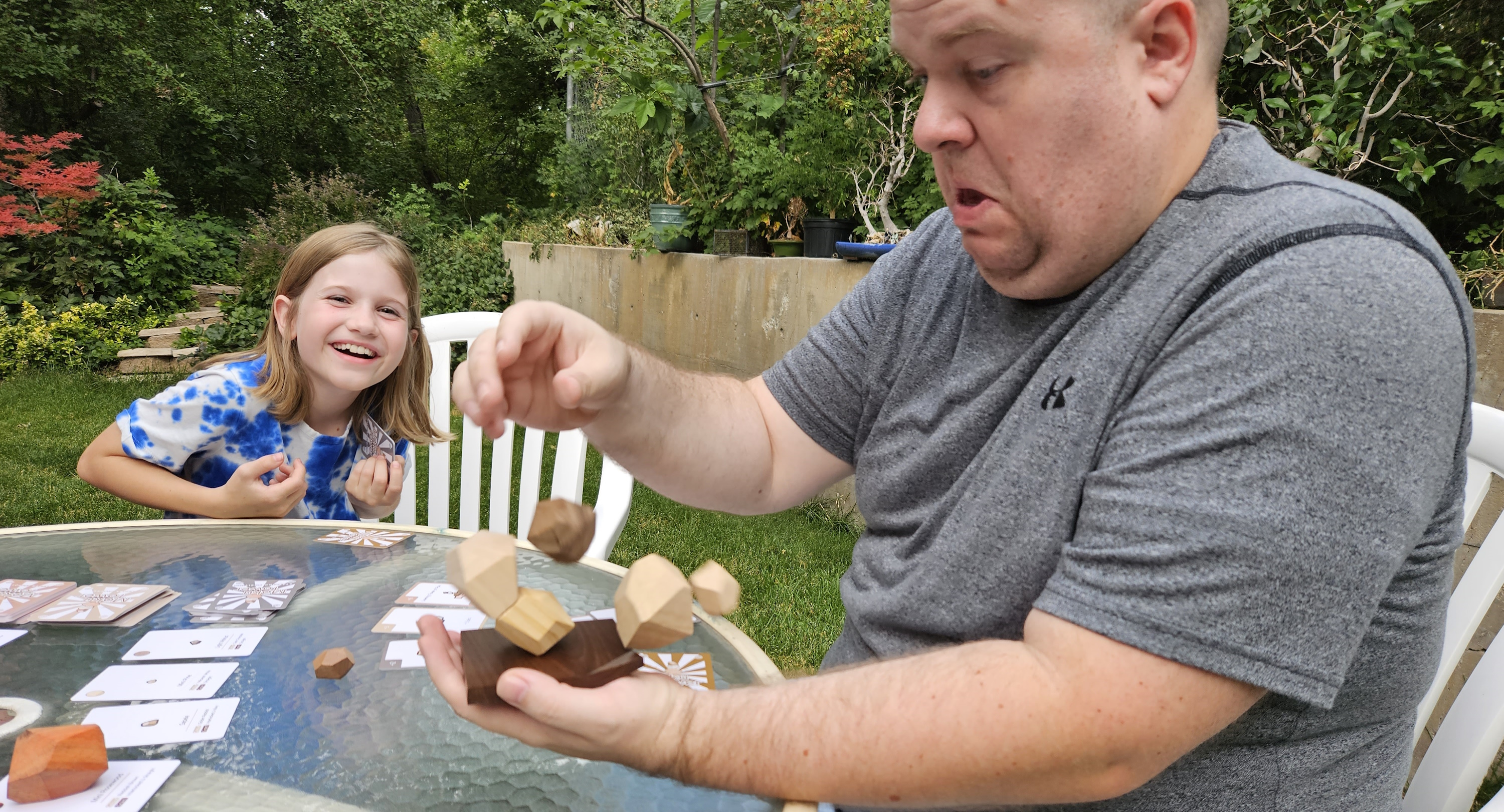
I am a failure in many regards.
Moku Tower is uneven. Sometimes that’s its appeal. It wouldn’t be interesting with too much polish. As it stands, its pieces are oddly shaped and not so smooth that their grains can’t catch against one another during a precarious build. It’s pretty to look at and pleasant to handle.
At other times, its unevenness tilts the other way. It’s messy and vague. Some of its card effects are obnoxious. Not every wood is as distinct as one might like. The result has a natural wildness. It’s a game that sometimes bites. I like what it’s doing — and wish it had better struck that difficult middle ground between sanded and rough.
(If what I’m doing at Space-Biff! is valuable to you in some way, please consider dropping by my Patreon campaign or Ko-fi.)
A complimentary copy was provided.
Posted on July 27, 2023, in Board Game and tagged Board Games, Moku Tower, Mokuomo. Bookmark the permalink. 2 Comments.

 SPACE-BIFF!
Sounds really fun!!! Great photos, and an excellent review.
Thank you!